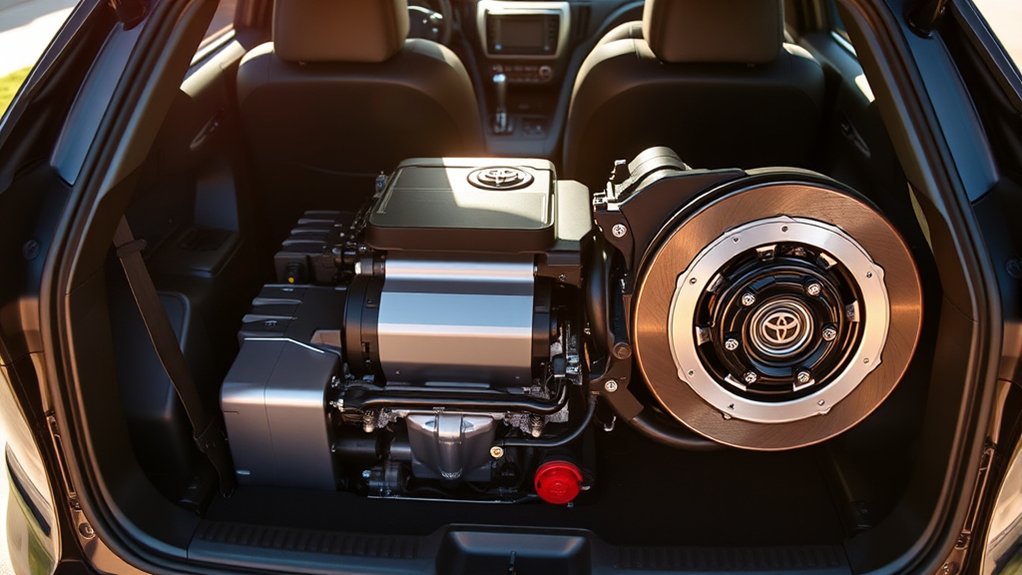
The Toyota RAV4 Hybrid is a full hybrid SUV that automatically combines a gasoline engine with electric motor-generators. It does not need to be plugged in. Instead, it manages energy while you drive, recovering some of the vehicle’s motion during deceleration and using that electricity later to assist the wheels.
The exact design, battery chemistry, output, fuel economy, drive modes, and towing capacity vary by model year, trim, drivetrain, and market. This guide explains the system in general while highlighting the redesigned 2026 U.S. RAV4 Hybrid where current specifications are useful.
Quick Answer
The Toyota RAV4 Hybrid is a non-plug-in full hybrid. A gasoline engine, two front motor-generators, a traction battery, power electronics, and—on AWD models—a rear motor automatically share the work. The system recovers energy while slowing and starts the engine whenever power, cabin heat, emissions control, or battery charging requires it.
Key Takeaways
- The RAV4 Hybrid computer—not the driver—decides when to use the gasoline engine, electric drive, or both.
- Regenerative braking recovers part of the vehicle’s kinetic energy, but friction brakes still provide stopping power when needed.
- The regular RAV4 Hybrid has no charging port; the RAV4 Plug-in Hybrid is a different model.
- Battery chemistry and specifications vary. The 2026 U.S. RAV4 Hybrid uses a lithium-ion traction battery.
- Fuel economy, towing capacity, drive modes, and warranty terms must be checked for the exact model year and trim.
Note: Toyota has used different hybrid components and calibrations across RAV4 generations. Treat specifications in this article as U.S.-market examples, then confirm your vehicle’s details in its owner’s manual, warranty guide, EPA label, and towing section.
Understanding the RAV4 Hybrid System
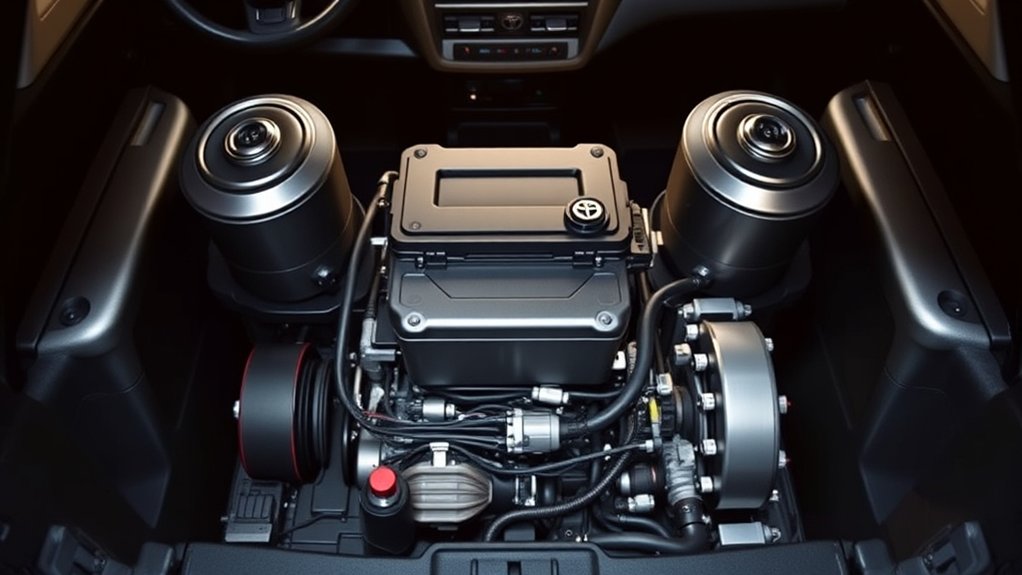
The RAV4 Hybrid is a power-split full hybrid. Its gasoline engine and electric motor-generators connect through an electronically controlled transaxle. The vehicle can move briefly on electric power, run the engine, or combine both sources without requiring the driver to make those choices.
According to Toyota’s 2026 RAV4 technical information, the current U.S. Hybrid uses a 2.5-liter four-cylinder engine with two front motor-generators called MG1 and MG2. AWD versions add a dedicated rear electric motor.
Main RAV4 Hybrid Components
- Gasoline engine: Supplies sustained power, assists during stronger acceleration, and can turn a motor-generator to produce electricity.
- MG1 motor-generator: Starts the gasoline engine, generates electricity, and helps control the power-split transaxle.
- MG2 drive motor: Provides electric torque to the front wheels and acts as a generator during regenerative braking.
- Traction battery: Stores electrical energy for the drive motors. The 2026 U.S. model uses a lithium-ion battery; other years or markets may differ.
- Power-control electronics: The inverter, converter, and control modules manage voltage and direct electricity among the battery and motor-generators.
- Electronically controlled transaxle: Uses a planetary power-split device rather than a conventional stepped automatic gearbox.
- Rear electric motor on AWD models: Drives the rear wheels when the control system requests additional traction or stability.
For the 2026 U.S. RAV4 Hybrid, Toyota lists 226 net combined horsepower with front-wheel drive and 236 horsepower with Electronic On-Demand AWD.
Why the RAV4 Hybrid Model Year Matters
“RAV4 Hybrid” describes several generations, not one unchanging powertrain. Battery chemistry, motor output, fuel-economy ratings, available modes, controls, AWD tuning, and towing limits can change from one model year to another.
The redesigned 2026 U.S. RAV4 moves to Toyota’s fifth-generation hybrid system and a lithium-ion traction battery. It is offered with front-wheel drive or Electronic On-Demand AWD, depending on grade. Earlier RAV4 Hybrids may have different components, ratings, and controls, so an older manual should not be replaced with 2026 instructions.
| 2026 U.S. Hybrid example | Toyota specification |
|---|---|
| Front-wheel-drive system output | 226 net combined horsepower |
| AWD system output | 236 net combined horsepower |
| Traction-battery chemistry | Lithium-ion |
| Estimated combined fuel economy | Approximately 38–43 mpg, depending on drivetrain and grade; verify the vehicle’s EPA label |
How Regenerative Braking Enhances Efficiency
When the RAV4 Hybrid slows, its drive motor can operate as a generator. Instead of allowing all the vehicle’s kinetic energy to become heat at the brake rotors, the system converts part of that motion into electricity and sends it to the traction battery.
The process is automatic. During gentle deceleration, the vehicle can rely heavily on regenerative braking. When you request stronger stopping, the battery cannot accept more energy, road traction is limited, or the vehicle is moving very slowly, the hydraulic friction brakes provide more of the stopping force.
The redesigned 2026 system uses electronically coordinated braking to blend regeneration with conventional brakes. This helps the vehicle recover energy while preserving predictable stopping performance.
- Light, early braking usually gives the system more time to recover energy.
- Hard stops require greater use of the friction brakes.
- A nearly full, very cold, or very hot battery may accept less regenerative energy.
- ABS, stability control, road conditions, and low vehicle speed can reduce regeneration.
- Regeneration improves efficiency, but it cannot recover all the energy used to accelerate the vehicle.
Pro Tip: Look farther ahead and release the accelerator early instead of racing toward each stop. Smooth deceleration usually creates more opportunity for regeneration and reduces unnecessary friction-brake use.
The Hybrid Battery’s Role in Energy Management
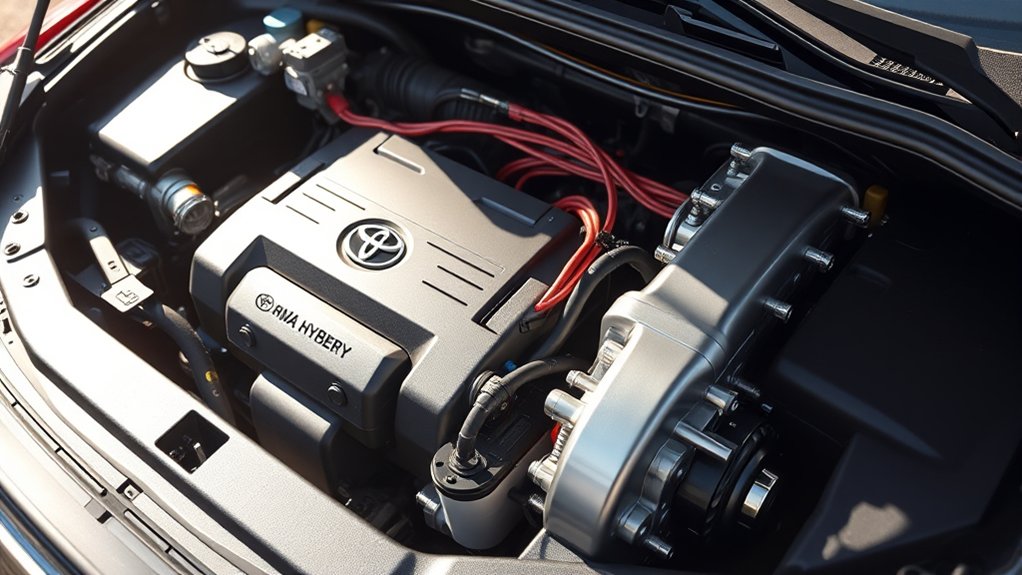
The traction battery acts as an energy buffer. It stores electricity recovered while slowing and electricity produced through the engine and motor-generators. The control system then uses that energy when electric assistance can improve response or reduce gasoline consumption.
The battery gauge is not intended to behave like the fuel gauge in a battery-electric vehicle. The hybrid computer normally keeps the battery within a managed operating range rather than repeatedly charging it to its absolute maximum or draining it to its absolute minimum.
Energy Storage Functionality
| Battery topic | What owners should know |
|---|---|
| Main purpose | Supply and receive short bursts of electrical power as driving conditions change. |
| Charging method | Regenerative braking and electricity generated through the hybrid system while driving. |
| External charging | Not supported on the regular RAV4 Hybrid because it has no charge port. |
| Replacement schedule | There is no routine age or mileage at which every battery must be replaced. |
| U.S. warranty example | For model year 2020 and newer Toyota hybrids, the hybrid battery is generally covered for 10 years or 150,000 miles, whichever comes first, subject to the warranty guide’s terms. |
Regenerative Braking Contribution
During deceleration, MG2 changes from producing driving torque to generating electricity. The power electronics condition that electricity before storing it in the traction battery.
The amount recovered is never a fixed percentage. It depends on vehicle speed, braking force, battery charge, battery temperature, wheel traction, accessory use, and system limits. Energy is also lost through aerodynamic drag, tire resistance, electrical conversion, battery resistance, and mechanical friction.
Regenerative braking recovers energy that a conventional vehicle would mostly discard as heat, but it does not create energy or make the vehicle independent of gasoline.
How the Gasoline Engine and Electric Motors Work Together
The system continuously chooses an efficient combination of engine power, electric torque, electricity generation, and battery use. The driver normally notices the result rather than each individual transition.
| Driving situation | Typical system behavior |
|---|---|
| Starting or moving slowly | The vehicle may move using electric power when battery charge, temperature, speed, and power demand allow it. |
| Steady cruising | The engine may drive the wheels efficiently while the system adds electric assistance, generates electricity, or briefly shuts the engine off as conditions change. |
| Strong acceleration or a steep hill | The engine and drive motor can work together for greater output. |
| Coasting or braking | The drive motor generates electricity while the braking system blends regeneration and friction braking. |
| Stopped with the READY indicator on | The engine may remain off or restart to warm itself, heat the cabin, charge the battery, or support other system needs. |
The engine starting unexpectedly is not automatically a fault. Cold weather, windshield defrosting, high climate-control demand, low battery charge, emissions-system warm-up, and firm acceleration can all cause it to run.
Power Distribution: Efficiency and Performance
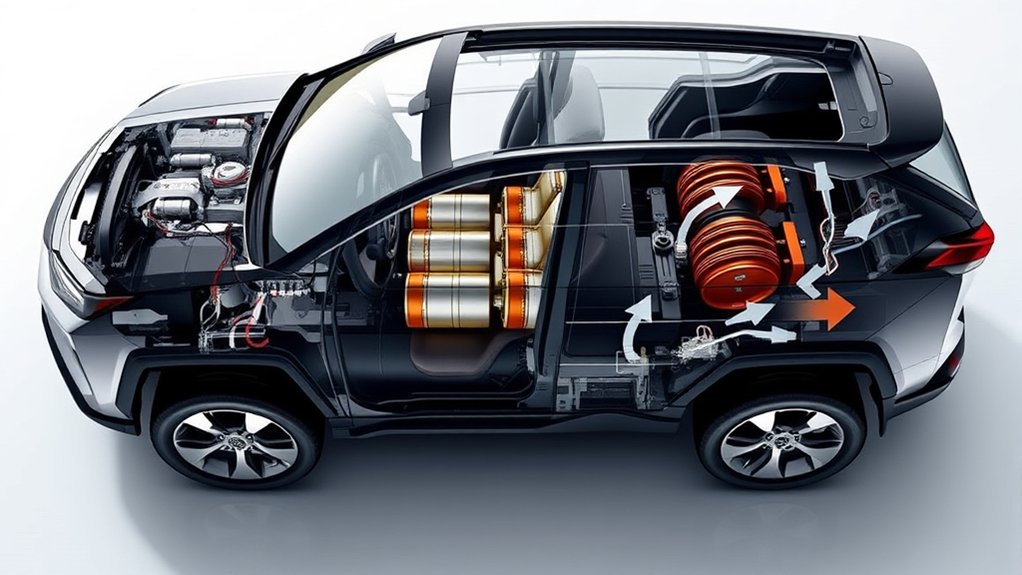
The RAV4 Hybrid’s electronically controlled transaxle is often called an eCVT, but it does not operate like a belt-and-pulley continuously variable transmission. A planetary power-split device allows the engine and motor-generators to operate at different speeds while the control system balances mechanical and electrical power.
Because of this design, engine speed may rise and remain steady during acceleration even while road speed continues to increase. That behavior can sound different from the gear changes of a conventional automatic transmission, but it is generally normal.
The system can favor low engine load when cruising, add immediate motor torque during acceleration, generate electricity when useful, and limit battery output to protect temperature and charge limits.
Electronic On-Demand AWD
AWD RAV4 Hybrid models add a dedicated electric motor for the rear wheels. The vehicle computer uses accelerator position, wheel speeds, steering input, traction conditions, and other data to decide when rear torque can help.
The rear motor may assist when starting, accelerating, cornering, or detecting front-wheel slip. It does not mean that equal power is sent to all four wheels at all times, and AWD does not overcome tire-grip limits.
Good tires remain essential. AWD may help the vehicle accelerate on a slippery surface, but braking and cornering still depend heavily on tire condition, temperature, road surface, and driver input.
RAV4 Hybrid Drive Modes and EV Mode
Selectable drive modes adjust vehicle response; they do not directly command a permanent engine-only or electric-only power source. Available modes vary by model year and grade.
For the 2026 U.S. RAV4, Toyota lists the following general settings:
- Normal: Balances accelerator response, comfort, and everyday efficiency.
- Eco: Softens or manages response to support economical driving, especially where speed changes are frequent.
- Sport: Makes throttle and steering response feel more immediate.
- Custom: Allows selected vehicle responses to be adjusted on equipped models.
- EV mode: Requests brief electric-only operation at low speed when battery charge, temperature, engine warm-up, accelerator demand, and other conditions permit it.
EV mode can refuse to activate or can cancel itself without indicating a defect. The engine will start whenever the hybrid computer determines that engine operation is required.
Note: The regular RAV4 Hybrid does not provide a normal driver-selectable “Gasoline Only” mode. Engine-only, electric-assisted, and combined operation are automatic energy-flow states.
Top Benefits of the RAV4 Hybrid’s Non-Plug-In System
The phrase self-charging hybrid is sometimes used to describe a vehicle that does not connect to a charger. A more precise term is non-plug-in hybrid. Its battery is charged by regenerative braking and by electricity generated while the gasoline engine is operating.
The system’s main advantages include:
- No charging routine: You refuel it with gasoline and drive it much like a conventional vehicle.
- Efficient urban operation: Engine-off periods, regenerative braking, and electric assistance are particularly useful in variable-speed traffic.
- Immediate electric torque: The drive motor can respond quickly during initial acceleration.
- Long-distance convenience: The vehicle retains the quick refueling and driving range associated with gasoline.
- Available electric AWD: AWD versions can add rear-wheel torque without requiring the driver to engage a traditional transfer case.
- Reduced friction-brake use in some conditions: Regeneration can decrease how much work the pads and rotors perform, although wear still depends on driving and environment.
These benefits do not make the RAV4 Hybrid a zero-emission vehicle. It burns gasoline, produces tailpipe emissions whenever the engine runs, and loses energy through normal mechanical and electrical inefficiencies.
How Drivers Can Make Better Use of Regenerative Energy
The system performs regeneration automatically, but driving style affects how often it can recover energy. Smooth, predictable inputs usually provide better opportunities than repeated hard acceleration and late braking.
Regenerative Braking Mechanism
- Accelerate progressively instead of requesting maximum power for routine starts.
- Maintain a safe following distance so you can slow gradually.
- Release the accelerator early when traffic is stopping ahead.
- Use the hybrid or Eco display as feedback without staring at it while driving.
- Keep tires inflated to the pressure specified on the vehicle placard.
- Combine short trips when practical because a cold engine may run more often.
For long or steep descents, use the downhill or engine-braking setting described in your model’s owner’s manual. Control labels and procedures can differ. A lower or braking range is intended to help control speed and reduce continuous brake use, not to improve everyday fuel economy.
Energy Storage Efficiency
The battery is most useful as a temporary buffer rather than a large reservoir for long electric trips. The system protects it by limiting maximum charge, minimum charge, temperature, and power flow.
A high indicated charge can reduce how much regenerative energy the battery accepts. A low indicated charge can cause the engine to run more often. Both behaviors can be normal because the computer is maintaining a usable operating window.
Real fuel economy also changes with speed, weather, trip length, elevation, tires, roof accessories, cargo, towing, cabin heating, air conditioning, fuel formulation, and driver behavior. Regenerative braking is only one part of the result.
Fuel Economy, Towing, and Real-World Limits
Fuel-economy numbers must always include a model year, drivetrain, and trim. For example, the EPA lists the 2025 RAV4 Hybrid AWD at 41 mpg city, 38 mpg highway, and 39 mpg combined.
For the redesigned 2026 Hybrid, Toyota’s detailed manufacturer estimates range from approximately 38 to 43 mpg combined, depending on grade and drivetrain. Manufacturer estimates and EPA-certified label values are not interchangeable, so use the window sticker or current FuelEconomy.gov entry for the exact vehicle.
Towing capacity also changes by configuration. Toyota states that for the 2026 U.S. RAV4:
| 2026 configuration | Maximum stated towing capacity |
|---|---|
| Hybrid FWD models | 1,750 pounds |
| Hybrid LE AWD | 1,750 pounds |
| Selected AWD Hybrid grades, including XLE Premium, Woodland, SE, XSE, and Limited | Up to 3,500 pounds |
Warning: Never use a towing figure from another model year or trim. Confirm the exact vehicle rating, hitch limits, trailer-brake requirements, payload, tongue weight, tire limits, and Gross Combined Weight Rating before towing.
Hybrid Battery Maintenance and Normal Behavior
The traction battery does not have a routine owner replacement interval. It is monitored by the vehicle’s battery-management and hybrid-control systems. Most owner care involves following the scheduled maintenance guide and preventing the battery-cooling path from becoming blocked.
- Keep any battery-cooling intake identified in the owner’s manual clear of luggage, seat covers, pet hair, dust, and debris.
- Do not pour liquids into an intake or attempt to clean internal high-voltage components.
- Have persistent hybrid-system, battery-cooling, or master-warning messages diagnosed promptly.
- Do not assume reduced fuel economy proves the traction battery has failed; tires, temperature, brakes, alignment, short trips, and engine issues can produce similar symptoms.
- Use a qualified technician to test battery condition before authorizing replacement.
Normal Behaviors That Can Look Like Problems
- The engine runs while stopped: It may be warming up, heating the cabin, supporting defrost, or charging the battery.
- The battery gauge rises and falls quickly: The displayed range represents a controlled operating window, not the pack’s full chemical capacity.
- EV mode is unavailable: Charge level, temperature, speed, accelerator demand, or engine warm-up may prevent it.
- A fan can be heard from the cabin area: The traction-battery cooling system may increase airflow when needed.
- Brake feel changes near a stop: The system transitions between regenerative and hydraulic braking as speed and demand change.
- Engine speed does not match road speed: The power-split eCVT can hold the engine at an efficient or high-output speed without conventional gear changes.
Warning: Do not open the traction battery, touch orange high-voltage cables, or attempt high-voltage repairs. After a serious crash, flood, fire, smoke, unusual heat, leaking fluid, popping, or hissing, move away from the vehicle and contact emergency services. Treat exposed high-voltage parts as energized.
Comparing the RAV4 Hybrid With Other Hybrid Systems
The standard RAV4 Hybrid is a full HEV, which places it between a mild hybrid and a plug-in hybrid in electric capability.
| System type | External charging | Electric driving capability |
|---|---|---|
| Mild hybrid | No | Motor assists the engine but generally does not propel the vehicle independently. |
| RAV4 Hybrid HEV | No | Can move on electric power for short periods when operating conditions permit. |
| RAV4 Plug-in Hybrid | Yes | Uses a larger externally chargeable battery for much longer electric operation before functioning as a hybrid. |
The 2026 RAV4 Plug-in Hybrid is a separate powertrain with a larger battery, charging equipment, and a manufacturer-estimated electric range of up to 52 miles on selected grades. The regular Hybrid cannot gain that capability by connecting an aftermarket charger.
- The standard Hybrid is best suited to drivers who want hybrid efficiency without a charging routine.
- The Plug-in Hybrid can reduce gasoline use further when it is charged regularly and trips fit within its electric range.
- A mild hybrid provides less electric propulsion but may be mechanically simpler and less expensive in some vehicle lines.
Frequently Asked Questions
How long does the RAV4 Hybrid battery last?
There is no fixed age or mileage at which every RAV4 Hybrid battery fails. Service life depends on the model, climate, use, cooling, battery management, and individual condition. For U.S. Toyota hybrids from model year 2020 onward, the hybrid battery is generally covered for 10 years or 150,000 miles, whichever comes first. Warranty length is not a predicted failure date.
Can I charge the regular RAV4 Hybrid battery at home?
No. The standard RAV4 Hybrid has no external charge port. Its traction battery receives energy from regenerative braking and the hybrid system while driving. The RAV4 Plug-in Hybrid is the version designed for home or public charging.
What maintenance is required for the hybrid battery?
Follow the model-specific maintenance guide, keep the battery-cooling intake clear, and have warning messages inspected. Do not open the battery or service orange high-voltage wiring yourself. The battery has no universal scheduled replacement interval.
Does the RAV4 Hybrid use gasoline and electric power at the same time?
It can. During stronger acceleration or climbing, the gasoline engine and electric drive motor may work together. At other times, the engine may drive the vehicle efficiently, the motor may assist, or the vehicle may move briefly with the engine off. The computer changes the combination automatically.
Is the RAV4 Hybrid suitable for towing?
It can handle light towing when properly equipped, but the limit varies. For 2026 U.S. models, FWD and LE AWD versions are rated up to 1,750 pounds, while selected AWD Hybrid grades are rated up to 3,500 pounds. Always confirm the exact model’s manual, payload, hitch, tongue-weight, and combined-weight limits.
Why does the engine start when the battery gauge shows a charge?
The gauge does not control the engine by itself. The engine may start for acceleration, cabin heat, windshield defrosting, emissions-system warm-up, battery-temperature control, or to maintain the battery within its preferred operating range.
Why will EV mode not turn on?
EV mode is conditional. It may be unavailable when the battery charge is too low, the battery or engine is too cold or hot, vehicle speed is too high, the accelerator is pressed firmly, climate demand is high, or the engine needs to complete its warm-up cycle.
How much does a RAV4 Hybrid battery replacement cost?
There is no reliable universal price. Cost depends on model year, battery assembly, new or remanufactured parts, labor, taxes, location, and warranty coverage. Obtain a diagnostic report and a VIN-specific written estimate before approving replacement.
Conclusion
The Toyota RAV4 Hybrid improves efficiency by coordinating a gasoline engine, electric motor-generators, a traction battery, regenerative braking, and an electronically controlled power-split transaxle. AWD versions add a rear electric motor that supplies rear-wheel torque when the control system determines it can help.
The system requires little day-to-day involvement from the driver. It decides when to start the engine, use electric assistance, generate electricity, or recover energy while slowing. Owners mainly need to drive smoothly, follow the correct maintenance guide, keep the battery-cooling path clear, and use model-specific ratings for fuel economy, warranty coverage, and towing.
Sources
- Toyota USA Newsroom: 2026 RAV4 technical overview — hybrid-system components, lithium-ion battery, output, drive modes, AWD operation, and manufacturer fuel-economy estimates.
- Toyota 2026 RAV4 Hybrid Warranty & Maintenance Guide — hybrid battery, hybrid-system, powertrain, and basic warranty coverage.
- Toyota: Hybrid and Plug-in Hybrid Differences — external charging and regenerative-braking distinctions.
- U.S. Department of Energy Alternative Fuels Data Center: Hybrid Electric Vehicles — full-hybrid operation, engine assistance, regenerative braking, and non-plug-in charging.
- FuelEconomy.gov: 2025 Toyota RAV4 Hybrid AWD — official EPA fuel-economy example.
- National Highway Traffic Safety Administration: Electric and Hybrid Vehicle Safety — high-voltage, collision, fire, and flood safety guidance.

1 thought on “How the Toyota RAV4 Hybrid System Works: Battery, Motors and Regenerative Braking”