Your Toyota Tacoma fuse box diagram helps you match a failed electrical feature to the correct fuse, amperage rating, and fuse-box location. Because Tacoma fuse layouts change by model year, cab, trim, and equipment, always use the diagram on your fuse-box cover and your vehicle-specific Toyota owner’s manual before pulling or replacing any fuse.
Quick Answer
To use a Toyota Tacoma fuse box diagram, find the fuse panel shown in your owner’s manual, match the failed component to the labeled fuse slot, remove the fuse with the engine off, and replace it only with the same amperage rating. If the new fuse blows again, stop and diagnose the circuit.
Key Takeaways
- Tacoma fuse-box layouts are model-year-specific, so do not rely on a generic diagram alone.
- Use the fuse-box lid, owner’s manual, and amperage number printed on the fuse before replacing anything.
- Never install a higher-rated fuse to “fix” a blown fuse, because that can overheat wiring.
- A fuse that blows again usually points to a short circuit, failed part, water intrusion, or overloaded accessory circuit.
- Stop DIY work if you see melted plastic, smell burning, find moisture, or lose power to safety systems.
At a Glance
| Time Required | 5 to 15 minutes for a basic fuse check |
| Difficulty | Easy for owner-accessible blade fuses; advanced for wiring faults or fusible links |
| Tools Needed | Owner’s manual, flashlight, fuse puller or small needle-nose pliers, same-amp spare fuse, and a multimeter or test light if needed |
| Cost | Usually low for a spare fuse; diagnostic costs vary if the circuit has a short or module problem |
Why Fuses Matter in Your Toyota Tacoma
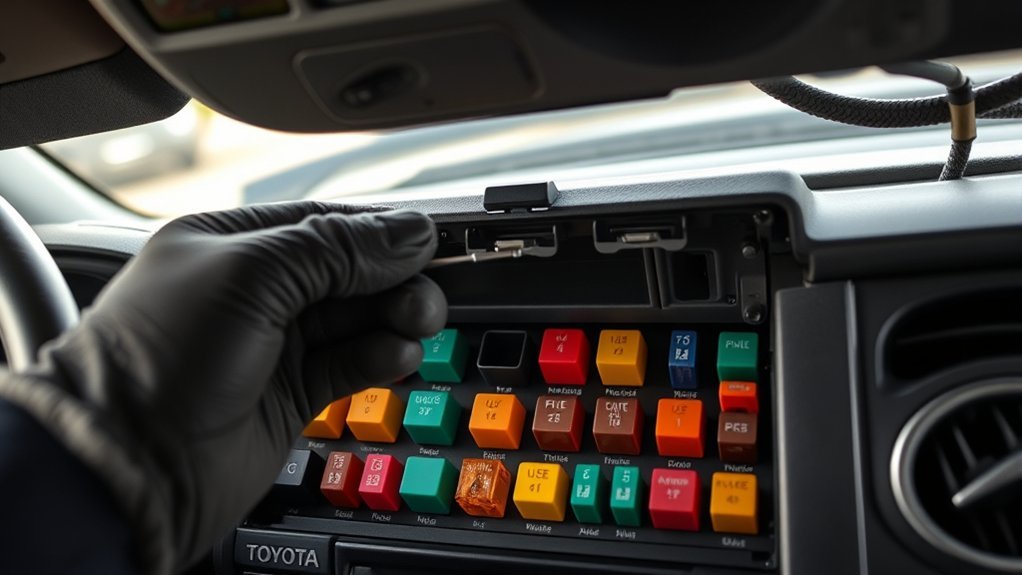
Fuses protect your Tacoma’s wiring and electrical parts by opening the circuit when current gets too high. That simple part helps protect circuits for lights, wipers, power outlets, audio equipment, ignition-related systems, and other accessories.
A blown fuse is not the problem by itself. It is usually a symptom. The circuit may have a short, a failed bulb, a bad accessory, moisture in a connector, damaged wiring, or an overloaded add-on device.
Warning: Never replace a Tacoma fuse with a higher amperage fuse, foil, wire, or any bypass. The fuse rating protects the wiring. A higher-rated fuse may let the circuit overheat before the fuse opens.
Where to Find Your Tacoma Fuse Box Diagram
Your first source should be the diagram printed on the fuse-box cover. Your second source should be your model-year owner’s manual from Toyota. The exact fuse names, ratings, and locations can change across Tacoma generations, trims, and optional equipment.
Common Tacoma fuse locations may include an engine-compartment fuse and relay box and an interior fuse panel near the lower dash area. Some model years may use additional junction blocks for certain equipment. Do not assume another Tacoma’s diagram matches yours unless the year, trim, engine, and equipment are the same.
Note: If the fuse-box lid is missing or unreadable, use Toyota’s official manual lookup page and select your exact Tacoma model year.
How to Read Fuse Labels and Amperage Ratings
A Tacoma fuse box diagram usually shows three things: the fuse position, the circuit name, and the amperage rating. The circuit name may be short, such as “P/OUTLET,” “RADIO,” “ECU,” “STOP,” “TAIL,” or “WIPER.” The abbreviations can vary by year.
Fuse color can help you identify common ratings, but the amperage number printed on the fuse is more important than color alone. Match the replacement fuse to the original amperage and physical fuse type.
- Blade fuses: Common small plug-in fuses used for many interior and accessory circuits.
- Cartridge or J-case fuses: Larger fuses often used for higher-current circuits.
- Relays: Switches that control higher-load circuits. A relay is not the same as a fuse.
- Fusible links: High-current protection points that usually require more careful diagnosis.
Pro Tip: Take a phone photo of the fuse-box cover before removing fuses. It gives you a quick reference if you forget a slot location or orientation.
Getting to Know Your Tacoma’s Fuse Box Layout
Start with the fuse panel that matches the failed feature. If your power outlet stopped working, look for the accessory or power outlet fuse. If the wipers stopped, look for the wiper fuse. If several features failed at once, look for a shared fuse, relay, ground, or power supply issue.
Use this general approach before replacing anything:
- Confirm the exact symptom, such as one dead outlet, all wipers inoperative, or no interior lights.
- Find the matching fuse name in the diagram on the cover or in the owner’s manual.
- Check the fuse rating before removal.
- Inspect only owner-accessible fuse covers and panels.
- Stop if the manual points to a high-current fuse, fusible link, or area that requires trim removal.
Common Fuse Issues and Quick Fixes
Blown fuses often appear after a bulb fails, a charger shorts out, an accessory draws too much current, or moisture reaches a connector. A quick fuse replacement may restore the circuit, but the real fix depends on why the fuse opened.
| Symptom | Likely Fuse Area | First Check |
|---|---|---|
| Power outlet or 12V socket does not work | Power outlet, accessory, or related interior fuse | Unplug chargers and accessories before replacing the fuse. |
| Wipers stop working | Wiper fuse or wiper relay circuit | Check for ice, jammed wipers, or a seized motor before replacing the fuse. |
| Radio or infotainment screen loses power | Audio, accessory, ECU, or display-related fuse | Check the correct diagram because audio fuse labels vary by year. |
| Brake lights or tail lights fail | Stop, tail, lighting, or body ECU fuse | Check bulbs, trailer wiring, and moisture before assuming the fuse is the only fault. |
| Several systems fail at the same time | Shared power supply, main fuse, relay, or junction block | Do not keep replacing fuses. Diagnose the shared circuit. |
Check and Replace Blown Fuses Safely
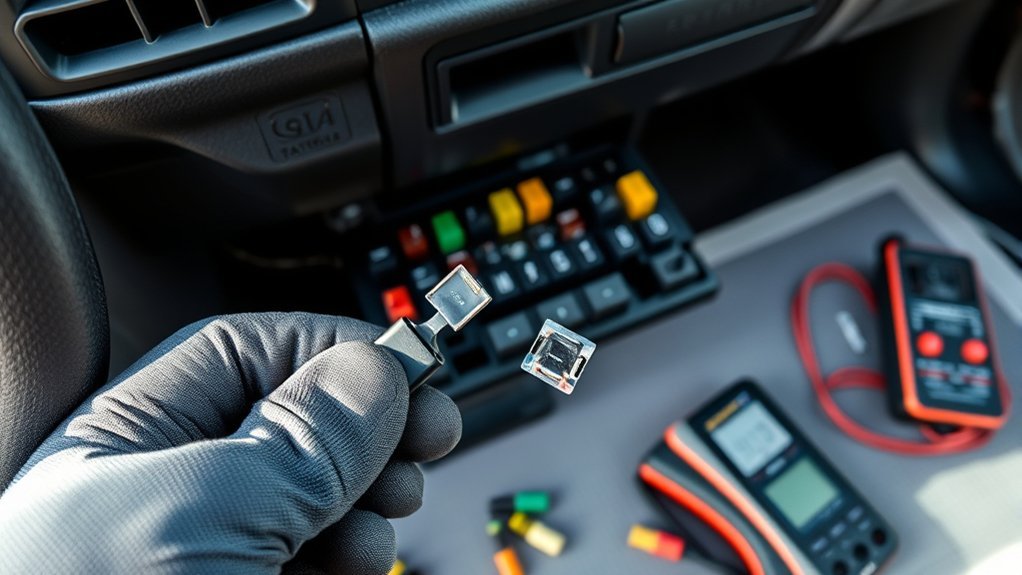
Checking a Tacoma fuse is simple when the fuse is in an owner-accessible panel. Work slowly and avoid forcing covers, clips, or fuses.
- Park safely. Shift to Park, set the parking brake, turn the ignition off, and remove the key or key fob from the cabin.
- Find the correct fuse panel. Use the fuse-box lid and your owner’s manual to confirm the exact location.
- Match the circuit name. Find the fuse for the failed feature before pulling anything.
- Remove the fuse carefully. Use the fuse puller if provided. If you use needle-nose pliers, grip the plastic body, not the metal blades.
- Inspect the fuse. Look for a broken metal strip, dark spot, or melted plastic. Some failures are hard to see, so test it if unsure.
- Replace it with the same rating. Use the same amperage and same physical fuse style.
- Test the circuit. Turn the vehicle back on only after the fuse is seated and the cover is reinstalled.
How to Test a Fuse With a Multimeter or Test Light
A fuse can look good and still fail. If the visual check is unclear, use a multimeter set to continuity or resistance. A good fuse should show continuity across its two terminals. An open fuse will not.
You can also use a 12V test light on the small exposed test points at the top of many blade fuses. With the circuit powered, both test points should have power. Power on one side only usually means the fuse is blown.
Note: Some circuits only receive power with the ignition on, lights on, or accessory mode active. Check your manual before assuming a fuse has no power.
What It Means If the New Fuse Blows Again
If a replacement fuse blows right away, the circuit has a problem that needs diagnosis. Do not install another fuse and keep trying. Repeated failures can point to a shorted wire, failed motor, damaged bulb socket, wet connector, trailer wiring fault, or overloaded aftermarket accessory.
Aftermarket add-ons deserve special attention. Dash cams, light bars, radios, power inverters, trailer wiring, and bed accessories can overload circuits if they are tied into the wrong fuse or installed without the right protection.
For repeated fuse failures, use Toyota’s Technical Information System or have a qualified technician trace the circuit with a wiring diagram.
When to Stop DIY and Get Help
Fuse checks are fine for simple owner-level problems. Electrical diagnosis becomes more serious when heat, water, warning lights, or safety systems are involved.
- You smell burning plastic or see melted fuse-box material.
- A new fuse blows immediately.
- The same fuse fails more than once.
- Water entered the cab, engine bay, or fuse panel.
- Brake lights, headlights, airbags, ABS, or ignition-related systems are affected.
- The problem started after trailer wiring or aftermarket accessory installation.
- The diagram points to a high-current fuse, fusible link, or main relay.
If the issue may involve a safety defect, check your Tacoma by VIN through the NHTSA recall lookup. For replacement electrical parts, use your VIN on the official Toyota Parts site or ask a Toyota dealer to confirm fitment.
Troubleshooting Common Fuse-Related Issues in the Tacoma
When a Tacoma electrical feature stops working, start with the simplest checks. Confirm the component is actually failing, check the correct fuse, and look for obvious causes such as a bad bulb, loose plug, wet connector, or blown accessory charger.
If multiple components fail together, look for a shared circuit instead of replacing random fuses. A shared power supply, relay, ground point, or body-control circuit may affect several systems at once.
Also consider what changed recently. A new trailer harness, aftermarket radio, bed lighting kit, dash cam, alarm, remote-start system, or USB charger can create a fuse problem if the circuit is overloaded or incorrectly tapped.
A blown fuse is a clue, not a cure. Replace it once with the correct rating, then diagnose the circuit if it fails again.
Frequently Asked Questions
Where is the Toyota Tacoma fuse box diagram?
The diagram is usually printed on the fuse-box cover and listed in your owner’s manual. Use the diagram for your exact model year because Tacoma fuse names, locations, and ratings can change.
How do I tell which fuse does what in a Tacoma?
Match the fuse label on the diagram to the failed component. Then confirm the amperage number printed on the fuse. If an abbreviation is unclear, check the owner’s manual for your exact year.
Can I use a higher amp fuse if the original fuse keeps blowing?
No. Always use the same amperage rating. A fuse that keeps blowing usually means the circuit has a short, overloaded accessory, bad component, moisture problem, or wiring fault.
Do I need to disconnect the battery before replacing a Tacoma fuse?
For a simple owner-accessible blade fuse, turning the ignition off and removing the key is usually enough. Disconnect the battery or get professional help if you are working near high-current fuses, damaged wiring, melted plastic, or moisture.
What should I do if my Tacoma has no fuse-box cover?
Use Toyota’s official owner-manual lookup for your model year or ask a Toyota dealer to identify the correct fuse layout. Do not rely on an image from a different Tacoma unless it matches your year and equipment.
Conclusion
Your Toyota Tacoma fuse box diagram is a practical troubleshooting map, but it only works when you use the correct diagram for your exact truck. Start with the fuse-box cover and owner’s manual, match the circuit name carefully, and replace blown fuses only with the same amperage rating.
If the new fuse works, you may have fixed a simple overload or failed accessory. If it blows again, stop replacing fuses and diagnose the circuit. That extra step protects your wiring, prevents repeat failures, and keeps your Tacoma’s electrical systems safer.
Sources
- Toyota Manuals and Warranties — official source for model-year owner manuals and vehicle-specific fuse information.
- Toyota Technical Information System — official source for Toyota repair manuals, service information, and wiring diagrams.
- Toyota Parts — official Toyota parts lookup by vehicle or VIN.
- NHTSA Recalls — official VIN-based recall and safety-issue lookup.