
A Toyota Tacoma fuse box location depends on the model year and generation. On 2005–2015 and 2016–2023 Tacomas, Toyota identifies an engine-compartment fuse box and an interior fuse panel under the instrument panel. On the 2024 Tacoma, Toyota identifies Type A and Type B engine-compartment fuse boxes, a passenger-side instrument-panel fuse box, and an additional fuse box under the right-hand rear seat on vehicles with rear seats.
Last updated: September 16, 2026. Fuse-location, replacement, and accessory-power guidance was rechecked against Toyota owner-manual information and current hardwire-kit guidance.
Quick Answer
- Do not assume every Tacoma uses the same fuse-box layout; check the exact model year first.
- 2005–2015 Tacomas use an engine-compartment fuse box and an interior fuse area under the instrument panel.
- 2016–2023 Tacomas also use an engine-compartment fuse box and an interior panel under the instrument panel.
- The 2024 Tacoma uses Type A and Type B engine-compartment boxes, a passenger-side instrument-panel box, and a right-rear-seat box on vehicles with rear seats.
- Replace a blown fuse only with the amperage specified for that circuit. Never install a higher-rated fuse.
- For a dash cam or other accessory, identify constant and switched power with a meter and preserve the factory circuit’s original fuse rating.
Where Is the Toyota Tacoma Fuse Box Located by Model Year?
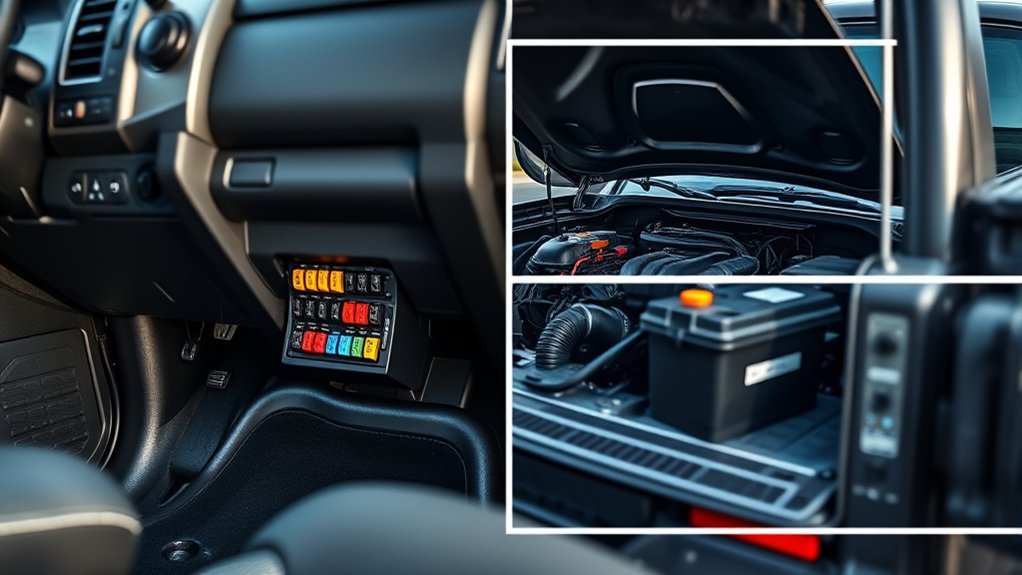
The safest way to find the correct Tacoma fuse box is to start with the truck’s model year. Toyota changed the interior access points and added fuse-box locations as the Tacoma evolved, so a diagram or video for another generation may not match your truck.
| Tacoma model years | Fuse-box locations to check first | Access note |
|---|---|---|
| 2005–2015 | Engine compartment and under the instrument panel | Later second-generation manuals show the interior panel accessed through the auxiliary-box area. Confirm the exact procedure for your model year. |
| 2016–2023 | Engine compartment and under the instrument panel | Remove the appropriate cover shown in the exact model-year owner’s manual before pulling a fuse. |
| 2024 | Engine-compartment Type A and Type B boxes, passenger-side instrument panel, and under the right-hand rear seat on vehicles with rear seats | The rear location requires raising the seat cushion and removing the specified trim/undercover pieces. |
For 2025, 2026, or any Tacoma not covered by the examples above, use Toyota’s manual for the exact year instead of assuming another year’s fuse locations and assignments are identical. Toyota provides current manuals through its official manuals and warranties portal.
If you need individual circuit labels and fuse functions after locating the panel, see the Toyota Tacoma fuse box diagram guide.
How Do You Read a Tacoma Fuse Box Diagram?
The fuse-box cover or exact model-year owner’s manual is the source of truth for the circuit name, fuse position, and amperage rating. Do not select a replacement fuse simply because another Tacoma uses the same-looking slot.
Depending on the model year, the panel may contain small blade fuses, higher-current fuses, relays, or other protected circuits. Toyota’s 2024 instructions distinguish multiple fuse types and direct owners to contact a Toyota dealer for certain types rather than attempting to replace every fuse themselves.
- Match the failed component to the circuit label on the cover or manual.
- Check the amperage printed for that exact circuit.
- Replace only owner-serviceable fuses described by the manual.
- Never replace a fuse with a higher amperage rating, wire, foil, or another substitute.
- If the replacement fuse blows again, stop replacing it and diagnose the circuit.
Fuse color can be a useful visual clue, but the printed amperage rating and model-year diagram are more important than color alone.
Which Tacoma Fuse Should You Use for a Dash Cam or Accessory?
There is no single Tacoma fuse that is automatically the best choice for every dash cam, 12V accessory, model year, or trim. First identify whether the accessory needs switched power only or both switched and constant power for a feature such as parking mode.
Use a multimeter or circuit tester and the exact Tacoma fuse diagram to identify a suitable circuit. Avoid choosing a donor circuit solely because an online post says it worked on another truck.
If a compatible add-a-circuit is appropriate, do not reduce or increase the vehicle’s original fuse rating. Put the original vehicle fuse in the factory-circuit position of the fuse tap and use the separate accessory fuse specified by the hardwire-kit manufacturer for the added circuit. Follow the hardwire kit’s instructions for fuse-tap orientation and maximum load.
A parking-mode dash cam should also use a hardwire kit with low-voltage battery protection so the camera can shut down before excessive battery discharge. Current hardwire instructions from BlackVue, for example, distinguish switched ACC power from constant battery power and retain the vehicle’s original fuse in the fuse tap.
How Do You Test a Tacoma Fuse for Constant or ACC Power?

To classify an accessory-power circuit, compare its voltage with the vehicle off and with the ignition in ACC or ON. A constant-power circuit remains energized when the truck is off. A switched or ACC circuit is unpowered with the truck off and becomes energized when the appropriate ignition mode is selected.
- Park safely and switch off unnecessary electrical loads.
- Use the exact model-year fuse diagram to identify a candidate circuit.
- Connect the meter ground lead to a known good chassis ground.
- Measure the circuit with the vehicle OFF.
- Repeat the measurement in ACC or ON.
- Record the readings before deciding whether the circuit is constant or switched.
| Vehicle state | Typical reading | What it suggests |
|---|---|---|
| OFF | About 12 V | Candidate constant-power circuit |
| OFF | 0 V | Could be switched or inactive; test again with ignition on |
| ACC/ON | About 12 V after reading 0 V in OFF | Candidate switched/ACC circuit |
| OFF and ACC/ON | About 12 V in both states | Candidate constant-power circuit |
No voltage in every mode does not automatically mean the fuse is blown. The circuit may be inactive under the test conditions, the meter may have a poor ground, or the slot may not be powered. If you are checking whether the fuse itself is open, switch the vehicle off, remove the owner-serviceable fuse as directed by the manual, and test it for continuity.
How Do You Replace a Tacoma Fuse Safely?
Turn the vehicle off before removing an owner-serviceable fuse. Identify the exact circuit on the cover or model-year manual, remove the fuse with the proper puller where applicable, and replace a blown fuse only with the specified amperage.
- Never install a higher-amperage fuse to stop repeated failures.
- Never substitute wire, foil, or another object for a fuse.
- Do not force a high-current or non-owner-serviceable fuse out of the panel.
- Make sure the replacement is fully seated and reinstall the panel cover securely.
- If the correct replacement fuse blows again, stop and have the circuit diagnosed.
A second failure usually means the fuse is protecting the truck from another fault, such as an overload, short circuit, damaged wiring, failed electrical component, water intrusion, or an incorrectly installed aftermarket accessory.
Common Tacoma Fuse Problems and What to Check
Start with the symptom, then use the exact Tacoma model-year diagram to identify the related circuit. Do not guess the fuse amperage from the failed component.
| Symptom | What to check first |
|---|---|
| 12V outlet has no power | Find the power-outlet/accessory circuit shown for your exact model year and test the specified fuse. |
| Radio or multimedia system is dead | Check the model-year diagram for the applicable audio, radio, ACC, or related power circuit before removing a fuse. |
| Interior lights are out | Match the symptom to the dome/interior-light circuit shown on the truck’s diagram. |
| Headlight or taillight is out | Confirm whether the fault is a fuse, bulb, connector, module, or wiring issue instead of assuming a fuse is responsible. |
| Replacement fuse blows again | Stop replacing fuses and diagnose the circuit for an overload, short, damaged component, or aftermarket wiring problem. |
If the failed circuit involves airbags, ABS, steering, engine management, a burning smell, melted plastic, or repeated fuse failure, professional diagnosis is safer than continuing to swap fuses.
Related Guides
Frequently Asked Questions
Where Is the Tacoma Fuse Box in the Engine Bay?
Tacoma engine-compartment fuse-box locations and layouts vary by model year. Toyota manuals for earlier generations identify an engine-compartment fuse box, while the 2024 Tacoma manual identifies Type A and Type B engine-compartment fuse boxes. Use the cover diagram and your exact model-year manual before removing a fuse.
Where Is the Fuse Box on a Toyota Tacoma?
The location depends on the model year. 2005–2015 and 2016–2023 Tacoma manuals identify an engine-compartment box and an interior fuse panel under the instrument panel. The 2024 Tacoma adds a passenger-side instrument-panel fuse box and, on vehicles with rear seats, another fuse box under the right-hand rear seat.
Where Is the Interior Tacoma Fuse Box Located?
On 2005–2023 Tacoma generations, Toyota describes the interior fuse location as under the instrument panel, with the exact access method changing by generation. On the 2024 Tacoma, Toyota identifies the passenger-side instrument panel. Check your exact model-year manual before removing trim.
How Do I Tell Constant Power From ACC Power?
A candidate constant-power circuit has voltage with the vehicle off and remains powered with the ignition on. A candidate switched or ACC circuit reads no voltage with the vehicle off and becomes powered in ACC or ON. Verify the readings with a multimeter instead of relying on a fuse name alone.
Why Does My Replacement Tacoma Fuse Keep Blowing?
If a correctly rated replacement fuse blows again, stop replacing it. Repeated failure can indicate an overload, short circuit, damaged wiring, failed component, water intrusion, or incorrectly installed accessory. Do not install a higher-amperage fuse to keep the circuit operating.
Conclusion
The correct Toyota Tacoma fuse box location starts with the model year. Earlier Tacomas generally use an engine-compartment box plus an interior panel under the instrument panel, while the verified 2024 layout adds Type A and Type B engine boxes, a passenger-side instrument-panel box, and a right-rear-seat box on vehicles with rear seats.
After finding the correct panel, use the cover or exact model-year manual to identify the circuit and amperage. Replace only owner-serviceable blown fuses with the specified rating. For accessory hardwiring, test constant and switched power instead of guessing, preserve the vehicle’s original fuse rating, and use a separately fused accessory circuit. If the correct fuse blows again, diagnose the fault rather than fitting a larger fuse.
