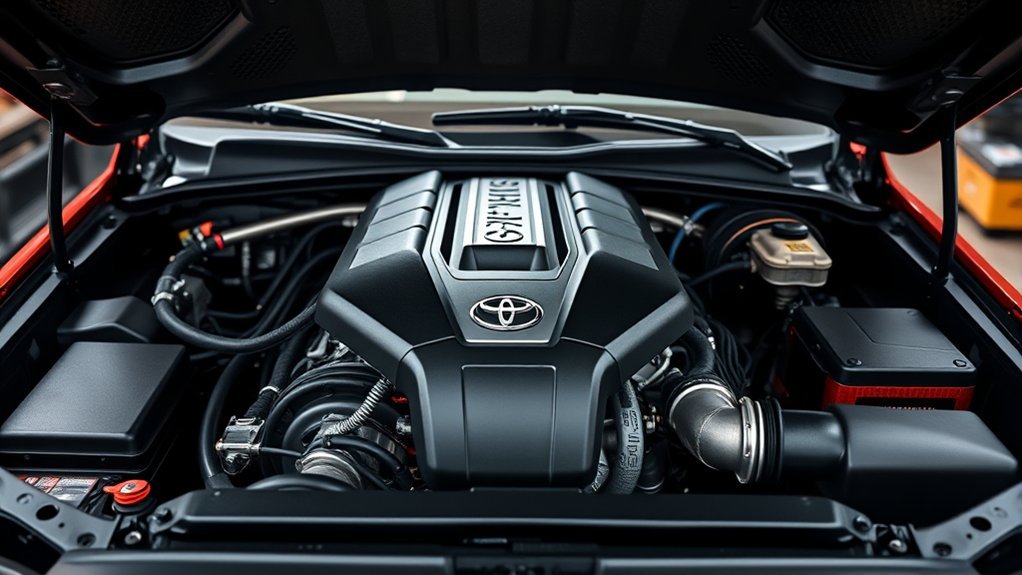
Toyota’s Tacoma i-FORCE and i-FORCE MAX powertrains use the same basic 2.4-liter turbocharged four-cylinder engine, but they serve different priorities. The standard i-FORCE keeps the drivetrain simpler, while i-FORCE MAX adds an electric motor and hybrid battery for much stronger low-end torque. This guide explains their power, fuel economy, towing limits, drive modes, warranty coverage, and ownership tradeoffs using current 2026 U.S. specifications.
Quick Answer
Choose i-FORCE MAX when you want the Tacoma’s strongest acceleration, 465 lb-ft of torque, standard hybrid assistance, and 23 MPG combined rating. Choose the non-hybrid i-FORCE when you prefer a simpler drivetrain, lower vehicle weight, more rear under-seat storage, or an available manual transmission on select trims.
Key Takeaways
- i-FORCE is not a hybrid. It is Toyota’s turbocharged gasoline powertrain and produces up to 278 hp and 317 lb-ft.
- i-FORCE MAX is the hybrid. It combines the turbo engine with a 48-hp electric motor for 326 hp and 465 lb-ft.
- Toyota gives the 2026 i-FORCE MAX an EPA-estimated 23 MPG combined, not 25–30 MPG.
- The hybrid is designed mainly to improve torque and response. Its fuel-economy gain is useful but not dramatic.
- Towing and payload depend on the truck’s exact trim, cab, bed, drivetrain, tires, options, and installed equipment.
- The hybrid battery receives a 10-year/150,000-mile warranty, while other covered hybrid components receive 8 years/100,000 miles.
Quick Verdict: Is i-FORCE or i-FORCE MAX Worth It?
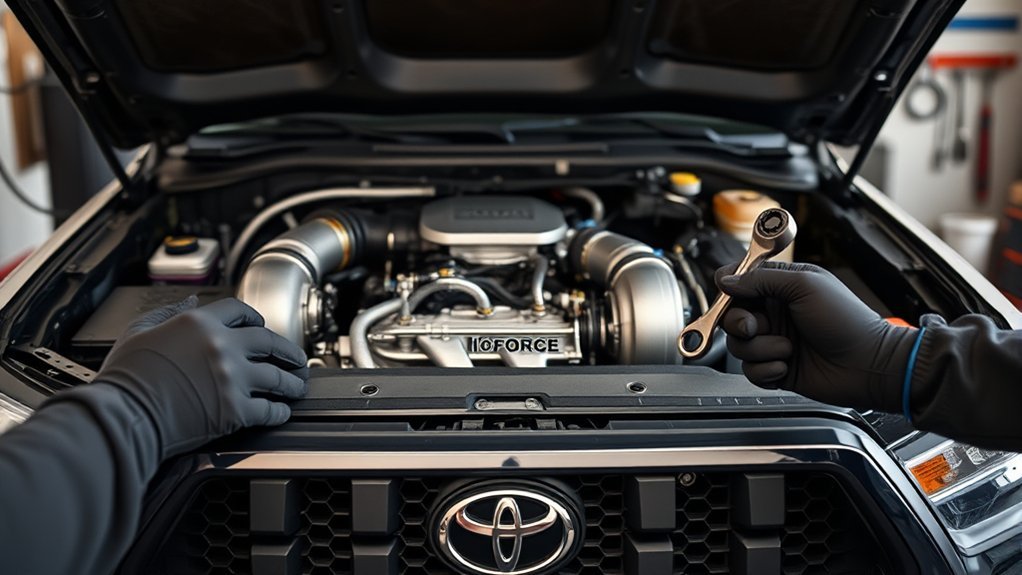
The i-FORCE MAX is worth considering when you want the strongest Tacoma powertrain and regularly drive with passengers, equipment, steep grades, or a trailer. According to Toyota’s 2026 Tacoma information, it produces 326 hp and 465 lb-ft and carries an EPA-estimated 23 MPG combined rating.
Those numbers make the hybrid noticeably stronger than the standard i-FORCE, which produces up to 278 hp and 317 lb-ft. Electric assistance helps the truck respond quickly from a stop and reduces the need for frequent downshifts during moderate acceleration.
However, i-FORCE MAX is not an economy-first hybrid like a Prius. Its main advantage is performance. You also give up some rear under-seat storage, cannot select a manual transmission, and add high-voltage components that require trained service if a problem develops.
The non-hybrid i-FORCE is the better match when you want straightforward truck performance, more configuration choices, or the available six-speed manual transmission offered on select models. Your best choice depends on how much you value added torque compared with drivetrain simplicity.
What “i-FORCE” and “i-FORCE MAX” Actually Mean
i-FORCE is Toyota’s name for the Tacoma’s turbocharged gasoline powertrain. In the 2026 lineup, it uses a 2.4-liter four-cylinder engine and produces up to 278 hp and 317 lb-ft when paired with the eight-speed automatic. Select versions are also available with a six-speed intelligent manual transmission.
i-FORCE MAX is the hybrid version. Toyota places a 48-hp electric motor within the eight-speed automatic transmission and powers it with a 1.87-kWh nickel-metal hydride battery. The engine and motor work together to produce 326 hp and 465 lb-ft.
This is a conventional, self-contained hybrid. You do not plug it into an external charger, and Toyota does not list a driver-selectable EV-only mode for the Tacoma. The system manages the engine, electric motor, battery charge, and regenerative braking automatically.
Note: A Tacoma may briefly move or coast with the gasoline engine off when operating conditions allow. That behavior is automatic and should not be confused with a dedicated electric-driving mode.
i-FORCE Components and Drivetrain Layout
The Tacoma uses a longitudinal engine layout designed for a body-on-frame, rear-wheel-drive-based truck. That arrangement differs from the front-wheel-drive-based hybrid systems used in many Toyota cars and crossovers.
Engine and Motor Placement
Both powertrains place the 2.4-liter turbocharged engine at the front of the truck. In i-FORCE MAX models, Toyota integrates one 48-hp motor-generator into the eight-speed automatic transmission. The motor assists the gasoline engine rather than powering a separate electric axle.
This design allows the hybrid to retain conventional mechanical driveshafts and truck-oriented four-wheel-drive hardware. It also lets the electric motor add torque before the turbocharged engine and transmission have delivered their full response.
Transmission and Transfer Case
Automatic i-FORCE models and all i-FORCE MAX models use an eight-speed electronically controlled automatic transmission. Select non-hybrid i-FORCE models can instead use a six-speed manual with rev matching and stall-avoidance technology.
Tacoma drivetrain availability includes rear-wheel drive, part-time four-wheel drive, and full-time four-wheel drive depending on the trim. Most i-FORCE MAX models use four-wheel drive. The Limited i-FORCE MAX uses a full-time four-wheel-drive system with a locking center differential.
Off-road grades may also include an electronically locking rear differential, Multi-Terrain Select, CRAWL Control, Downhill Assist Control, and other hardware. These features vary by trim and should not be assumed to come with every i-FORCE MAX truck.
Battery and Cooling Layout
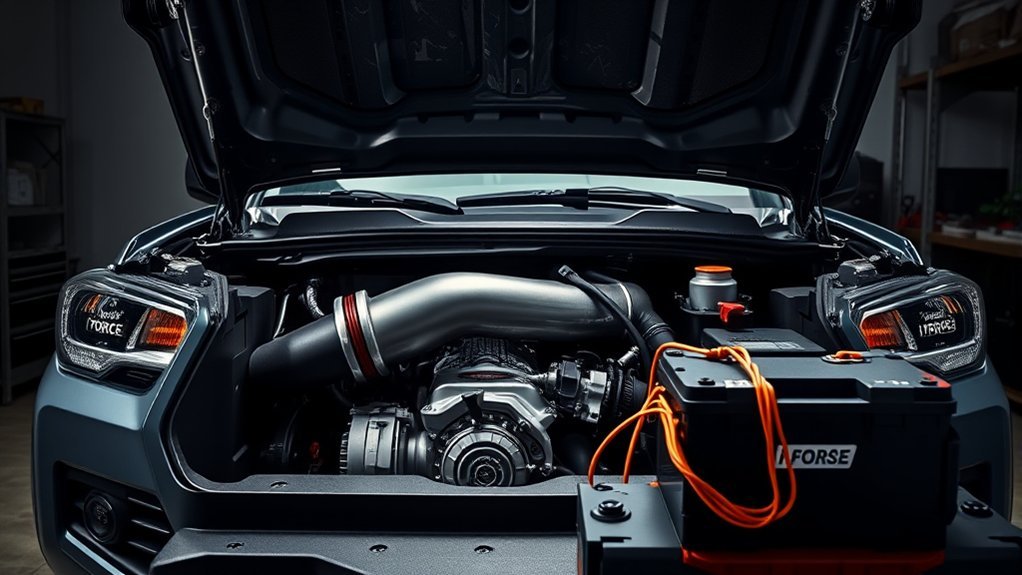
The i-FORCE MAX uses a 1.87-kWh nickel-metal hydride battery beneath the rear seat. This keeps the battery within the truck’s protected cabin structure, but it occupies space that gas-powered Tacoma models can use for additional under-seat storage.
The truck automatically manages battery temperature, charging, and power flow. Regenerative braking recovers some energy during deceleration and sends it back to the battery. The system then uses that stored energy when electric assistance can improve response or efficiency.
| Component | Purpose |
|---|---|
| 1.87-kWh NiMH battery | Stores recovered energy and supplies the hybrid motor. |
| 48-hp motor-generator | Adds low-speed torque, supports acceleration, and recovers energy. |
| Eight-speed automatic | Blends engine and motor output through conventional transmission ratios. |
| Regenerative braking | Converts part of the truck’s deceleration energy into battery charge. |
Do not open, disconnect, or attempt to repair high-voltage components yourself. Hybrid-system diagnosis and repair should be handled by qualified technicians using the correct safety procedures.
Key Specs: Power, Torque, Transmission, and Battery
| Specification | i-FORCE | i-FORCE MAX |
|---|---|---|
| Engine | 2.4-liter turbo four-cylinder | 2.4-liter turbo four-cylinder plus electric motor |
| Maximum output | Up to 278 hp | 326 total system hp |
| Maximum torque | Up to 317 lb-ft | 465 lb-ft |
| Transmission | Eight-speed automatic or six-speed manual on select trims | Eight-speed automatic |
| Hybrid battery | None | 1.87-kWh nickel-metal hydride |
| Electric motor | None | 48 hp |
| 2026 fuel-economy figure cited by Toyota | Up to 26 MPG highway | 23 MPG combined |
The 2026 Tacoma i-FORCE MAX produces 326 hp and 465 lb-ft while carrying an EPA-estimated 23 MPG combined rating.
The 326-hp figure is the total output of the complete hybrid system. You should not add the engine’s standalone horsepower and the motor’s 48-hp rating because their peak outputs do not necessarily occur at the same speed or operating condition.
Which Tacoma Trims Get i-FORCE MAX?
For the 2026 model year, Toyota offers i-FORCE MAX on the following grades:
- TRD Sport: Available as an upgrade.
- TRD Off-Road: Available as an upgrade.
- Limited: Available with full-time four-wheel drive and a locking center differential.
- Trailhunter: Standard powertrain.
- TRD Pro: Standard powertrain.
The exact equipment, bed length, suspension, tires, four-wheel-drive system, towing hardware, and payload rating change by trim. Compare complete configurations rather than assuming every truck with the hybrid badge has identical capability.
What Driving With i-FORCE Feels Like
Both Tacoma engines deliver stronger low-speed response than the previous naturally aspirated V6, but i-FORCE MAX feels more immediate because its electric motor contributes torque while the engine and turbocharger build output.
Smooth, Immediate Throttle Response
When you press the accelerator in an i-FORCE MAX Tacoma, the hybrid system blends electric and gasoline power automatically. The motor can support the first part of acceleration, which reduces hesitation and helps the truck move away from a stop without immediately demanding high engine speed.
That response is useful in city traffic, on steep access roads, and when easing a loaded truck into motion. It does not turn the Tacoma into an electric vehicle, but it makes the powertrain feel less dependent on turbo boost and transmission downshifts.
Confident Low-End Torque
The hybrid’s 465 lb-ft is its most important performance advantage. You feel that torque during passing, hill climbing, low-speed trail driving, and moderate towing. The engine can often maintain speed without the hurried sound or frequent gear changes associated with a lower-torque powertrain.
However, extra torque does not raise the truck’s certified capacity by itself. The frame, cooling system, brakes, axles, hitch, tires, suspension, and total vehicle weight still determine what a specific Tacoma can safely carry or tow.
Engine-Off Operation and Regenerative Braking
The i-FORCE MAX may shut off its gasoline engine briefly during stops, light-load operation, or deceleration when the battery and operating conditions permit. These transitions can make low-speed driving quieter, but Toyota does not provide a selectable Tacoma EV mode for sustained electric-only travel.
During braking and coasting, the motor-generator recovers part of the truck’s motion and converts it into electrical energy. That regeneration can reduce some friction-brake use, although your driving style, load, terrain, temperature, tires, and traffic conditions affect how often it operates.
Fuel Economy: EPA Rating vs. Real-World Expectations
Toyota gives the 2026 Tacoma i-FORCE MAX an EPA-estimated 23 MPG combined. The earlier 25–30 MPG projections sometimes associated with the truck are not current official ratings.
Your actual mileage may be lower or higher. Heavy all-terrain tires, roof equipment, lifts, cold weather, short trips, high speeds, idling, off-road use, and towing can all reduce fuel economy. A lightly loaded truck driven at moderate speeds will usually perform better than an accessorized off-road grade carrying equipment.
| Powertrain | 2026 Toyota Fuel-Economy Figure | What It Means |
|---|---|---|
| i-FORCE | Up to 26 MPG highway | The best highway result applies only to qualifying configurations. |
| i-FORCE MAX | 23 MPG combined | The hybrid favors stronger torque with a modest efficiency benefit. |
Do not compare the hybrid’s combined rating directly with the gas engine’s best highway figure. Compare the city, highway, and combined ratings for the exact trims you are considering.
Towing and Payload for i-FORCE and i-FORCE MAX
Toyota lists the 2026 Tacoma lineup with a maximum towing capacity of 6,500 pounds and a maximum payload of 1,705 pounds. These are lineup maximums, not ratings that apply to every Tacoma or every i-FORCE MAX configuration.
Your truck’s actual limits depend on its cab, bed, powertrain, drivetrain, trim, axle equipment, wheels, tires, factory options, accessories, passengers, cargo, and hitch equipment. Off-road hardware and larger tires may also reduce the available payload or tow rating.
Warning: Never use the Tacoma lineup’s maximum towing or payload figure without confirming the rating for your exact truck. Check the certification labels, owner information, hitch rating, tire limits, trailer weight, tongue weight, axle ratings, and gross combined weight rating before loading or towing.
- Payload includes more than bed cargo. Passengers, accessories, tools, the hitch, and trailer tongue weight all use available payload.
- Tongue weight reduces carrying capacity. A trailer may remain below the tow rating while still pushing the truck over its payload or rear-axle limit.
- Torque is not the same as capacity. The i-FORCE MAX may pull strongly, but certified limits still control safe operation.
- Accessories matter. Bumpers, racks, steps, skid plates, larger tires, and camping equipment add permanent weight.
- Towing reduces fuel economy. Trailer size, frontal area, speed, wind, grade, and total weight can produce a large MPG drop.
Drive Modes and How They Change Power Delivery
Every 2026 i-FORCE MAX Tacoma includes Drive Mode Select. The standard choices are Normal, Eco, and Sport. Toyota also provides Tow/Haul mode on i-FORCE MAX models.
- Normal: Balances throttle response, transmission behavior, steering, and climate operation for everyday driving.
- Eco: Softens accelerator response and adjusts supporting systems to help reduce unnecessary fuel use.
- Sport: Sharpens response and changes transmission behavior for quicker acceleration.
- Tow/Haul: Adjusts powertrain operation for a loaded truck or trailer and can reduce unhelpful gear hunting.
Limited models add Sport S+, Comfort, and a customizable mode. These settings can also change steering and Adaptive Variable Suspension behavior. Drive modes alter response and control strategy; they do not increase the engine’s rated output or the truck’s certified towing capacity.
Reliability, Warranty, Maintenance, and Ownership Costs
The fourth-generation Tacoma and its i-FORCE MAX option are still relatively new. Hybrid-powered Tacoma models reached buyers in 2024, so there is not yet enough model-specific history to make confident claims about 10-year or 200,000-mile reliability.
Toyota has extensive experience building hybrid systems, but the Tacoma combines that technology with a turbocharged truck engine, an eight-speed automatic, four-wheel-drive hardware, and demanding towing and off-road use. How the truck is driven and maintained will strongly affect long-term durability.
What to Check Before Buying
Added hybrid hardware introduces components that are not present in the standard i-FORCE truck, including the high-voltage battery, inverter, control modules, wiring, and motor-generator. These parts do not automatically make the truck unreliable, but diagnosis and repair may require Toyota-specific equipment and trained technicians.
Before buying a new or used Tacoma, check the exact VIN through the NHTSA recall lookup. A general model-year search cannot tell you whether a specific truck has an unrepaired campaign, and recently announced recalls may take time to appear for every affected VIN.
Pro Tip: When comparing used trucks, request the maintenance history, confirm recall completion, scan all control modules for stored faults, inspect aftermarket wiring, and verify that tires and suspension parts match the truck’s intended use.
Maintenance and Warranty Coverage
The i-FORCE MAX still has a gasoline engine, so it requires engine oil, filters, coolant inspections, spark plugs, belts, tires, brakes, driveline service, and other scheduled maintenance. Regenerative braking may reduce some brake-pad wear, but it does not eliminate normal brake inspection or service.
Follow the schedule for your exact model, drivetrain, and operating conditions through Toyota’s manuals and warranty portal. Severe use such as frequent towing, dusty trails, repeated short trips, or extensive low-speed operation may require additional inspections or shorter service intervals.
| Coverage | 2026 Tacoma Term |
|---|---|
| Basic warranty | 3 years or 36,000 miles |
| Powertrain warranty | 5 years or 60,000 miles |
| Hybrid-related component coverage | 8 years or 100,000 miles |
| Hybrid battery warranty | 10 years or 150,000 miles |
| Corrosion perforation coverage | 5 years with no mileage limit |
| ToyotaCare scheduled maintenance | 2 years or 25,000 miles |
| ToyotaCare roadside assistance | 2 years with unlimited mileage |
Warranty coverage is subject to Toyota’s terms, exclusions, in-service date, maintenance requirements, and applicable emissions rules. Review the warranty guide for the exact truck rather than relying only on a general summary.
Who Should Choose i-FORCE MAX vs. a Non-Hybrid Tacoma?
Choose i-FORCE MAX when its added torque and standard features solve a real need rather than simply because it has the highest output.
Choose i-FORCE MAX if:
- You want the strongest factory Tacoma powertrain.
- You regularly drive on steep grades or with substantial loads.
- You value immediate low-speed response and fewer downshifts.
- You want a TRD Pro or Trailhunter, where the hybrid is standard.
- You prefer the Limited model’s available full-time four-wheel-drive system.
- You accept reduced rear under-seat storage and additional hybrid complexity.
Choose the non-hybrid i-FORCE if:
- You prefer a simpler powertrain with fewer high-voltage components.
- You want an available manual transmission on a qualifying trim.
- You need the greatest possible rear under-seat storage.
- You do not need 465 lb-ft of torque for your normal driving.
- You want to compare lower-trim configurations that are not offered with i-FORCE MAX.
- You care more about purchase cost and simplicity than maximum output.
Fuel savings alone may not justify the hybrid for every driver. Compare the complete vehicles, their EPA labels, insurance, tires, equipment, financing, expected mileage, and configuration-specific capacity before deciding.
Related Guides
Frequently Asked Questions
How does the Toyota i-FORCE engine work?
The standard i-FORCE uses a 2.4-liter turbocharged four-cylinder engine. Depending on the Tacoma configuration, it connects to an eight-speed automatic or an available six-speed manual transmission. It does not include the i-FORCE MAX electric motor or high-voltage battery.
What does i-FORCE mean on a Toyota Tacoma?
On the current Tacoma, i-FORCE identifies Toyota’s turbocharged gasoline powertrain. It produces up to 278 hp and 317 lb-ft. The word “MAX” identifies the version that adds hybrid assistance.
What is the difference between i-FORCE and i-FORCE MAX?
i-FORCE is the non-hybrid turbo engine. i-FORCE MAX adds a 48-hp electric motor and a 1.87-kWh NiMH battery, raising total output to 326 hp and 465 lb-ft. The hybrid is automatic-only and occupies some rear under-seat storage.
Do you have to plug in the Tacoma i-FORCE MAX?
No. The Tacoma i-FORCE MAX is not a plug-in hybrid. It charges its small hybrid battery through the gasoline engine and regenerative braking, so it has no routine external charging requirement.
Does the Tacoma i-FORCE MAX have an EV mode?
Toyota does not list a driver-selectable EV-only mode for the Tacoma. The engine may shut off briefly when conditions allow, but the system is designed to blend gasoline and electric power automatically rather than provide sustained electric driving.
Is i-FORCE MAX better for towing?
Its 465 lb-ft can make acceleration and grade climbing feel easier, but it is not automatically rated to tow more than every gas Tacoma. Use the certified tow, payload, axle, tire, hitch, and combined-weight limits for the exact truck.
Conclusion
The Tacoma i-FORCE MAX is a performance-focused hybrid rather than a high-MPG economy model. Its 326 hp, 465 lb-ft, eight-speed automatic, and electric assistance deliver the quickest and strongest response in the Tacoma lineup, while Toyota rates it at 23 MPG combined for 2026.
The standard i-FORCE remains a strong choice when you want a simpler drivetrain, an available manual transmission, more rear under-seat storage, or do not need the hybrid’s extra torque. Neither engine is automatically right for every buyer.
Compare complete configurations and verify their individual towing, payload, warranty, and fuel-economy information. That approach gives you a more useful answer than choosing only by horsepower or the presence of a hybrid badge.
Sources
- Toyota USA Newsroom: The 2026 Toyota Tacoma — current power, MPG, trim availability, drive modes, towing, payload, warranty, and ToyotaCare information.
- Toyota USA Newsroom: 2024 Tacoma Technical Introduction — electric-motor output, 1.87-kWh NiMH battery, transmission integration, and drivetrain layout.
- Toyota Manuals and Warranties — official warranty terms, hybrid-battery coverage, and vehicle-specific owner documents.
- National Highway Traffic Safety Administration Recall Lookup — VIN-specific safety-recall and campaign checks.
