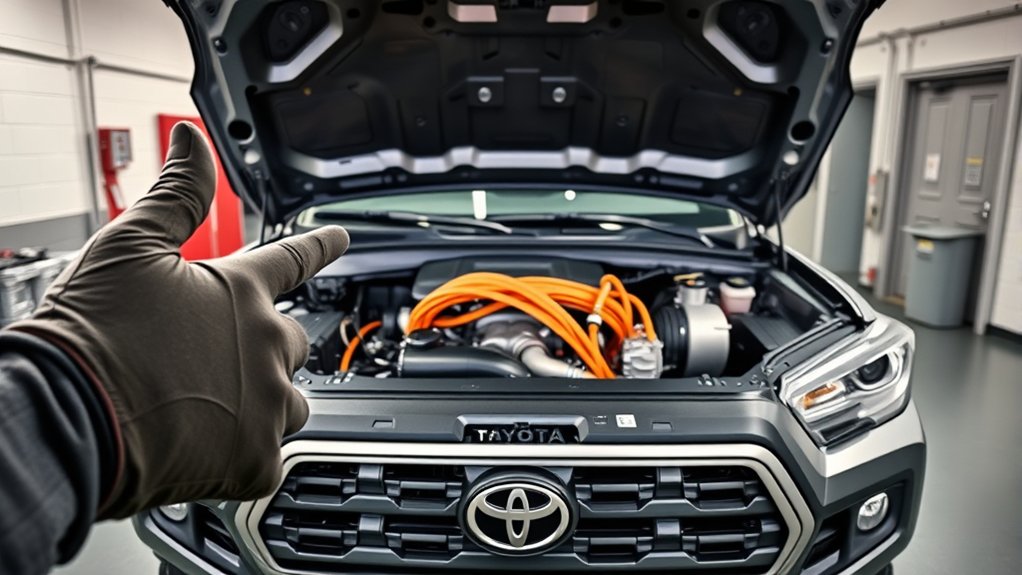
The Toyota Tacoma i-FORCE MAX is designed to add torque and responsiveness rather than turn the Tacoma into an economy-first hybrid. It combines a turbocharged gasoline engine, an electric motor, a compact battery, and an eight-speed automatic. Understanding how those parts work together can help you compare trims, interpret fuel-economy and towing ratings, and plan long-term ownership.
Quick Answer
Toyota’s Tacoma i-FORCE MAX is a performance-focused, non-plug-in hybrid. It combines a 2.4-liter turbo engine, a 48-hp electric motor, a 1.87-kWh NiMH battery, and an eight-speed automatic. The complete system produces 326 hp and 465 lb-ft while using electric assistance and regenerative braking to improve response and efficiency.
Key Takeaways
- The Tacoma i-FORCE MAX uses an eight-speed automatic, not an e-CVT.
- Its 326 hp and 465 lb-ft figures are combined hybrid-system outputs, not gasoline-engine-only ratings.
- The battery charges through regenerative braking and powertrain operation, so you never plug the truck into an external charger.
- Fuel economy, towing capacity, payload, and four-wheel-drive equipment vary by trim and configuration.
- Toyota provides separate warranty coverage for hybrid components and the traction battery, but long-term Tacoma-specific field history is still developing.
What i-FORCE MAX Is and What It Is Designed to Do
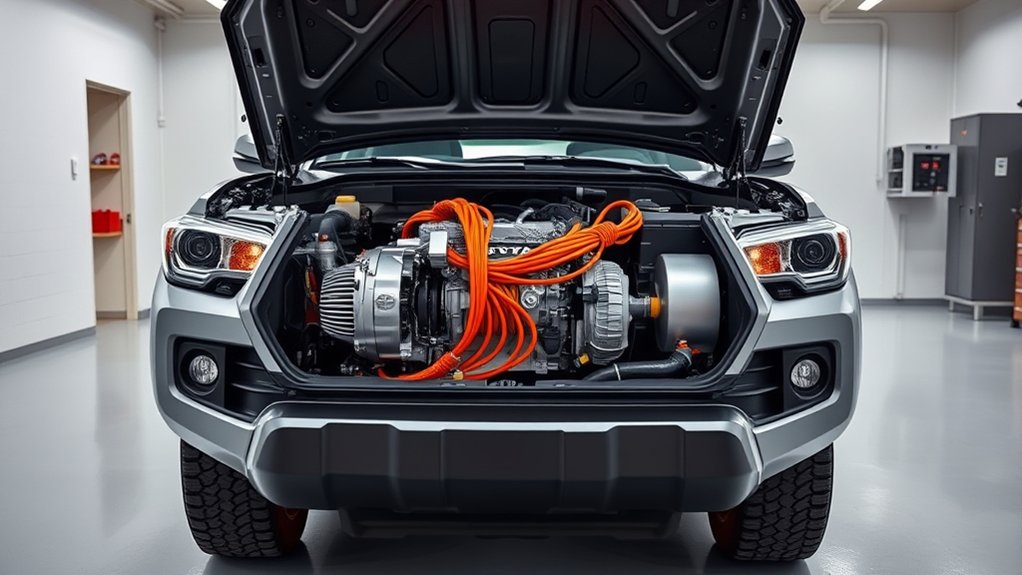
The Tacoma i-FORCE MAX is Toyota’s performance-oriented hybrid powertrain for the current-generation Tacoma. According to Toyota’s official Tacoma technical overview, it pairs a 2.4-liter turbocharged four-cylinder engine with a 48-hp electric motor and a 1.87-kWh nickel-metal-hydride battery.
The complete system produces up to 326 hp and 465 lb-ft of torque in applicable configurations. Those are combined output figures. You should not add the engine’s peak rating and the motor’s peak rating because they may occur at different speeds and operating conditions.
This is a self-charging hybrid rather than a plug-in hybrid. Regenerative braking recovers part of the truck’s kinetic energy during deceleration, while the powertrain can also manage battery charging as you drive. You do not connect the Tacoma to an external charger, and it is not designed to provide sustained electric-only commuting range.
The main i-FORCE MAX benefit is stronger, more immediate torque delivery. Fuel savings are a secondary benefit rather than the system’s sole purpose.
Key Components of the Tacoma Hybrid System
Five main elements work together: the turbo engine, motor-generator, traction battery, eight-speed automatic, and hybrid control electronics. Their roles are related, but each component performs a different job.
| Component | Published Specification | Primary Role |
|---|---|---|
| Gasoline engine | 2.4-liter turbocharged four-cylinder | Provides sustained propulsion and most of the truck’s power over a broad operating range. |
| Electric motor-generator | 48 hp, integrated with the transmission | Adds immediate torque, assists the engine, starts the engine when required, and recovers energy during deceleration. |
| Traction battery | 1.87-kWh NiMH pack | Stores recovered energy and supplies short bursts of electricity to the motor. |
| Transmission | Eight-speed automatic | Provides conventional stepped gear ratios for road driving, towing, and off-road use. |
| Hybrid control system | Electronic power and battery management | Coordinates engine operation, motor assistance, battery charge, regenerative braking, and protective limits. |
The electric motor is positioned between the engine and transmission. This layout allows Toyota to retain a conventional eight-speed automatic while adding electric assistance directly to the driveline. It differs from the power-split e-CVT arrangement used in many Toyota cars and crossovers.
The traction battery is mounted beneath the rear-seat area. That location keeps the battery out of the cargo bed, although it can reduce the under-seat storage available compared with some non-hybrid Tacoma configurations.
Note: The i-FORCE MAX output rating belongs to the complete powertrain. Motor and engine peak ratings cannot be added directly because their maximum outputs do not necessarily occur at the same time.
How i-FORCE MAX Works While You Drive
The hybrid controller continually adjusts engine operation, motor assistance, battery use, and regenerative braking. You do not need to select when the gasoline engine or motor should operate.
| Driving Situation | What the System Does | What You May Notice |
|---|---|---|
| Starting and low-speed movement | The motor can help move the truck and restart the engine when operating conditions permit. | A smooth initial response and occasional engine-off operation. |
| Acceleration | The motor adds immediate torque while the turbocharged engine builds and sustains power. | Strong low-speed response with less waiting for turbo boost. |
| Steady driving | The controller balances engine load, battery charge, and motor assistance for the conditions. | Transitions that normally require no driver input. |
| Braking and coasting | The motor acts as a generator and recovers some energy before or alongside the friction brakes. | A braking feel that may differ slightly from a non-hybrid truck. |
| Heavy load or low battery charge | The engine may run more often, and available electric assistance can change. | Less engine-off operation and fuel use closer to a conventional turbo truck. |
The Tacoma does not have one fixed speed at which it switches from electricity to gasoline. Engine operation depends on accelerator demand, road grade, battery charge, temperature, vehicle speed, accessory loads, and powertrain protection requirements. The engine may start at low speed during hard acceleration or remain off briefly at a higher speed when conditions permit.
Regenerative braking cannot recover all of the energy used to accelerate the truck. Some energy is lost through aerodynamic drag, tire resistance, heat, and conversion losses. The friction brakes also remain necessary for strong stops, low-speed stopping, stability-control intervention, and situations where regenerative braking is limited.
Power, Fuel Economy, and Towing Ratings
Power and Torque
The i-FORCE MAX system produces up to 326 hp and 465 lb-ft of torque. For comparison, Toyota has rated the higher-output non-hybrid i-FORCE engine at up to 278 hp and 317 lb-ft in applicable configurations. The hybrid’s larger torque figure is especially relevant during initial acceleration, hill climbing, towing, and low-speed off-road driving.
Peak output does not mean the truck delivers maximum power or torque continuously. Battery charge, temperature, engine speed, selected gear, traction, altitude, and protective controls can all affect the power available at a particular moment.
Fuel Economy
Toyota advertised the 2025 Tacoma i-FORCE MAX at up to an EPA-estimated 24 mpg combined. That “up to” wording matters. City, highway, and combined ratings can change with the trim, drivetrain, tire package, cab and bed configuration, and model year.
Use the truck’s window sticker or search the exact configuration through FuelEconomy.gov before comparing models. Your actual mileage can be lower when you tow, carry heavy cargo, install larger tires, drive quickly, operate in extreme temperatures, or spend significant time off-road.
The hybrid’s economy improvement may appear modest beside an economy-focused car hybrid. Its electric system is calibrated to support a heavier truck while delivering high torque, four-wheel-drive capability, and useful towing performance.
Towing Capacity, Payload, and Tongue Weight
Properly equipped i-FORCE MAX configurations can tow up to approximately 6,000 pounds, but the exact limit depends on the truck. Do not assume every hybrid Tacoma receives the maximum figure.
Before towing, verify all of the following:
- Tow rating: The maximum trailer weight allowed for that configuration.
- Payload: The weight available for passengers, cargo, accessories, and trailer tongue weight.
- GVWR: The maximum allowable loaded weight of the truck.
- GCWR: The maximum combined loaded weight of the truck and trailer.
- Hitch and component ratings: The limits of the receiver, ball mount, hitch ball, trailer, and tires.
Trailer tongue weight counts against payload. A truck can remain below its advertised tow rating and still exceed its payload or rear-axle limit after passengers, cargo, accessories, and tongue weight are added.
Warning: Use the ratings in your Tacoma’s owner documentation, certification labels, and towing guide. A general “up to” figure cannot account for your truck’s trim, equipment, passengers, cargo, accessories, or trailer tongue weight.
Trim and Drivetrain Differences
i-FORCE MAX equipment varies across the Tacoma lineup. Toyota has offered the system on TRD Sport, TRD Off-Road, Limited, Trailhunter, and TRD Pro models, with availability and standard equipment depending on model year.
Most hybrid Tacoma grades use a four-wheel-drive system with high and low ranges. Limited configurations may use full-time four-wheel drive with a locking center differential, while off-road-focused grades use equipment tailored to trail driving. Verify the exact drivetrain instead of assuming every hybrid Tacoma operates the same way.
Hybrid models also include a 2,400-watt AC inverter in applicable current-generation configurations. It can power suitable tools, camping equipment, and other devices within the outlet and system limits. Check the owner’s manual before connecting equipment with a high startup surge or continuous load.
Towing and Off-Road Behavior
Electric assistance is valuable at low engine speeds because the motor can respond immediately. During a steep climb or controlled crawl, that assistance can help the truck build torque smoothly while the automatic transmission and four-wheel-drive system provide mechanical reduction.
On part-time four-wheel-drive configurations, low range is intended for suitable low-speed, low-traction conditions. Follow the owner’s manual when shifting into or out of low range. Using part-time four-wheel drive on dry, high-traction pavement can cause driveline binding.
Drive modes and off-road controls can adjust throttle response, transmission behavior, traction management, and other settings. They do not increase the truck’s certified towing, payload, axle, tire, or hitch ratings.
When towing, sustained climbing, driving through deep sand, or crawling at low speed, the engine, transmission, motor, battery, and cooling systems can generate substantial heat. The truck monitors operating conditions and may change electric assistance or powertrain behavior to protect components. No thermal-management system can guarantee unrestricted output under every load and temperature.
Pro Tip: Before a towing or off-road trip, inspect tire pressures, fluid levels, cooling openings, trailer connections, and the spare tire. Remove mud, leaves, or accessories that block cooling airflow.
Reliability, Maintenance, and Buyer Considerations
The i-FORCE MAX adds a traction battery, motor-generator, inverter electronics, high-voltage wiring, and additional control systems to the conventional turbocharged powertrain. Those parts increase complexity, but they also allow regenerative braking, engine assistance, and stronger low-speed torque.
Because customer deliveries began with the current Tacoma generation, long-term Tacoma-specific hybrid failure data remains more limited than it is for Toyota hybrid cars that have been sold for decades. Claims that the battery will never need replacement or that repairs will always be inexpensive are not supportable.
Battery and Hybrid Warranty
Toyota’s published U.S. warranty for the 2024 Tacoma included coverage for hybrid-related components for eight years or 100,000 miles and hybrid-battery coverage for ten years or 150,000 miles, whichever came first. Toyota stated that the battery warranty was transferable across ownership.
Warranty terms can change by model year, market, vehicle use, or policy revision. Confirm your truck’s coverage through the Toyota Owners warranty and manuals portal using the correct model year or VIN.
The battery’s placement beneath the rear-seat area protects bed space but does not make it maintenance-free. Cooling airflow around the battery area should remain unobstructed, and warning messages should be diagnosed promptly.
Routine Service
Follow the model-year maintenance guide rather than applying one universal interval to every Tacoma. Normal service still includes engine oil and filter changes, tire rotations, brake inspections, fluid checks, filters, and drivetrain inspections. Usage such as towing, repeated short trips, dusty driving, and off-road operation may place the truck under a more demanding service schedule.
Regenerative braking may reduce some friction-brake use, but it does not eliminate brake maintenance. Calipers, pads, rotors, brake fluid, and parking-brake components still need inspection because corrosion, contamination, age, and conventional braking continue to affect them.
Warning: Do not open the traction battery, touch damaged orange high-voltage cables, or attempt inverter and motor repairs without the required training and safety equipment. Have high-voltage faults inspected by a qualified hybrid technician.
Practical Durability Tips
- Follow the maintenance schedule for the correct model year and operating conditions.
- Use fluids, filters, and replacement parts that meet Toyota’s published specifications.
- Investigate hybrid, charging-system, overheating, or power-reduction warnings instead of repeatedly clearing them.
- Keep battery and powertrain cooling inlets free from dirt, cargo, pet hair, and aftermarket coverings.
- Recheck cooling systems, tires, brakes, and fluid condition after severe towing or off-road use.
- Account for oversized tires, heavy armor, lifts, and other modifications that can affect efficiency, payload, temperatures, handling, and warranty claims.
Used Tacoma i-FORCE MAX Buyer Checklist
Before buying a used hybrid Tacoma:
- Verify the VIN, model year, trim, drivetrain, and original equipment.
- Review maintenance and repair records instead of relying only on a clean dashboard.
- Check the certification labels for payload, GVWR, axle, and tire information.
- Confirm remaining hybrid and battery warranty coverage.
- Look for collision, flood, underbody, battery-area, and off-road damage.
- Test the truck from a cold start and watch for hybrid, charging, cooling, transmission, or four-wheel-drive warnings.
- Have a qualified shop scan all control modules and inspect the high-voltage system.
- Search the VIN through the NHTSA recall database and confirm that open safety recalls have been completed.
Frequently Asked Questions
How does the Tacoma i-FORCE MAX hybrid work?
A 2.4-liter turbo engine and 48-hp electric motor send power through an eight-speed automatic. The motor assists the engine during acceleration and can recover energy during braking. A hybrid controller manages engine operation, motor assistance, battery charge, regenerative braking, and protective limits automatically.
Can the Tacoma i-FORCE MAX drive using electricity alone?
The engine may switch off briefly when speed, load, battery charge, and temperature allow, but the Tacoma is not a plug-in vehicle and is not designed for sustained electric-only travel. The motor primarily assists the gasoline engine and recovers energy during deceleration.
At what speed does the Tacoma hybrid switch from electric power to gasoline?
It has no fixed changeover speed. The engine can start or stop at different speeds depending on accelerator demand, road grade, battery charge, temperature, accessory loads, and other operating conditions. The driver normally does not control the transition.
What is the difference between a Toyota hybrid, Hybrid MAX, and i-FORCE MAX?
Toyota’s conventional hybrid systems generally emphasize fuel efficiency, although their designs vary by vehicle. Hybrid MAX is performance-oriented branding used on certain Toyota passenger vehicles. i-FORCE MAX is Toyota’s truck-focused hybrid branding. The Tacoma version uses a turbo engine, an electric motor integrated with an eight-speed automatic, and a compact NiMH battery to prioritize torque and capability.
Conclusion
The Tacoma i-FORCE MAX combines a 2.4-liter turbo engine, 48-hp electric motor, 1.87-kWh NiMH battery, and eight-speed automatic to produce up to 326 hp and 465 lb-ft. Its electric system supports acceleration, regenerative braking, and smoother torque delivery rather than providing long electric-only range.
The powertrain can improve response and provide useful towing and off-road capability, but its ratings are configuration-specific. Check the exact truck’s fuel-economy label, payload sticker, towing documentation, warranty guide, and maintenance schedule before making a purchase or loading a trailer.
Sources
- Toyota: 2024 Tacoma Technical Overview — supports the engine, motor, battery, transmission, combined output, drivetrain, inverter, and warranty information.
- Toyota: 2025 Tacoma Overview — supports current-generation trim availability, drivetrain features, and published EPA fuel-economy information.
- Toyota Owners: Warranty and Manuals — provides model-year owner manuals, warranty guides, and maintenance information.
- FuelEconomy.gov Vehicle Search — provides configuration-specific EPA city, highway, and combined fuel-economy ratings.
- NHTSA Recall Lookup — provides VIN-based safety-recall information for current owners and used-vehicle buyers.
