A Toyota Tacoma misfire can feel like shaking at idle, hesitation under load, weak acceleration, or an uneven exhaust note. The check engine light may stay on or flash. Because a misfire can come from ignition, fuel, air, wiring, or internal engine problems, diagnose it in a clear order instead of replacing parts at random.
Quick Answer
Start by scanning for P0300-series codes and saving freeze-frame data. Then inspect the affected cylinder’s spark plug, coil, injector connector, vacuum sources, and fuel delivery. If the misfire remains, test compression and wiring. Stop driving if the check engine light flashes, power drops sharply, or the engine overheats.
Key Takeaways
- P0300 means a random or multiple-cylinder misfire; P0301 through P0306 identify a detected misfire on a numbered cylinder.
- Do not replace coils, plugs, or injectors until basic scan data and visual checks point toward that system.
- A flashing check engine light can indicate a severe active misfire that may overheat the catalytic converter.
- Compression specifications, spark plug gaps, torque values, and test procedures vary by Tacoma year and engine.
- Persistent misfires need prompt diagnosis because continued driving can reduce power, increase emissions, and damage other components.
At a Glance
| Time Required | About 30 to 90 minutes for an initial scan and inspection; longer if compression, smoke, or fuel-pressure testing is needed |
| Difficulty | Moderate; basic scanning and inspection are DIY-friendly, while fuel and internal-engine tests may require professional equipment |
| Tools Needed | OBD2 scanner, flashlight, basic socket set, spark plug socket, torque wrench, and optional smoke, compression, or fuel-pressure test equipment |
| Cost | Low if you already own a scanner and hand tools; parts and professional testing vary by model year, engine, diagnosis, and local labor rates |
Warning: Do not keep driving with a flashing check engine light, severe shaking, overheating, fuel odor, or major power loss. Pull over safely, switch off the engine, and arrange diagnosis or towing. Run the engine only in a well-ventilated area, never in a closed garage.
Common Misfire Symptoms in Toyota Tacoma
Common misfire symptoms include engine shaking, rough idle, hesitation, weak acceleration, and an uneven exhaust sound. You may notice the problem only during a cold start, at a certain RPM, under heavy load, or after the engine warms up.
- Steady check engine light: A fault has been stored, but the severity depends on the code and current symptoms.
- Flashing check engine light: Treat this as urgent because the engine may be misfiring heavily.
- Loss of power: One or more cylinders may not be contributing normally.
- Fuel smell or poor fuel economy: Unburned fuel or an incorrect air-fuel mixture may be present.
- Hard starting or stalling: The fault may affect several cylinders or a shared system.
- High or unstable idle: A vacuum leak, throttle-control issue, or incorrect sensor input may be involved.
An idle above a specific RPM is not proof of a misfire by itself. Idle speed varies with engine temperature, electrical load, air conditioning, and model year. Use scan data and the correct Toyota service information before calling the idle abnormal.
How to Use an OBD2 Scanner for Diagnosis
Connect an OBD2 scanner to the diagnostic port under the dashboard. Follow the scanner’s instructions, turn the ignition on as required, and read stored, pending, and permanent codes. Save the freeze-frame data before clearing anything because it records conditions such as RPM, load, coolant temperature, and fuel trim when the fault set.
| Misfire Code | General Meaning | Best Next Step |
|---|---|---|
| P0300 | Random or multiple-cylinder misfire detected | Check shared causes such as fuel quality, intake leaks, fuel pressure, sensor input, timing, or several worn ignition parts |
| P0301 | Cylinder 1 misfire detected | Inspect and compare cylinder 1 ignition, injector, wiring, and compression |
| P0302 | Cylinder 2 misfire detected | Inspect and compare cylinder 2 components |
| P0303 | Cylinder 3 misfire detected | Inspect and compare cylinder 3 components |
| P0304 | Cylinder 4 misfire detected | Inspect and compare cylinder 4 components |
| P0305 or P0306 | Cylinder 5 or 6 misfire detected on engines with those cylinders | Inspect the named cylinder and compare it with a known-good cylinder |
A cylinder-specific code tells you where the computer detected uneven combustion, not which part failed. Review related codes for lean conditions, injector circuits, oxygen sensors, airflow, cam timing, or coolant temperature. Live misfire counters, short-term fuel trim, long-term fuel trim, and cylinder balance data can narrow the search when your scanner supports them.
Note: Do not erase codes before recording them. Clearing the memory also removes useful readiness and freeze-frame information. After a repair, clear codes only when appropriate, then complete a road test and rescan for pending faults.
Use a Logical Diagnostic Order
A clear sequence prevents unnecessary parts replacement. Start with the fastest, least invasive checks, then move toward tests that require more tools.
- Confirm the complaint: Note whether the misfire happens cold, hot, at idle, under load, in rain, or after recent work.
- Scan all modules: Record codes, freeze-frame data, fuel trims, and misfire counts.
- Perform a visual inspection: Look for loose connectors, damaged wiring, disconnected hoses, oil or coolant in plug wells, and signs of rodent damage.
- Check the affected cylinder: Inspect its plug and coil, then compare them with another cylinder when the design allows.
- Evaluate air and fuel: Check for intake leaks, contaminated fuel, injector operation, and fuel-pressure concerns.
- Check mechanical condition: Use compression, leak-down, or valve-timing tests if ignition and fuel checks do not explain the fault.
- Verify the repair: Reassemble correctly, clear codes when suitable, road-test under the original conditions, and scan again.
How to Inspect Spark Plugs for Damage and Wear
Spark plug condition can reveal ignition, fuel, oil-control, or cooling problems. Remove plugs only when the engine is cool, keep dirt out of the plug wells, and label each plug by cylinder so you can compare patterns.
Visual Inspection Techniques
Look for carbon tracking, cracks, damaged terminals, worn electrodes, heavy deposits, and oil or coolant contamination. Carbon tracking often appears as a dark line on the porcelain where voltage has leaked along the surface. A cracked insulator can also allow the spark to escape before it reaches the electrode gap.
Dry black deposits may point to a rich mixture, repeated short trips, weak ignition, or an incorrect heat range. Wet fuel can appear after repeated failed starts or a dead cylinder. Oily deposits may indicate oil entering the combustion chamber, but one plug alone cannot identify the exact internal fault.
Signs of Wear
| Inspection Area | What You May See | What It Can Suggest |
|---|---|---|
| Electrodes | Rounded, eroded, or unusually wide gap | Normal wear, high mileage, or excessive voltage demand |
| Ceramic insulator | Crack, chip, carbon track, glazing, or heavy deposits | Spark leakage, overheating, fouling, or installation damage |
| Firing tip | Wet fuel, oil, ash, or coolant-like residue | Fuel control, oil control, or possible sealing concerns |
| Threads and seat | Cross-threading, damaged seat, or incorrect torque evidence | Installation damage or poor sealing at the plug, not an intake vacuum leak |
Measure the gap only when the plug design and manufacturer permit adjustment. Many fine-wire plugs can be damaged by rough gapping. Use the specification for your exact Tacoma engine, install the correct plug type, and tighten it to the Toyota procedure. Incorrect torque can damage threads or affect heat transfer.
Understanding the Role of Ignition Coils in Misfires
Ignition coils raise battery voltage so the spark can jump the plug gap and ignite the compressed mixture. A weak coil may fail only when cylinder pressure is high, so the truck can idle acceptably yet misfire during acceleration, towing, or climbing.
A cylinder-specific misfire code identifies the cylinder that lost combustion. It does not prove the ignition coil is bad.
Inspect the coil boot for cracks, carbon tracks, oil contamination, moisture, and a damaged spring or terminal. Check the connector lock and nearby wiring. On a coil-on-plug engine, you can sometimes swap the suspected coil with a known-good cylinder. If the misfire code moves with the coil, the coil becomes the leading suspect.
Do not use a swap test when moving the part could damage brittle connectors, mix incompatible components, or create a safety risk. If the code stays on the same cylinder, continue with the plug, injector, wiring, intake leak, and compression checks.
Pro Tip: Change only one variable at a time during a swap test. Record the original cylinder, clear or monitor codes as appropriate, and repeat the same operating condition. This makes the result easier to trust.
Diagnosing Misfire-Related Fuel Injector Problems
A fuel injector can cause a misfire if it is clogged, leaking, electrically open, shorted, restricted by contamination, or not commanded correctly. A new injector can also be defective, installed incorrectly, or affected by wiring and fuel-pressure problems.
Start with the injector connector and harness. Look for bent pins, corrosion, broken locks, rubbed wiring, or damage near recent repair work. A mechanic may use a stethoscope, noid light, oscilloscope, resistance test, current-ramp test, or injector balance test. The correct method depends on the engine and injector system.
Fuel-trim data can add context. Strong positive trim may support a lean condition from unmetered air, low fuel delivery, or restricted injectors. Strong negative trim may point toward excess fuel, but trims must be read with load, bank, temperature, and sensor data in mind.
Do not loosen pressurized fuel connections without the model-specific procedure and proper protective equipment. Gasoline can spray, ignite, or injure you. Professional diagnosis is the safer choice when fuel-pressure or injector balance testing is required.
How to Identify Vacuum Leaks and Their Effects
A vacuum or unmetered-air leak can make the mixture too lean, especially at idle. The result may be a rough idle, high idle, lean codes, hesitation, or a random misfire. Small leaks can affect one bank or one cylinder more than others.
Common Vacuum Leak Sources
- Cracked, loose, or disconnected vacuum and breather hoses
- Intake manifold or throttle-body gasket leaks
- PCV valve, hose, or grommet faults where applicable
- Brake-booster hose or check-valve leaks
- EVAP purge valve stuck open
- Injector seals or intake runners leaking near one cylinder
- EGR-related vacuum connections on engines that use them
Symptoms of Vacuum Leaks
| Symptom or Data | Possible Effect | Safer Check |
|---|---|---|
| Rough or high idle | Unmetered air has a larger effect at low airflow | Visual inspection, scan data, or a controlled smoke test |
| Hissing sound | Air may be entering through a hose or gasket | Listen with care and inspect hoses with the engine off |
| Positive fuel trim at idle that improves with RPM | Pattern may support an intake leak | Compare trims at idle and a steady higher RPM |
A smoke machine designed for automotive intake testing is safer and more controlled than spraying flammable cleaner around a running engine. Follow the smoke-machine instructions and do not overpressurize the intake system.
Evaluating the EGR System’s Role in Misfires
An exhaust gas recirculation system can contribute to rough running if the valve sticks open, passages clog unevenly, or the control circuit fails. However, EGR design varies by Tacoma year and engine, and some versions use different emissions-control strategies. Confirm that your engine has the component before testing or replacing it.
A valve stuck open can dilute the intake charge at idle and cause stumbling or misfires. Restricted passages may create uneven distribution or set flow-related codes. Inspect related wiring, vacuum lines where used, and commanded-versus-actual data when available. Use the Toyota repair manual for the exact test sequence rather than cleaning or replacing the valve based only on a misfire code.
Why Proper Fuel Delivery Is Critical for Engine Performance
The engine needs stable pressure, adequate volume, clean fuel, and accurate injector control. Low pressure from a weak pump, restricted pickup, electrical voltage drop, or control problem can cause hesitation and multi-cylinder misfires under load. Contaminated or incorrect fuel can produce similar symptoms.
Some Tacoma generations use coil-on-plug ignition, while older engines may use different coil and wire arrangements. Worn spark plug wires can cause misfires only on engines equipped with them. They do not create a fuel-delivery fault, so keep ignition and fuel diagnosis separate.
Before testing fuel pressure, confirm the correct connection point, pressure specification, safety procedure, and operating conditions for the exact engine. A pressure reading without the matching Toyota specification can be misleading.
Other Causes You Should Not Overlook
If plugs, coils, injectors, and obvious intake leaks check out, broaden the diagnosis. A persistent Tacoma misfire can also come from:
- MAF sensor contamination or incorrect airflow data: Check live data and the intake tract before cleaning or replacing the sensor.
- Coolant-temperature or air-fuel sensor errors: Incorrect feedback can distort mixture control.
- Camshaft timing or variable valve timing faults: Oil condition, control valves, timing components, and correlation codes matter.
- Mechanical wear or damage: Burned valves, valve-clearance problems, worn rings, a head-gasket leak, or valvetrain damage can lower cylinder output.
- Electrical faults: Corroded grounds, low charging voltage, damaged harnesses, poor connector tension, or water intrusion can create intermittent misfires.
- Recent service errors: Crossed connectors, pinched seals, loose intake ducts, incorrect plugs, or debris in a plug well are common after repairs.
- Calibration, service campaign, or recall issues: Check Toyota service information and search your VIN for open campaigns before assuming the fault is purely mechanical.
Checking Engine Compression: A Guide
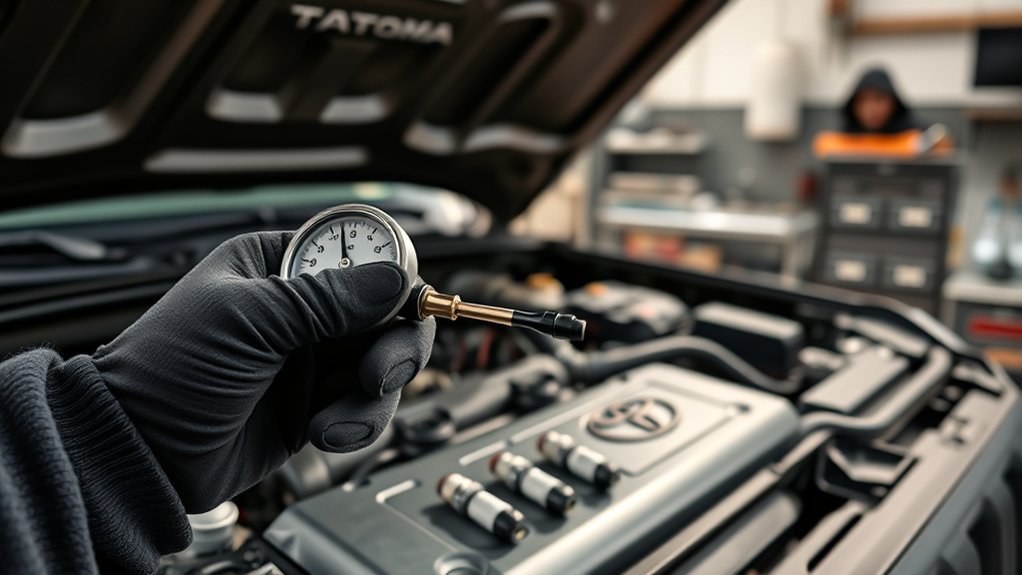
A compression test helps compare the cylinders’ ability to seal and build pressure during cranking. It is useful when a misfire stays on one cylinder after ignition, injector, wiring, and intake checks.
Tools Needed for Testing
- Compression gauge: Use an adapter that matches the spark plug threads.
- Ratchet, extension, and spark plug socket: Remove plugs without damaging the wells or threads.
- Battery support or fully charged battery: Consistent cranking speed improves comparison.
- Torque wrench: Reinstall plugs to the correct specification.
- Safety glasses and gloves: Protect against debris, hot parts, and accidental contact.
- Model-specific service information: Use the correct disable procedure, throttle position, pressure limit, and cylinder-variation specification.
Warm-engine testing is often preferred, but only when it can be done safely and the service procedure calls for it. Disable fuel and ignition correctly, remove all spark plugs when specified, hold the throttle as directed, and crank each cylinder for the same number of compression strokes.
Interpreting Compression Results
Do not rely on a universal range such as 120 to 180 psi. Tacoma compression specifications vary with engine design, altitude, cranking speed, gauge accuracy, temperature, and test method. Compare every reading with the Toyota repair manual for the exact year and engine, then compare cylinder-to-cylinder variation.
One low cylinder can point toward a valve, ring, piston, head-gasket, or valvetrain problem. Several low cylinders may reflect test setup, battery speed, valve timing, or broad mechanical wear. A leak-down test can help locate escaping air through the intake, exhaust, crankcase, cooling system, or an adjacent cylinder.
Note: A compression test measures the result of several systems working together. It does not identify the failed part by itself. Use a leak-down test, borescope, valve-clearance check, or timing inspection when the readings are abnormal.
When to Seek Professional Help for Persistent Misfires
Seek professional help when the check engine light flashes, the truck shakes severely, the engine overheats, you smell raw fuel, or power drops enough to make traffic unsafe. Towing may cost less than catalytic-converter or engine damage caused by continued driving.
Professional diagnosis is also appropriate when:
- The misfire remains after basic plug, coil, connector, and hose checks.
- Several cylinders misfire or P0300 returns without a clear pattern.
- Fuel-pressure, injector balance, oscilloscope, smoke, leak-down, or timing tests are needed.
- Compression is low or coolant and oil contamination are suspected.
- The fault is intermittent and requires data logging under load.
- You are not sure how to disable fuel, ignition, or high-pressure components safely.
Give the technician your saved codes, freeze-frame data, repair history, recent fuel purchases, and the exact conditions that trigger the symptom. That information can shorten diagnosis and reduce repeated testing.
Frequently Asked Questions
What are the symptoms of a bad engine misfire?
Typical symptoms include rough idle, shaking, hesitation, power loss, poor fuel economy, hard starting, an uneven exhaust note, and a steady or flashing check engine light. Symptoms may appear only when cold, under load, or at a certain RPM.
What is the most common problem with a Toyota Tacoma?
No single problem is the most common across every Tacoma year, engine, mileage, and use pattern. For a specific misfire, worn spark plugs, weak coils, intake leaks, injector faults, wiring issues, and mechanical problems are all possible. Diagnose the stored codes and test results instead of assuming one universal cause.
What are the three most common causes of a misfire?
The main cause groups are ignition faults, fuel or air-mixture faults, and mechanical compression or timing faults. Spark plugs and coils are common ignition checks, but a code alone cannot prove either part has failed.
What causes a misfire in a Toyota Tacoma?
Possible causes include worn or fouled plugs, weak coils, damaged wiring, injector or fuel-pressure faults, vacuum leaks, incorrect sensor data, valve-timing problems, low compression, coolant intrusion, or contaminated fuel. The model year and engine determine which systems and tests apply.
Can I drive a Toyota Tacoma with a misfire?
Avoid driving if the light flashes, the truck shakes badly, power is limited, the engine overheats, or you smell fuel. A mild intermittent misfire still needs prompt diagnosis. Continued driving can increase emissions and may damage the catalytic converter or other components.
Can bad gas cause a Tacoma misfire?
Yes. Water, contamination, incorrect fuel, or very low-quality fuel can cause rough running or multi-cylinder misfires. Consider the timing of the symptom, the last fuel stop, and whether several cylinders are affected. Do not drain or handle fuel without the correct safety equipment.
Conclusion
Diagnosing a Toyota Tacoma misfire starts with evidence, not guesswork. Record the codes and operating conditions, inspect the affected cylinder, and work through ignition, air, fuel, wiring, and mechanical checks in order. Use specifications for the exact year and engine. If the light flashes or the fault persists, stop driving and arrange professional diagnosis before a small problem becomes a larger repair.
Sources
- Toyota Manuals and Warranties — model-specific owner and maintenance information.
- Toyota Technical Information System — factory repair manuals, service bulletins, wiring diagrams, and diagnostic information.
- NGK: How to Read a Spark Plug — spark plug appearance, deposits, overheating, fouling, and wear.
- NHTSA Recall Lookup — VIN, model, complaint, investigation, and recall information.
- CDC/NIOSH Carbon Monoxide Guide — carbon monoxide exposure hazards and limits.
