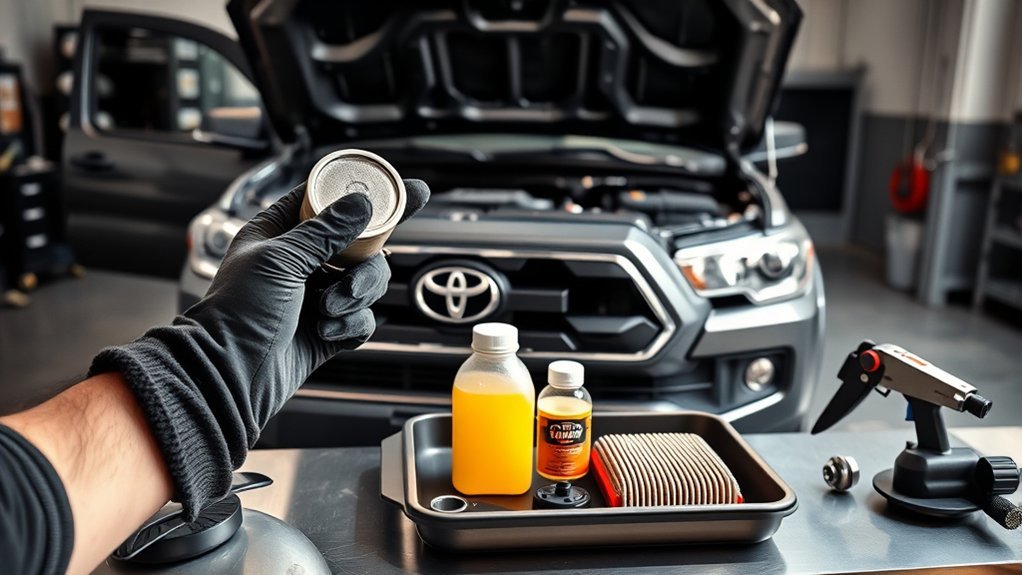
Your Toyota Tacoma’s maintenance schedule depends on its model year, engine, transmission, drivetrain, and how you use the truck. Towing, dusty roads, heavy loading, prolonged low-speed operation, and off-road driving can add inspections or shorten selected service intervals. Start with the Toyota guide that matches your truck rather than applying one universal schedule to every Tacoma.
Quick Answer
Toyota schedules Tacoma maintenance by both time and mileage. For a 2025 Tacoma, service is due every 5,000 miles or six months, but normal-use oil changes can extend to 10,000 miles or 12 months. Primarily dusty-road use shortens oil service, while towing and off-road use add driveline checks.
Key Takeaways
- Use the maintenance guide for your Tacoma’s exact model year and configuration.
- A 5,000-mile service visit does not automatically mean every Tacoma needs an oil change.
- Toyota’s added special-condition services apply to specific uses, not every demanding trip.
- The 2025 guide does not require a universal 30,000-mile brake-fluid exchange or transmission-fluid change.
- Keep dated service records showing the mileage, work performed, fluids used, and parts installed.
At a Glance
| Time Required | 15–30 minutes to build the schedule; service time varies by task |
| Difficulty | Easy to plan; basic to advanced when performing the work |
| Tools Needed | Model-year maintenance guide, odometer reading, tire gauge, inspection light, and service log |
| Cost | Varies by model year, parts, fluids, labor, and required inspections |
Note: The intervals below use the 2025 Tacoma Warranty & Maintenance Guide as a current example. Older and newer Tacomas may use different engines, fluids, filters, spark plugs, transmissions, and replacement intervals.
Understanding Your Tacoma’s Maintenance Schedule

Begin by opening the Toyota manual and warranty portal and selecting your Tacoma’s model year. Confirm the engine, transmission, drivetrain, and hybrid status before copying any interval into your service plan.
In the 2025 Tacoma Warranty & Maintenance Guide, scheduled maintenance is due every 5,000 miles or six months, whichever comes first. That visit can include tire rotation, brake inspection, fluid-level checks, and other inspections without necessarily requiring an oil change.
For normal 2025 use, Toyota instructs owners not to exceed 10,000 miles or 12 months between engine-oil and filter changes. When the truck is driven primarily on dirt or dusty roads, the oil and filter interval becomes 5,000 miles or six months.
Treat 5,000 miles or six months as the recurring inspection point. Then use your model-specific chart to determine which items are inspected, performed, or replaced at that visit.
What Toyota Means by Special Operating Conditions
Toyota assigns extra tasks to individual operating conditions. One condition does not automatically trigger every severe-service item.
- Dirt or dusty roads: More frequent oil service and inspections of the engine air filter, suspension boots, steering components, and related parts may apply.
- Towing, a roof carrier, or heavy loading: Differential, transfer-case, manual-transmission, propeller-shaft, and chassis services may be added at specified intervals.
- Prolonged idling or low-speed driving: Certain automatic-transmission services may apply when this describes most vehicle use.
- Road-salt exposure: Chassis, propeller-shaft, fastener, brake, and corrosion inspections deserve extra attention.
- Off-road driving through deep sand, mud, or water: Toyota specifies additional checks after the trip rather than waiting for the next mileage interval.
Occasional towing or one dusty-road trip does not necessarily place the truck on every special-condition interval. Toyota’s guide says these added scheduled services generally apply when most of your driving occurs under the listed condition.
Essential Toyota Tacoma Maintenance Tasks at 5K, 10K, 15K, and 30K Miles
The following table summarizes the 2025 schedule as an example. Your model-year chart remains the final authority.
| Interval | Typical 2025 Baseline | Special-Use Considerations |
|---|---|---|
| 5,000 miles or 6 months | Rotate tires; inspect brake pads and discs, fluid levels, wiper blades, and the driver’s floor mat installation. | Change engine oil and filter when the truck is driven primarily on dirt or dusty roads. Add listed chassis and driveline checks when applicable. |
| 10,000 miles or 12 months | Replace engine oil and filter under normal service if the change has not already been completed. | Continue the shorter oil interval when dusty-road use remains the truck’s primary operating condition. |
| 15,000 miles or 18 months | Complete the recurring service and expanded inspections of listed brake, steering, suspension, exhaust, driveshaft, and chassis components. | Some differential-oil and hardware services begin at this point when towing or carrying heavy loads. |
| 30,000 miles or 36 months | Replace the engine and cabin air filters in the 2025 schedule and complete the listed fluid, brake, driveline, steering, and cooling-system inspections. | Applicable manual-transmission, transfer-case, and differential services may be required under specified towing or heavy-load use. |
| 60,000 miles or 72 months | Repeat the corresponding inspection and replacement items shown in the model-year chart. | The 2025 chart includes selected automatic-transmission-fluid service under specified towing, heavy-load, prolonged-idling, or low-speed conditions. |
| 100,000 miles or 120 months | The 2025 guide lists the initial engine and intercooler coolant replacement, where applicable. | Inspect more frequently when leakage, contamination, overheating, or operating conditions justify earlier attention. |
Brake fluid should be checked for level and condition. The 2025 chart does not prescribe an automatic brake-fluid exchange at 30,000 miles. Replace it when required by the model-specific guide, fluid condition, testing, contamination, or a brake repair procedure.
What to Consider for Your Tacoma’s Maintenance in Severe Conditions?
Start by identifying which special condition describes most of the truck’s use. A contractor’s Tacoma that idles and moves slowly throughout the day may need different added service from a weekend truck that occasionally pulls a small trailer.
After Driving Through Deep Sand, Mud, or Water
Toyota’s 2025 guide calls for added off-road checks after these trips. Inspect or have a qualified technician inspect:
- Brake pads, discs, lines, and hoses
- Ball joints, dust covers, driveshaft boots, and steering boots
- Engine air filter condition
- Differential, transmission, and transfer-case areas for contamination or leakage
- Chassis and body fasteners
- Propeller-shaft hardware on applicable 4WD models
- The clutch-fork lubrication point on applicable 4WD models
Remove packed mud from the radiator, intercooler, condenser, brakes, wheels, skid plates, and suspension areas. Saltwater, deep-water crossings, or fluid contamination require prompt professional inspection.
Warning: Water can contaminate axle, transmission, or transfer-case lubricants without producing an immediate warning light. Stop driving and seek professional help if a fluid becomes milky, a breather was submerged, the brakes behave abnormally, or the truck develops vibration, noise, leakage, or overheating.
Towing and Heavy Loading
Check the owner’s manual before towing and stay within the truck’s payload, axle, tire, hitch, and trailer limits. Heavy use increases heat and load in the transmission, differentials, transfer case, brakes, tires, cooling system, and propeller shaft.
Before and after a towing trip, inspect tire pressure when cold, tire damage, trailer connections, fluid leaks, brake operation, coolant level, and unusual driveline noise. Follow the special-condition fluid intervals shown for your model year instead of choosing a generic 30,000-mile replacement rule.
Dust, Heat, Cold, and Short-Trip Use
Dust can load the engine and cabin filters early. Inspect them rather than waiting for the normal replacement mileage when airflow drops or visible contamination develops.
Very hot or cold weather can affect battery performance, tire pressure, coolant protection, oil selection, and warm-up behavior. Use the oil viscosity, coolant, battery, and tire-pressure specifications listed for your exact Tacoma. Temperature alone should not be used to assume that every towing or dusty-road service item applies.
Importance of Genuine Toyota Parts for Your Tacoma
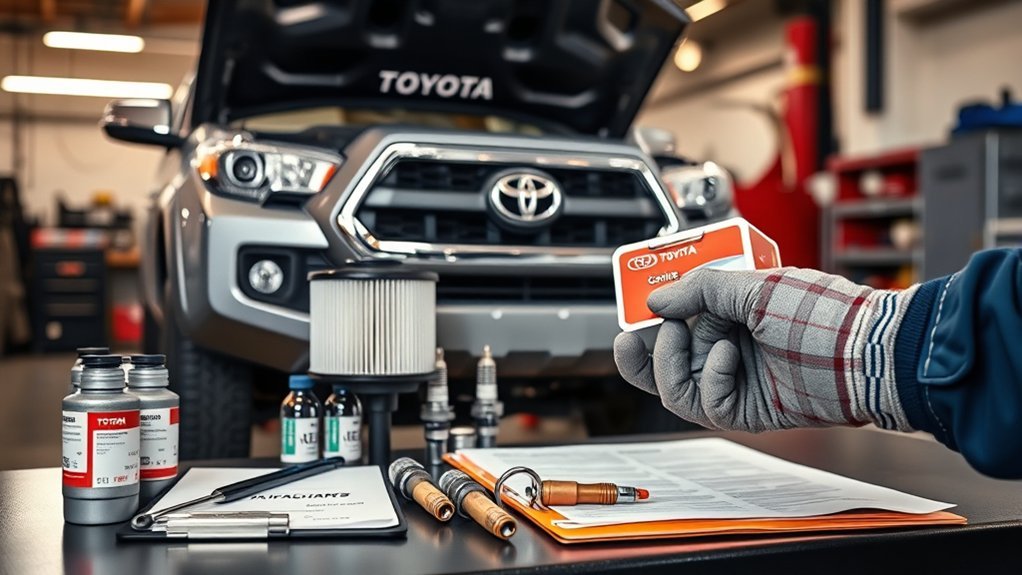
Toyota Genuine Parts offer known fit, specifications, and Toyota-backed parts coverage. However, they are not the only acceptable choice for customer-paid maintenance. Toyota’s guide states that maintenance may be performed by the owner or another automotive service provider and that non-Toyota replacement parts may be selected.
The important requirement is to use the correct oil viscosity, fluid specification, filter type, capacity, part quality, installation method, and replacement interval. An unsuitable part or incorrect service procedure can cause damage regardless of the brand printed on the package.
Enhanced Vehicle Reliability
Correctly specified components reduce fitment errors and help seals, filters, sensors, brakes, and driveline parts perform as designed. Genuine Toyota parts can simplify selection, especially for newer engines or hybrid components. A reputable equivalent-quality part can also be appropriate when it meets the required specification.
Optimal Performance Assurance
Fluids deserve particular attention. Do not substitute engine oil, coolant, brake fluid, transmission fluid, gear oil, or transfer-case lubricant based only on viscosity or color. Confirm the complete Toyota specification and capacity for your model year and configuration.
Factory-trained technicians may be useful when a task requires scan-tool procedures, fluid-temperature checks, high-voltage training, calibration, programming, or model-specific torque sequences. A qualified independent shop can also perform routine maintenance when it follows the correct specifications and procedures.
Long-Term Cost Savings
Compare total value rather than assuming the cheapest or most expensive part is automatically best. Consider fit, expected service life, warranty terms, labor required for replacement, and the cost of a failure. Keep receipts and record the manufacturer, part number, specification, mileage, and installation date.
Choosing Between DIY Maintenance and Professional Service
DIY maintenance can reduce labor costs and help you understand your Tacoma. It is appropriate only when you have the tools, service information, workspace, and experience to complete the task safely.
Benefits of DIY Maintenance
- Closer inspections: You can examine filters, fluids, tires, boots, fasteners, and leaks at your own pace.
- Better records: You can document every part number, fluid specification, torque value, and observation.
- Lower routine costs: Basic inspections, filters, wiper blades, and some oil services may cost less when completed correctly at home.
- Early problem detection: Regular hands-on checks can reveal unusual wear, seepage, damage, or contamination before it becomes severe.
Warning: Never work beneath a Tacoma supported only by a jack. Use level ground, wheel chocks, correctly rated lifting equipment, and approved support points. Follow model-specific torque procedures. On i-FORCE MAX models, do not touch or service orange high-voltage cables or components unless you are properly trained.
When to Seek Professionals
Use a qualified technician when the work involves high-voltage hybrid components, internal transmission service, brake hydraulics, air bags, programming, advanced diagnostics, wheel alignment, refrigerant, structural damage, persistent warning lights, overheating, contaminated driveline fluid, or repairs requiring specialized tools.
Professional inspection is also appropriate after deep-water operation, severe impact, repeated heavy towing, brake fade, fluid loss, steering looseness, vibration, unusual engine noise, or a major change in shifting behavior.
Toyota does not require all customer-paid maintenance to be performed at a dealership. However, damage caused by improper maintenance or repair may not be covered. Retain detailed records regardless of who performs the work.
Benefits of Regular Maintenance for Long-Term Vehicle Reliability
A consistent maintenance plan helps you find developing problems while they remain easier to diagnose and repair. It also gives a future buyer or technician a clear record of how the truck was cared for.
- More consistent operation: Correct fluids, filters, tire pressure, and inspections help the engine, brakes, steering, cooling system, and driveline work as intended.
- Earlier fault detection: Routine checks can expose leakage, damaged boots, worn brakes, loose hardware, contaminated filters, or uneven tire wear.
- Better maintenance decisions: Records show which items were replaced, which conditions were observed, and what should be checked next.
- Stronger resale documentation: A dated service history can demonstrate that required maintenance was completed.
- Fewer unnecessary services: Comparing recommendations with the factory chart helps you separate required maintenance from optional dealer services.
How to Maintain Your Tacoma: A Step-by-Step Guide
- Identify the truck: Record the model year, VIN, engine, transmission, drivetrain, mileage, tire size, and hybrid status.
- Download the correct guides: Use Toyota’s owner portal to obtain the matching owner’s manual and Warranty & Maintenance Guide.
- Classify your use: Decide whether most driving involves normal roads, dust, dirt, towing, heavy loading, prolonged idling, low-speed commercial use, road salt, or off-road conditions.
- Build the 5,000-mile baseline: Schedule service every 5,000 miles or six months, whichever comes first, and list the inspections due at each point.
- Add replacement intervals: Enter the correct dates and mileages for oil, filters, spark plugs, coolant, and other model-specific items.
- Add special-condition tasks: Include only the tasks linked to the operating conditions that apply to your truck.
- Inspect after demanding trips: Check the brakes, tires, filters, boots, fluids, cooling surfaces, steering, and driveline after towing or off-road use.
- Record every service: Save the date, mileage, work performed, findings, part numbers, fluid specifications, receipts, and technician or shop name.
- Review the plan twice a year: Update it when your driving pattern, accessories, payload, trailer, tires, or ownership use changes.
Pro Tip: Photograph each receipt and the odometer after service. Store the images in a folder named with the Tacoma’s VIN or model year so you can quickly document maintenance later.
Frequently Asked Questions
What is the major maintenance schedule for a Toyota Tacoma?
The schedule is model-year-specific. For a 2025 Tacoma, Toyota sets recurring maintenance every 5,000 miles or six months. Larger service points add filters, driveline inspections, spark plugs, coolant, and condition-specific fluid work according to the chart. Check the guide matching your VIN before authorizing a major service.
What year Toyota Tacoma should I stay away from?
Do not reject or purchase a Tacoma solely because of a general model-year list. Check the specific VIN for open recalls through the NHTSA recall portal, review its service history, inspect the frame and underbody for corrosion or damage, test every system, and obtain an independent pre-purchase inspection.
When should a Toyota Tacoma timing chain be replaced?
The 2025 Tacoma scheduled-maintenance chart does not list routine timing-chain replacement. Have the system diagnosed if you hear persistent timing-area rattling, experience rough running, receive camshaft or crankshaft correlation fault codes, or find related oil-pressure or lubrication problems. Do not replace a chain based only on mileage without diagnosis.
How often should I change the transmission fluid in my Toyota Tacoma?
There is no single interval for every Tacoma. The correct answer depends on the model year, automatic or manual transmission, and operating conditions. The 2025 guide includes selected transmission-fluid services under specified towing, heavy-loading, prolonged-idling, or low-speed use. Follow the exact chart and use the required fluid and service procedure.
Does a Tacoma need a brake-fluid exchange at 30,000 miles?
Not as a universal rule. The 2025 guide calls for checking brake-fluid level and condition but does not prescribe an automatic exchange at 30,000 miles. Replace the fluid when required by the applicable guide, testing, contamination, component replacement, or a repair procedure.
Does every Tacoma need an oil change every 5,000 miles?
No. The 2025 guide allows up to 10,000 miles or 12 months between oil and filter changes under normal use. It shortens the interval to 5,000 miles or six months when the truck is driven primarily on dirt or dusty roads. Other model years may differ, so confirm the correct guide.
Conclusion
A dependable Tacoma maintenance plan begins with the guide for the truck’s exact model year and configuration. Use the 5,000-mile or six-month visit as a recurring checkpoint, but do not assume that every visit requires oil, brake fluid, or transmission fluid replacement.
Add only the special-condition services that match how the truck is primarily used. Inspect it promptly after towing, deep mud, water, sand, road salt, or other demanding operation. Whether you complete routine work yourself or hire a professional, correct specifications, safe procedures, and detailed records matter more than generic interval advice.
Sources
- Toyota 2025 Warranty & Maintenance Guide — scheduled maintenance, special operating conditions, off-road checks, fluid inspections, service-provider guidance, and warranty responsibilities
- Toyota Manuals and Warranties — model-year owner’s manuals and maintenance guides
- National Highway Traffic Safety Administration Recall Lookup — VIN-specific unrepaired safety-recall information
