The best way to prevent hydroplaning in a Toyota Tacoma is to slow down before standing water, keep the tires at the correct cold pressure, maintain adequate tread, avoid cruise control on slippery roads, and use smooth steering and braking. If the truck begins to hydroplane, ease off the accelerator, keep the steering steady, and let tire contact return before making larger steering, braking, or acceleration inputs.
Last updated: September 11, 2026
Quick Answer
To reduce hydroplaning risk in a Toyota Tacoma, slow down before puddles, maintain the correct cold tire pressure, replace damaged or badly worn tires, leave extra space, and avoid cruise control on slippery roads. If the truck hydroplanes, ease off the accelerator, hold the wheel steady, avoid abrupt braking or steering, and let traction return before accelerating again.
Key Takeaways
- Slow down before reaching standing water. Hydroplaning risk rises with speed, water depth, and worn or damaged tires.
- Check cold tire pressure monthly using the driver-door Tire and Loading Information label or your model-year owner’s manual.
- Treat about 4/32 inch as a wet-weather warning point. Tire-industry guidance shows wet performance declines as tread wears, while NHTSA advises replacement when tread reaches 2/32 inch.
- Four-wheel drive, traction control, ABS, and stability control cannot create grip when a tire is riding on water.
- Never drive into floodwater or around a road barricade. Turn around and use another route.
- If hydroplaning begins, ease off the accelerator, keep the wheel steady, and avoid abrupt steering or braking.
At a Glance
| Standing Water Ahead | Slow down before reaching it and avoid the pooled water when you can. Do not wait until the tires are already in the puddle to brake hard. |
| Steering Suddenly Feels Light | Ease off the accelerator, look toward your open path, hold a steady steering angle, and avoid abrupt braking or steering until normal tire contact returns. |
| Tread Near 4/32 Inch | Treat it as a wet-weather warning point and consider replacement if you regularly drive in heavy rain or wet highway conditions. |
| Tread at 2/32 Inch | Replace the tire. NHTSA identifies 2/32 inch as the minimum tread point at which a tire should no longer remain in normal service. |
| Flooded Road or Barricade | Turn around. Do not use another vehicle as a depth gauge or drive around an official barrier. |
| 4WD, ABS, TRAC, or VSC | These systems can help in some traction situations, but none can prevent hydroplaning when water separates a tire from the pavement. |
What Is Hydroplaning and Why Tacoma Owners Need to Know It
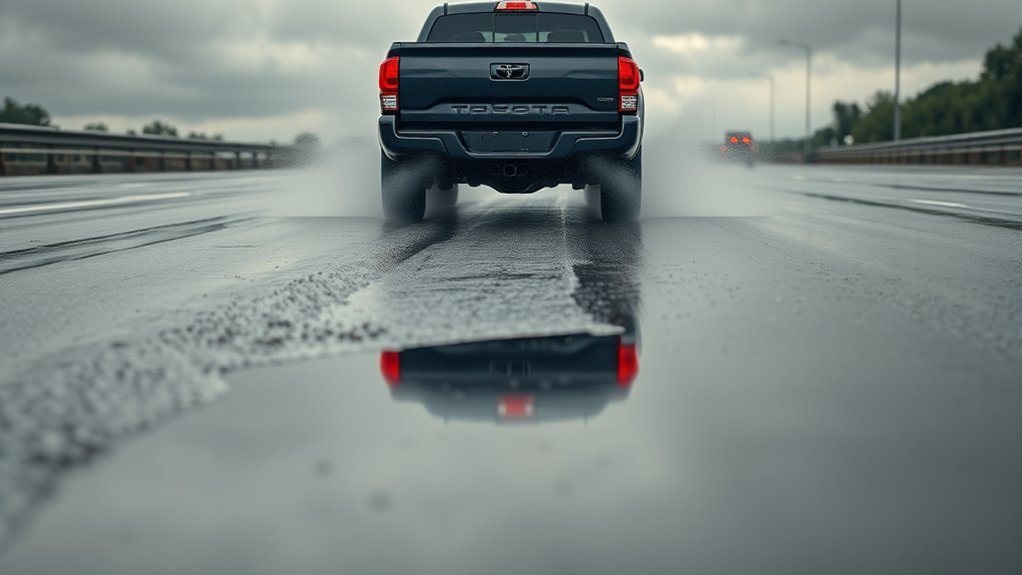
Hydroplaning occurs when water builds beneath a tire faster than the tread can move it away. The tire may partially or completely lose contact with the road. Steering, braking, and acceleration can then become less effective until the tire reconnects with the pavement.
No single speed causes every vehicle to hydroplane. Risk changes with your speed, water depth, tread depth, tire design, inflation pressure, vehicle load, and road surface. A shallow puddle may cause no problem at one speed but become dangerous when you travel faster or the tire tread is worn.
An unloaded pickup may respond differently from the same truck carrying secured cargo, but that does not make the Tacoma uniquely prone to hydroplaning. Speed, water depth, tire condition, inflation pressure, and road surface remain the main factors you can control.
You can review the figures on the Federal Highway Administration Road Weather Management page.
What Should You Do If Hydroplaning Happens?
If your Tacoma begins to feel light, stops responding normally to small steering inputs, or drifts across the lane in standing water, treat it as a possible hydroplaning event. Stay focused, look where you want the truck to go, and avoid sudden control inputs.
Warning: Do not slam on the brakes, jerk the steering wheel, or accelerate hard while the tires have limited contact with the pavement. Abrupt inputs may make the truck harder to control when traction returns.
Remain Calm and Focused
Keep both hands on the steering wheel and look toward a clear path ahead. Ease off the accelerator smoothly. Avoid staring at a guardrail, vehicle, or shoulder that you do not want to hit.
Do not switch lanes unless avoiding a collision requires it. Small, measured corrections give the tires a better chance to reconnect without creating a second skid.
Gradually Reduce Speed
Allow the truck to slow naturally as you ease off the accelerator. Avoid applying heavy braking while the steering feels light or unresponsive. As the tires regain contact, the steering should begin to feel normal again.
If braking becomes necessary after traction returns, use smooth pressure. For an emergency stop, follow the braking instructions in your Tacoma’s model-year owner’s manual. Do not assume every model or road surface will respond in exactly the same way.
Steer Smoothly to Maintain Control
Use this recovery sequence:
- Look ahead: Focus on the open path where you want the truck to travel.
- Ease off the accelerator: Let speed decrease without an abrupt weight transfer.
- Hold a steady steering angle: Avoid sawing the wheel back and forth.
- Wait for normal steering feel: Let the tires reconnect before making larger corrections.
- Continue at a lower speed: Avoid the next puddle and increase your following distance.
If the truck begins to rotate, keep looking toward the open path you want to follow and make only smooth, measured steering inputs. Avoid a large countersteer or rapid back-and-forth correction. Once tire contact returns, continue at a lower speed.
How to Prevent Hydroplaning While Driving
Your driving choices make the largest immediate difference. Reduce speed before reaching water, not after your tires enter it. A slower tire has more time to move water through its tread channels.
- Increase following distance: Leave more room because wet pavement reduces available traction.
- Avoid cruise control: Keep direct control of the accelerator when water depth and traction may change quickly.
- Use smooth inputs: Accelerate, steer, and brake gradually.
- Avoid visible ruts and puddles: Water often collects in worn wheel paths and low sections of pavement.
- Use low-beam headlights: Improve your visibility to other drivers when rain reduces contrast, following applicable local laws.
- Delay the trip when practical: Heavy rainfall can overwhelm road drainage and reduce visibility.
Pro Tip: Cancel cruise control before driving on a slippery rain-covered road. Direct throttle control lets you ease off immediately when you see pooled water or feel the tires begin to lose grip.
Roads may be unusually slick when rain begins after a long dry period because moisture can mix with residue on the pavement. Treat early rainfall as a condition that may require extra caution rather than relying on a fixed “first 10 minutes” rule.
Essential Tire Maintenance Tips for Wet Weather Performance
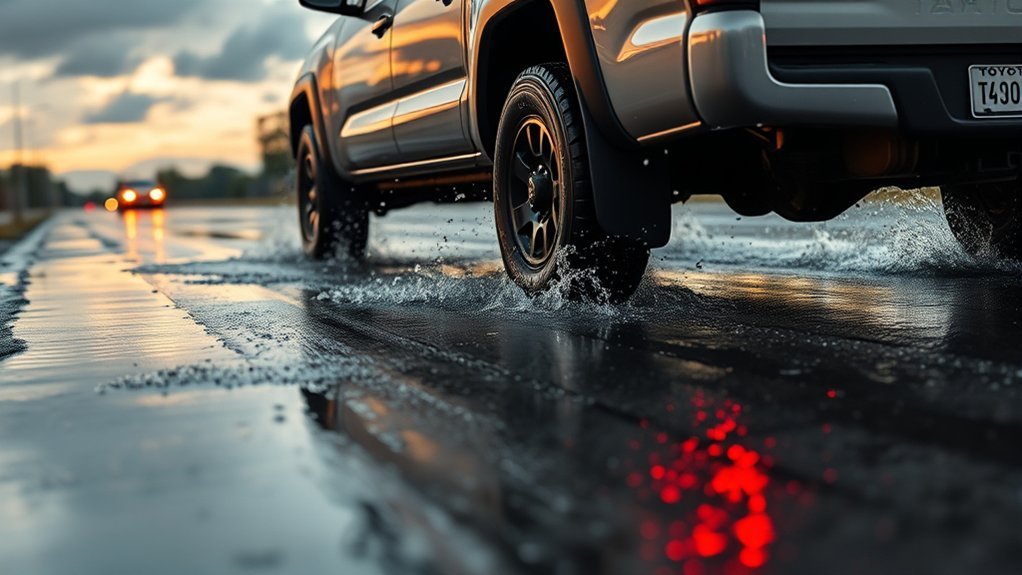
Your Tacoma’s tires provide its only contact with the road. Tread depth, inflation pressure, damage, age, and tire design all affect wet-weather braking and steering.
Tire Tread Depth Importance
Deeper tread channels can generally move more water than severely worn tread. Check several grooves across each tire because one side may wear faster than another.
A tread-depth gauge provides the clearest measurement. A quarter can serve as a wet-weather warning check around 4/32 inch, while the penny test checks approximately the 2/32-inch replacement point. Bridgestone’s tread-depth guidance identifies 4/32 inch as an important wet-weather threshold, while the National Highway Traffic Safety Administration advises replacing tires when tread reaches 2/32 inch.
Do not wait for the minimum tread depth when a tire has exposed cords, a bulge, a deep cut, repeated pressure loss, or poor wet-road performance. Have it inspected promptly.
Regular Pressure Checks
Check every tire at least once a month while it is cold. NHTSA defines a cold check as one made after the vehicle has been parked for at least three hours. Use an accurate gauge instead of judging pressure by appearance.
Inflate the tires to the pressure shown on the Tire and Loading Information label near the driver’s door or in the correct model-year owner’s manual. Do not use the maximum pressure molded into the tire sidewall as the vehicle’s normal inflation target.
For a Tacoma-specific walkthrough, see how to decode the Tacoma tire-pressure placard.
Note: A tire-pressure monitoring system usually warns only after pressure has dropped significantly. It does not replace monthly checks with a gauge.
Quality Tire Selection
Choose the size, load rating, and type approved for your Tacoma. Check the driver-door label and the appropriate Toyota manual before changing sizes or load ranges.
Do not assume an aggressive all-terrain pattern automatically provides better rain performance. Compare published wet-braking and wet-handling results for the exact tire model. A tire designed mainly for mud or loose terrain may behave differently on wet pavement.
Rotate the tires according to your model-year maintenance schedule. Rotation can reduce irregular wear, but it cannot repair alignment problems, damaged tread, or an unsuitable tire.
How to Spot Worn Tires and Why It Matters
Inspect your tires monthly and before a long trip. Look beyond the center groove because shoulder wear or one-sided wear can reduce wet grip even when another part of the tire appears usable.
- Low tread: Replace a tire at 2/32 inch. If wet roads are a frequent concern, treat about 4/32 inch as a warning point and evaluate replacement before reaching the minimum.
- Treadwear bars: Replace the tire when the tread becomes level with the built-in bars.
- Uneven wear: Feathering, cupping, or one-sided wear may indicate an alignment, balance, suspension, or pressure problem.
- Sidewall damage: Bulges, exposed cords, deep cuts, and spreading cracks require professional inspection.
- Repeated pressure loss: A slow leak can leave the tire underinflated before the warning light appears.
- Vibration or noise: A new vibration, thump, or pull may indicate tire damage or irregular wear.
The penny test remains useful for checking the 2/32-inch replacement point. Insert a penny with Lincoln’s head facing down into several tread grooves. If the top of his head remains visible, the tread is near or below 2/32 inch.
Adjusting Your Driving Style for Rainy Conditions
Wet-weather control depends on how smoothly you ask the tires to accelerate, turn, or stop. Sudden inputs demand more of the limited traction available.
Gentle Steering Techniques
Reduce speed before a curve and turn the wheel smoothly. Avoid abrupt lane changes, especially where water collects in wheel ruts or beside concrete barriers.
Keep both hands on the wheel when rainfall is heavy. Crosswinds, passing trucks, puddles, and pavement changes can affect the truck at the same time.
If your Tacoma carries a load, has a suspension lift, uses nonstandard wheels, or runs different tire sizes, its response may differ from a stock truck. Leave a larger safety margin until you understand how those changes affect wet handling.
Smooth Acceleration Practices
Apply the accelerator gradually when starting, merging, or changing lanes. Hard acceleration can spin the drive tires or activate traction control without improving forward control.
Four-wheel drive may help distribute engine power during acceleration, but it does not prevent hydroplaning or guarantee shorter stopping distances on wet pavement. Keep the same cautious speed and following distance you would use without 4WD.
If you are towing, reduce speed further and leave more room. A trailer adds mass, increases stopping distance, and may react differently when one side encounters pooled water.
How Reducing Speed Can Prevent Hydroplaning in Heavy Rain
Reducing speed gives the tread more time to move water away from the tire’s contact area. It also reduces the distance you travel while reacting to a puddle, stalled vehicle, or sudden loss of visibility.
No universal hydroplaning speed applies to every Tacoma. Water depth, tread design, tread depth, inflation, road surface, vehicle load, and speed all affect when a tire may lose contact. Do not treat 35 mph or any other number as a guaranteed safe limit.
- Slow before the water: Braking hard after entering a puddle may make control more difficult.
- Match speed to visibility: You should be able to stop within the clear distance you can see.
- Watch the vehicle ahead: Tire spray, brake lights, and sudden lane changes may reveal deeper water.
- Leave a larger gap: Extra space allows you to slow gradually instead of making a panic stop.
- Exit when conditions become unsafe: Use a parking area or other safe location rather than stopping in an active lane.
The posted speed limit describes the maximum allowed under suitable conditions. It is not a target speed during heavy rain, poor visibility, or standing water.
Tips for Safe Driving Through Standing Water
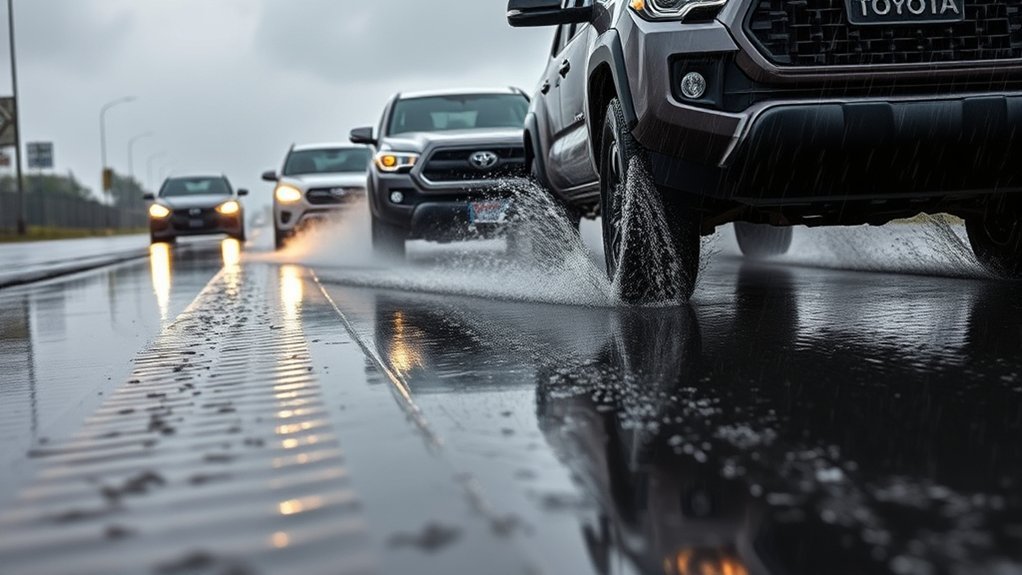
Ordinary shallow puddles and a flooded roadway are not the same hazard. Avoid puddles when you can, and reduce speed before reaching them. Never enter water that covers the road when you cannot confirm the pavement, depth, or flow.
Warning: Never drive into floodwater or around a barricade. The road may be washed out beneath the water. The National Weather Service says 12 inches of rushing water can carry away most cars, while 2 feet can carry away SUVs and trucks.
Do not use another vehicle as a depth gauge. A larger vehicle may have different tires, clearance, weight, or momentum, and it may still become stranded after you lose sight of it.
Follow the National Weather Service’s Turn Around Don’t Drown guidance. Choose another route when water covers the road, emergency crews have placed barriers, or the current is visibly moving.
If you enter an ordinary puddle unexpectedly, keep the wheel steady, ease off the accelerator, and avoid hard braking until you feel normal tire contact again.
Preparing Your Tacoma for Rain: Key Tips
A short pre-drive check can reveal problems before you reach highway speeds or heavy rainfall.
- Measure cold tire pressure: Use the driver-door label or the correct Toyota manual for the target pressure.
- Inspect tread and sidewalls: Check all four tires, not only the easiest areas to see.
- Test the wipers and washer system: Replace blades that streak, chatter, split, or leave large unwiped areas.
- Check exterior lights: Confirm that low beams, brake lights, turn signals, and hazard lights work.
- Watch dashboard warnings: Address tire-pressure, ABS, traction-control, or stability-control warnings before severe weather.
- Secure cargo: Keep cargo from shifting and remain within the truck’s Tire and Loading Information limits.
- Check the route and forecast: Avoid low-water crossings, road closures, and areas under flood warnings.
If your wipers are streaking or skipping, see how to replace Toyota Tacoma wiper blades before driving in heavy rain.
Do not add loose ballast to the bed solely to prevent hydroplaning. Extra weight does not guarantee tire contact with the road, and unsecured material can shift or become hazardous during a sudden stop. If you normally carry cargo, secure it and stay within the truck’s rated capacity.
Use Toyota’s manual and warranty portal to find guidance for your exact Tacoma year and configuration.
Practical Tacoma-Specific Considerations
Owner experiences can help identify situations worth watching, but they should not replace tire measurements, vehicle specifications, or established road-safety guidance.
- Unloaded-bed feel: An empty pickup may respond differently from the same truck carrying secured cargo, especially during abrupt steering or acceleration.
- All-terrain tires: Wet-road performance varies widely between models. Judge the exact tire, not only its category or appearance.
- Four-wheel drive: It can help with powered traction, but it cannot prevent hydroplaning or create grip beneath a tire riding on water.
- Lift kits and larger tires: Changes to ride height, tire width, pressure needs, or alignment can affect steering response and water evacuation.
- Towing: A trailer increases total mass and may react sharply if its tires encounter standing water.
If your Tacoma repeatedly feels unstable in rain, have the tires, alignment, suspension, and steering inspected. Do not treat repeated loss of grip as normal pickup behavior.
Hydroplaning Versus Wet-Road Skidding
Hydroplaning occurs when water separates part of the tire from the pavement. A wet-road skid can happen even when the tire still touches the road but available friction is too low for the requested braking, acceleration, or cornering force.
The prevention methods overlap: reduce speed, maintain the tires, leave more space, and avoid abrupt inputs. However, recognizing hydroplaning helps explain why steering may suddenly feel light or temporarily unresponsive in pooled water.
Do Four-Wheel Drive and Electronic Systems Prevent Hydroplaning?
No. No Tacoma drivetrain mode can prevent hydroplaning. Four-wheel drive changes how engine power reaches the wheels; it does not remove water from beneath the tread.
Tacoma drivetrain hardware varies by model year and trim. For example, Toyota lists 2WD, part-time 4WD, and full-time 4WD in the 2026 lineup, with Limited grades using full-time 4WD with an electronic locking center differential. Older Tacomas can use different systems, so follow the manual for your exact truck. Toyota’s current lineup details are available in its 2026 Tacoma information.
For a deeper explanation of the drivetrain differences, see Toyota Tacoma part-time vs. full-time 4WD.
Traction control, anti-lock brakes, and stability control can help manage wheelspin, braking, or vehicle rotation when the tires have usable contact with the road. Their ability to help is limited when one or more tires are separated from the pavement by water.
Keep these systems switched on for normal road driving unless your owner’s manual specifically directs otherwise. A warning light for ABS, traction control, or stability control should be inspected because the system may not be available when you need it.
When Rain Is Too Heavy to Keep Driving
Leave the roadway when you cannot see lane markings, surrounding vehicles, road edges, or standing water early enough to respond safely. Do not stop in an active traffic lane or beneath an overpass where other drivers may not see you.
Use a rest area, parking lot, fuel station, or another safe location away from flood-prone ground. Keep your lights on and wait for visibility or drainage to improve.
Also stop or reroute when emergency alerts report flash flooding, a road is barricaded, water is moving across the pavement, or other vehicles are becoming stranded.
Sources
- National Highway Traffic Safety Administration: TireWise — tire pressure, tread depth, inspection, rotation, TPMS, and tire-label guidance
- National Highway Traffic Safety Administration: Summer Driving Tips — cold tire-pressure checks, tread inspection, lights, wipers, and trip preparation
- Bridgestone: Tire Tread Depth and Quarter Test — 4/32-inch wet-weather tread guidance
- Federal Highway Administration: Road Weather Impacts — U.S. weather-related crash and rain statistics
- National Weather Service: Turn Around Don’t Drown — floodwater, road-barrier, and vehicle-sweep-away guidance
- Toyota Owners: Manuals and Warranties — model-year-specific Tacoma operating and maintenance guidance
- Toyota USA: 2026 Tacoma — current Tacoma drivetrain configurations
Frequently Asked Questions
How can you prevent hydroplaning in heavy rain?
Reduce speed before reaching puddles, avoid cruise control on slippery roads, leave extra following distance, keep the tires correctly inflated, and replace damaged or badly worn tires. Avoid visible standing water and leave the roadway safely when visibility becomes too poor.
What are the two most effective ways to reduce hydroplaning risk?
First, slow down because higher speed gives the tread less time to move water. Second, maintain the tires by checking cold pressure, tread depth, damage, and uneven wear.
What should you do when your Tacoma starts hydroplaning?
Look where you want to go, ease off the accelerator, keep the steering wheel steady, and avoid abrupt braking or steering. Let the truck slow until the tires regain normal contact, then continue at a lower speed.
Does four-wheel drive prevent a Toyota Tacoma from hydroplaning?
No. Four-wheel drive changes how engine power reaches the wheels, but it cannot remove water beneath the tread. A four-wheel-drive Tacoma still needs proper tires, lower speed, smooth inputs, and extra following distance.
Should you use 4H in a Tacoma when it is raining?
Do not select a Tacoma 4WD mode solely to prevent hydroplaning. The correct drivetrain setting depends on the truck’s model year, trim, transfer case, and road surface. Follow the exact owner’s manual for your Tacoma. Regardless of mode, reduce speed and maintain the tires because 4WD cannot stop a tire from riding on water.
Is 4/32 inch of tread required for rain?
It is not a universal legal requirement. About 4/32 inch is a useful wet-weather warning point because wet braking and water evacuation decline as tread wears. NHTSA identifies 2/32 inch as the replacement threshold. Damage or poor wet-road performance can require earlier replacement.
Should you add weight to a Tacoma bed for better rain traction?
Do not add loose ballast solely to prevent hydroplaning. Extra weight does not guarantee road contact and may change handling or stopping distance. Secure any normal cargo and remain within the Tire and Loading Information limits.
Is there a speed that guarantees a Tacoma will not hydroplane?
No fixed speed guarantees that a Tacoma will not hydroplane. Risk changes with water depth, tread depth, tire design, inflation pressure, road surface, vehicle load, and speed. Slow down before standing water instead of treating 35 mph or any other number as a universal safe limit.
Conclusion
Preventing hydroplaning in your Toyota Tacoma starts with good tires, correct cold inflation pressure, lower speed, and enough space to react smoothly. Four-wheel drive and electronic safety systems can help in some traction situations, but they cannot create grip when water separates a tire from the road.
If the truck begins to hydroplane, ease off the accelerator, hold the wheel steady, and let traction return before making larger steering or braking inputs. Avoid flooded roads completely, and leave the roadway safely when rainfall or visibility makes continued driving unsafe.
Before your next wet-weather drive, check the cold tire pressure against the driver-door placard and measure tread across all four tires. Those two checks can identify preventable problems before you reach standing water.