The Toyota Tundra’s approach, departure, and breakover angles tell you whether the truck’s front, rear, or center is likely to touch the ground as it crosses a sharp change in terrain. These are clearance measurements—not ratings for the steepest hill the truck can climb. Because Tundra geometry varies by model year, cab, bed, trim, tires, hitch, load, and modifications, use published numbers only when they match your exact configuration.
Quick Answer
Approach angle is the front-clearance limit, departure angle is the rear-clearance limit, and breakover angle is the center-underbody clearance limit over a crest. Toyota’s 2025 U.S. brochure lists 21.0 degrees approach and 24.0 degrees departure for the standard Double Cab and CrewMax configurations shown, while TRD Pro CrewMax is listed at 26.2 and 24.2 degrees; the brochure does not list breakover. Toyota’s TRD 3-inch lift comparison moves an eligible 21/24-degree configuration to 26/25 degrees, and its related SEMA release reports a two-degree breakover improvement. Treat every number as configuration-specific.
Last updated: September 11, 2026. Toyota announced an updated 2027 Tundra in July 2026 and said full 2027 details are planned for fall 2026. Because that announcement does not publish a complete approach/departure/breakover set, this guide does not carry older geometry figures forward to the 2027 model year.
Key Takeaways
- Approach, departure, and breakover angles describe body clearance at sharp terrain transitions; they do not state the steepest continuous grade a Tundra can climb.
- Cab, bed, wheelbase, tires, load, bumpers, air dams, hitches, and suspension changes can alter the effective angles.
- Toyota’s verified TRD 3-inch lift example changes approach angle from 21 to 26 degrees and departure angle from 24 to 25 degrees on compatible trucks.
- A drop hitch, heavy payload, or low accessory can reduce clearance even when the suspension has been lifted.
- Measure your truck in its normal trail-ready condition and use a spotter whenever you cannot see a potential contact point.
Note: A published angle is normally a static geometry measurement. Suspension compression, tire deflection, articulation, passengers, cargo, and trail speed can reduce the clearance available in the real world.
What Are Approach, Departure, and Breakover Angles?

Approach, departure, and breakover angles describe whether a vehicle can pass over a sharp change in terrain without its body, frame, hitch, bumper, or undercarriage touching the ground. Toyota identifies approach angle, departure angle, and ground clearance as important parts of off-road vehicle geometry. SAE J689 documented standardized definitions for approach, departure, and ramp-breakover measurements on passenger cars and light trucks; SAE marks the 2009 revision as canceled, so it is best treated here as a historical measurement reference rather than a current active standard.
| Measurement | What It Measures | Typical Contact Point |
|---|---|---|
| Approach angle | The steepest ramp transition the front tires can reach before the truck’s lowest forward point touches. | Air dam, bumper, skid plate, recovery point, or another low front component. |
| Departure angle | The steepest ramp transition the rear tires can leave before the lowest rear point touches. | Receiver hitch, ball mount, bumper, exhaust, spare tire, or step. |
| Breakover angle | The sharpest crest the truck can straddle without the area between its axles contacting the surface. | Frame crossmember, skid plate, transfer-case area, fuel-tank protection, or another central component. |
Use any angle number in three steps:
- Confirm the published number matches the truck’s model year, cab, bed, drivetrain, suspension, tires, and bumper or air-dam setup.
- If the truck is modified or normally carries cargo, measure it in that loaded condition and identify the actual lowest contact point.
- Treat the static number as a clearance reference, not a safety guarantee; articulation, tire deflection, traction, side slope, and momentum can change the real result.
A larger angle generally provides more room at that part of the truck. However, an angle does not guarantee that an obstacle is safe. Traction, soil strength, tire grip, wheel placement, rollover risk, water depth, suspension travel, and the driver’s line still matter.
Note: Approach angle is not the same as gradeability. A Tundra might have enough front clearance to enter a slope but still lack traction or stability to climb it safely.
Why Your Tundra’s Approach Angle Matters Off-Road
Your Tundra’s approach angle becomes important when the front tires meet a ledge, washout, ramp, ditch bank, or sudden uphill transition. If the transition is sharper than the truck’s effective approach angle, a low front component can touch before the tires begin climbing.
The effective angle depends on more than suspension height. A low air dam, winch mount, aftermarket bumper, snowplow bracket, or recovery accessory may become the first point of contact. A heavy front accessory can also compress the suspension and reduce clearance.
Before approaching a ledge, stop where you can inspect the line. Identify the lowest rigid front component and compare it with the obstacle. Approach slowly and use a spotter when that component is outside your view.
Pro Tip: Check the front corners as well as the center. Turning slightly may place a corner of the bumper closer to the obstacle even when the center appears clear.
How Your Tundra’s Departure Angle Affects Off-Road Performance
Departure angle determines whether the rear of your Tundra can clear a sharp crest or descending transition after the rear tires pass it. The receiver hitch is often the limiting point, especially when a drop hitch or ball mount remains installed.
| Configuration or Change | Likely Effect | What to Check |
|---|---|---|
| Factory bumper and empty receiver | Establishes the original rear geometry for that configuration. | Lowest point of the receiver, bumper, exhaust, and spare tire. |
| Drop hitch or ball mount installed | Usually reduces the effective angle. | Remove unused towing hardware before entering a trail. |
| Heavy bed load or trailer tongue weight | Can lower the rear and reduce clearance. | Measure the loaded truck and remain within payload and towing limits. |
| High-clearance rear bumper | May improve the angle if it moves the lowest contact point upward or forward. | Receiver, exhaust, spare tire, wiring, sensors, and legal requirements. |
| Toyota TRD 3-inch lift on a compatible truck | Toyota reports a change from 24 to 25 degrees in its tested configuration. | Model, drivetrain, bed, suspension, and package compatibility. |
A bumper change alone cannot guarantee a specific departure angle. The lowest and rearmost component controls the final measurement. After any rear modification, measure the truck again with the usual cargo and towing equipment installed.
What’s a Breakover Angle and Why Should You Care?

Breakover angle matters when both axles are on different sides of a crest, ridge, berm, rock, or sharply crowned road. If the crest is too sharp, the truck can become high-centered with its tires carrying less weight or losing contact.
Importance of Breakover Angles
A higher breakover angle gives the center of the truck more room to cross a sharp crest. Wheelbase and the clearance at the lowest point between the axles have the greatest influence. For the current-generation wheelbase ranges that affect this geometry, see the Toyota Tundra dimensions guide.
| Vehicle Factor | Effect on Breakover Angle | Practical Meaning |
|---|---|---|
| Wheelbase | A longer wheelbase generally reduces the angle when center clearance is unchanged. | Long-bed configurations may contact a crest sooner than a shorter-wheelbase setup. |
| Lowest center clearance | More clearance generally increases the angle. | Measure the actual lowest rigid point, not only a brochure’s maximum ground-clearance figure. |
| Payload and suspension sag | Usually reduces the available angle. | A camping or work load can change the result measured with an empty bed. |
| Larger-diameter tires | May provide a modest increase in static clearance. | A two-inch diameter increase adds about one inch of theoretical ride height before load and deflection. |
| Skid plates | May slightly reduce measured clearance while protecting vulnerable parts. | Protection can be more useful than chasing a small angle increase. |
Impact on Off-Roading
A weak breakover angle becomes noticeable on short, sharp crests rather than long gradual hills. A Tundra may climb the first side without touching its front bumper and still contact the center as the front axle passes over the top.
Wheel placement can help. Crossing a ridge at a slight diagonal may allow one tire to climb first and reduce the immediate crest angle seen by the truck. However, a diagonal line also increases body roll and can place more load on fewer tires. Use this technique only at low speed with enough side clearance and a spotter.
Calculating Your Vehicle’s Angle
For a simplified vehicle with the lowest point centered between the axles, the approximate breakover angle is:
Breakover angle ≈ 2 × arctan[(2 × midpoint clearance) ÷ wheelbase]
For example, a hypothetical truck with a 145.7-inch wheelbase and 10 inches of true midpoint clearance has an estimated breakover angle of about 15.6 degrees. This is only a geometry example—not a published Tundra specification. The result changes if the lowest point is not centered, the tires compress, or the suspension is loaded.
Approach and departure angles can be estimated with similar right-triangle geometry:
Approach angle ≈ arctan(front-point clearance ÷ front overhang to that point)Departure angle ≈ arctan(rear-point clearance ÷ rear overhang to that point)
A straight board and digital angle gauge usually provide a more practical owner measurement because they account for the actual bumper, hitch, and accessories on the truck.
Stock vs. Modified Tundra Angles: What’s the Difference?
There is no single stock angle set for every Toyota Tundra. Geometry can change with the generation, cab, bed, drivetrain, suspension, tire package, front air dam, tow equipment, and vehicle load. A figure published for one CrewMax or Double Cab should not be applied automatically to another configuration.
Stock Vehicle Specifications
The following table uses Toyota-published information and clearly limits each figure to the configuration described by Toyota.
| Configuration | Approach | Departure | Breakover |
|---|---|---|---|
| 2025 U.S. brochure — listed Double Cab and CrewMax standard configurations | 21.0 degrees | 24.0 degrees | Not listed in Toyota’s brochure |
| 2025 U.S. brochure — TRD Pro CrewMax | 26.2 degrees | 24.2 degrees | Not listed in Toyota’s brochure |
| Toyota baseline used for its TRD lift comparison on compatible 2022-and-newer 4×4 Tundras | 21 degrees | 24 degrees | Absolute value not stated in the final lift-kit release |
| Same eligible configuration with Toyota’s TRD 3-inch lift | 26 degrees | 25 degrees | Toyota reported a two-degree relative improvement in its related SEMA release |
| 2027 Tundra announcement (pre-full-spec release) | Toyota announced the updated 2027 Tundra on July 21, 2026 and said full details are planned for fall 2026. The announcement does not publish a complete approach/departure/breakover set, so older figures should not be assumed for 2027. | ||
Toyota’s approved TRD 3-inch lift provides a useful real-world example: approach angle rises by five degrees, while departure improves by one degree on the compatible configuration Toyota tested.
The Toyota TRD 3-inch lift is listed for eligible model-year 2022-and-newer i-FORCE and i-FORCE MAX 4×4 trucks with a 5.5- or 6.5-foot bed. Toyota says it is not compatible with TRD Pro, TRD Sport, Adaptive Variable Suspension, or air-suspension configurations. Confirm current fitment by VIN before ordering.
2027 model-year note: Toyota’s July 2026 Tundra announcement introduces an updated truck and a new Trailhunter package, but says full 2027 details are planned for fall 2026. Until Toyota publishes production geometry, do not assume the 2022–2026 angle references above apply unchanged to every 2027 configuration.
Modifications Impacting Angles
Different upgrades affect different parts of the truck:
- Suspension lift: Can raise the frame and body, improving center clearance and often improving all three static angles. It does not shorten the wheelbase or automatically move low bumpers and hitches.
- Front bumper or air-dam change: Can improve approach angle when the lowest front point moves upward or rearward.
- Rear bumper or hitch change: Can improve departure angle when the lowest rear point moves upward or forward.
- Larger-diameter tires: Can add modest clearance, but may create rubbing, gearing, braking, steering, load-rating, and calibration concerns.
- Skid plates: Usually protect components rather than improve the measured angle. A smooth skid plate may allow controlled sliding where an unprotected component could catch.
Always measure the truck after the work. Advertised lift height alone does not reveal the final approach, departure, or breakover angle.
How to Measure Your Tundra’s Angles at Home
At a Glance
| Time Required | About 20–30 minutes |
| Difficulty | Easy to moderate |
| Tools Needed | Tape measure, straight board or metal bar, digital angle finder or inclinometer app, chalk, wheel chocks, and a helper |
| Cost | About $0–$30, depending on the tools already available |
Warning: Park on firm, level ground, apply the parking brake, chock the wheels, and keep the transmission in Park. Never crawl under a truck supported only by a jack. Use rated stands at approved support points if under-vehicle access is unavoidable.
- Set the truck up as it will be used. Adjust the tires to the specified cold pressure and load the normal recovery gear, passengers, bed equipment, spare tire, and towing hardware.
- Identify the limiting points. Find the lowest rigid component ahead of the front tires, behind the rear tires, and between the axles. Do not assume that the bumper is the lowest point.
- Measure approach angle. Place a straight board so it touches the ground at the front tire’s contact area and reaches the lowest forward component. Use the angle finder to record the board’s angle from level.
- Measure departure angle. Repeat the process from the rear tire’s contact area to the lowest rear component. Include the receiver, ball mount, exhaust, and spare tire in the inspection.
- Measure breakover angle. Record wheelbase and the clearance at the lowest central point. Use the simplified formula when that point is close to the middle, or use two straightedges running from the tire contact areas toward the central point.
- Repeat with different loads. Compare empty-bed and normal trail or towing conditions. Rear sag may materially reduce departure and breakover clearance.
- Record the setup. Note tire size and pressure, cargo weight, hitch position, bumper, suspension, and measurement points so future comparisons are meaningful.
Pro Tip: Photograph each board position and mark the limiting component. After a lift, bumper, tire, hitch, or skid-plate change, repeat the same measurement at the same load and tire pressure.
Boosting Your Tundra’s Angles With Lift Kits and Bumper Upgrades
The safest upgrade is the one that addresses the component actually limiting your truck. A large suspension lift may be unnecessary when a removable drop hitch or low front air dam is the first point that would touch.
Use this order when planning changes:
- Remove unnecessary low accessories. An unused ball mount, step, or rack bracket may reduce clearance at no benefit on the trail.
- Measure the baseline. Record the exact point limiting each angle before buying parts.
- Protect vulnerable components. Skid plates and rock sliders may provide more practical protection than a small numerical angle increase.
- Consider bumper geometry. Choose a bumper based on its lowest point, overhang, weight, recovery ratings, sensor compatibility, cooling airflow, and legal requirements—not appearance alone.
- Use a validated suspension system. Verify model, drivetrain, bed, shocks, control arms, driveshafts, brake hoses, alignment range, towing compatibility, and driver-assistance requirements.
- Choose tires conservatively. Confirm wheel width and offset, load rating, full-steering clearance, suspension-compression clearance, speedometer error, spare-tire fit, gearing, and braking performance.
- Inspect and remeasure. Complete an alignment, torque check, clearance inspection, and driving-support-system check after installation.
Toyota reports that its approved TRD 3-inch kit raises ground clearance by 2.6 inches and changes approach angle from 21 to 26 degrees and departure angle from 24 to 25 degrees on the eligible configuration it tested. Toyota’s related lifted Tundra release reports a two-degree breakover improvement.
Warning: Toyota’s 2026 Tundra manual states that aftermarket lift kits may degrade driving-support-system performance. It identifies Toyota official lift kits up to four inches, including tire height, as the exception described in that manual. Check the manual for your model year and have required sensor, camera, alignment, and headlight procedures completed.
A very tall lift or extreme tire size can raise the center of gravity and change steering, braking, rollover resistance, suspension travel, driveline angles, towing behavior, and component life. Do not select lift height from a generic recommendation.
Using Your Tundra’s Angles in Real-World Off-Road Scenarios
Knowing the angles helps you identify which part of the truck is most likely to touch, but the numbers work best as planning tools rather than pass-or-fail guarantees. Clearance and traction are separate problems; for transfer-case mode selection on loose or slippery terrain, see the Toyota Tundra 4WD system guide.
- Entering a steep bank: Inspect the front air dam, bumper corners, skid plate, and recovery points. Approach squarely at crawl speed unless a carefully chosen diagonal line is safer.
- Dropping off a ledge: Check the hitch, ball mount, bumper, spare tire, and exhaust. Remove unused drop-hitch hardware and use a spotter to watch the rear.
- Crossing a sharp crest: Watch the frame and skid plates between the axles. Stop before momentum carries the truck onto its center.
- Driving with cargo: Account for rear sag and tire deflection. An angle measured with an empty bed may not represent an overlanding, work, or towing load.
- Using a diagonal line: Proceed slowly. A diagonal can soften the immediate ramp transition but may increase body roll and reduce stability.
Warning: Do not continue merely because a published angle appears sufficient. Stop when the line is blind, the surface is unstable, passengers cannot remain safely seated, or the truck begins sliding, lifting a wheel unexpectedly, or contacting an unprotected component.
Tips for Maximizing Your Tundra’s Off-Road Capability
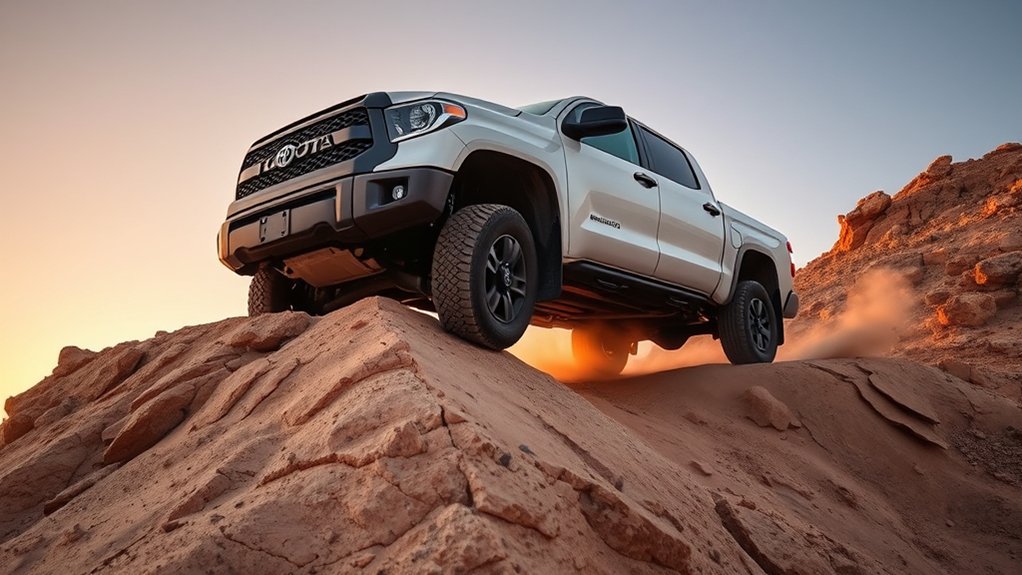
Good off-road preparation balances clearance with traction, protection, reliability, braking, payload, towing needs, and stability. The largest modification is not always the most effective one.
| Modification or Action | Potential Benefit | Important Tradeoff or Check |
|---|---|---|
| Remove an unused drop hitch | Immediate departure-clearance improvement | Store it securely before driving |
| High-clearance bumper | May improve approach or departure geometry | Weight, airbags, cameras, radar, lighting, cooling, recovery rating, and legal fitment |
| Moderately larger approved tires | Modest clearance and footprint increase | Rubbing, load rating, wheel offset, gearing, braking, spare fit, and calibration |
| Validated lift kit | Raises parts of the chassis and may improve all three angles | Alignment, driveline geometry, sensor performance, center of gravity, warranty, payload, and towing |
| Skid plates and rock sliders | Protect vulnerable components during contact | Added weight and possible small clearance loss |
| Spotter and slow line selection | Reduces avoidable contact without changing the truck | Agree on hand signals and maintain visual contact |
Before a trail, inspect tire condition, recovery points, underbody protection, fluid leaks, steering parts, brake hoses, and loose hardware. Confirm that recovery equipment is rated and that everyone understands where it is safe to stand.
Pro Tip: The most useful number is often your own loaded measurement. Record it beside the exact tire pressure, cargo, bumper, hitch, and suspension setup so you can compare future changes accurately.
Frequently Asked Questions
What is the approach angle of the 2025 Toyota Tundra?
Toyota’s 2025 U.S. brochure lists a 21.0-degree approach angle and 24.0-degree departure angle for the Double Cab and CrewMax standard configurations shown in its dimensions table. The same brochure lists the TRD Pro CrewMax at 26.2 degrees approach and 24.2 degrees departure. Toyota does not list a breakover angle in that table. Modifications, accessories, tires, and load can still change the effective clearance on an individual truck.
What is the breakover angle of a Toyota Tundra?
There is no universal Tundra breakover angle. Breakover changes with wheelbase, loaded center clearance, tires, suspension height, and the lowest rigid point between the axles. Toyota’s 2021 SEMA release states that its lifted 2022 Tundra example improved breakover by two degrees, but that release does not provide one absolute breakover number for every Tundra.
Is approach angle the same as the steepest hill a Tundra can climb?
No. Approach angle describes front-end clearance at a sharp transition. Hill-climbing ability also depends on traction, tire grip, surface strength, drivetrain, gearing, available torque, stability, side slope, and driver control. A truck can clear the start of a slope without having enough traction or stability to climb it safely.
Does a lift kit improve a Tundra’s breakover angle?
It can. A lift that raises the lowest point between the axles generally improves static breakover angle, although it does not shorten the wheelbase. Toyota reported a two-degree breakover improvement for its TRD 3-inch lift example. The final result depends on the exact truck, tires, load, and lowest central component.
Do larger tires improve approach, departure, and breakover angles?
A larger tire can raise the axles and chassis by roughly half the increase in tire diameter before load and deflection are considered. The improvement is usually modest compared with the fitment changes extreme tire sizes may require. Check rubbing, wheel offset, load rating, braking, gearing, steering, spare-tire fit, and system calibration.
Does a tow hitch reduce a Tundra’s departure angle?
The receiver may be the lowest rear point, and a drop hitch or ball mount can reduce the effective departure angle further. Remove unused towing hardware before off-road driving. When towing, account for tongue weight and rear suspension compression, which may also reduce clearance.
Do published Tundra angles stay the same when the truck is loaded?
Not necessarily. Cargo, passengers, accessories, trailer tongue weight, tire pressure, and suspension movement can lower part of the truck. Measure the vehicle with its normal trail or work load when you need a realistic clearance estimate.
Conclusion
Understanding your Toyota Tundra’s approach, departure, and breakover angles helps you predict whether the front, rear, or center may touch at a sharp terrain transition. The key is to use figures that match the exact truck rather than treating one model’s measurements as universal.
Start by identifying the limiting front, rear, and center components on your own Tundra. Measure the truck at its normal load and tire pressure, then repeat the same measurements after any tire, bumper, hitch, skid-plate, or suspension change. Use Toyota’s published geometry only for a matching configuration, and wait for production specifications before applying older figures to the updated 2027 Tundra. That process gives you a more defensible trail-clearance estimate than a generic angle or lift recommendation.
Sources
- Toyota: Explaining Toyota’s Vehicle Geometry — supports the role of approach angle, departure angle, and ground clearance.
- Toyota: 2025 Tundra Brochure — lists 21.0/24.0-degree approach/departure geometry for the standard Double Cab and CrewMax configurations shown and 26.2/24.2 degrees for TRD Pro CrewMax.
- SAE J689_200908: Curbstone Clearance, Approach, Departure and Ramp Breakover Angles — documents the measurement definitions and is marked canceled by SAE.
- Toyota: Tundra TRD 3-Inch Lift Kit — supports the 21-to-26-degree approach change, 24-to-25-degree departure change, 2.6-inch ground-clearance increase, compatibility limits, and dealer-installed kit details.
- Toyota: Lifted 2022 Tundra at SEMA — supports the reported five-degree approach, one-degree departure, and two-degree breakover improvements for that showcased configuration.
- Toyota: 2026 Toyota Tundra — supports current-generation model and off-road-system context.
- Toyota: 2027 Tundra Announcement — supports the July 2026 update and Toyota’s statement that full 2027 details are planned for fall 2026.
- Toyota 2026 Tundra Driving Support Systems Manual — supports the lift-related LTA warning and Toyota-official-lift exception up to four inches including tire height.