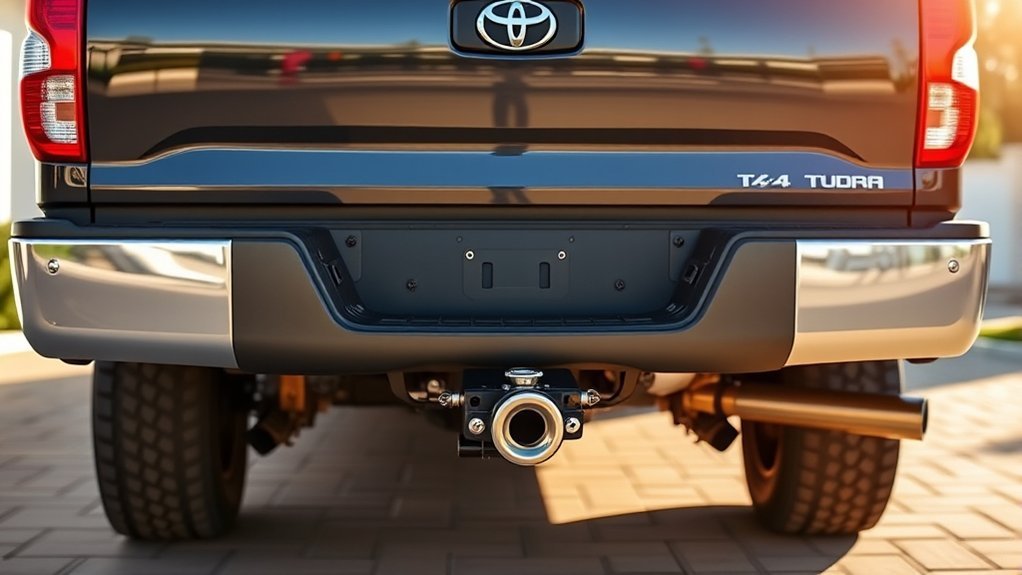
The Toyota Tundra can be a capable tow vehicle, but there is no single tow-package specification that applies to every year, trim, cab, bed, drivetrain, or market. The safest approach is to identify the equipment installed on your exact truck, confirm every weight rating, and match the hitch, brakes, mirrors, and trailer hardware to the load you plan to pull.
Quick Answer
A properly configured 2026 U.S. Toyota Tundra can tow up to 12,000 pounds, but that number does not apply to every truck. The hitch receiver and trailer connectors are standard for 2026, while brake controllers, tow mirrors, cameras, backup aids, and trailer-matched hitch hardware vary by grade, option package, and model year.
Key Takeaways
- Toyota lists an up to 12,000-pound towing maximum for the 2026 U.S. Tundra, but the exact limit depends on the truck’s configuration and loaded weight.
- A factory tow hitch or technology package does not automatically include the correct hitch ball, ball mount, weight-distributing hitch, safety chains, or other trailer-matched hardware.
- Tongue weight, passengers, cargo, accessories, and hitch equipment all use payload and may become limiting factors before the advertised tow rating.
- A weight-distributing hitch can improve load distribution when correctly selected and adjusted, but it never increases the truck’s published ratings.
- Always verify the owner’s manual, door labels, receiver label, trailer ratings, tire ratings, brake requirements, and local towing laws before departure.
At a Glance
| Time Required | About 15–30 minutes for a routine pre-tow inspection; allow additional time for the first hitch and brake-controller setup. |
| Difficulty | Moderate. Professional setup is appropriate when installing or adjusting an unfamiliar weight-distributing hitch, brake system, or electrical connection. |
| Tools Needed | Truck and trailer manuals, tire-pressure gauge, tape measure, wheel chocks, and the sockets and calibrated torque wrench specified by the hitch manufacturer. Access to a vehicle scale is strongly recommended. |
| Cost | Varies by configuration. Factory towing equipment may already be installed, while a trailer-matched ball mount, hitch ball, weight-distribution system, mirrors, camera, brake service, or professional installation can cost extra. |
Warning: Never use the 12,000-pound headline figure as your truck’s automatic towing limit. The safe limit is the lowest applicable rating for the exact truck, receiver, hitch components, tires, axles, trailer, and loaded combination. Exceeding payload, GVWR, GAWR, GCWR, tongue-weight, or component limits can cause instability, brake overload, tire failure, or loss of control.
Note: The current specifications in this guide refer to the 2026 U.S.-market Toyota Tundra. Canadian and other-market ratings, trim names, option packages, equipment, and legal requirements may differ. Earlier Tundra generations also use different capacities and towing systems.
Why Choose the Toyota Tundra Tow Package?

The Toyota Tundra combines a full-size pickup platform with factory towing hardware, selectable driving modes, available visibility aids, and an integrated trailer-brake system on applicable configurations. These features can simplify trailer connection and maneuvering, but they do not replace correct loading, properly rated equipment, or driver judgment.
According to Toyota’s current U.S. Tundra specifications, a properly configured 2026 model can tow up to 12,000 pounds and carry up to 1,850 pounds of payload. Those are separate model-line maximums and may not occur on the same truck. Your door labels, owner’s manual, equipment, passengers, cargo, and trailer determine what your individual Tundra can safely handle.
Toyota rates the 2026 U.S. Tundra line for up to 12,000 pounds of towing, but the safe limit for any individual truck is the lowest rating among the truck, hitch, trailer, tires, axles, payload, and loaded combination.
For 2026, Toyota states that a tow hitch receiver and 7/4-pin trailer connector are standard on all U.S. Tundra models, including SR. Other features—such as power-extending tow mirrors, Trailer Backup Guide with Straight Path Assist, Panoramic View Monitor, an integrated trailer-brake controller, and a wireless trailer camera—depend on the grade, option package, and build configuration.
What “Tow Package” Actually Means
Dealers, owners, and listings often use “tow package” as a general phrase, but it may describe different equipment. Review the original window sticker, build sheet, dashboard controls, receiver label, connectors, and mirrors instead of relying on the phrase alone.
| Equipment | 2026 U.S. Status | What to Verify |
|---|---|---|
| Tow hitch receiver | Standard on all models | Receiver label, weight-carrying and weight-distributing ratings, and condition |
| 7-pin and 4-pin connector | Standard on all models | Correct pin functions, clean contacts, trailer-light operation, and brake connection |
| Integrated trailer-brake controller | Standard or available depending on grade and equipment | Dashboard controls, gain display, compatible trailer brakes, and correct operation |
| TOW/HAUL modes | Factory powertrain feature on current models | Owner’s-manual instructions and the appropriate mode for the load and terrain |
| Trailer-Sway Control | Standard current-model stability aid | Warning indicators and the limitations described in the owner’s manual |
| Power-extending tow mirrors | Available equipment | Mirror width, extension, heating, power functions, and legal rearward visibility |
| Backup, panoramic-view, and trailer-camera technology | Available on qualifying grades and packages | Window sticker, package description, camera compatibility, and calibration |
| Ball mount, hitch ball, and weight-distributing hitch | Normally selected separately for the trailer | Class, size, rise or drop, tongue rating, gross-trailer rating, and receiver compatibility |
Current Tundras are engineered with powertrain cooling and control systems suitable for their published ratings, but you should not assume that an unspecified “tow package” adds a particular cooler, alternator, axle ratio, or electrical output. Verify those details on the build sheet and in the manual for the exact model year.
Key Components of the Towing Package
A complete towing setup is a system rather than one accessory. The truck, receiver, ball mount, hitch ball, coupler, safety chains, breakaway system, electrical connector, trailer brakes, tires, mirrors, and load placement must all be compatible.
Essential Towing Hardware Included
For a current 2026 U.S. Tundra, Toyota identifies the receiver and 7/4-pin connector as standard truck equipment. Do not assume the truck also came with the correct ball mount, hitch ball, weight-distribution system, locking pin, or other trailer-specific parts.
Inspect or obtain the following hardware before towing:
- Rated receiver: Read the receiver label and confirm whether the intended load requires weight-carrying or weight-distributing operation.
- Correct ball mount: Match the receiver size, required rise or drop, and load rating.
- Correct hitch ball: The ball diameter must exactly match the coupler, and the ball’s shank and load rating must suit the mount and trailer.
- Trailer coupler: Inspect the latch, adjustment, wear, corrosion, and safety pin.
- Safety chains: Use chains with sufficient rated capacity, cross them beneath the coupler when the trailer manufacturer directs, and leave enough movement for turns without allowing them to drag.
- Breakaway cable: Attach it independently to the tow vehicle as directed by the trailer manufacturer—not to a safety chain where one failure could defeat both systems.
- Electrical connector: Confirm running lights, turn signals, brake lights, electric brakes, ground connection, and auxiliary power where applicable.
- Trailer brakes: Maintain the trailer’s brake assemblies, wiring, battery, and breakaway switch.
Properly attached safety chains provide a secondary connection if the coupler separates, but they do not guarantee a safe outcome. Damaged, underrated, incorrectly crossed, or dragging chains must be corrected before travel.
Enhanced Stability Features Offered
Toyota offers several features that may improve control and visibility:
- TOW/HAUL modes alter transmission and powertrain behavior for a loaded truck and trailer.
- Integrated trailer-brake control allows compatible trailer brakes to work in coordination with the truck’s braking inputs.
- Trailer-Sway Control can intervene when the vehicle detects certain sway conditions.
- Trailer Backup Guide with Straight Path Assist can assist with low-speed reversing on equipped models.
- Panoramic View Monitor can display views around the truck during positioning.
- Power-extending tow mirrors can improve rearward visibility around a wide trailer.
- Wireless trailer-camera technology may be available through certain Tow Tech configurations.
Note: Stability and camera systems are driver aids. They cannot overcome excessive speed, poor tongue weight, an overloaded axle, a mismatched hitch, worn tires, failed trailer brakes, strong crosswinds, or abrupt steering.
How the Integrated Trailer Brake Controller Enhances Safety
An integrated trailer-brake controller sends a braking command to compatible electric or electric-over-hydraulic trailer brakes. It can help the trailer share the stopping work instead of relying on the truck’s brakes alone.
The controller must be adjusted for the trailer’s loaded weight, brake condition, road surface, and response. A gain setting that is too low can leave the truck doing too much braking. A setting that is too high can cause the trailer brakes to grab or lock.
| Controller Function | Safety Benefit | Driver Check |
|---|---|---|
| Adjustable gain | Matches trailer-brake output to the loaded trailer and conditions | Perform the owner’s-manual low-speed test and adjust without wheel lock or weak braking |
| Integrated brake signal | Provides smoother coordination between truck and trailer braking | Verify that the dashboard recognizes the trailer and shows no connection fault |
| Manual trailer-brake control | Allows the trailer brakes to be tested and, where appropriate, applied without the truck brakes | Know the control location before driving and follow the manual for permitted use |
| Fault monitoring | Can alert the driver to certain disconnections or controller problems | Do not depart with a trailer-brake warning or intermittent connection |
How to Set the Brake Controller
- Load the trailer as it will be used, secure the cargo, and confirm correct tire pressure.
- Connect the 7-pin plug, safety chains, and breakaway cable.
- Start with the gain-setting procedure specified in the Tundra owner’s manual.
- In a safe, open area away from traffic, perform the manual-control test at the low speed specified by Toyota.
- Increase or decrease gain until the trailer brakes provide firm, smooth braking without locking, grabbing, or leaving the truck to do most of the work.
- Repeat the test whenever trailer loading, brake condition, road grip, or trailer type changes.
Pro Tip: Test the trailer brakes before entering traffic, not after reaching highway speed. Also pull the breakaway pin briefly only when and as directed by the trailer manufacturer; never tow with the pin removed.
The brake controller is not a cure for sway. Trailer-Sway Control is a separate aid, and neither system can compensate for unsafe speed, incorrect tongue weight, poor tire condition, or an overloaded combination.
What Are the Benefits of a Weight-Distributing Hitch?
A conventional trailer places tongue weight behind the truck’s rear axle. That leverage can lower the rear suspension and reduce load on the front axle. A correctly selected and adjusted weight-distributing hitch uses spring bars to transfer part of that load toward the truck’s front axle and the trailer axles.
Potential benefits include:
- More balanced axle loading within the limits of the truck, receiver, and trailer
- Improved steering feel and headlight aim compared with an improperly loaded rear-heavy setup
- Better control of suspension movement
- Improved compatibility with a properly selected sway-control system
- A more level truck-and-trailer combination when all ratings and setup instructions are followed
Toyota’s 2023 Tundra manual states that a sway-control device of sufficient capacity is required when gross trailer weight exceeds 2,000 pounds and that a weight-distributing hitch of sufficient capacity is required above 5,000 pounds. Treat those as model-year-specific instructions: consult the owner’s manual for your exact Tundra, because thresholds and terminology can differ.
Warning: A weight-distributing hitch does not increase towing capacity, payload, GVWR, GAWR, GCWR, receiver capacity, tire capacity, or trailer capacity. It must not be used to make an overloaded combination appear level.
The hitch’s spring-bar range should match the trailer’s loaded tongue weight plus any cargo carried behind the truck’s rear axle when the hitch manufacturer requires it in the calculation. An underrated system may not distribute enough load; an excessively stiff system can produce poor handling or overstress components.
The Toyota Tundra Tow Package: The Role of Extended Mirrors

Extended towing mirrors provide a wider rearward view around trailers that block the factory mirrors. Toyota describes power-extending and power-folding towing mirrors as available equipment on current Tundras, so their presence should be confirmed rather than assumed.
Importance of Extended Mirrors
Proper mirrors help you see traffic approaching from behind, monitor the trailer’s position, judge turns, and check whether the trailer is tracking within its lane. They are especially valuable with enclosed cargo trailers, travel trailers, and boats that are wider than the truck’s cab.
Useful mirror features may include:
- Extension: Moves the mirror outward to improve the sight line along the trailer.
- Large upper glass: Provides a normal rearward traffic view.
- Convex lower glass: Expands the view of adjacent lanes and the trailer’s wheels.
- Heating: Helps clear frost, mist, or light ice when equipped and used correctly.
- Power folding: Makes it easier to reduce the truck’s width in tight parking areas.
Enhanced Towing Visibility Benefits
Adjust the mirrors after the truck and trailer are aligned on level ground. You should be able to see a narrow portion of the trailer along the inner edge of each mirror while preserving as much roadway view as possible.
A rear or trailer camera can supplement the mirrors, but it should not replace direct observation. Camera lenses can be dirty, distorted, blocked, delayed, or difficult to interpret in rain, glare, darkness, or snow. Check mirror-width laws in every jurisdiction through which you will travel.
Pro Tip: After adjusting both mirrors, have a helper walk behind and along each side of the trailer. This simple check helps reveal blind zones before you enter traffic.
Essential Towing Accessories in the Tow Package
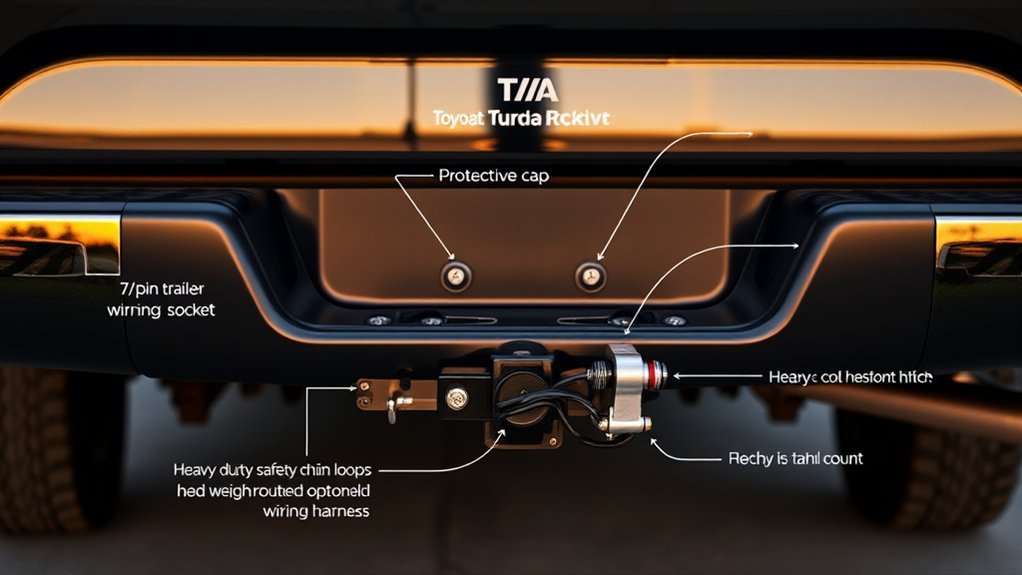
The truck’s receiver and connector are only part of the towing system. The following equipment should be selected and inspected for the specific trailer:
- Ball mount: Rated for the loaded trailer and configured with the correct rise or drop.
- Hitch ball: Exact coupler diameter, adequate gross-trailer and tongue rating, correct shank diameter, and proper installation torque.
- Weight-distributing hitch: Required when specified by Toyota, the receiver manufacturer, the trailer manufacturer, or applicable regulations.
- Sway-control equipment: Selected for the trailer type, hitch system, and manual requirements.
- Safety chains: Correct capacity, attachment style, length, and condition.
- Breakaway system: Charged battery, functional switch, intact cable, and independent attachment point.
- 7-pin electrical cable: Sufficient length for turns without dragging or pulling tight.
- Trailer-brake system: Properly adjusted brakes and a functioning controller connection.
- Extended mirrors: Factory or approved add-on mirrors when the trailer blocks the required rearward view.
- Wheel chocks: Used during hitching, unhitching, and parking where appropriate.
- Tire and wheel equipment: Gauge, inflator, suitable jack, lug-wrench or torque tools, and serviceable spare tires for the truck and trailer.
Do not select an accessory by truck model alone. Its rating must also cover the trailer’s loaded weight and tongue weight. The weakest component determines the system’s limit.
Enhancements for Towing Stability and Control
The Tundra’s towing and driver-assistance features can reduce workload, especially when starting, descending, reversing, or positioning a trailer. Their availability varies by configuration.
TOW/HAUL Driving Modes
TOW/HAUL mode changes transmission and powertrain behavior to better suit a loaded combination. It may hold gears longer, reduce unnecessary shifting, and improve response when accelerating or descending. Use the mode described in the owner’s manual for the trailer weight and terrain.
Trailer Backup Guide and Straight Path Assist
On equipped trucks, Trailer Backup Guide can provide visual guidance, while Straight Path Assist can help maintain a straighter path during low-speed reversing. Set up and calibration requirements must be completed before relying on the system.
Continue checking mirrors, cameras, clearances, the trailer’s front corners, overhead obstacles, and the area behind the trailer. Use a spotter in congested locations and agree on hand signals before moving.
Panoramic View Monitor
The available Panoramic View Monitor combines camera views to help display the area around the truck. It can be useful when aligning the hitch ball, clearing obstacles, or positioning a trailer, but displayed distances may differ from actual distances.
Trailer-Sway Control
Trailer-Sway Control can apply selective braking and adjust engine output when certain sway is detected. It is an emergency aid, not a substitute for correcting the underlying cause.
Common causes of sway include:
- Excessive speed
- Insufficient or excessive tongue weight
- Cargo shifting inside the trailer
- Improper hitch height or weight-distribution adjustment
- Underinflated, overloaded, worn, or mismatched tires
- Strong crosswinds or air pressure from passing trucks
- Worn suspension, coupler, hitch, or sway-control components
- A trailer that is overloaded or poorly matched to the tow vehicle
How to Find Your Tundra’s Actual Towing Capacity
The advertised maximum is only the beginning. Use the following information for the exact truck and trailer:
- Owner’s manual: Find the towing section for the correct model year and powertrain.
- Certification label: Read the truck’s GVWR and front and rear GAWR values on the driver’s door or door jamb.
- Tire and loading label: Note the stated maximum combined weight of occupants and cargo.
- Configuration-specific towing chart: Match cab, bed, drivetrain, grade, engine, and other required equipment.
- Receiver label: Confirm the weight-carrying and, where applicable, weight-distributing limits.
- Trailer certification label: Find the trailer GVWR, GAWR, tire size, and cold inflation pressure.
- Hitch-component labels: Verify the ball, mount, shank, spring bars, coupler, chains, and fasteners.
- Scale weights: Weigh the loaded truck and trailer to confirm axle and combined weights.
Important Towing Weight Terms
| Term | Meaning | Why It Matters |
|---|---|---|
| TWR | Trailer Weight Rating | The maximum trailer weight permitted for the specified truck configuration and conditions |
| GVWR | Gross Vehicle Weight Rating | The maximum allowed weight of the loaded truck or loaded trailer, depending on which label is being read |
| GAWR | Gross Axle Weight Rating | The maximum permitted load on an individual front, rear, or trailer axle |
| GCWR | Gross Combined Weight Rating | The maximum allowed combined weight of the loaded truck and loaded trailer |
| Payload | The weight the truck can carry, subject to all other ratings | Passengers, cargo, accessories, hitch hardware, and trailer tongue weight all use payload |
| Tongue weight | The downward load the trailer places on the hitch | It affects payload, rear-axle load, steering, braking, stability, and hitch selection |
The Lowest-Rating Rule
Your permissible load is the lowest applicable limit—not whichever number is largest. For example, the truck may have remaining trailer-weight capacity but already be at its rear GAWR or payload limit after adding passengers, bed cargo, accessories, hitch hardware, and tongue weight.
Use a certified vehicle scale to record, as applicable:
- Truck front-axle weight
- Truck rear-axle weight
- Total loaded truck weight
- Trailer axle weight
- Combined truck-and-trailer weight
- Tongue weight using an appropriate method or scale
Compare every measured value with the corresponding truck, tire, receiver, hitch, and trailer rating. Do not subtract an estimated curb weight from a brochure maximum and assume the result is safe.
The Importance of Proper Ball Mount Height
Proper ball-mount height helps the loaded trailer travel level or at the attitude specified by its manufacturer. A trailer that is substantially nose-high or nose-low can place the wrong load on its axles and tires and may handle poorly.
- Park on level ground: Position the unloaded truck and level trailer on a firm, flat surface.
- Measure the receiver: Measure from the ground to the top of the receiver opening.
- Measure the coupler: Level the trailer and measure from the ground to the bottom of the coupler where it sits on the ball.
- Calculate rise or drop: Use the difference as a starting point when selecting a rated mount.
- Account for loaded position: Recheck after the trailer is loaded and coupled because suspension movement can change the final height.
- Confirm clearance: Check the tongue jack, weight-distribution hardware, tailgate, bumper, chains, wiring, and ground clearance through turns and driveway transitions.
An adjustable ball mount can accommodate different trailers, but every adjustment point, pin, ball, and component must be rated for the load and secured as the manufacturer specifies.
Pro Tip: Record the correct loaded ball height and brake-gain setting for each trailer. Recheck both when cargo placement, water tanks, hitch equipment, tire size, or suspension components change.
How to Install the Weight-Distributing Hitch
Weight-distributing hitches use different head angles, washer stacks, chain links, brackets, jacks, latches, or built-in sway-control mechanisms. The hitch manufacturer’s instructions and the Tundra owner’s manual take priority over generic steps.
- Verify compatibility and ratings. Confirm that the Tundra receiver permits weight-distributing use and that the hitch, ball, shank, spring bars, coupler, and trailer frame are compatible and adequately rated.
- Load the truck and trailer. Set up passengers, cargo, propane, batteries, water, tools, and supplies as they will be carried. Secure all cargo.
- Measure the uncoupled truck. On level ground, record the front and rear fender or axle-reference heights specified by the hitch manufacturer.
- Level the trailer and set ball height. Install the shank and hitch head at the required rise or drop. Install and torque the hitch ball and head fasteners to the component manufacturer’s specifications.
- Couple the trailer. Fully seat and latch the coupler, insert its safety device, and raise the combination with the tongue jack when the hitch instructions call for unloading the spring bars during attachment.
- Install the spring bars. Attach the bars and frame brackets exactly as specified. Keep hands, feet, cables, propane lines, batteries, and body parts clear of bars or chains under tension.
- Adjust weight distribution. Follow Toyota and hitch-manufacturer limits for front-axle-load restoration, truck attitude, and trailer level. Do not use spring-bar tension simply to eliminate all rear suspension movement.
- Secure and inspect all components. Install pins, clips, retainers, locks, chains, breakaway cable, and electrical plug. Confirm that bars, brackets, chains, and wiring have clearance during full turns.
- Test the brakes and lights. Verify every light function, perform the low-speed trailer-brake test, and check for controller faults.
- Weigh the combination. Confirm truck axle, trailer axle, total truck, and combined weights. Readjust or reduce the load if any rating is exceeded.
- Reinspect after initial travel. Stop in a safe location after the first portion of the trip and inspect the hitch, chains, plug, tires, cargo, and trailer temperature or bearing indicators as applicable.
Warning: Weight-distributing spring bars store substantial energy. Never release a loaded bar, chain, or latch without following the manufacturer’s unloading procedure. Have the system installed or inspected by a qualified towing professional when compatibility, torque, frame attachment, or adjustment is uncertain.
Pre-Tow Safety Checklist
Complete this check with the trailer loaded for travel:
- Truck GVWR, front GAWR, rear GAWR, payload, GCWR, and trailer-weight limits verified
- Trailer GVWR, axle ratings, tire ratings, and actual loaded weight verified
- Tongue weight measured or confirmed by an appropriate weighing method
- Receiver, ball mount, hitch ball, coupler, weight-distribution system, and sway-control ratings verified
- Coupler fully seated, latched, pinned, and visually checked
- Safety chains correctly attached, not twisted, dragging, or too tight for turns
- Breakaway cable independently attached and breakaway battery charged
- 7-pin or 4-pin plug fully connected with sufficient turning clearance
- Running lights, turn signals, brake lights, hazard lights, and marker lights working
- Trailer brakes working and controller gain tested at low speed
- Truck and trailer tires inspected cold for pressure, load capacity, damage, and age-related deterioration
- Wheel fasteners, hitch fasteners, spring-bar retainers, doors, ramps, awnings, jacks, steps, and cargo secured
- Mirrors extended and adjusted; cameras clean and operational
- Trailer jack fully raised and any removable foot or handle secured
- Wheel chocks removed and stored
- Route checked for grades, clearance, fuel stops, weather, and trailer restrictions
The National Highway Traffic Safety Administration emphasizes securing cargo so it cannot shift or leave the vehicle. A load that moves inside a trailer can change tongue weight and stability even when the total weight remains unchanged.
Towing Stability, Driving, and Temperature Tips
- Accelerate gradually: Leave more space for merging and avoid abrupt throttle inputs.
- Increase following distance: A loaded combination requires more distance to stop and maneuver.
- Control downhill speed early: Select the appropriate TOW/HAUL setting or lower gear before speed builds. Do not ride the brakes continuously.
- Reduce speed for wind and traffic turbulence: Crosswinds and passing large vehicles can move a tall trailer laterally.
- Allow wider turns: Trailer wheels track inside the truck’s path and can strike curbs, posts, or adjacent vehicles.
- Avoid abrupt steering: Smooth inputs reduce the chance of sway or cargo movement.
- Use cruise control selectively: Disengage it where grades, wind, traffic, curves, or slippery conditions require frequent speed changes.
- Stop periodically: Inspect the hitch, tires, cargo, electrical cable, chains, and trailer components.
- Respond to warnings: If the truck displays an engine, transmission, brake, tire, or trailer warning, reduce demand and stop safely as directed by the owner’s manual.
Warning: Never remove a radiator or cooling-system cap while the system is hot. If a temperature warning appears, move to a safe location and follow the exact shutdown and inspection procedure in the Tundra owner’s manual.
Troubleshooting Common Towing Problems
| Problem | Possible Causes | Safe Response |
|---|---|---|
| Trailer begins to sway | Excess speed, wind, poor tongue weight, shifted cargo, tire problems, or incorrect hitch setup | Hold the steering wheel steadily, ease off the accelerator, avoid abrupt steering, and follow the manual’s trailer-brake guidance. Stop safely and correct the cause before continuing. |
| Trailer brakes feel weak | Low gain, poor ground, damaged wiring, worn brakes, faulty magnets or actuator, or discharged breakaway battery | Leave traffic safely, inspect the connection, and have the brake system serviced. Do not compensate indefinitely with higher gain. |
| Trailer brakes grab or lock | Gain too high, brake contamination, uneven adjustment, wiring fault, or low-grip surface | Reduce gain according to the manual and inspect the trailer brakes if the problem continues. |
| Truck rear appears excessively low | Too much tongue weight, overloaded truck, cargo behind the axle, incorrect hitch adjustment, or inadequate equipment | Weigh the combination and correct the loading. Do not use suspension aids or more spring-bar tension to conceal an overload. |
| Intermittent trailer connection | Dirty or loose connector, poor ground, strained cable, corrosion, damaged socket, or trailer wiring fault | Stop and repair the connection before continuing, especially when trailer brakes depend on the 7-pin circuit. |
| Temperature warning appears | High load, steep grade, high ambient temperature, cooling fault, or excessive combination weight | Reduce demand, move to a safe location, and follow the owner’s-manual warning procedure. Do not open a hot cooling system. |
Maximizing Your Towing Experience With the Tundra
The best way to use the Tundra’s towing capability is to combine its factory systems with accurate loading and disciplined setup.
- Confirm the exact configuration: Use the VIN, window sticker, owner’s manual, certification labels, and Toyota’s model-specific information.
- Work from actual weights: Load the truck and trailer as used and verify them on a scale.
- Protect payload: Count passengers, bed cargo, accessories, hitch hardware, and tongue weight.
- Match every hitch component: The receiver, mount, ball, coupler, spring bars, and chains need adequate ratings.
- Set the trailer brakes correctly: Test gain at low speed before entering traffic.
- Use visibility equipment: Extend and adjust towing mirrors and clean all camera lenses.
- Use TOW/HAUL appropriately: Follow Toyota’s instructions for load and terrain.
- Secure the load: Prevent cargo from shifting and changing tongue weight.
- Drive for the combination: Reduce speed, increase following distance, and plan braking and turns early.
- Inspect repeatedly: Recheck the hitch, tires, chains, connector, cargo, and trailer during the trip.
Technology such as Trailer Backup Guide, Panoramic View Monitor, Straight Path Assist, Trailer-Sway Control, and a wireless trailer camera can make specific tasks easier. Their availability and package names vary, so consult the original equipment documentation rather than assuming that every Tow Tech Package contains the same features.
Frequently Asked Questions
What does the Tundra’s tow package include?
There is no universal package list for every Tundra. For the 2026 U.S. model, Toyota says the tow hitch receiver and 7/4-pin connector are standard on all grades. An integrated trailer-brake controller, tow mirrors, backup assistance, panoramic cameras, and wireless trailer-camera equipment depend on grade and options. The correct ball mount, hitch ball, weight-distribution system, and trailer safety hardware are normally selected separately.
Does every Toyota Tundra tow 12,000 pounds?
No. Twelve thousand pounds is the maximum advertised rating for a properly configured 2026 U.S. Tundra. The exact limit varies with cab, bed, drivetrain, grade, equipment, curb weight, passengers, cargo, payload, axle ratings, receiver limits, and trailer setup.
Is a weight-distributing hitch included with the Tundra?
Do not assume it is included. A weight-distributing hitch must match the receiver, trailer frame, loaded tongue weight, and gross trailer weight. Toyota’s 2023 Tundra manual requires one of sufficient capacity above 5,000 pounds, but you should verify the requirement in the manual for your exact model year.
What are the Tundra’s best towing features?
Useful features include the factory receiver and trailer connectors, TOW/HAUL modes, an integrated trailer-brake controller on applicable builds, Trailer-Sway Control, available power-extending mirrors, Trailer Backup Guide with Straight Path Assist, Panoramic View Monitor, and available trailer-camera technology. Correct loading and equipment remain more important than any electronic aid.
What is the Toyota Towing Technology or Tow Tech Package?
Tow Tech is a model-year- and grade-dependent technology package rather than a universal hardware bundle. Recent versions have emphasized trailer-camera and maneuvering features. Check the original window sticker or Toyota build information for the exact contents; do not assume it includes a weight-distributing hitch or every towing aid.
What Toyota Tundra year should I stay away from?
No single model year should be rejected without examining the individual truck. Review its VIN for open recalls, maintenance records, accident history, modifications, configuration, towing use, corrosion, and inspection results. Certain 2022–2024 gasoline-engine Tundra VINs have been included in Toyota recall actions, but recall coverage is VIN-specific. Use Toyota’s official recall lookup before buying.
How do I find the exact towing capacity of my Tundra?
Match the truck’s model year, cab, bed, drivetrain, grade, engine, and required equipment to Toyota’s towing information. Then verify the certification label, payload label, receiver rating, tire ratings, owner’s manual, and loaded scale weights. Your final limit is the lowest applicable truck, hitch, trailer, axle, tire, payload, or combined-weight rating.
Conclusion
The Toyota Tundra offers strong towing capability, useful factory hardware, and available technology that can make connecting, maneuvering, and controlling a trailer easier. For the 2026 U.S. model, the advertised maximum reaches 12,000 pounds, but only a properly configured truck under the required loading conditions can use that rating.
Before towing, identify the equipment on your exact Tundra, calculate payload and tongue-weight use, verify every component rating, test the trailer brakes, inspect the connection, and weigh the loaded combination. A correctly matched and maintained setup—not the package name alone—is what produces stable, predictable towing.
Sources
- Toyota Tundra Official Model Page — current U.S. towing, payload, mirror, camera, brake-controller, and towing-feature information.
- 2026 Toyota Tundra Press Release — 2026 equipment updates, towing maximum, hitch receiver, trailer connectors, and Tow Tech availability.
- Toyota Vehicles for Towing — current towing-capacity qualifications and Trailer-Sway Control information.
- 2026 Toyota Tundra Manuals and Warranties — model-year-specific operating, loading, braking, and towing instructions.
- 2023 Toyota Tundra Digital Owner’s Manual: Trailer Towing — towing ratings, sway-control requirements, weight-distributing-hitch guidance, and weight terminology.
- Toyota Recall Lookup — VIN- or license-plate-based recall checking for new and used Tundras.
