Extreme heat and cold can expose a weak Toyota Tundra battery, but most preventable failures come down to charge level, clean and tight connections, secure mounting, and timely testing. The right maintenance depends on your model year and battery type, so use this guide for the 12-volt battery and confirm model-specific procedures in your Toyota owner’s manual.
Quick Answer
Before extreme weather, inspect the Tundra’s 12-volt battery for corrosion, loose connections, case damage, and an insecure hold-down, then have it tested if starts are slow or the battery is several years old. Keep it charged, use only a compatible automatic maintainer during storage, and never open a sealed or AGM battery.
Key Takeaways
- Cold reduces available cranking performance, while heat accelerates internal aging and corrosion.
- A discharged lead-acid battery is more vulnerable to freezing than a fully charged one; 32°F (0°C) is not a universal freezing point.
- Check electrolyte only on a battery clearly labeled as serviceable. Do not open sealed, maintenance-free, AGM, or other valve-regulated batteries.
- Repeated jump-starts, slow cranking, swelling, leakage, or recurring corrosion call for professional testing.
- On an i-FORCE MAX Tundra, this article applies to the 12-volt system—not the high-voltage hybrid battery.
At a Glance
| Time Required | 10–20 minutes for inspection; about 20–30 minutes for careful terminal cleaning |
| Difficulty | Easy inspection; moderate cleaning because battery acid and electrical short circuits are hazards |
| Tools Needed | Safety glasses, acid-resistant gloves, terminal brush, baking soda, water, clean cloths, and the correct wrench; a compatible charger or tester is optional |
| Cost | Usually $0–$25 for inspection and cleaning supplies; testing, charging, or replacement costs vary |
Note: Battery location, type, disconnect precautions, charging points, and memory-reset procedures vary by Tundra model year. Select your vehicle on the Toyota Manuals and Warranties portal before disconnecting or charging the battery.
Understanding the Impact of Temperature on Your Tundra’s Battery
Temperature affects a lead-acid starting battery in two different ways. In cold weather, the battery’s chemical reactions slow and its available output drops. At the same time, cold engine oil can increase the effort required to crank the engine. A battery that seemed acceptable in mild weather may therefore reveal its weakness during the first hard freeze.
Heat often causes the lasting damage. High underhood temperatures speed internal corrosion and water loss in vented batteries, while also increasing self-discharge. The truck may continue to start normally through summer, then fail when cold weather demands more cranking power.
The original idea that battery fluid automatically freezes below 32°F (0°C) is misleading. A lead-acid battery’s electrolyte freezing point depends heavily on its state of charge: a discharged battery is far more vulnerable than a fully charged one. The practical protection is to keep the battery properly charged, not to assume every battery needs a warmer at the freezing point.
Cold weather usually exposes an already weak battery; sustained heat is often what accelerated the battery’s aging beforehand.
Seasonal Battery Maintenance Tips for Your Tundra
Inspect the battery before the hottest and coldest parts of the year, before a long trip, and whenever starting behavior changes. A quick seasonal check should cover the case, terminals, cables, hold-down, state of charge, and battery age.
- Before winter: Have the battery and charging system tested if cranking is slower than normal, the battery is several years old, or the truck has needed a jump-start.
- During extreme cold: Keep the battery charged. Use a battery warmer only when it is approved for the battery and installation, and follow the warmer manufacturer’s instructions.
- Before summer: Look for swelling, leakage, recurring terminal corrosion, heat damage, or loose mounting hardware.
- During storage: Use a compatible automatic battery maintainer rather than relying on short periods of idling.
- Year-round: Keep cable connections clean and tight, confirm the hold-down is secure, and avoid leaving lights or accessories operating with the engine off.
Pro Tip: Record the battery’s installation date. Age alone does not prove failure, but it helps a technician interpret borderline test results and plan replacement before extreme weather.
Recognizing Signs of a Failing Tundra Battery
Battery trouble often appears as a change from the truck’s normal behavior. Watch for:
- Slow, uneven, or labored cranking.
- A rapid clicking sound with little or no engine cranking.
- Headlights or interior lights that dim heavily during a start attempt.
- Electronic systems that reset, flicker, or behave unpredictably during startup.
- A battery or charging-system warning indicator.
- Frequent jump-starts or a battery that goes flat after sitting.
- Heavy corrosion, a loose terminal, damaged cables, a swollen case, cracks, or leakage.
These symptoms do not always prove the battery itself is defective. A weak alternator, parasitic electrical draw, loose ground, damaged cable, or starter problem can produce similar signs. Repeatedly replacing or jump-starting the battery without testing the full starting and charging system can leave the real fault unresolved.
How to Properly Clean and Inspect Your Tundra’s Battery
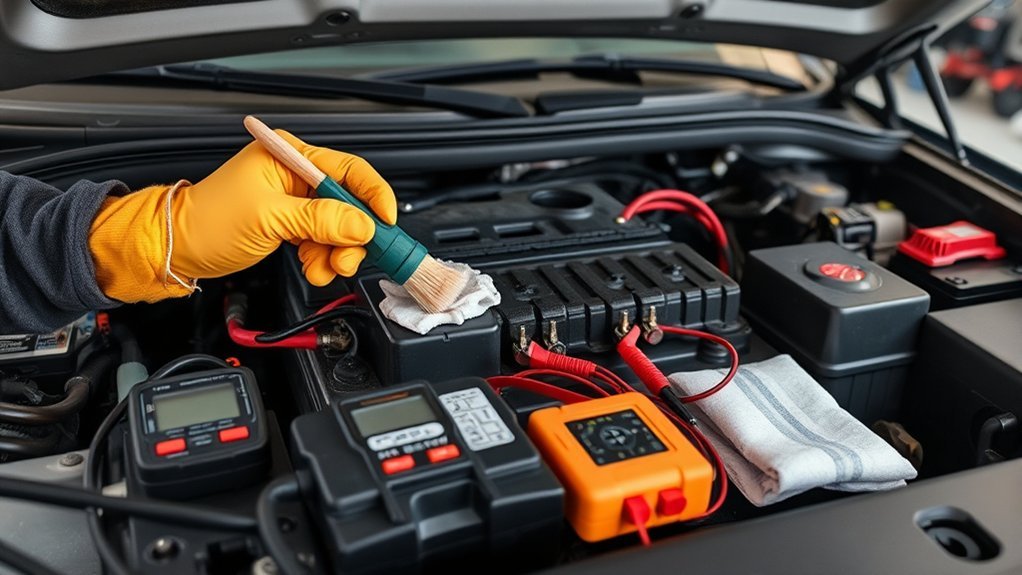
Warning: Batteries can contain corrosive acid and may release flammable gas. Wear eye and hand protection, work in a ventilated area, keep sparks and flames away, and never bridge the positive terminal to metal with a tool. Stop immediately if the case is cracked, leaking, hot, or swollen.
1. Prepare the Truck
Park on a level surface, set the parking brake, switch off the engine and all accessories, and keep the key or smart key away from the truck. Review the model-year manual before disconnecting power because stored settings and electronic systems may be affected.
2. Inspect Before Disconnecting
Check the case for bulging, cracks, wet areas, or discoloration. Confirm that the battery is firmly secured and that the positive terminal cover is intact. Inspect both cable ends for looseness, broken strands, damaged insulation, or heavy corrosion. Do not clean or reconnect a physically damaged battery; have it replaced professionally.
3. Disconnect in the Safe Order
If the manual permits owner disconnection, remove the negative terminal first, followed by the positive terminal. This sequence reduces the chance of creating a short circuit through the body or engine. Keep the disconnected cables from springing back onto the posts.
4. Neutralize and Remove External Corrosion
Apply a small amount of baking-soda-and-water solution to corrosion on the outside of the terminals and cable ends. Scrub with a dedicated terminal brush. Avoid getting the solution, loose debris, or rinse water into battery vents or cells. Wipe or lightly rinse the cleaned area as appropriate, then dry it thoroughly.
5. Inspect the Battery Type Before Checking Fluid
Do not remove caps or add water unless the battery is clearly labeled as serviceable and the battery manufacturer or Toyota manual provides a procedure. Sealed, maintenance-free, AGM, and other valve-regulated batteries must not be opened. If a serviceable flooded battery genuinely requires water, use only the type and amount specified by its manufacturer—typically distilled water—and never add acid.
6. Reconnect and Secure
Reconnect the positive terminal first, then the negative terminal. Tighten the connections to the specified torque without overtightening or damaging the posts. Refit the positive-terminal cover, confirm the hold-down is secure, and apply a battery-terminal protectant only if its instructions allow it.
7. Verify Operation
Start the truck and check for normal cranking and warning lights. Restore any settings that were lost. If a warning indicator remains on, the truck cranks slowly, or corrosion returns quickly, arrange a battery, starter, cable, and charging-system test.
Tips to Extend Your Battery Life
No routine can guarantee a specific lifespan, but these habits reduce avoidable stress:
- Keep the battery fully charged without overcharging it.
- Use a battery charger or maintainer that is compatible with the exact battery chemistry, capacity, and vehicle instructions.
- Avoid repeated deep discharges from lights, accessories, dash cameras, or other aftermarket equipment.
- Take enough normal road trips to replenish energy used during starting; frequent very short trips may not fully recover the charge.
- Have unexplained discharge diagnosed instead of assuming the battery is old.
- Keep terminals, grounds, and cable connections clean and tight.
- Keep the battery clamped securely so vibration does not damage it.
- Replace a damaged battery immediately and recycle the old battery through an approved retailer or facility.
Many automotive batteries are replaced after roughly three to five years, but climate, battery design, charging conditions, vibration, driving pattern, and electrical load can shorten or extend that range. Testing is more useful than replacing solely by calendar age.
Toyota Tundra Battery Maintenance in Hot Weather
Hot-weather care focuses on limiting underhood stress, catching physical damage early, and confirming that the charging system is not overcharging the battery. Parking in shade or a garage can reduce heat soak, but it does not replace testing or repair.
Inspect Battery Condition Regularly
During prolonged heat, perform a quick visual inspection more often and before long drives. Focus on:
- Case condition: Swelling, leakage, warping, or a sulfur-like odor requires prompt professional attention.
- Terminal condition: Clean corrosion and investigate rapid recurrence, which may point to leakage, venting, or a charging problem.
- Battery mounting: Confirm the hold-down is secure and the positive terminal cannot contact surrounding metal.
- Electrolyte level: Inspect only if the battery is explicitly serviceable; never pry open a sealed battery.
- Performance: Request a conductance or load test when starting slows, warning lights appear, or the battery is aging.
Check Cooling System Efficiency
The engine cooling system does not directly cool the 12-volt battery, but an overheating engine compartment can worsen heat exposure and may signal a broader maintenance problem. Keep the cooling system in good condition by following the Tundra’s model-year maintenance schedule, checking for leaks, and using the Toyota-specified coolant rather than assuming every truck needs a homemade 50/50 mixture.
If the temperature gauge rises, a warning appears, coolant is leaking, or the cooling fans do not operate correctly, stop treating the issue as battery maintenance and have the cooling system diagnosed.
Maintain Air Conditioning Function
A functioning air conditioner does not preserve the 12-volt battery directly. However, the blower, control modules, and compressor system add electrical demand, so weak charging-system performance may become more noticeable with the A/C, lights, and other accessories operating. If lights dim abnormally, voltage-related warnings appear, or the engine struggles only under heavy accessory load, request a charging-system test.
On an i-FORCE MAX model, the high-voltage hybrid system is separate from the 12-volt battery covered here. Do not touch orange high-voltage cables or attempt traction-battery service. Keep any owner-accessible hybrid cooling air inlets unobstructed as directed by the model-year manual.
When to Seek Professional Battery Service for Your Tundra?
Professional testing is appropriate when visual maintenance cannot explain the symptom or when the battery may be unsafe to handle. A qualified technician can test battery condition, cranking performance, charging output, cable voltage drop, and key-off electrical draw.
Signs of Weak Battery
Arrange testing when you notice slow cranking, repeated clicking, dimming during startup, frequent resets, repeated jump-starts, or a battery that loses charge while parked. Replace rather than clean a battery with a swollen or cracked case, active leakage, severe heat damage, or a loose terminal post.
Extreme Weather Impact
Test before severe weather if the battery is aging or has shown any weakness. Do not use a fixed temperature alone as the replacement rule, and do not put a battery warmer on a hot battery. If a warmer is appropriate for severe cold, it must be compatible with the battery, installed correctly, and used exactly as its manufacturer directs.
| Condition | Recommended Action |
|---|---|
| Cold weather plus slow cranking | Test the battery, cables, starter, and charging system before the next cold snap |
| Extreme heat plus swelling or leakage | Do not handle or charge it; arrange prompt replacement and inspect charging voltage |
| Recurring corrosion | Clean it safely, then check for leakage, venting, loose connections, and overcharging |
| Repeated jump-starts or overnight discharge | Diagnose battery health, alternator output, cable voltage drop, and parasitic draw |
Routine Maintenance Schedule
Use the following practical schedule, then adjust it for climate, use, and the model-year maintenance guide:
- Monthly or before a long trip: Look for loose connections, corrosion, damage, and an insecure hold-down.
- Before peak summer and winter: Request testing if the battery is older, the truck is used mainly for short trips, or starting performance has changed.
- After a jump-start or deep discharge: Fully recharge with an approved method and have the battery tested if it does not recover.
- During long storage: Connect a compatible automatic maintainer or follow Toyota’s storage procedure; inspect the charger and cables periodically.
- Immediately: Seek service for swelling, leakage, heat damage, warning lights, repeated jump-starts, or burning and sulfur-like odors.
Related Guides
Frequently Asked Questions
How do I protect my Tundra battery in hot weather?
Keep the battery clean, tight, charged, and securely mounted. Park in shade when practical, limit accessory use with the engine off, and inspect for swelling, leakage, or recurring corrosion. Check fluid only on a clearly serviceable battery. Have the battery and charging system tested when starting changes.
How often should I start my Tundra to keep the battery charged in cold weather?
There is no reliable universal interval, and idling for 15–20 minutes may not replace the energy used to start the engine. For a truck that sits, follow the Toyota storage guidance and use a compatible automatic maintainer. When driving, a normal road trip is generally more useful than repeated short starts and idling.
Does hot weather make a car battery drain faster?
Heat can increase self-discharge and accelerates internal corrosion and water loss in vented lead-acid batteries. That damage may not cause an immediate no-start; the weakened battery often becomes obvious later when cold weather reduces available cranking performance.
Can I leave a trickle charger on the battery all winter?
Use only an automatic maintainer designed for long-term connection and compatible with the battery type. Follow both the charger and Toyota instructions, use a dry and ventilated location, and inspect the setup periodically. Do not leave an old unregulated trickle charger connected indefinitely because it may overcharge the battery.
Should I add water to my Toyota Tundra battery?
Only if the battery is explicitly serviceable and its manufacturer provides a procedure. Never open a sealed, maintenance-free, AGM, or valve-regulated battery. If a serviceable flooded battery needs topping up, use the specified water—normally distilled water—and never add sulfuric acid.
Is the 12-volt battery the same as the hybrid battery in an i-FORCE MAX Tundra?
No. An i-FORCE MAX truck has a separate high-voltage hybrid system. The inspection and terminal-cleaning guidance in this article is for the 12-volt battery only. High-voltage components and orange cables require trained service procedures.
Conclusion
Reliable Toyota Tundra battery performance in hot and cold weather depends on condition, charge, connections, and correct testing—not a single temperature threshold. Keep the 12-volt battery clean and secure, avoid deep discharge, use only compatible charging equipment, and act quickly on slow cranking, repeated jump-starts, swelling, leakage, or warning lights. Always follow the instructions for your exact model year and battery type.
Sources
- Toyota Manuals and Warranties — model-year owner instructions, warnings, maintenance information, and hybrid-system guidance.
- Battery Council International — lead-battery industry standards, safety, fitment, and recycling information.
- Lead-Acid Battery Lifetime Extension Under Different Operating Conditions — research on corrosion, operating conditions, and lead-acid battery degradation.
- AAA Cold-Weather Battery Guidance — current guidance on reduced cold-weather performance, testing older batteries, and maintainers.
- Battery Council International Recycling Study — proper recovery and recycling of used lead batteries.