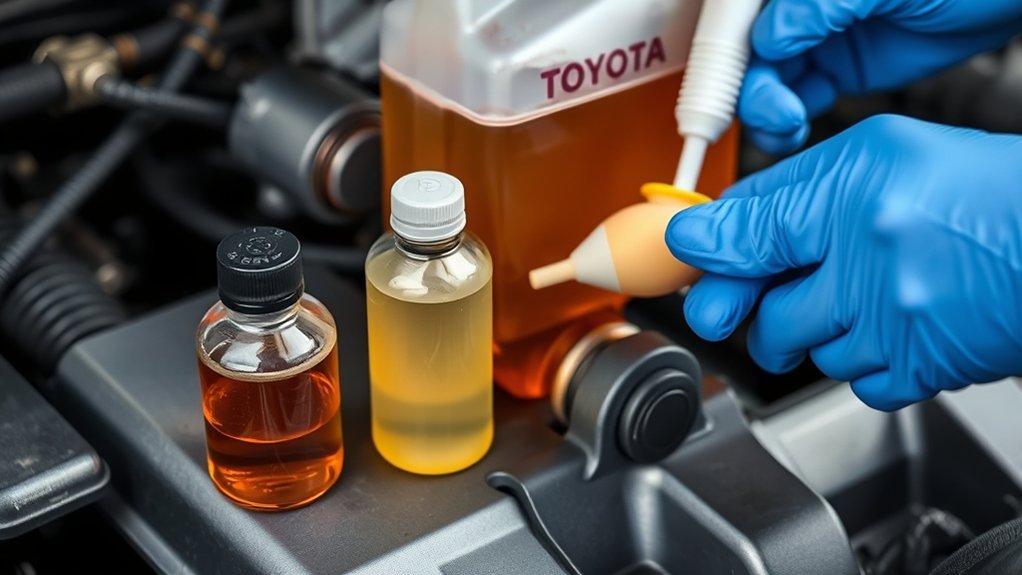
Toyota Tundra Brake Fluid: DOT 3 vs. DOT 4
Last updated: September 19, 2026 — model-year fluid guidance, federal DOT specifications, maintenance language, and safety guidance reviewed against Toyota documentation and FMVSS No. 116.
Choosing Toyota Tundra brake fluid depends on the truck’s model year and market. Verified Toyota documentation shows why a single answer does not fit every Tundra: the 2021 Tundra owner’s manual specifies FMVSS No. 116 DOT 3 / SAE J1703, while Toyota documentation for 2022 and the 2024 Tundra lists DOT 3/J1703 or DOT 4/J1704. For any other model year or market, confirm the brake-fluid reservoir cap and the exact Toyota owner’s manual before adding or replacing fluid.
Quick Answer
Use the brake-fluid specification Toyota lists for your exact Tundra. A verified 2021 U.S. Tundra manual calls for DOT 3 / SAE J1703. Toyota documentation for 2022 and the 2024 Tundra permits DOT 3 / SAE J1703 or DOT 4 / SAE J1704. If your manual or reservoir cap lists both, either listed grade meets Toyota’s stated fluid requirement; DOT 4 has higher federal minimum dry and wet boiling points.
| Toyota documentation | Listed brake fluid | What it means |
|---|---|---|
| 2021 Tundra owner’s manual | FMVSS No. 116 DOT 3 or SAE J1703 | Use DOT 3/J1703 unless Toyota documentation for the exact truck states otherwise. |
| 2022 Toyota Tundra service/accessory procedure | DOT 3/J1703 or DOT 4/J1704 | Toyota documentation for this application permits either listed grade. |
| 2024 Tundra owner’s manual | DOT 3/J1703 or DOT 4/J1704 | Either listed specification is acceptable under the manual. |
| Other years or markets | Check exact Toyota documentation | Do not extrapolate one model year’s specification to every Tundra. |
Key Takeaways
- Check the owner’s manual and reservoir cap for your exact Tundra before purchasing or adding fluid.
- Verified Toyota documentation differs by model year: the 2021 manual lists DOT 3, while Toyota documentation for 2022 and 2024 lists DOT 3 or DOT 4.
- DOT 4 has higher federal minimum dry and wet boiling points than DOT 3, but a higher number does not override Toyota’s specification.
- DOT 3 and DOT 4 do not automatically form sludge when mixed, but casual mixing can leave the system with uncertain performance and service history.
- Never substitute silicone-based DOT 5, mineral oil, power-steering fluid, or another unapproved liquid.
- A low reservoir, soft pedal, visible leak, or change in stopping ability needs diagnosis rather than a simple top-up.
Evidence note: This guide synthesizes Toyota owner/service documentation and the federal motor-vehicle brake-fluid standard. It does not claim hands-on testing across every Tundra generation, model year, brake system, or market. When vehicle-specific information differs, the documentation for the exact truck controls.
Understanding Brake Fluid: DOT 3 vs. DOT 4
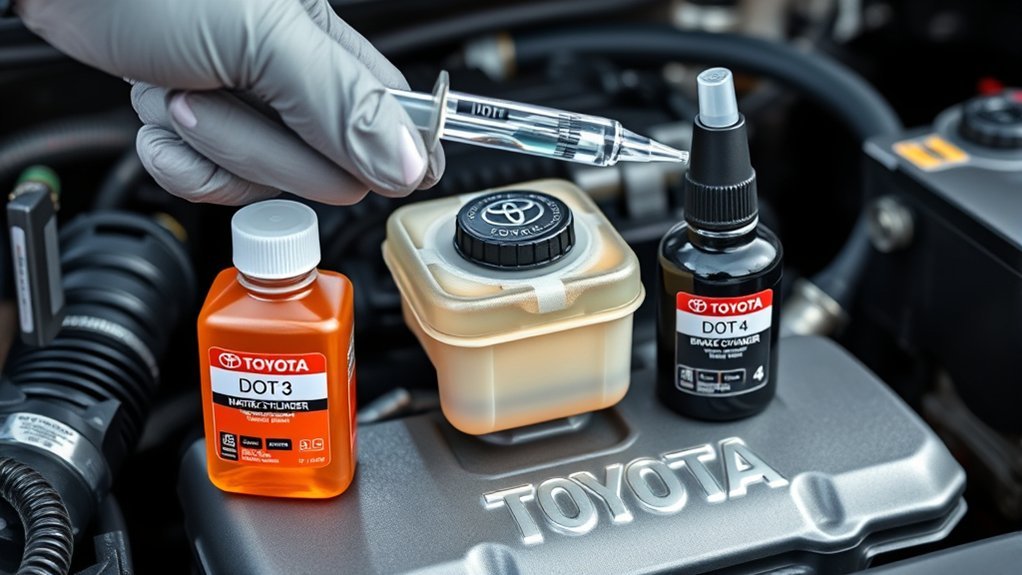
Brake fluid transfers hydraulic pressure from the brake pedal to the wheel brakes. It must remain stable across a wide temperature range, protect brake-system materials, resist excessive corrosion, and maintain suitable flow characteristics in cold weather.
In the United States, Federal Motor Vehicle Safety Standard No. 116 establishes minimum performance requirements for DOT brake-fluid grades. These are minimum standards; an individual product may exceed them.
| Feature | DOT 3 | DOT 4 |
|---|---|---|
| Minimum dry boiling point | 205°C / 401°F | 230°C / 446°F |
| Minimum wet boiling point | 140°C / 284°F | 155°C / 311°F |
| Maximum viscosity at −40°C | 1,500 mm²/s | 1,800 mm²/s |
| Best Tundra choice | Use when specified or permitted by Toyota for the exact truck | Use when Toyota permits DOT 4 for the exact truck |
A dry boiling point describes new fluid tested under specified conditions. A wet boiling point represents fluid after controlled moisture exposure. The wet number is especially useful because brake fluid can absorb moisture while in service, reducing its resistance to vapor formation under heavy braking.
DOT 4’s higher boiling-point minimum can provide additional thermal margin. That advantage is real, but it does not prove that DOT 4 is required for every Tundra. The correct decision still begins with Toyota’s fluid specification for the exact vehicle.
A higher DOT number describes particular performance requirements; it is not automatic permission to ignore the fluid grade Toyota specifies for your truck.
Can DOT 3 and DOT 4 Be Mixed?
FMVSS No. 116 includes compatibility testing intended to evaluate brake fluid with other motor-vehicle brake fluids. That means the blanket claim that compliant DOT 3 and DOT 4 fluids automatically turn to sludge or immediately destroy the hydraulic system when combined is not supported.
Even so, casual mixing is not the best maintenance practice. A blend should not be assumed to provide the full boiling-point performance of fresh DOT 4, and repeatedly topping up different grades can make the service history harder to interpret. If Toyota permits DOT 4 and a change of grade is desired, a proper fluid exchange is preferable to repeatedly adding small amounts to old fluid.
Warning: DOT 5 is a different, silicone-based grade and must not be confused with DOT 5.1. Do not add DOT 5, mineral oil, petroleum products, power-steering fluid, or any unidentified liquid to a Toyota Tundra brake system. Keep brake fluid clean and dry, and use only a newly opened or tightly sealed original container.
Which Brake Fluid Should Your Toyota Tundra Use?
The correct choice follows a simple decision rule: use the specification Toyota lists for the exact model year and market. A higher boiling point can matter under heat, but compatibility comes first.
| What Toyota documentation says | What to do | Reason |
|---|---|---|
| DOT 3 / SAE J1703 only | Use fresh DOT 3/J1703 fluid that meets the required standard. | It directly matches the listed factory specification. |
| DOT 3/J1703 or DOT 4/J1704 | Either listed specification is permitted; DOT 4 provides higher federal minimum boiling points. | Toyota has listed both alternatives for that application. |
| Fluid type is unknown or information conflicts | Do not guess or top up blindly. Verify the exact manual, reservoir labeling, and service information. | A safety-critical hydraulic system should not be serviced from an assumption. |
How Do You Verify the Correct Fluid for Your Model Year?
- Read the owner’s manual: Use Toyota’s official Manuals and Warranties portal and select the correct year and model.
- Inspect the reservoir cap: Look for the specified DOT grade and any additional standard printed on or beside the cap.
- Resolve conflicting information: If the cap, manual, prior service record, or aftermarket advice does not agree, do not guess. Ask a Toyota dealer or consult Toyota’s official service information.
- Check the container: Buy fresh fluid in a sealed container with the correct DOT designation and required compliance labeling.
Note: The Tundra spans multiple generations and markets. A specification verified for one year should not automatically be applied to every truck carrying the Tundra name.
Does DOT 4 Help When Towing or Driving in the Mountains?
If Toyota lists DOT 4 as an approved fluid for the exact Tundra, its higher minimum dry and wet boiling points can provide additional thermal margin during repeated heavy braking, such as long descents or other high-heat operation.
Towing by itself does not mean every Tundra should be converted to DOT 4. Brake temperature is also affected by vehicle and trailer load, trailer-brake adjustment, speed, downhill technique, brake condition, tire grip, and whether the driver uses an appropriate lower gear instead of continuously riding the brakes.
A higher-boiling fluid cannot compensate for worn pads, sticking calipers, overloaded equipment, an improperly adjusted trailer-brake system, or repeated braking beyond the system’s thermal capacity. It also does not increase the truck’s rated towing or payload limits.
If the truck’s documentation permits DOT 4 and you want the system filled with DOT 4, a complete exchange performed with the correct model-specific procedure provides a more predictable result than adding a small amount of DOT 4 to aged DOT 3.
Pro Tip: Before changing fluid grades for towing, inspect the brake pads, rotors, calipers, hoses, trailer-brake controller, trailer brakes, and fluid condition. A mechanical or setup problem matters more than the number printed on the fluid bottle.
How Do You Keep Tundra Brake Fluid in Good Condition?

Good brake-fluid maintenance is based on the correct specification, contamination control, service history, Toyota’s model-specific maintenance guidance, and inspection. Never leave the reservoir open longer than necessary, and do not pour used fluid back into a storage container.
How Often Should Toyota Tundra Brake Fluid Be Changed?
Do not apply a generic “every two years” or fixed-mileage rule to every Tundra as if it were a universal Toyota requirement. Toyota U.S. Tundra maintenance material includes inspection of brake-fluid level and condition, while exact replacement requirements can vary by vehicle documentation and market. Follow the maintenance guide for your model year and region.
Fluid should also be evaluated when the service history is unknown, the hydraulic system has been opened, contamination is suspected, the wrong liquid has been introduced, testing indicates degraded condition, or the brakes have experienced abnormal heat.
A fluid exchange replaces aged fluid throughout the hydraulic system. Bleeding removes air from the hydraulic system. The procedures can overlap during service, but they solve different problems. Replacing only the visible fluid in the reservoir does not renew fluid trapped in brake lines, calipers, and control components.
How Can You Monitor Brake-Fluid Condition?
Check the fluid level and look for obvious contamination during routine service. Fresh DOT 3 and DOT 4 fluids are generally colorless to amber when packaged, but fluid color alone is not a complete condition test. Darkening can justify closer inspection, while apparently clear fluid can still contain moisture or have an unknown service history.
- Level: The reservoir should remain within the marked operating range.
- Clarity: Cloudiness, debris, separation, or an unidentified liquid requires professional inspection.
- Service history: Unknown or poorly documented fluid deserves closer evaluation.
- Testing: Moisture, boiling-point, and corrosion-indicator tests can help, but the test procedure and manufacturer’s interpretation should be followed.
Copper test strips are sometimes used as a supplemental indicator of brake-fluid condition. Do not treat one universal copper value as a Toyota replacement threshold unless the test manufacturer and the applicable Toyota service information support that interpretation.
How Do You Check the Reservoir Safely?
- Park on level ground, secure the truck, switch it off, and allow hot under-hood components to cool.
- Locate the brake-fluid reservoir using the owner’s manual.
- Clean dirt from around the reservoir before touching the cap.
- Inspect the fluid level through the reservoir whenever possible without opening it.
- If the level is below the specified range, consider brake-pad wear or a hydraulic leak instead of automatically adding fluid.
- If opening the reservoir is necessary, prevent dirt and moisture from entering and use only the exact approved fluid from a clean, sealed container.
When Does Brake Bleeding Require Model-Specific Service Information?
The owner’s manual, reservoir cap, and factory service information take priority over forum posts, bottle marketing, and generalized fluid charts. Toyota’s Technical Information System contains factory service and diagnostic information for Toyota vehicles marketed in North America.
Brake bleeding procedures can vary with model year, brake-system configuration, and the components that were opened. Some procedures involving electronically controlled brake components may require diagnostic-tool or actuator steps. Do not assume that one generic bleeding sequence applies to every Tundra. A visual fluid-level check may be suitable for an owner, but a complete exchange or repair is safety-critical work that requires the correct procedure, tools, and experience.
What Signs Mean the Brake System Needs Service?
Brake-fluid condition is only one part of the hydraulic braking system. The following signs justify prompt inspection:
- Low reservoir level: A gradual reduction can accompany brake-pad wear, while a sudden or severe drop may indicate leakage.
- Soft, spongy, or sinking pedal: Possible causes include air, a leak, overheated fluid, a failing hose, or another hydraulic fault.
- Visible fluid leakage: Wetness around a caliper, hose, line, master cylinder, or under the truck needs immediate attention.
- Reduced braking or increased pedal travel: Do not assume that a fluid change alone will solve the problem.
- Red brake-system warning: Stop safely and follow the owner’s manual, especially when braking behavior has changed.
- ABS warning light: The ABS system has detected a fault that requires diagnosis. The light is not a reliable test of fluid moisture or contamination.
- Contamination or incorrect fluid: Do not operate the truck until the extent of contamination and the required repair are determined.
Warning: Do not continue driving if the brake pedal sinks, braking ability changes, the reservoir is unexpectedly empty, or a hydraulic leak is visible. Have the Tundra transported for professional inspection rather than relying on a top-up.
How to Choose Brake Fluid for Your Toyota Tundra
The best choice is a fresh, uncontaminated brake fluid that matches one of the specifications Toyota lists for the exact truck. Do not select fluid simply because it has the highest DOT number or because a retailer lists it as a generic fit.
Use this checklist when selecting fluid:
- The DOT and SAE specification matches the exact owner’s manual, reservoir labeling, or applicable Toyota service information.
- The container is sealed, clean, undamaged, and clearly labeled.
- The product states compliance with the applicable motor-vehicle brake-fluid standard.
- The fluid is not silicone-based DOT 5 or another unapproved chemistry.
- The bottle contains enough fresh fluid for the planned service without relying on an old, repeatedly opened container.
- Any fluid exchange or bleeding work follows the procedure for the exact Tundra and brake-system configuration.
Related Guides
Frequently Asked Questions
Does Toyota use DOT 3 or DOT 4 brake fluid in the Tundra?
It depends on model year and market. A verified 2021 Tundra owner’s manual lists FMVSS No. 116 DOT 3 / SAE J1703. Toyota documentation for 2022 and the 2024 Tundra lists DOT 3/J1703 or DOT 4/J1704. Check the exact manual and reservoir labeling for your truck.
What brake fluid does a 2021 Toyota Tundra use?
Toyota’s 2021 U.S. Tundra owner’s manual lists FMVSS No. 116 DOT 3 or SAE J1703 brake fluid. Confirm the reservoir cap and documentation for the individual truck before service.
Can a 2024 Toyota Tundra use DOT 4 brake fluid?
Yes. Toyota’s 2024 Tundra owner’s manual lists FMVSS No. 116 DOT 3 / SAE J1703 and FMVSS No. 116 DOT 4 / SAE J1704 as brake-fluid options.
Does it matter whether I use DOT 3 or DOT 4?
Yes. DOT 3 and DOT 4 have different minimum boiling-point and viscosity requirements. If Toyota lists only DOT 3 for your truck, follow that specification. If Toyota lists both DOT 3 and DOT 4, either listed grade is permitted, while DOT 4 provides higher federal minimum dry and wet boiling points.
What happens if DOT 3 and DOT 4 are mixed?
FMVSS-compliant brake fluids undergo compatibility testing, so mixing DOT 3 and DOT 4 does not automatically mean the fluid will gel or destroy the system. However, the blend should not be assumed to retain the full performance of fresh DOT 4, and the specification Toyota lists for the truck still controls the service decision.
Should I switch to DOT 4 because I tow with my Tundra?
Not automatically. First confirm that Toyota lists DOT 4 for the exact truck. When DOT 4 is permitted, its higher minimum boiling points can provide additional thermal margin, but brake condition, trailer-brake adjustment, load, speed, gearing, and downhill technique are also important.
Is DOT 5.1 the same as DOT 5?
No. DOT 5 is a silicone-based brake-fluid grade, while DOT 5.1 is a different non-silicone DOT classification. Do not use either as a substitute merely because the number is higher; use the specification Toyota lists for the exact Tundra.
How often should Toyota Tundra brake fluid be changed?
Do not treat one mileage or time interval as a universal Toyota rule for every Tundra. Follow the maintenance guide for the exact model year and market, monitor fluid level and condition, and replace the fluid when the applicable schedule, service work, contamination, testing, or condition requires it.
Can I simply top up low brake fluid?
Do not top it up without considering why the level is low. Brake-pad wear can lower the reservoir level gradually, while a sudden drop or frequent need for fluid can indicate a leak or another fault. Diagnose the cause and use only the specified fluid when a top-up is appropriate.
Conclusion
For a Toyota Tundra, use the brake fluid Toyota lists for the exact model year and market. Verified examples show that a 2021 Tundra specifies DOT 3/J1703, while Toyota documentation for 2022 and the 2024 Tundra permits DOT 3/J1703 or DOT 4/J1704. DOT 4 has higher federal minimum boiling points, but that advantage does not make it a universal substitute. Use fresh, correctly labeled fluid, protect the system from contamination, and investigate leaks, low fluid, warning lights, or pedal changes instead of relying on repeated top-ups.
Sources
- Toyota Manuals and Warranties — official model-year owner’s manuals, warranty documents, and maintenance information.
- Toyota 2022 Tundra/Tundra HV TRD Lift Kit Service Procedure — Toyota procedure listing SAE J1703/FMVSS DOT 3 and SAE J1704/FMVSS DOT 4 brake fluid.
- 2024 Toyota Tundra Warranty & Maintenance Guide — model-specific Toyota maintenance guidance.
- Toyota Technical Information System — official factory service, repair, diagnostic, and technical information for North American Toyota vehicles.
- 49 CFR 571.116, Federal Motor Vehicle Safety Standard No. 116 — brake-fluid boiling points, viscosity, compatibility, packaging, labeling, contamination, and performance requirements.