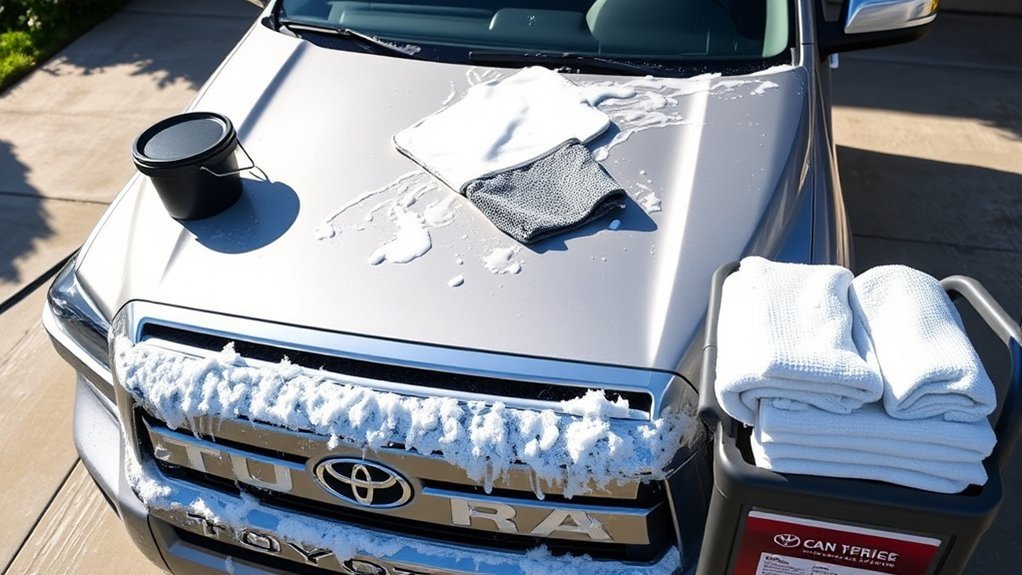
Washing a Toyota Tundra without adding swirl marks requires more than a soft mitt. The safest routine removes loose grit before you touch the paint, keeps wheel debris away from body-wash tools, uses light pressure, and dries the truck before mineral-rich water can evaporate. No contact wash is completely scratch-proof, but careful technique can greatly reduce the risk.
Quick Answer
Park the Tundra in a cool, shaded area, clean the wheels with separate tools, and thoroughly pre-rinse the body. Hand wash from the roof downward with automotive shampoo, a clean microfiber mitt, and separate wash and rinse buckets. Rinse each section, then dry immediately with clean microfiber towels or a vehicle dryer.
Key Takeaways
- Pre-rinsing is essential because loose sand, salt, and road grit can scratch paint when trapped under a mitt or towel.
- Use separate tools for wheels and body panels so brake dust and coarse debris never reach the paint.
- Use a dedicated automotive shampoo at the label’s recommended dilution instead of judging the mixture by how much foam it produces.
- Wash with light, straight passes from the cleanest upper panels toward the dirtier lower panels.
- Check your exact model-year owner’s manual before using a pressure washer near cameras, sensors, trim, the windshield, or the underbody.
At a Glance
| Time Required | About 45–75 minutes, depending on dirt level and truck configuration |
| Difficulty | Easy, with careful tool handling |
| Tools Needed | Two buckets, optional grit guards, microfiber wash mitt, wheel brushes, hose, drying towels, and optional vehicle dryer |
| Cost | About $20–$60 if you are buying basic supplies for the first time |
Why Hand Washing Your Tundra Helps Protect the Paint

A careful hand wash gives you control over the tools, pressure, and direction used on each panel. That control matters because most wash-induced marring occurs when dirt is moved across the finish rather than lifted away from it.
The two-bucket method reduces cross-contamination by keeping shampoo in one bucket and clean rinse water in the other. After washing a section, rinse the mitt thoroughly before returning it to the shampoo. Optional grit guards or dirt separators can help keep settled debris away from the mitt, but they do not replace frequent inspection and rinsing.
Hand washing is not automatically safer than every machine wash. A dirty mitt, rough towel, dry wiping, heavy pressure, or reused wheel tool can scratch paint quickly. The technique and cleanliness of the supplies matter more than the fact that the work is being done by hand.
The safest washing routine removes loose grit before contact and prevents dirty tools from returning to clean paint.
Gather the Right Tundra-Washing Supplies
Use clean products and tools intended for automotive surfaces. Household rags, bath towels, stiff brushes, and old sponges can trap abrasive particles or create unnecessary friction. Wash all microfiber tools before their first use and remove any tags or sharp labels that could touch the paint.
| Supply | Purpose | Important Note |
|---|---|---|
| Automotive shampoo | Cleans while providing lubrication | Choose one labeled safe for your paint and existing wax, sealant, or coating. |
| Two buckets | Separates shampoo from dirty rinse water | Add grit guards if available, but still inspect the mitt frequently. |
| Microfiber wash mitt or paint-safe wash pad | Provides gentle contact with the paint | Stop using it if it falls on the ground or traps visible grit. |
| Separate wheel brushes and mitt | Removes brake dust and road grime | Never reuse wheel tools on painted body panels. |
| Large microfiber drying towels | Removes water before spotting occurs | Keep several available so a saturated or dirty towel can be replaced. |
| Bug and tar remover | Softens stubborn contamination | Confirm compatibility and test an inconspicuous area first. |
| Hose with a gentle spray nozzle | Pre-rinses and flushes shampoo away | A pressure washer is optional and requires model-specific precautions. |
Prepare Your Tundra Before Washing
- Park on a suitable surface: Choose a cool, shaded location with enough room to reach the roof, bed sides, tailgate, and lower panels safely.
- Let hot components cool: Do not touch or spray a hot exhaust outlet immediately after driving.
- Close the truck: Confirm that the windows, doors, tailgate, tonneau cover, moonroof, and sliding rear window are fully closed as applicable.
- Remove scratch hazards: Take off rings, watches, bracelets, belt accessories, and anything else that could contact the paint.
- Control the hose: Keep the hose and fittings from dragging across the bumper, fenders, running boards, or bedside.
- Inspect the finish: Identify matte paint, vinyl wrap, paint-protection film, fresh bodywork, ceramic coating, or decals before selecting chemicals and protection products.
- Check the manual: Review the instructions for your exact model year through Toyota’s Tundra owner’s-manual library.
Warning: High-pressure water can damage trim or interfere with cameras, radar equipment, seals, and other components when used too close or aimed at sensitive areas. Toyota’s 2024 Tundra manual also warns against washing the underside with a high-pressure washer. Use a gentle hose rinse on the wheel wells and underbody unless the instructions for your exact model year state otherwise.
Step-by-Step Guide to Washing Your Toyota Tundra
1. Clean the Wheels and Tires First
Rinse one wheel at a time, apply a cleaner that is compatible with the wheel finish, and agitate it with dedicated brushes or a wheel mitt. Clean the tire sidewalls and accessible wheel-well surfaces, then rinse thoroughly.
Do not let wheel cleaner dry, and do not carry the same brushes, mitts, towels, or bucket water over to the paint. Brake dust and coarse road debris can create scratches if transferred to a body panel.
2. Pre-Rinse the Body Thoroughly
Rinse the roof, glass, hood, doors, bed sides, tailgate, bumpers, running boards, and lower panels before touching the paint. The goal is to float away as much loose grit as possible.
Pay extra attention to mud trapped behind wheel openings, along rocker panels, around badges, under the tailgate handle, and near the rear bumper. Use gentle water flow around seals, cameras, parking sensors, radar-related components, and exterior electrical accessories.
3. Prepare the Two-Bucket System
Fill the wash bucket with water and the amount of automotive shampoo stated on the product label. Fill the second bucket with clean water for rinsing the mitt. More foam does not necessarily mean more lubrication or better cleaning, so avoid exceeding the recommended concentration merely to create thicker suds.
Place an optional grit guard in one or both buckets. Keep a spare mitt available for the lower panels, which usually hold more abrasive contamination than the roof and upper doors.
4. Wash From the Top Down
Load the mitt with shampoo and begin with the roof. Continue with the glass, hood, upper doors, bed rails, upper bed sides, tailgate, and then the lower panels. Work on one manageable section at a time.
- Use light pressure and short, straight, overlapping passes.
- Avoid forceful circular scrubbing.
- Flip or rotate the mitt to a clean side when possible.
- Rinse the mitt after each section and whenever it looks dirty.
- Replace the mitt immediately if it touches the ground.
- Keep already-washed areas wet so shampoo and minerals do not dry on the finish.
Pro Tip: Use one mitt for the cleaner upper panels and a second mitt for rocker panels, bumpers, running boards, and other heavily soiled areas. This creates another barrier against transferring grit to highly visible paint.
5. Soften Bugs, Sap, and Bird Droppings
Do not scrape or aggressively scrub dried contamination. Wet the area, apply a finish-compatible remover or shampoo solution, and allow it to soften according to the product instructions. Wipe gently with a dedicated clean microfiber towel, then rewash and rinse the area.
If the residue remains, repeat the soaking process rather than increasing pressure. Stop if the surface feels rough after washing; bonded contamination may require a proper decontamination treatment instead of more scrubbing.
6. Rinse the Tundra Completely
Rinse from the top downward until no shampoo remains around mirrors, badges, handles, window trim, the grille, bed rails, tonneau-cover edges, the tailgate, or running boards.
For the final pass, remove the spray nozzle and let a gentle stream of water flow across large panels. This “sheeting” rinse can leave fewer isolated droplets, making the truck faster and safer to dry.
7. Dry the Truck Immediately
Begin drying before water starts evaporating. Use a clean microfiber drying towel with light contact. Lay the towel across a panel and gently pull it in a straight line, or blot the surface rather than pressing hard.
Open doors and the tailgate only after the exterior has been rinsed. Use a separate towel for door jambs, the fuel-door area, running boards, and other locations that may contain hidden dirt.
Tips for Drying Your Truck Without Leaving Water Spots

Water spots form when droplets evaporate and leave dissolved minerals or other residue behind. Dark paint may show these deposits quickly, particularly when the panels are warm or the local water supply contains substantial mineral content.
Microfiber Towel Drying
- Use a large, clean towel designed for automotive drying.
- Start with the roof and glass before moving down the sides.
- Turn the towel frequently and replace it when saturated or contaminated.
- Do not use the same towel on wheels, exhaust outlets, door sills, and painted panels.
- Wash microfiber separately from lint-producing cotton and avoid fabric softener, which can reduce absorbency.
Using a Vehicle Dryer or Blower
A clean vehicle dryer or clean electric blower can reduce paint contact and remove trapped water from mirrors, badges, grille openings, window trim, bed rails, door handles, and the tailgate. Confirm that the intake and nozzle are clean before use, and avoid blowing dust from the ground onto wet paint.
Even when using a blower, inspect the truck afterward and remove remaining droplets with a clean microfiber towel before they dry.
Note: If water begins drying before you reach a panel, wet that panel again rather than rubbing a dry mineral deposit with a towel.
Choosing the Right Soap for Your Tundra Wash
Use a dedicated automotive shampoo labeled as safe for clear-coated paint and compatible with any wax, sealant, or coating already on the truck. A pH-neutral or pH-balanced shampoo is a common maintenance-wash choice, but compatibility, lubrication, correct dilution, and complete rinsing matter more than a marketing label alone.
Do not routinely substitute hand soap, laundry detergent, household degreaser, or dishwashing liquid. These products are not formulated as lubricated automotive shampoos and may weaken or remove protective waxes and sealants. Consumer Reports’ car-washing guidance likewise advises against household cleaning agents on automotive paint.
Follow the shampoo manufacturer’s dilution instructions. Too little product may provide inadequate cleaning or lubrication, while too much may be harder to rinse and can leave residue. Foam volume by itself does not prove that a mixture is safer or more effective.
Common Mistakes That Cause Swirl Marks
- Wiping dust from dry paint: Even a soft towel can drag grit across the finish without adequate lubrication.
- Using one tool everywhere: Wheel debris and lower-panel grit should never be carried to the hood, doors, or roof.
- Pressing harder on stubborn contamination: Soak and repeat instead of forcing the mitt or towel across the spot.
- Allowing tools to touch the ground: Retire or thoroughly wash a dropped mitt or towel before it contacts paint again.
- Using dirty automatic-wash or self-service brushes: Previously trapped grit may be transferred to the truck.
- Washing hot paint: Shampoo and rinse water can dry before they are removed.
- Letting the truck air-dry: Evaporation can leave mineral deposits and streaks.
- Dragging hoses or buckles across panels: Washing accessories and clothing can scratch the finish just as easily as a dirty mitt.
Hand Wash vs. Touchless and Brush Car Washes
A properly performed hand wash offers the greatest control, but a careless hand wash can still cause scratches. Automatic brush or cloth washes introduce physical contact from shared equipment, so they are not the first choice for owners trying to minimize visible marring.
A touchless wash avoids rotating-brush contact and may be the better automated option when a safe hand wash is unavailable. However, it is not completely risk-free. Touchless systems may use stronger detergents or concentrated water pressure, may leave bonded grime behind, and may not dry every surface completely.
If your Tundra has loose paint, damaged trim, aftermarket accessories, vinyl graphics, paint-protection film, or a special coating, confirm the equipment and chemical restrictions before entering any automatic wash.
Special Finishes, Wraps, and Coatings
Factory gloss paint, matte paint, vinyl wrap, paint-protection film, and ceramic coatings do not always use the same soaps, stain removers, waxes, or drying products.
- Matte or low-gloss paint: Do not apply conventional wax, polish, glaze, or abrasive products unless the finish manufacturer specifically approves them. Review PPG’s matte-finish care guidance.
- Vinyl wrap: Use wrap-compatible chemicals and avoid aggressive scrubbing. The 3M vehicle-wrap maintenance bulletin recommends careful rinsing, soft clean tools, hand washing when possible, and finish-specific product selection.
- Paint-protection film: Follow the film installer’s or manufacturer’s instructions, especially around exposed edges and high-pressure water.
- Ceramic coating: Use a maintenance shampoo and drying aid approved by the coating manufacturer. Avoid assuming that a coating makes abrasive washing harmless.
- Fresh paint or body repair: Follow the repair facility’s curing and washing instructions before applying pressure, chemicals, wax, or sealant.
How Often Should You Wash a Toyota Tundra?
Wash the truck when contamination becomes visible and promptly after exposure to road salt, coastal spray, heavy mud, bird droppings, insects, tree sap, fuel spills, or other substances that can stain or attack the finish. Toyota identifies several of these conditions as reasons for prompt exterior cleaning in its 2024 Tundra owner’s manual.
There is no single ideal calendar interval for every owner. A garaged truck used in dry weather may need washing less often than a work truck driven on salted roads, construction sites, farms, beaches, or muddy trails. Wash when needed, but make every contact wash deliberate and gentle.
Frequently Asked Questions
What is the best way to wash a Toyota Tundra without scratching the paint?
Thoroughly pre-rinse the truck, clean wheels with separate tools, and hand wash the body from top to bottom with automotive shampoo and a clean microfiber mitt. Rinse the mitt after each section, use minimal pressure, keep the paint wet, and dry immediately with clean microfiber towels or a vehicle dryer.
Do I need two buckets to wash a Toyota Tundra safely?
Two buckets are recommended because one holds shampoo and the other removes dirt from the mitt before it returns to the wash solution. They reduce contamination but do not guarantee a scratch-free wash. Multiple clean mitts can provide an additional safeguard.
Should I wash the Tundra’s wheels before the body?
Yes. Wheels and wheel wells usually contain brake dust, sand, and coarse road debris. Clean and rinse them first with dedicated brushes, a separate mitt, and separate towels so that contamination is not transferred to painted body panels.
Can I use a pressure washer on a Toyota Tundra?
A pressure washer may be used only with appropriate distance, spray pattern, and model-specific precautions. Do not direct concentrated pressure at cameras, radar-related components, seals, damaged paint, trim edges, the lower windshield, or aftermarket accessories. Toyota’s 2024 Tundra manual warns against using a high-pressure washer on the underside, so review the manual for your exact model year before proceeding.
What type of automatic car wash is least likely to scratch paint?
A touchless wash avoids contact from rotating brushes and shared cloth strips, so it generally presents less contact-related risk than a brush wash. It is not guaranteed to be harmless, because chemical strength, water pressure, existing paint damage, and incomplete drying can still affect the finish.
Is Dawn dish soap safe for Toyota Tundra paint?
Dish soap is not recommended for routine washing. It is not formulated as a lubricated automotive shampoo and may weaken or remove waxes and sealants. A single accidental use does not automatically mean the clear coat is ruined, but a dedicated automotive shampoo is the safer maintenance choice.
Should I wax the Tundra after every wash?
Not necessarily. Reapply wax, sealant, or another protection product according to that product’s instructions and only when it is compatible with the finish. Do not apply conventional wax to matte paint or certain wraps unless the finish manufacturer specifically approves it.
Conclusion
The safest way to wash a Toyota Tundra is to control every source of contact. Pre-rinse thoroughly, keep wheel tools separate, use properly diluted automotive shampoo, wash with light top-to-bottom passes, and replace any mitt or towel that becomes contaminated.
Finish by rinsing every crevice and drying the truck before water evaporates. These habits cannot guarantee that paint will never develop a mark, but they significantly reduce avoidable wash-induced marring and help preserve the Tundra’s appearance without relying on exaggerated products or aggressive cleaning methods.
Sources
- Toyota 2026 Tundra Owner’s Manuals and Warranties — current access point for model-specific Toyota manuals.
- Toyota 2024 Tundra Owner’s Manual — exterior-cleaning, high-pressure-water, sensor, exhaust, and underbody cautions.
- Consumer Reports: How to Wash Your Car Like a Pro — automotive shampoo, household-cleaner, washing, and drying guidance.
- PPG Matte Finish Care Guide — finish-specific advice on shade, pre-rinsing, two buckets, soft tools, wheel separation, and drying.
- 3M Vehicle Graphics Maintenance Instruction Bulletin — wrap-specific hand-washing, touchless-wash, rinsing, drying, and chemical-compatibility guidance.