Your Toyota Tacoma can tow steadily when the truck, trailer, hitch, tires, brakes, and cargo all work as one correctly matched system. The most important steps are confirming your exact vehicle ratings, measuring the loaded trailer and tongue weight, keeping the trailer level, and driving at a speed that suits the conditions.
Quick Answer
To improve Toyota Tacoma towing stability, stay within every weight rating, place heavier trailer cargo low and ahead of the axle, measure tongue weight, level the trailer, maintain correct tire pressure, use properly adjusted trailer brakes, and slow down for wind, hills, curves, or passing traffic.
Key Takeaways
- Use the ratings for your exact Tacoma configuration, not a general maximum quoted for another year or trim.
- Tongue weight, passengers, bed cargo, accessories, and hitch equipment all use the truck’s available payload.
- Correct loading and measured weights prevent more sway problems than suspension modifications.
- A weight-distribution hitch should be used only when Toyota and the hitch and trailer manufacturers permit or require it.
- Driver-assistance technology can help, but it cannot overcome overloading, poor maintenance, or excessive speed.
At a Glance
| Time Required | About 30–60 minutes for a complete setup inspection, plus time at a public scale when weighing the combination |
| Difficulty | Moderate; professional help is recommended when ratings, brake setup, or hitch compatibility are unclear |
| Tools Needed | Cold-tire pressure gauge, wheel chocks, torque wrench, tongue-weight scale or public vehicle scale, tape measure, and the truck, hitch, brake-controller, and trailer manuals |
| Cost | Varies; basic inspections may require only a scale fee, while worn tires, brake equipment, or compatible hitch components cost more |
Warning: Towing limits vary by model year, cab, bed, drivetrain, transmission, trim, options, and installed equipment. Follow the owner’s manual and certification labels for your exact Tacoma. Never exceed the lowest rating among the truck, receiver, ball mount, hitch ball, coupler, trailer, tires, axles, or other components.
Understanding Towing Stability in the Toyota Tacoma
Towing stability describes how well your Tacoma and trailer remain aligned and predictable during acceleration, braking, cornering, and exposure to wind. A stable combination responds smoothly to steering and does not repeatedly swing from side to side.
Stability starts with the physical setup. Your loaded trailer must remain within its rating, place an appropriate amount of weight on the hitch, sit close to level, and use tires and brakes that are suitable for the load. Cargo must stay secured so its position cannot change while you drive.
Your Tacoma’s suspension and electronic systems can support a correct setup, but they cannot make an overloaded or poorly balanced trailer safe. Trailer-Sway Control and other stability systems are backup aids, not replacements for measured weights, correct equipment, and attentive driving.
Verify Your Tacoma’s Exact Ratings
Do not rely on a single towing-capacity number from an advertisement or an article about a different Tacoma. Find the information for your exact model year and configuration in the Toyota owner’s manual and warranty portal.
Check these ratings before loading the trailer:
- GVWR: The maximum allowed weight of the loaded Tacoma, including passengers, cargo, accessories, hitch equipment, and trailer tongue weight.
- GAWR: The maximum permitted weight on each axle. Rear-axle weight often becomes a limiting factor while towing.
- GCWR: The maximum combined weight of the loaded truck and loaded trailer, when specified for the configuration.
- Payload: The amount of passenger and cargo weight the individual truck can carry. Use the label on your truck rather than a generic online figure.
- Trailer weight rating: The maximum trailer weight allowed for the exact truck and required equipment.
Remember that the advertised maximum normally applies only to a specific configuration. Larger wheels, extra accessories, four-wheel drive, passengers, bed cargo, and optional equipment may reduce the usable margin.
Note: Tongue weight counts against the Tacoma’s payload. A trailer can remain below its maximum trailer rating while still overloading the truck’s payload or rear axle.
Common Causes of Toyota Tacoma Trailer Sway
Trailer sway rarely has only one cause. It often develops from a combination of incorrect loading, excessive speed, poor tire condition, an unlevel trailer, worn components, crosswinds, or steering inputs that start an oscillation.
Overloaded Trailer Weight
An overloaded truck or trailer has less reserve for braking, steering, heat control, and sudden maneuvers. You must stay within every applicable truck, trailer, axle, tire, and hitch rating rather than focusing only on the maximum trailer-weight figure.
Include all of the following when calculating the real load:
- The empty trailer and factory-installed equipment
- Water, fuel, batteries, propane, tools, and optional accessories
- Food, luggage, vehicles, or other cargo inside the trailer
- Passengers and cargo in the Tacoma
- Bed caps, steps, recovery gear, toolboxes, and other truck accessories
- The receiver insert, weight-distribution hardware, and tongue weight
No universal rule says that every trailer must remain below 60 percent of the Tacoma’s maximum rating. A lighter trailer usually leaves more operating margin, but actual stability still depends on loading, design, maintenance, weather, and speed.
Improper Weight Distribution
A trailer with too little weight on the tongue can become unstable because its center of mass sits too far rearward. Too much tongue weight can overload the Tacoma’s payload, rear axle, tires, receiver, or suspension.
For many conventional bumper-pull trailers, placing roughly 60 percent of the cargo in the front half is a useful starting point. It is not a substitute for measuring tongue weight. Follow the trailer manufacturer’s loading instructions and verify the finished setup with an appropriate scale.
Keep dense items low, close to the trailer’s centerline, and slightly ahead of the axle group. Avoid placing heavy cargo at the far front or rear. Secure every item so braking, bumps, or turns cannot move it.
Insufficient Hitch Setup
A mismatched or poorly adjusted hitch can create nose-high towing, reduced front-axle loading, loose coupling, uneven weight transfer, or inadequate ground clearance.
- Match the receiver, ball mount, hitch ball, coupler, pin, and safety chains to the load.
- Confirm that the hitch ball diameter matches the coupler exactly.
- Use the lowest rated component as the system’s maximum limit.
- Adjust rise or drop so the loaded trailer sits level or as its manufacturer specifies.
- Cross safety chains beneath the coupler without allowing them to drag.
- Attach the breakaway cable to the truck separately from the safety chains.
- Inspect the receiver, welds, mounting hardware, coupler, latch, and chains for damage or unusual wear.
A weight-distribution hitch may restore some load to the Tacoma’s front axle and improve control when correctly selected and adjusted. Use one only if the manuals for the Tacoma, receiver, hitch, and trailer permit it. Certain surge-brake systems and trailer frames require specific equipment or adjustment.
The Impact of Weight Distribution on Towing Stability
Weight distribution affects steering response, braking balance, rear-axle load, headlight aim, tire loading, and the trailer’s resistance to sway. Visual appearance alone cannot confirm that the combination is within its limits.
Proper Tongue Weight
Many conventional trailers are designed to place approximately 10 to 15 percent of their loaded weight on the hitch. The exact target depends on the trailer design and manufacturer instructions.
For example, a loaded 4,000-pound conventional trailer might require approximately 400 to 600 pounds of tongue weight if its manufacturer specifies the common 10-to-15-percent range. That entire load, plus the hitch equipment, passengers, accessories, and bed cargo, must fit within the Tacoma’s payload and axle limits.
Measure tongue weight with a correctly rated tongue-weight scale or by using an accepted public-scale method. Measure the trailer in its travel-ready condition, including fluids, batteries, propane, luggage, and other cargo.
A published tow rating does not guarantee that your Tacoma has enough payload for the trailer’s tongue weight, passengers, hitch equipment, and bed cargo.
Load Placement Strategy
Load the heaviest items low and near the trailer’s centerline. Position them ahead of the axle group only far enough to reach the trailer manufacturer’s tongue-weight target. Secure them to rated anchor points with restraints suitable for the load.
Avoid storing dense items at the rear of the trailer. Rear-heavy loading reduces tongue weight and can make the trailer more sensitive to steering movements, crosswinds, and pressure changes from passing vehicles.
Recheck tongue weight whenever you change the cargo arrangement, fill or drain tanks, add batteries, mount equipment, or carry a vehicle. Tank location matters because water or fuel can significantly change both total weight and balance.
How to Weigh the Tacoma and Trailer
A public vehicle scale provides the most useful confirmation of your setup. Load the truck and trailer exactly as they will travel, including passengers, fuel, cargo, water, and hitch equipment.
- Weigh the complete combination with the truck and trailer axles on the appropriate scale platforms.
- Record the Tacoma’s front-axle, rear-axle, and trailer-axle weights when the scale provides separate platform readings.
- Disconnect the trailer in a permitted area and weigh the loaded Tacoma by itself.
- Use the readings to determine the loaded trailer weight and the amount of weight transferred to the truck.
- Compare every result with the truck, axle, tire, hitch, and trailer ratings.
If you use a weight-distribution hitch, follow its manufacturer’s weighing procedure to confirm that the front axle has been restored appropriately without exceeding any rating.
Pro Tip: Keep a written record of your loaded scale readings, tire pressures, hitch settings, and cargo arrangement. Repeating a known setup is safer and faster than rebuilding it from memory before every trip.
Tips to Boost Your Tacoma’s Towing Stability
After confirming that the combination is within every weight rating, use these checks to improve control:
- Level the trailer: Measure the loaded trailer at the front and rear. Adjust the ball mount according to the trailer and hitch instructions.
- Check cold tire pressure: Use the specifications for the loaded truck and trailer. Do not use the sidewall maximum as a universal target.
- Inspect tire capacity: Confirm that every tire has the correct size, load rating, condition, and remaining tread for its axle load.
- Adjust the brake controller: Follow the controller and trailer-brake instructions so the trailer brakes firmly without locking.
- Test lights and wiring: Verify running lights, brake lights, turn signals, electric brakes, and the breakaway battery before departure.
- Secure cargo: Use rated straps, chains, nets, blocks, or other restraints appropriate for the load.
- Increase following distance: A loaded combination requires more room to stop and react.
- Reduce speed: Slow down before curves, descents, rough pavement, crosswinds, or areas with heavy passing traffic.
What to Do if Trailer Sway Begins
If the trailer begins moving from side to side, stay calm and avoid abrupt steering. Hold the steering wheel steadily, ease off the accelerator, and allow the combination to slow in a controlled manner.
Avoid accelerating in an attempt to pull the trailer straight. Avoid sudden tow-vehicle braking unless needed to prevent a collision. If your brake-controller manufacturer instructs you to use its manual trailer-brake control during sway, follow that procedure.
Move off the roadway only when you can do so safely. Then inspect the load, tongue weight, tire condition and pressure, hitch connection, suspension, and weather conditions. Do not continue at the same speed without identifying the cause.
Warning: Electronic Trailer-Sway Control cannot correct every sway event. Severe oscillation, component failure, overloading, or poor trailer balance can exceed the system’s ability to help.
How Suspension Upgrades Can Minimize Trailer Sway
Suspension components can improve ride control, but they should be considered only after you correct loading, tire, hitch, brake, and maintenance problems. They do not increase the Tacoma’s GVWR, GAWR, GCWR, payload, receiver rating, or trailer rating.
Newer Tacoma configurations may use different factory rear-suspension designs. For example, Toyota lists coil-spring rear suspension on applicable Double Cab models and model-specific off-road shocks on certain trims. These are factory configuration differences, not evidence that an older Tacoma should be converted to another rear-suspension architecture.
| Equipment | What It May Improve | What It Cannot Do |
|---|---|---|
| Quality replacement shocks | Damping, body-motion control, and recovery after bumps | Correct poor tongue weight or increase certified capacity |
| Helper springs | Additional spring support and reduced sag within existing limits | Raise GVWR, GAWR, payload, or tow rating |
| Air-helper springs | Adjustable ride-height support and left-to-right leveling | Replace correct hitch adjustment or permit overloading |
| Weight-distribution hitch | Load distribution between the tow vehicle and trailer when compatible and correctly adjusted | Make an overloaded truck or trailer legal or safe |
Replace worn shocks, springs, bushings, wheel bearings, steering parts, or tires before considering upgrades. If the rear of the truck sags while all weights remain legal, have a qualified towing or suspension professional review the setup rather than adding parts without diagnosis.
Safety Features to Counteract Towing Challenges
Available towing and driver-assistance features vary by Tacoma year, trim, transmission, and equipment. Check the manual and window sticker for your truck rather than assuming that every Tacoma includes the same systems.
On properly equipped newer models, Toyota lists available towing technology such as Trailer Backup Guide with Straight Path Assist, an integrated trailer brake controller, and Blind Spot Monitor that can extend its detection area after identifying a trailer. You can review current examples on the official Toyota Tacoma page.
- Trailer-Sway Control: May use stability-control inputs to help reduce detected sway. It cannot overcome poor loading or excessive speed.
- Integrated brake controller: Helps coordinate compatible electric trailer brakes when properly adjusted.
- Trailer-aware Blind Spot Monitor: May increase the monitored area on supported, properly equipped models.
- Trailer Backup Guide: Provides visual guidance for low-speed reversing on compatible models.
- Pre-Collision System: Is designed to provide warnings and, under certain conditions, automatic emergency braking. It does not guarantee collision prevention.
Keep cameras, radar areas, lights, connectors, and sensors clean. Read the feature limitations in the exact owner’s manual, especially when towing changes the truck’s length, braking response, visibility, and handling.
Top Techniques to Secure Your Trailer Load
Cargo that moves during braking or cornering can quickly change tongue weight and trailer balance. Restrain every item in all directions, including objects stored in cabinets or exterior compartments.
- Use tie-downs with adequate working-load limits for the cargo.
- Attach restraints only to rated anchor points.
- Protect web straps from sharp edges, heat, and abrasion.
- Block wheels, cylinders, machinery, or other rolling objects.
- Use more than one restraint direction for tall or top-heavy cargo.
- Close and latch doors, ramps, drawers, cabinets, and exterior compartments.
- Stop shortly after departure to recheck straps and hitch components.
- Repeat inspections after rough roads, hard braking, or major temperature changes.
Do not use bungee cords as the primary restraint for heavy cargo. Replace straps or chains with cuts, broken stitching, severe corrosion, bent fittings, or damaged hooks.
Choosing the Right Hitch for Your Tacoma
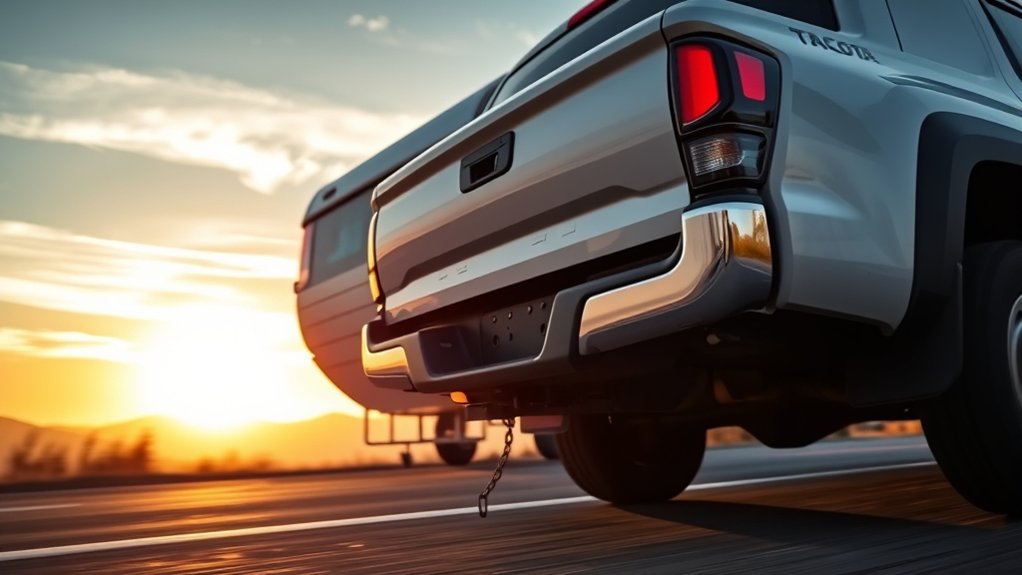
Selecting a hitch involves more than choosing a receiver class. Every part must fit the Tacoma, trailer, coupler height, trailer weight, tongue weight, brake system, and intended use.
- Receiver: Confirm its weight-carrying and, when applicable, weight-distribution ratings.
- Ball mount: Choose the correct rise or drop and sufficient gross-trailer and tongue-weight ratings.
- Hitch ball: Match the coupler diameter, shank size, mounting-hole requirements, and load rating.
- Coupler: Inspect the latch, socket, adjustment, mounting hardware, and rating.
- Safety chains: Use two correctly rated chains or cables and suitable attachment points.
- Wiring connector: Confirm that all lighting and brake circuits work without loose pins or damaged insulation.
- Breakaway system: Test the switch and battery according to the trailer manufacturer’s instructions.
A higher hitch-class label does not raise the Tacoma’s towing capacity. The truck remains limited by its certified ratings and by the lowest-rated part in the complete system.
When a Weight-Distribution Hitch May Help
A weight-distribution hitch may be appropriate when a compatible trailer places enough tongue weight on the truck to unload the front axle or cause excessive rear suspension compression while remaining within all ratings.
Before installing one, verify:
- Toyota permits it for the exact model and receiver.
- The trailer frame manufacturer permits spring-bar loads.
- The system is compatible with the trailer’s brake type.
- The hitch is rated for the measured trailer and tongue weights.
- The spring-bar rating matches the real tongue weight rather than an estimate.
- The setup allows adequate turning and ground clearance.
Follow the hitch manufacturer’s adjustment and weighing procedure. Excessive spring-bar tension can create poor handling or overload components just as insufficient tension can.
Troubleshooting Towing Stability Issues
| Symptom | Likely Checks | Corrective Action |
|---|---|---|
| Trailer begins swaying at highway speed | Tongue weight, rear-heavy cargo, speed, crosswind, tire pressure, alignment, and worn components | Slow down smoothly, stop safely, inspect the setup, measure weights, and correct the cause before continuing |
| Truck steering feels light | Excessive tongue weight, rear-axle overload, nose-high truck attitude, or incorrect weight-distribution adjustment | Verify axle weights, reduce or reposition cargo, and adjust compatible hitch equipment according to its manual |
| Trailer pushes the truck during braking | Brake-controller gain, trailer brakes, wiring, connector, battery, or excessive trailer weight | Test and service the braking system before returning to traffic |
| Trailer bounces or porpoises | Incorrect tire pressure, worn shocks, poor hitch adjustment, unbalanced load, rough pavement, or excessive speed | Inspect the tires and suspension, verify loading and hitch setup, and reduce speed |
| Combination pulls to one side | Uneven tire pressure, dragging brake, shifted cargo, wheel-bearing problem, alignment, or road crown | Stop and inspect. Obtain professional service when heat, brake drag, bearing noise, or visible damage is present |
Pre-Trip Towing Checklist
- Truck, axle, payload, hitch, trailer, and tire ratings verified
- Loaded truck and trailer weights confirmed
- Tongue weight measured and within the required range
- Trailer level when attached and loaded
- Coupler latched and secured
- Hitch pin and retaining clip installed
- Safety chains crossed and clear of the road
- Breakaway cable independently attached
- Trailer jack fully raised and secured
- Cold tire pressures checked on truck and trailer
- Tires inspected for cracking, bulges, damage, and adequate tread
- Wheel fasteners torqued according to manufacturer instructions
- Lights, brakes, controller, wiring, and breakaway system tested
- Mirrors adjusted for adequate rearward visibility
- Cargo secured and compartments latched
- Route, weather, fuel stops, grades, and legal requirements reviewed
Stop towing and seek professional help when the setup exceeds a rating, the truck or trailer cannot be leveled correctly, the combination remains unstable after loading corrections, brakes do not operate properly, tires overheat, or structural damage is visible.
Frequently Asked Questions
Are Toyota Tacomas good at towing?
A correctly equipped Tacoma can tow many utility, boat, cargo, and smaller recreational trailers. Suitability depends on the exact truck’s ratings, available payload, trailer weight, tongue weight, frontal area, brakes, terrain, weather, and driving needs. Check the manual and labels for your specific configuration before choosing a trailer.
What is the most common problem with a Toyota Tacoma while towing?
The most common setup problem is focusing on the advertised trailer rating while overlooking payload, rear-axle load, tongue weight, tire capacity, or trailer brakes. A trailer may be below the published maximum yet still overload the truck once passengers, cargo, accessories, and hitch equipment are included.
How do you turn off trailer driving assist on a Toyota Tacoma?
Controls and available towing-assistance features vary by model year and trim. Use the settings instructions in the exact owner’s manual rather than following a generic menu sequence. Do not disable a stability or safety feature to hide a sway problem. Correct the trailer’s loading, speed, hitch, tires, or brakes first.
Is the Toyota 2.7-liter four-cylinder a good engine for towing?
The 2.7-liter engine used in certain older Tacomas may suit lighter trailers when the exact truck remains within all ratings. It generally offers less acceleration and climbing reserve than more powerful configurations. Use the model-year towing chart and account for passengers, cargo, elevation, heat, and trailer frontal area.
Do airbags or helper springs increase Tacoma towing capacity?
No. They may support the existing suspension, reduce sag, or improve ride control, but they do not change Toyota’s GVWR, GAWR, GCWR, payload, or trailer rating. They also cannot correct an overloaded axle or improper tongue weight.
Should you use cruise control while towing a trailer?
Cruise-control guidance depends on the Tacoma’s model year, road, weather, grade, and system limitations. Avoid using it when conditions require frequent speed changes, traction is reduced, traffic is heavy, or the transmission repeatedly shifts. Follow the owner’s manual for your exact truck.
Conclusion
Improving Toyota Tacoma towing stability starts with measurements rather than accessories. Confirm your exact ratings, weigh the travel-ready combination, measure tongue weight, level the trailer, maintain the tires and brakes, and secure every item before driving.
Suspension aids and electronic towing features can support a correct setup, but they cannot increase certified capacity or compensate for poor loading. When sway begins, slow down smoothly, stop safely, and correct the cause before continuing. A properly matched and verified combination gives you more predictable steering, braking, and control throughout the trip.
Sources
- Toyota Tacoma — current Tacoma powertrain, suspension, trim, and available towing-technology information
- Toyota Manuals and Warranties — model-specific owner’s manuals, operating instructions, limitations, and towing requirements
- Toyota Safety Hub — driver-assistance feature functions, conditions, and limitations
- NHTSA: Towing a Trailer, Being Equipped for Safety — trailer loading, tongue weight, equipment, and towing-safety guidance
