
Your Toyota Tacoma’s 4WD selector can improve traction, but only when you match the mode to the road surface. Most part-time 4WD Tacomas use 2HI for normal pavement, 4HI for loose or slippery terrain, and 4LO for slow situations that need extra torque. Procedures vary by year, transmission, and transfer case, so your owner’s manual remains the final authority.
Last updated: July 14, 2026. This guide covers general Tacoma 4WD operation and highlights important differences between older models and the fourth-generation Tacoma.
Quick Answer
Use 2HI on normal dry pavement. Select 4HI when snow, ice, gravel, mud, sand, or another loose surface allows some tire slip. Use 4LO only for very slow, high-torque driving. Do not apply one shift speed or indicator sequence to every Tacoma; check the manual for your exact year and drivetrain.
Key Takeaways
- 2HI: Best for ordinary dry or firmly paved roads on part-time 4WD Tacomas.
- 4HI: Adds front-wheel drive for loose, icy, snowy, muddy, sandy, or gravel surfaces.
- 4LO: Multiplies torque for slow climbs, descents, deep ruts, rocks, or recovery work.
- Rain alone does not always justify 4HI because wet pavement may still provide enough grip to cause binding.
- Four-wheel drive can help you move, but it does not create extra braking grip or eliminate the need to slow down.
- Exact shift speeds, selector movements, and dashboard indicators vary by model year.
At a Glance
| Time Required | About 1 minute to select a mode; several minutes to confirm engagement safely |
| Difficulty | Easy, but the correct procedure is model-specific |
| Tools Needed | Your Tacoma owner’s manual; no mechanical tools |
| Cost | No cost during normal operation |
Toyota Tacoma 2HI, 4HI, and 4LO Quick Rules
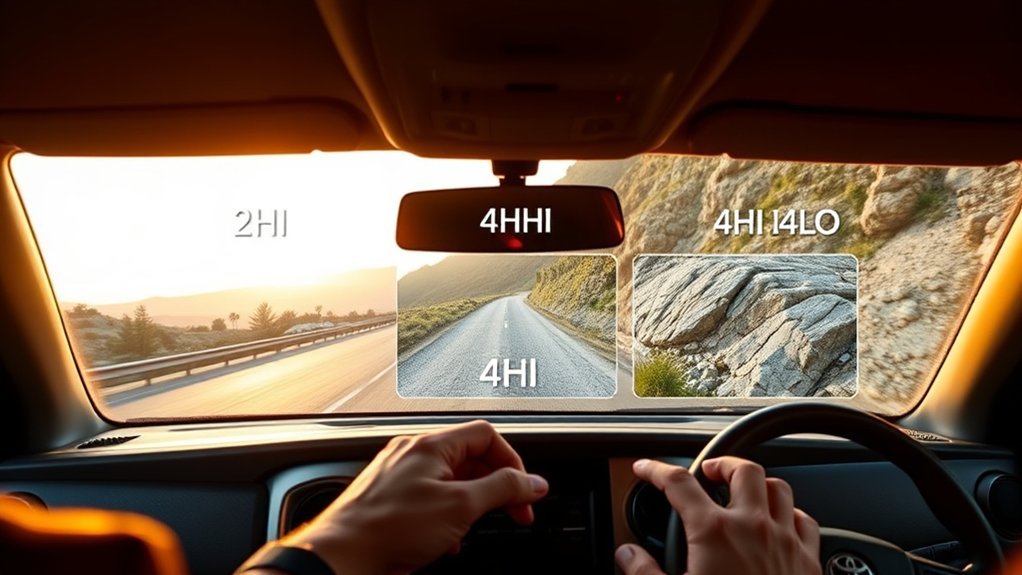
The labels may appear as 2HI, 4HI, and 4LO or as H2, H4, and L4. The meaning is similar, but the selector design and operating limits can differ.
| Mode | What It Does | Best Uses | Avoid |
| 2HI | Sends engine power to the rear wheels on a part-time 4WD Tacoma. | Dry pavement, city streets, highways, parking lots, and normal towing. | Deep snow, loose sand, mud, or other surfaces where the rear tires cannot maintain traction. |
| 4HI | Connects the front and rear driveline for additional traction without using low-range gearing. | Snow-covered roads, ice, dirt, gravel, loose trails, shallow mud, and sand. | Dry or high-grip pavement, especially during tight turns, unless your Tacoma has a full-time 4WD mode designed for pavement. |
| 4LO | Uses low-range transfer-case gearing to increase wheel torque and improve slow-speed control. | Rock crawling, steep climbs or descents, deep mud, deep sand, ruts, and controlled recovery. | Normal roads, ordinary highway driving, high speeds, or surfaces where low range is unnecessary. |
Warning: Four-wheel drive may help your Tacoma accelerate on snow or loose ground, but it does not increase the tire grip available for braking. Slow down, leave more following distance, and avoid sudden steering or braking on slick roads.
Confirm Which Tacoma 4WD System You Have
Before following any shift sequence, confirm your model year, transmission, selector labels, and transfer-case type. Toyota provides separate 2023 Tacoma manuals and 2024 Tacoma manuals.
Most part-time 4WD Tacomas provide a rear-wheel-drive high range, a four-wheel-drive high range, and a four-wheel-drive low range. However, the fourth-generation lineup includes an important exception. Toyota states that most 2024 four-wheel-drive models use an electronically controlled two-speed transfer case, while Limited i-FORCE MAX models offer a full-time 4WD system with a locking center differential.
Note: Advice about avoiding 4HI on dry pavement applies to locked or part-time four-wheel drive. A full-time 4WD mode with an unlocked center differential is designed differently. Follow the selector labels and instructions provided for your truck.
How to Shift Between 2HI, 4HI, and 4LO
The following steps are conservative general guidance. Do not use them to override the instructions printed in your Tacoma owner’s manual.
Shift From 2HI to 4HI
- Move onto a surface where four-wheel drive is appropriate, such as snow, ice, gravel, dirt, mud, or sand.
- Keep the truck traveling in a straight line with light, steady throttle.
- Reduce your speed to a moderate level that is safely below the limit in your owner’s manual.
- Turn or move the selector from 2HI or H2 to 4HI or H4.
- Wait for the expected 4WD indicator to stop flashing and remain illuminated before demanding heavy power.
Some Tacoma manuals permit high-range shifts while the truck is moving. The allowed speed and exact method are not the same for every model, so do not treat one published limit, including 62 mph, as universal.
Shift From 4HI to 2HI
- Drive straight and ease off the accelerator.
- Move the selector from 4HI or H4 to 2HI or H2.
- Wait for the 4WD indicator to stop flashing or switch off as described in your manual.
- Confirm that steering feels normal before entering dry pavement or making a tight turn.
Shift From 4HI to 4LO
- Stop on stable ground where the truck will not roll or slide.
- Keep your foot firmly on the brake.
- For an automatic transmission, select Neutral. For a manual transmission, follow Toyota’s clutch and gear-position instructions for your year.
- Move or push-turn the selector from 4HI or H4 to 4LO or L4.
- Wait for the low-range indicator to stop flashing and show full engagement.
- Select the required transmission gear and move away slowly.
Shift From 4LO to 4HI
- Bring the Tacoma to a complete stop.
- Hold the brake and place the transmission in Neutral.
- For a manual transmission, operate the clutch exactly as the manual directs.
- Move the selector from 4LO or L4 to 4HI or H4.
- Wait for the indicator to confirm that low range has disengaged.
- Resume driving gently and confirm normal steering response.
Pro Tip: Practice the shift sequence on a wide gravel or dirt area before you need low range on a difficult trail. Familiarity makes it easier to recognize normal indicator behavior and steering feel.
When to Use Each Tacoma Drive Mode
Use 2HI on Normal Pavement
On a part-time 4WD Tacoma, 2HI is the normal choice for dry highways, paved streets, parking lots, and most towing. It allows the front and rear axles to rotate at the different speeds needed during turns.
Use 2HI when the tires have normal grip. Switching to 4HI on high-traction pavement can make the steering feel heavy or cause hopping, scrubbing, vibration, or driveline wind-up during turns.
Use 4HI for Loose or Slippery Surfaces
Choose 4HI when the surface allows some tire slip and the truck needs added traction at ordinary trail or winter-road speeds. Suitable examples include:
- Snow-covered roads
- Ice or packed snow
- Loose gravel and dirt
- Shallow mud
- Loose sand
- Wet grass or uneven trails
Rain by itself is not always enough. A wet paved road may still provide strong traction, especially during slow, tight turns. Stay in 2HI unless the road is genuinely slippery or your exact Tacoma system is designed for full-time pavement use.
Use 4LO for Slow, High-Torque Driving
Use 4LO when you need controlled wheel speed, strong engine braking, or more torque than 4HI provides. Typical uses include:
- Climbing or descending a steep loose trail
- Crossing rocks, washouts, or deep ruts
- Moving through deep mud or soft sand
- Pulling away slowly while heavily loaded on loose ground
- Controlled recovery when the truck is stuck
Low range is not a general snow-driving mode. If you can travel normally in 4HI without excessive wheel spin or transmission hunting, you probably do not need 4LO.
Choose the least aggressive mode that provides steady traction. Start with 2HI, move to 4HI when the surface requires it, and reserve 4LO for slow work.
Tacoma 4WD Speed, Steering, Braking, and Towing Tips
A selector’s shift limit is not the same as a safe driving speed. Even when a manual allows an on-the-move shift into 4HI, you must still reduce speed for snow, ice, gravel, mud, visibility, tires, traffic, and trail conditions.
- Do not chase a universal maximum speed. Use the limit in the manual for your exact Tacoma and drive slower when conditions require it.
- Avoid abrupt throttle changes. Smooth inputs reduce wheel spin and driveline shock.
- Increase following distance. NHTSA advises slowing down because slick or snow-covered surfaces make vehicles harder to control and stop.
- Expect a wider turning feel. A locked part-time system resists the speed difference between the front and rear axles.
- Use 4LO at crawl speeds. Shift back to 4HI when low-range torque is no longer necessary.
- Do not assume 4WD raises towing limits. Follow the payload, axle, tire, hitch, and trailer limits assigned to your truck.
Four-wheel drive does not replace proper tires. NHTSA recommends using the manufacturer-specified tire size and inflation pressure and checking tread, damage, and cold tire pressure regularly. Review the NHTSA TireWise guidance before winter or off-road travel.
Warnings, Drivetrain Risks, and Dashboard Indicators
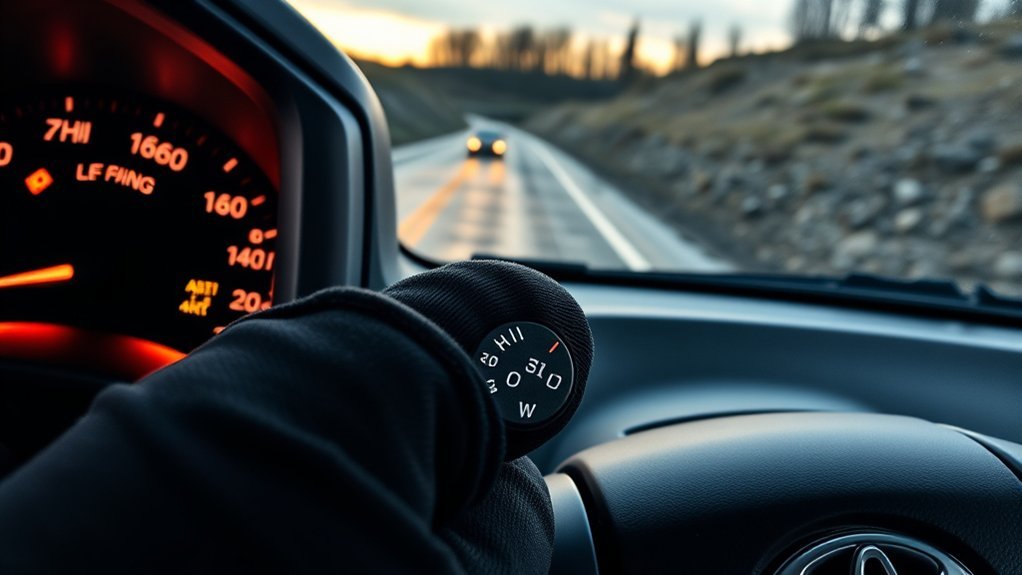
A steadily illuminated indicator normally confirms a selected mode, while a flashing indicator often means the shift is still in progress or the required conditions have not been met. Indicator colors, symbols, and combinations differ by year.
If a 4WD or low-range indicator continues flashing:
- Ease off the accelerator and keep the wheels pointed straight.
- Drive forward slowly for a short distance if the surface is safe.
- If the shift does not complete, stop and place the transmission in Neutral.
- Return the selector to the previous mode, wait briefly, and retry without forcing it.
- Check that the brake, clutch, transmission position, and vehicle speed meet the conditions in your manual.
- Arrange an inspection if the light continues flashing, a warning message appears, or you hear grinding or repeated abnormal noises.
Toyota’s warning-light resource directs owners to select their exact vehicle or consult its owner’s manual because indicator meanings vary.
What to Do if the Drivetrain Binds
Binding may feel like tire hopping, steering resistance, vibration, or the truck fighting a tight turn. It can happen when part-time 4WD is used on a surface with too much grip.
- Stop making tight turns.
- Move to a loose or slippery surface if one is immediately and safely available.
- Point the wheels straight and select 2HI according to the manual.
- Roll forward or backward slowly to release driveline tension.
- Stop and seek service if the system will not disengage or if abnormal noise continues.
Warning: Never force a transfer-case selector, continue driving through severe binding, or crawl under a vehicle that is not correctly secured. Grinding, leaks, violent vibration, or persistent warning messages require professional diagnosis.
Monthly 4WD Use, Maintenance, and Off-Road Checklist
Some Tacoma manuals recommend operating the four-wheel-drive system periodically when it has not been used. Follow the distance and frequency stated for your year. Do not complete a part-time 4WD exercise on dry, high-grip pavement merely to reach a mileage target.
Use a safe gravel road, dirt road, snow-covered area, or another suitable surface that allows tire slip. Keep the wheels mostly straight, use gentle throttle, and stop if you notice unusual vibration, noise, or resistance.
Before Using Tacoma Four-Wheel Drive
- Check all four tires for compatible size, construction, and similar wear.
- Inflate the tires to the pressure on the driver-door label, not the maximum pressure molded into the tire.
- Inspect tire tread, sidewalls, and the spare.
- Look underneath the truck for fluid leaks or damaged driveline components.
- Confirm that the 4WD indicators illuminate and stop flashing as expected.
- Carry appropriate recovery equipment and know where the approved recovery points are.
- Secure cargo before entering steep or uneven terrain.
- Check weather, trail closures, water depth, and communication coverage.
Understand Related Off-Road Features
The transfer-case mode is only one part of the Tacoma’s traction system. Depending on trim and year, your truck may also have A-TRAC, an electronic rear differential lock, Multi-Terrain Select, Crawl Control, or Downhill Assist Control.
These features do not mean the same thing as selecting 4HI or 4LO. For example, the rear differential lock changes how the rear wheels share torque, while low range changes transfer-case gearing. Follow the operating conditions for each feature separately.
Frequently Asked Questions
When should I use 4H and 4L in a Toyota Tacoma?
Use 4H or 4HI for loose or slippery surfaces when you still need normal driving range. Use 4L or 4LO for very slow driving that requires more torque, stronger engine braking, or precise control over rocks, deep mud, soft sand, steep grades, or ruts.
Can I switch from 2H to 4H while driving?
Many part-time 4WD Tacomas allow a shift between high-range modes while the truck is moving straight at an approved speed. However, the maximum speed and procedure vary. Use the limit and selector instructions in the owner’s manual for your exact model year.
Should I use 4HI whenever it rains?
No. Rain alone does not always reduce grip enough for part-time 4HI. Wet pavement can still cause binding during tight turns. Use 4HI when the surface is genuinely slippery or loose, and follow different instructions if your Tacoma has a full-time 4WD mode.
Does four-wheel drive help a Tacoma stop faster?
Not by itself. Four-wheel drive can help distribute power while accelerating, but braking and cornering still depend mainly on the tires and available road grip. Slow down and increase following distance on snow, ice, gravel, or mud.
Why is my Tacoma’s 4WD light flashing?
The transfer-case shift may still be in progress, or the required speed, transmission position, brake, clutch, or steering conditions may not have been met. Drive straight gently or stop, select Neutral, and retry according to the manual. Seek service if the light keeps flashing.
Can I drive in 4LO on pavement?
Avoid ordinary pavement in part-time 4LO. Low range is intended for slow travel on difficult, loose, or slippery terrain. High-grip pavement can cause binding, tire scrub, and unnecessary drivetrain stress.
Conclusion
Use 2HI for normal pavement, 4HI when the surface is loose or slippery enough to permit tire slip, and 4LO when you need slow-speed torque and control. Do not rely on four-wheel drive to compensate for excessive speed, worn tires, or limited braking grip.
The safest shift procedure is the one Toyota specifies for your exact Tacoma. Confirm the model year, transfer-case type, selector labels, speed limits, and dashboard indicators before using the system. If a shift will not complete or a warning persists, stop forcing the selector and arrange an inspection.
Sources
- Toyota 2023 Tacoma Manuals and Warranties — model-year-specific operating and maintenance information.
- Toyota 2024 Tacoma Manuals and Warranties — fourth-generation manual resources and vehicle-specific instructions.
- Toyota USA Newsroom: 2024 Tacoma — two-speed transfer-case details and the Limited i-FORCE MAX full-time 4WD system.
- NHTSA Winter Weather Driving Tips — speed, stopping-distance, following-distance, and winter preparation guidance.
- NHTSA TireWise — tire size, pressure, tread, maintenance, and traction guidance.
- Toyota Warning Lights — vehicle-specific indicator and warning-light resources.
