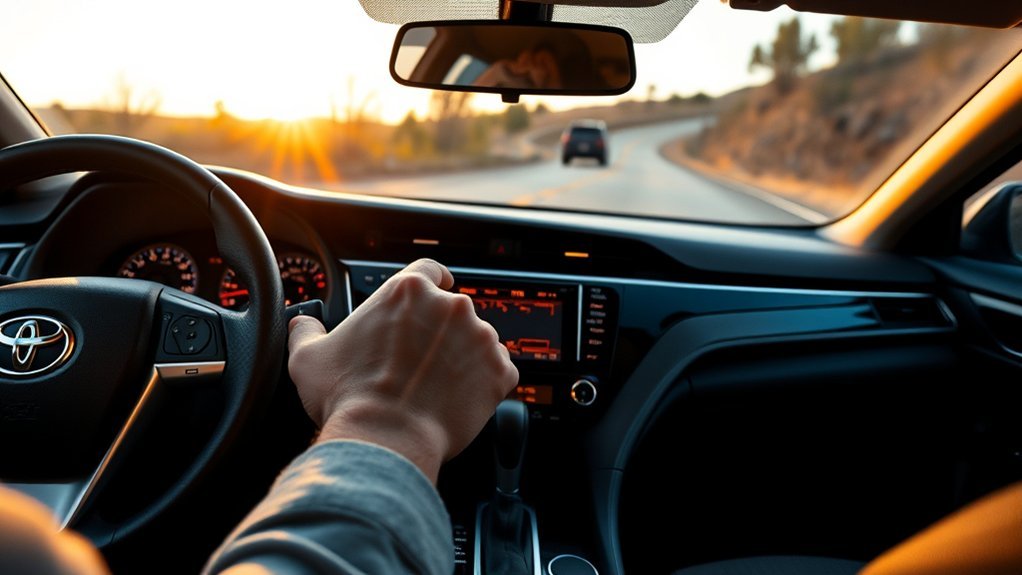
Use Toyota Camry S (Sequential) mode when you want extra control on a steep climb, a long downhill grade, or a winding road. On many U.S. Camrys, S mode lets you select or limit a shift range; on 2025–2026 U.S. Camrys, the hybrid eCVT provides sequential shift steps rather than conventional fixed gears. For normal commuting, steady highway driving, and fuel economy, use Drive (D). Confirm the exact controls for your year and trim in the Toyota owner’s manual.
Last updated: September 19, 2026 — rechecked against current Toyota Camry documentation and current road-safety guidance.
Quick Answer
Use Toyota Camry S/manual-style shift control mainly for long descents, steep climbs, and mountain or winding roads where a lower range can add engine braking or keep the powertrain from upshifting too soon. Shift smoothly, watch the displayed S range, and return to Drive when the extra control is no longer needed. S mode is not the same as the separate Sport drive mode on Camrys that have both.
Key Takeaways
- On many U.S. Camrys, S means Sequential mode; it is different from the separate Sport drive mode.
- A lower S range gives more engine braking and can help on long downhill grades.
- The 2025–2026 U.S. Camry uses a hybrid eCVT with sequential shift control; older gas Camrys may use stepped automatic gears and S-range limits.
- On slippery roads, avoid sudden acceleration or abrupt downshifts because a rapid change in engine braking can reduce traction.
- Use Drive for normal cruising and fuel economy, then return to D when you no longer need the extra control.
At a Glance
| Best Use Cases | Long descents, steep climbs, rolling mountain roads, and situations where you want more controlled engine braking |
| Normal Driving | Use D for routine commuting, steady highway driving, and best fuel economy |
| 2025–2026 U.S. Camry | Hybrid eCVT with S (Sequential) mode; paddle shifters are equipment-dependent |
| Main Caution | Do not make sudden shift or throttle changes on slippery surfaces |
What Is Manual Shift Mode and When to Use It?
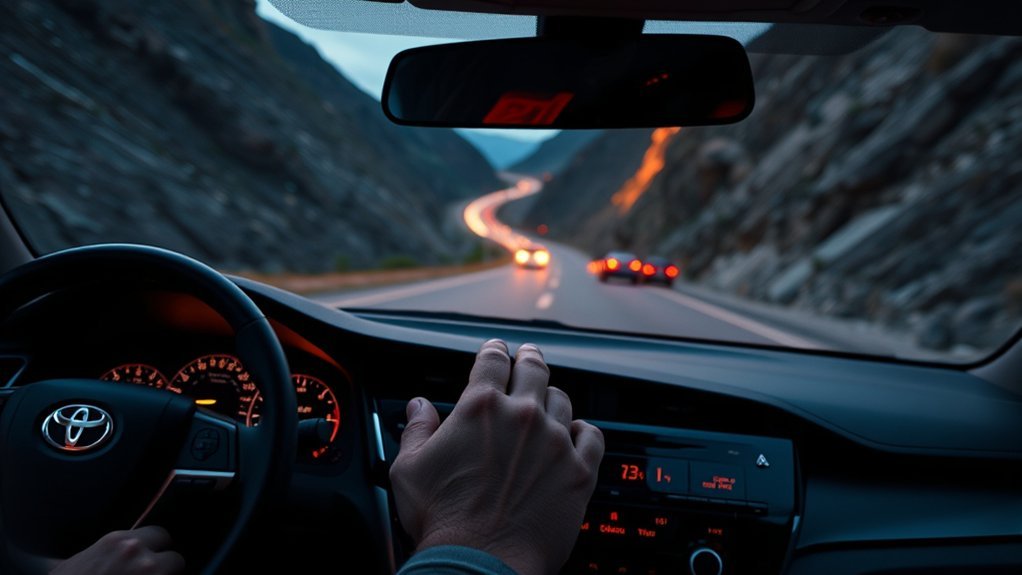
On many U.S. Toyota Camrys, the manual-style control is labeled S for Sequential mode. It does not turn the car into a clutch-operated manual. Instead, it lets you request a lower or higher shift range, or a simulated shift step on hybrid eCVT models.
On many 2018–2024 gas Camrys with the 8-speed automatic, an S range such as S4 means the transmission can automatically use gears up to the selected upper range rather than locking the car in one fixed gear. On 2025–2026 U.S. Camrys, Toyota pairs the hybrid system with an eCVT and S (Sequential) mode. Toyota’s 2025 Quick Reference Guide says downshifting can increase power going uphill or provide engine braking downhill, while D is recommended for normal driving and fuel economy.
A lower range is most useful before or during a long descent because it increases engine braking. It can also help on a climb by keeping the powertrain in a more responsive range. The vehicle’s control system can restrict a requested downshift or automatically upshift on some models to prevent excessive engine speed.
Note: Camry shift behavior varies by model year, powertrain, trim, and market. Do not assume an online instruction for an older gas Camry applies exactly to a current hybrid. Use the manual for your exact vehicle.
| Camry Version | What S/Manual-Style Control Does |
|---|---|
| 2025–2026 U.S. Camry | Hybrid eCVT with S (Sequential) mode; the driver can request stepped shift behavior with the lever and, when equipped, paddles. |
| 2018–2024 gas Camry | The stepped automatic can use S ranges that limit the highest available gear and increase engine braking at lower settings. |
| Earlier Camry Hybrid models | Many use an eCVT with sequential or simulated ranges; the number of steps and paddle availability vary by year and trim. |
| Older or non-U.S. Camrys | Controls and labels can differ, so follow the market-specific owner’s manual rather than assuming the same S-range behavior. |
What Do the Camry S, +, –, and Paddle Controls Mean?
Before using manual-style shift control, identify what the symbols on your Camry actually mean. On U.S. models, S commonly means Sequential mode, while Sport is a separate drive mode on Camrys that provide both controls.
| Control or Display | What It Usually Means |
|---|---|
| D | Normal Drive. Toyota recommends D for routine driving and fuel economy. |
| S | Sequential mode on many U.S. Camrys. It lets you request shift ranges or simulated steps, depending on the powertrain. |
| + | Requests a higher S range or simulated shift step. |
| – | Requests a lower S range for more response or engine braking. |
| Paddle shifters | Steering-wheel controls for requesting higher or lower ranges/steps on equipped trims. |
| Sport mode | A separate drive mode on equipped Camrys. It changes powertrain response and should not be confused with the S shift position. |
Is S Mode the Same as Sport Mode in a Toyota Camry?
No. On Camrys that have both controls, S (Sequential) mode and Sport mode perform different jobs. S mode uses the shifter or paddles to request a transmission range or simulated step. Sport mode is selected separately and changes how the powertrain responds to accelerator input.
This distinction matters on the 2025–2026 U.S. Camry because the car uses a hybrid eCVT while still offering S (Sequential) control. If you want to understand the separate drive-mode button, see the guide to Toyota Camry Sport Mode.
Why Use Manual Shift Mode for Hills and Engine Braking?
Manual-style shift control is most useful when you want the car to hold a lower range instead of relying entirely on Drive. The clearest benefit is engine braking on a descent. On older stepped automatics, selecting a lower S range can also prevent an unwanted upshift. On current eCVT Camrys, S mode provides stepped control without turning the transmission into a conventional geared manual.
| Feature | Benefit |
|---|---|
| Lower S range | Provides stronger engine braking on a long descent. |
| Range control on a climb | Keeps the powertrain in a more responsive range when the grade is steep. |
| Upper-range limit on stepped automatics | Can prevent an older gas Camry from upshifting above the selected S range. |
| Dashboard range display | Shows the range or step the vehicle accepted so you can avoid guessing. |
Use S mode as a temporary control tool rather than a default driving mode. Toyota’s own guidance favors D for normal driving and fuel economy.
How Do You Use S (Sequential) Mode in a Toyota Camry?
The exact display and number of ranges vary, but the basic process is simple. Make your selection before the road demands strong braking or acceleration, then use small, smooth inputs.
- Identify your Camry’s system: Check the owner’s manual for the exact year, powertrain, and trim. Current U.S. models use a hybrid eCVT; many older gas models use a stepped automatic.
- Move from D to S when appropriate: Toyota’s 2025 Quick Reference Guide instructs drivers to select S from D. Keep throttle and steering inputs smooth.
- Use “-” for a lower range: Request one lower range or step when you need more engine braking or stronger response.
- Use “+” for a higher range: Reduce engine braking or move toward normal cruising as the grade eases.
- Watch the range display: Confirm what the car accepted, then keep your attention on the road.
- Return to D: Once the descent, climb, or winding section ends, use Drive for normal automatic operation.
Pro Tip: Select the needed lower range before a long downhill grade begins. That lets engine braking help control speed before the car has already accelerated down the slope.
Warning: Do not accelerate or shift abruptly on snow, ice, standing water, or other slippery surfaces. Toyota warns that sudden changes in engine braking can cause a skid or spin.
When Is Manual Shift Mode Most Useful?
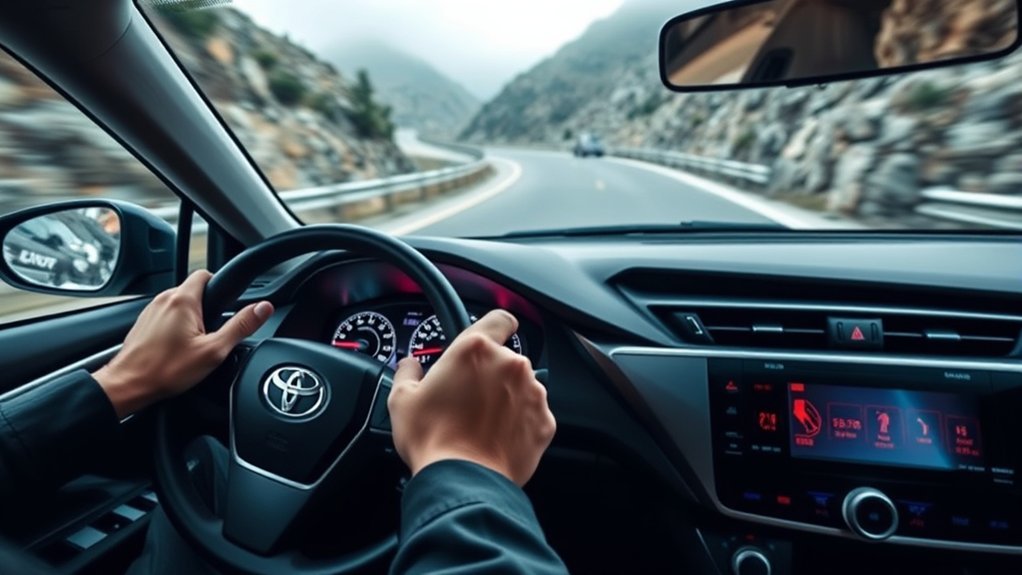
Use S mode when it solves a specific control problem: too much speed building on a descent, an unwanted upshift on an older stepped automatic, or a need for steadier response on a grade. It is not necessary simply because the road is wet or because you want Sport mode.
| Driving Situation | How S/Manual-Style Control Helps | Best Move |
|---|---|---|
| Long downhill grade | Adds engine braking so the service brakes do not have to do all the speed control. | Select a lower range before speed builds. |
| Steep uphill road | Keeps the powertrain in a more responsive range; on stepped automatics it can prevent an early upshift. | Use a lower range only as long as the grade requires it. |
| Rolling mountain road | Reduces repeated changes between strong acceleration and braking. | Choose a range that gives smooth response, then return to D on flatter roads. |
| Winding road | Can make engine braking and power response more predictable between curves. | Set your speed before the curve and avoid shifting abruptly mid-corner. |
| Steep descent on a slippery road | A lower range selected early can add engine braking, but abrupt shifts can reduce traction. | Slow down first, select the range before the descent, and use smooth inputs. |
Manual shift mode should support smooth driving. It does not replace a safe speed, adequate following distance, good tires, ABS, stability control, or careful braking.
For winter driving, the National Highway Traffic Safety Administration recommends slowing down and increasing following distance because slick or snow-covered surfaces are harder to control and stop on. The California DMV also advises selecting a low gear before descending a steep hill on slippery surfaces.
When Should You Stay in Drive Instead?
Use D when the transmission does not need help controlling a grade or holding a range. Drive is the normal setting and is the better default for most trips.
- Normal highway cruising: Use Drive for steady speeds and fuel economy.
- Heavy stop-and-go traffic: D reduces unnecessary shifting and driver workload.
- When you only want Sport mode: Use the separate Sport drive-mode control if your Camry has one; do not select S just to activate Sport.
- Active skidding or severe ice: Focus on smooth steering and speed reduction. Do not make sudden downshifts.
- When the engine is already revving high: Do not hold a low range unnecessarily; request a higher range or return to D.
- Warning lights or transmission problems: Stop using manual-style control and follow the warning-message or service guidance in the owner’s manual.
How Do You Switch Between Drive and S Mode Safely?
On Camrys designed for S-mode operation, the selector moves between D and S without a clutch pedal. The important part is to avoid abrupt control inputs and to follow the procedure for your exact model.
- Confirm the selector layout: Check the shifter gate and owner’s manual before trying S mode for the first time.
- Move between D and S smoothly: Do not make an abrupt throttle change at the same time.
- Change one range at a time: Use plus or minus in small steps and watch the display for the accepted range.
- Keep your eyes on the road: Glance at the indicator only long enough to confirm the selection.
- Let the vehicle protect itself: If a requested downshift is restricted or the car automatically upshifts, do not keep forcing the same request.
- Never select P or R while moving: Come to a complete stop and follow the normal shift procedure before using Park or Reverse.
Why Is Camry S Mode Not Working as Expected?
What looks like a problem can be normal protection logic, a trim difference, or confusion between S mode and Sport mode. Use the display and owner’s manual before assuming the transmission has failed.
- The Camry refuses to downshift: The requested range may be too low for the current vehicle speed. Some Camrys restrict a downshift that could over-rev the engine.
- The gear indicator does not show the range you requested: The control system may have delayed or denied the request for protection.
- The engine revs higher after a downshift: That is expected because lower ranges increase engine braking and engine speed. Request a higher range if the lower range is no longer needed.
- Paddle shifters do nothing: Paddle availability and operating rules vary by trim and model year; some cars require a particular selector position or deactivate temporary paddle control automatically.
- The current hybrid does not feel like a conventional gear change: The 2025–2026 Camry uses an eCVT, so S mode provides sequential control without a conventional stepped transmission.
- The S indicator does not illuminate or D remains displayed after selecting S: Toyota owner-manual guidance for some Camry generations says this can indicate a transmission-system malfunction that should be inspected.
- A warning light appears: Stop using S mode and follow the warning-message/service instructions in the owner’s manual.
Note: A rejected downshift or automatic upshift can be normal protection logic. A persistent S-mode indicator problem, warning message, or abnormal transmission behavior should be checked using the model-specific Toyota manual and, when indicated, by a qualified technician.
Related Guides
Frequently Asked Questions
How do you put a Toyota Camry in manual mode?
On many U.S. Camrys, move the shifter from D to S, then use the plus and minus controls to request higher or lower ranges. Equipped trims may also have paddle shifters. The exact number of ranges and paddle behavior vary by year and powertrain, so check your owner’s manual.
When should you use manual shift mode in a Camry?
Use it when you need extra engine braking or range control, especially on long downhill grades, steep climbs, and rolling or winding mountain roads. Return to D when the road no longer needs the extra control.
Is S mode the same as Sport mode in a Toyota Camry?
No. On Camrys that have both, S is the sequential shift position used to request a transmission range or simulated step. Sport mode is a separate drive mode that changes powertrain response. Selecting S does not simply turn on Sport mode.
Is manual shift mode bad for the transmission?
Not when it is used as designed. Toyota uses protection logic that can restrict a downshift or automatically upshift on some models if needed. Avoid abrupt inputs, do not ignore warning lights, and follow the operating limits in the owner’s manual.
Does manual mode save gas in a Toyota Camry?
Usually not. Toyota recommends D for normal driving and fuel economy. Holding a lower S range can keep engine speed higher than necessary, so use S mode for control rather than as a fuel-saving setting.
Should you use manual mode in snow or rain?
Do not select S mode simply because the road is wet or snowy. Slow down, increase following distance, and use smooth inputs first. If you need a lower range for a steep descent, select it before the grade and avoid abrupt downshifts because sudden engine braking can reduce traction.
What gear or range should you use going downhill?
Choose a lower range before the descent and use a setting that helps hold a safe speed without keeping engine speed unnecessarily high. If the car continues to accelerate, use the service brakes as needed and reduce speed; do not rely on engine braking alone.
Conclusion
Use Toyota Camry S (Sequential) mode when a hill or winding road calls for more engine braking or more deliberate range control. The biggest practical use is a long descent: select a lower range before speed builds, then let engine braking share the work with the service brakes.
For ordinary driving, stay in D. Current 2025–2026 U.S. Camrys use a hybrid eCVT, while many older gas Camrys use stepped automatics, so the exact ranges and paddle behavior are not universal. Check the manual for your model year, keep shift inputs smooth, and do not confuse S mode with the separate Sport drive mode.
Sources
- Toyota Manuals and Warranties — official Toyota manual lookup; use the exact model year to verify S-mode controls, range behavior, paddle availability, and current Camry hybrid transmission details.
- NHTSA Winter Weather Driving Tips — supports slowing down and increasing following distance on slick or snow-covered roads.
- California DMV Safe Driving Handbook — supports low-gear use before steep hills and smooth driving on slippery surfaces.
