
There is no single replacement interval that applies to every Toyota Camry. The correct schedule depends on the vehicle’s model year, engine, mileage, and age—not simply whether the spark plug is labeled standard, platinum, or iridium. Checking the Toyota maintenance guide for your exact Camry is the safest way to avoid replacing the plugs too early or leaving them in service too long.
Quick Answer
Check the maintenance guide for your Camry’s model year and engine. Toyota’s U.S. 2024 guide schedules the 2GR-FKS V6 at 60,000 miles or 72 months and lists other scheduled plug service at 120,000 miles or 144 months. The 2025 guide lists replacement at 120,000 miles. Replace sooner only when diagnosis shows a problem.
Key Takeaways
- Use the maintenance schedule for your exact model year and engine; do not rely on a universal 60,000–100,000-mile rule.
- Toyota’s 2024 U.S. guide specifies 60,000-mile service for the 2GR-FKS V6 and 120,000-mile service elsewhere in the schedule.
- Misfires, rough idle, hard starting, and poor fuel economy justify diagnosis, but they do not prove that the plugs are the cause.
- Install only the exact specified plug and follow the correct gap, thread, and torque instructions.
- Do not automatically apply anti-seize; thread lubricant changes the relationship between wrench torque and clamping force.
- Four-cylinder service may be accessible to an experienced DIYer, while rear-bank access on some V6 models is often better left to a professional.
Understanding Spark Plugs and Their Function

Spark plugs thread into the cylinder head and ignite the compressed air-fuel mixture inside each combustion chamber. That spark allows the gasoline engine to produce power. A hybrid Camry still uses spark plugs because its gasoline engine operates alongside the electric drive system.
Each plug must have the correct physical dimensions, heat range, electrical resistance, electrode design, and gap for the engine. A plug that looks similar but has the wrong reach or seat style can interfere with combustion or damage the cylinder head or piston.
As the electrodes wear, the ignition system may need more voltage to produce a reliable spark. Deposits can also interfere with ignition. However, abnormal deposits are not always the result of an old plug. Oil contamination, an overly rich fuel mixture, coolant entry, repeated short trips, or another engine fault can foul a plug before its scheduled replacement date.
Note: The replacement schedule tells you when routine service is due. It does not replace diagnosis when the engine is misfiring, running poorly, consuming oil, or displaying a warning light.
Recommended Replacement Intervals for Toyota Camry Spark Plugs
Toyota does not publish one spark-plug interval for every Camry. The schedule can change with the model year and engine. The following examples come from official U.S. Toyota maintenance guides and illustrate why the exact vehicle guide matters.
| Camry example | Toyota schedule | What it means |
|---|---|---|
| 2024 Camry with 2GR-FKS V6 | 60,000 miles or 72 months | The 2024 guide specifically identifies this engine at the 60,000-mile service. |
| Other 2024 Camry engines | 120,000 miles or 144 months | The guide lists spark-plug replacement at the 120,000-mile service. A V6 following a 60,000-mile cycle also reaches its next interval at this point. |
| 2025 Camry | 120,000-mile scheduled service | Toyota’s 2025 maintenance chart marks spark-plug replacement in the 120,000-mile column. |
| Earlier or later model years | Check the exact guide | Do not transfer a schedule from another model year, engine, market, or trim without verification. |
The official 2024 schedule can be reviewed in Toyota’s 2024 Camry Warranty and Maintenance Guide. Toyota’s 2025 Camry Warranty and Maintenance Guide contains the current-generation chart.
The maintenance interval belongs to the vehicle and engine—not to a generic plug-material chart.
How to Confirm Your Exact Replacement Interval
- Identify the model year. Use the registration, insurance card, VIN record, or driver-door certification label rather than the purchase date.
- Identify the engine when the guide distinguishes between engines. The emissions label under the hood, VIN information, or a Toyota dealer’s parts department can help confirm it.
- Open Toyota’s official documentation. Use the Toyota Manuals and Warranties portal and select the correct year.
- Search the Warranty and Maintenance Guide for “spark plugs.” Record both the mileage and time limit.
- Follow the earlier applicable limit. For example, a 60,000-mile/72-month entry becomes due when either threshold is reached.
- Document the service. Keep the date, mileage, part number, invoice, and any related diagnostic information with the vehicle’s records.
Severe driving conditions do not automatically create a universal shorter spark-plug schedule. Follow any special-condition instructions in the exact guide. Inspect or diagnose the ignition system sooner when the vehicle develops symptoms, a plug becomes contaminated, or another repair requires plug removal.
How Spark Plug Condition Impacts Engine Performance
A healthy spark plug helps the ignition system light the mixture consistently. Excessive electrode wear, a cracked insulator, incorrect gap, or heavy deposits can weaken or interrupt that process. The result may be intermittent misfires, hesitation under load, rough running, or more difficult starting.
A persistent misfire can also increase the workload on an ignition coil. Unburned fuel may enter the exhaust, and fuel economy may decline because combustion is no longer consistent. However, replacing the plugs without diagnosing the cause can waste money when the actual fault is a coil, injector, air leak, wiring problem, compression issue, or sensor failure.
Removed plugs can provide useful evidence:
- Normal light deposits and even wear: Usually consistent with ordinary service life.
- Heavy dry black deposits: May indicate rich operation, repeated short trips, excessive idling, or a weak ignition system.
- Wet fuel deposits: May accompany a cylinder that is not firing.
- Oily deposits: May indicate oil entering the combustion chamber.
- Chipped porcelain or damaged electrodes: Requires further investigation before another plug is installed.
- One plug that looks different from the rest: Can point to a cylinder-specific problem.
Plug appearance alone is not a complete diagnosis. Trouble codes, freeze-frame data, coil and injector testing, compression checks, and a review of operating conditions may also be necessary.
Signs You May Need New Spark Plugs

Worn or contaminated plugs can cause noticeable symptoms, but the same symptoms can have several other causes. Treat them as reasons to inspect and diagnose the vehicle rather than proof that a new set of plugs will solve the problem.
Engine Misfires and the Check-Engine Light
A misfire may feel like a stumble, momentary loss of power, vibration, or uneven exhaust note. The check-engine light may come on, and a scan tool may identify a general or cylinder-specific misfire code. Spark plugs are one possible cause, along with ignition coils, injectors, wiring, vacuum leaks, fuel-pressure problems, and low compression.
Warning: A flashing check-engine light can indicate an active, serious misfire. Reduce engine load and arrange prompt diagnosis rather than continuing to drive normally or replacing parts by guesswork.
Rough Idling Symptoms
At idle, a misfiring cylinder may make the engine shake or sound uneven. The symptom may become more noticeable when the air conditioner is operating or the transmission is in gear. Worn plugs can contribute, but dirty fuel injectors, engine mounts, air leaks, throttle-body deposits, and compression problems can produce similar behavior.
| Symptom | Possible spark-plug connection | Other causes to consider |
|---|---|---|
| Engine shaking or uneven idle | Weak or intermittent ignition | Coil, injector, air leak, mount, or compression problem |
| Hard starting | Excessive gap, fouling, or damaged plug | Battery, fuel pressure, sensor, or starter problem |
| Hesitation under acceleration | Spark breakdown under load | Fuel delivery, airflow, transmission, or ignition-coil fault |
| Lower fuel economy | Incomplete or inconsistent combustion | Tire pressure, driving conditions, brakes, sensors, or fuel-system problems |
When Symptoms Justify Early Replacement
Replacement before the scheduled interval may be appropriate when inspection finds a cracked insulator, eroded electrodes, an excessive gap, damaged threads, or deposits that cannot be safely corrected. If new plugs foul again, diagnose the underlying condition instead of repeatedly installing another set.
Why Regular Spark Plug Inspections Matter
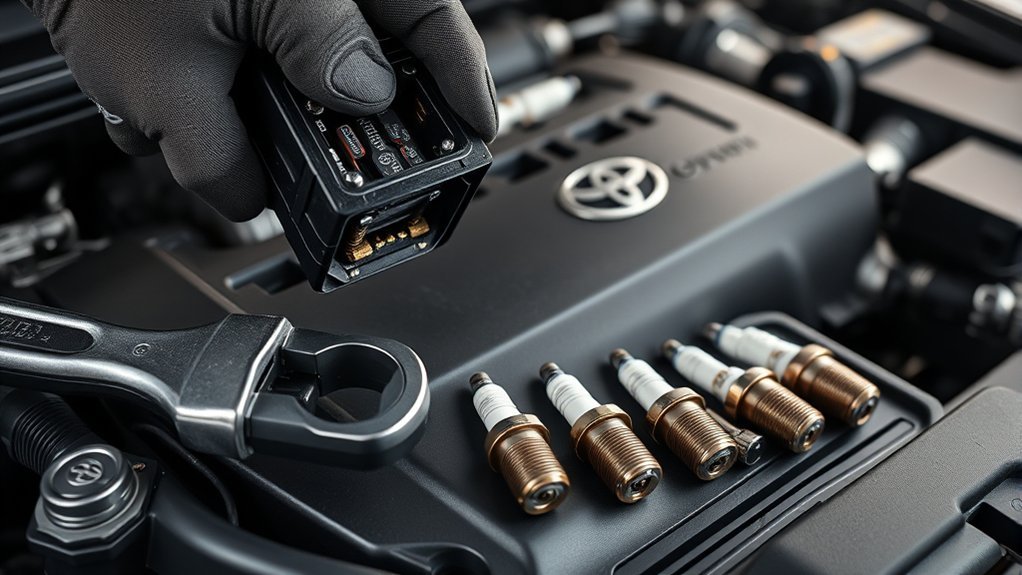
Routine spark-plug replacement should follow Toyota’s schedule. Inspection is especially useful when the engine has symptoms, when the plugs are already being removed during another repair, or when the vehicle’s maintenance history is unknown.
Early Problem Detection
Examining all plugs side by side can reveal uneven wear or a cylinder that is operating differently from the others. A technician can also inspect the ignition-coil boots, electrical connectors, plug wells, and valve-cover area for cracks, corrosion, oil, water, or tracking marks.
Finding oil in a plug well, for example, may point to a leaking seal rather than a failed plug. Correcting the leak before installing new parts helps prevent repeat problems.
Improved Engine Performance
Replacing plugs when they are actually due can restore consistent ignition and reduce the chance of wear-related misfires. Potential benefits include:
- Smoother idle when worn plugs were the cause of rough running
- More consistent acceleration under load
- Easier starting
- Less demand on ignition coils
- Reduced risk of a maintenance-related misfire
New plugs will not create extra power beyond the engine’s normal capability, and they will not correct unrelated mechanical or fuel-system faults.
Cost-Effective Maintenance Strategy
Replacing plugs at the specified interval is usually less expensive than diagnosing secondary problems created by neglected ignition maintenance. At the same time, replacing a good set far ahead of schedule without a documented reason creates unnecessary parts and labor expense.
The most cost-effective approach is to verify the interval, diagnose symptoms accurately, use the exact specified parts, and document the completed work.
Should You Replace Spark Plugs Yourself or Hire a Pro?
A careful DIY replacement may be practical on an accessible four-cylinder engine when the person doing the work has the correct parts, tools, torque specification, and experience. A V6 rear bank, damaged connector, oil-filled plug well, seized plug, or uncertain service history raises the difficulty and risk.
At a Glance
| Time Required | About 5–10 minutes to verify the schedule. Replacement time varies substantially by engine layout and rear-bank access. |
| Difficulty | Easy to verify; moderate on an accessible four-cylinder engine; potentially advanced on a V6. |
| Tools Needed | VIN or registration and the Toyota guide for verification; for replacement, the specified plugs, spark-plug socket, extensions, suitable compressed air or vacuum, and an accurate torque wrench. |
| Cost | No cost to confirm the interval. Parts and labor vary by engine, plug specification, local rates, and whether intake components or gaskets must be removed. |
DIY replacement offers labor savings and lets you inspect each removed plug. Professional service offers model-specific experience, better access tools, diagnostic capability, and support when a plug is difficult to remove.
Professional service is the safer choice when:
- The engine layout requires removal of intake, cowl, or plenum components.
- You cannot confirm the exact plug part number or torque specification.
- A plug feels seized or the threads appear damaged.
- Oil, coolant, corrosion, or standing water is present in a plug well.
- The check-engine light is flashing or the engine has an active misfire.
- You need diagnosis rather than routine scheduled maintenance.
Common Mistakes to Avoid When Replacing Spark Plugs
Spark-plug replacement looks simple, but an installation error can damage the plug, ignition coil, or aluminum cylinder head. Avoid these common mistakes:
- Buying by appearance alone: Match the exact application, thread diameter, reach, seat, heat range, resistor design, and specified gap.
- Working on a hot engine: Allow the engine to cool before removing plugs. Thread damage is more likely when hot aluminum and steel components are handled incorrectly.
- Letting debris fall into the cylinder: Clean around the coil and plug well before removing the plug.
- Pulling on coil wiring: Release the connector lock and handle the connector body rather than tugging on the wires.
- Starting the plug with a ratchet: Start it gently by hand with the socket and extension to reduce the risk of cross-threading.
- Using an unverified torque value: Use the specification for the exact engine, plug, and thread condition.
- Automatically applying anti-seize: Do not lubricate the threads unless the applicable service or plug-manufacturer instructions require it.
- Forcefully re-gapping fine-wire plugs: Many iridium plugs arrive with a preset gap. Improper tools can damage the center electrode or porcelain.
- Replacing plugs without investigating abnormal deposits: A new plug may foul again when the underlying cause is left unresolved.
- Mixing old and new plugs without a reason: For scheduled service, replace the complete engine set with matching specified plugs unless a diagnostic procedure directs otherwise.
DENSO’s installation guidance states that its published torque recommendations assume new plugs with unlubricated threads and warns that lubricated threads alter the required torque. NGK’s installation guidance also emphasizes correct torque, clean plug holes, and installation in a cool engine.
Pro Tip: Before removing anything, photograph the coil connectors, hose routing, brackets, and fastener locations. Work on one cylinder at a time when practical so parts are less likely to be mixed up.
How to Access Rear Spark Plugs on a V6 Toyota Camry
This section applies only to Camry models with a transverse V6 and a firewall-side rear cylinder bank. Four-cylinder and hybrid gasoline engines use a single inline row of cylinders and do not have the same rear-bank access problem.
On a V6, intake ducting, brackets, wiring, the cowl area, or an upper intake component may restrict access. The exact procedure changes by model year and engine. Do not loosen manifold or plenum bolts solely because a generic guide says they may need to be removed.
Removing Intake Manifold or Plenum Bolts
If the model-specific Toyota repair procedure calls for intake-plenum or manifold removal:
- Disconnect and move only the hoses, connectors, brackets, and ducts identified by the procedure.
- Label connectors and vacuum lines when their positions are not obvious.
- Track every bolt by location and length.
- Cover open intake passages immediately so no fastener or debris can enter.
- Inspect or replace required gaskets and seals rather than automatically reusing them.
- Use the specified tightening sequence and torque during reassembly.
- Check for disconnected hoses, trapped wiring, and intake leaks before declaring the job complete.
Warning: An open intake port can allow a bolt, tool, or debris to enter the engine. Cover every opening securely and account for all hardware before reassembly.
Positioning the Plug Socket Correctly
Keep the socket and extension aligned with the plug well. Side-loading the plug during removal or installation can crack the insulator or damage the threads. After the old plug is removed, compare it with the replacement and inspect the well before installation.
- Place the new plug squarely in the spark-plug socket.
- Lower it into the well without striking the electrode.
- Thread it by hand through the extension until the seat contacts the cylinder head.
- Stop immediately if it binds before seating; remove it and inspect the threads.
- Tighten it using the exact engine-specific torque procedure.
- Inspect the coil boot, reinstall the coil, and reconnect the electrical connector securely.
- Reinstall all removed components using their specified sequences and torque values.
A torque wrench is useful only when the correct specification and thread condition are known. It cannot compensate for cross-threading, dirt under the seat, an incorrect plug, lubricant that was not considered in the specification, or a damaged cylinder-head thread.
Should You Choose Genuine Toyota Spark Plugs or an Exact-Spec Equivalent?
Toyota Genuine Parts are selected to match Toyota’s vehicle specifications, which makes them a straightforward choice when the part number has been verified for the VIN. They can reduce uncertainty about fit, heat range, electrode design, and application.
A reputable aftermarket plug may also be suitable when its manufacturer’s current application catalog identifies it as an exact replacement for the specific Camry engine. Do not substitute a plug merely because the thread diameter or overall appearance seems similar.
Verify all of the following:
- Exact vehicle and engine application
- Thread diameter and reach
- Gasket or tapered seat design
- Heat range
- Resistor specification
- Electrode design and material
- Factory-set or required gap
- Installation and torque instructions
In the United States, using a non-Toyota-branded part does not automatically cancel warranty coverage. The Federal Trade Commission’s warranty guidance explains that coverage generally cannot be conditioned on using a particular brand of product or service. However, a warranty provider may deny a claim for damage caused by an incorrect, defective, or improperly installed part.
Note: Keep the receipt, packaging label, part number, installation date, and mileage. Those records can help establish that the correct maintenance was completed.
How to Schedule Your Spark Plug Replacement Effectively
Start with the official interval rather than a shop’s generic mileage menu. Record the due mileage and date, then compare both with the odometer and the vehicle’s age.
When booking service, provide the VIN and ask the shop to confirm:
- The engine and exact spark-plug part number
- The Toyota maintenance interval that applies
- Whether all plugs are included in the estimate
- Whether intake or cowl components must be removed
- Whether new plenum or intake gaskets are required
- Whether the ignition-coil boots and plug wells will be inspected
- Whether diagnostic work is included when the vehicle has a misfire or warning light
- The labor, parts, taxes, and additional-shop-supply charges
If the vehicle runs normally and the service is routine, arrange replacement by the applicable mileage or time limit. If it is misfiring, stalling, hard to start, or displaying a flashing check-engine light, request diagnosis promptly rather than waiting for the scheduled interval.
After service, confirm that the invoice lists the mileage, quantity of plugs, part number, and any additional gaskets or ignition components. Keep the invoice with the maintenance records.
Related Guides
Frequently Asked Questions
How often should spark plugs be changed on a Toyota Camry?
Use the schedule for the exact model year and engine. For example, Toyota’s 2024 U.S. guide specifies 60,000 miles or 72 months for the 2GR-FKS V6 and lists spark-plug service at 120,000 miles or 144 months elsewhere in the schedule. The 2025 guide marks replacement at 120,000 miles.
Is the correct Camry interval 60,000 or 120,000 miles?
Either can be correct. The answer depends on the model year and engine. The 2024 2GR-FKS V6 has a 60,000-mile interval, while other documented Camry applications reach scheduled plug replacement at 120,000 miles. Confirm the exact guide rather than choosing a number from a generic chart.
Do I really need to change my spark plugs at 100,000 miles?
Not every Camry has a 100,000-mile plug interval. If your guide specifies 120,000 miles and the engine has no diagnosed plug problem, 100,000 miles may be early. If your V6 schedule specifies 60,000 miles, waiting until 100,000 miles would be late. Follow the exact mileage-or-time entry.
How long do Toyota OEM spark plugs last?
Their intended service life is the interval Toyota assigns to the vehicle and engine in the applicable maintenance guide. The Toyota brand name alone does not establish one universal lifespan for every Camry.
Can a spark plug last 200,000 miles?
A plug may continue producing a spark beyond its scheduled life, but that does not mean its gap, electrodes, insulator, and sealing condition remain within specification. Do not use continued operation as a reason to ignore Toyota’s scheduled replacement interval.
Should anti-seize be applied to Toyota Camry spark plugs?
Do not apply it automatically. Follow the instructions for the exact plug and engine. Lubricating the threads changes the clamping force produced at a given wrench setting and can cause overtightening when a dry-thread torque specification is used.
Can worn spark plugs damage ignition coils?
Excessive plug wear or an enlarged gap can increase the voltage needed to fire the plug, which may place additional stress on the ignition system. A failed coil can also cause a misfire independently, so test the system instead of assuming one component caused the other.
Conclusion
The correct Toyota Camry spark-plug interval is the one published for the vehicle’s exact model year and engine. Current Toyota examples show why a blanket 60,000–100,000-mile recommendation is unreliable: one Camry engine may be scheduled at 60,000 miles, while another is scheduled at 120,000 miles.
Confirm the guide, follow both the mileage and time limits, use the exact specified plugs, and treat warning signs as reasons for diagnosis rather than automatic proof of plug failure. During installation, work on a cool engine, keep debris out of the plug wells, start every plug by hand, and use the correct torque procedure without adding thread lubricant unless the applicable instructions require it.
Sources
- Toyota 2024 Camry Warranty and Maintenance Guide — documents the 60,000-mile/72-month 2GR-FKS interval and the 120,000-mile/144-month service.
- Toyota 2025 Camry Warranty and Maintenance Guide — documents spark-plug replacement in the 120,000-mile maintenance column.
- Toyota Manuals and Warranties — official portal for model-year-specific owner and maintenance documentation.
- DENSO Spark Plug Installation — supports gap, torque, clean-thread, and thread-lubrication guidance.
- NGK Spark Plug Installation — supports cool-engine, clean-well, and correct-torque precautions.
- Federal Trade Commission Warranty Guidance — supports the explanation of branded replacement parts and warranty coverage.
