
An SUV tent for a winter road trip gives you sheltered sleeping space while keeping your cargo area within reach. The challenge is finding one that fits your hatch, handles ordinary rain, vents moisture, and remains practical when cold weather makes setup harder.
UNP 6-Person SUV Tent is the best overall pick because it balances a 10′ x 9′ floor with useful standing height and freestanding flexibility. For a more compact lower-priced option, consider the GoHimal SUV Tent.
We checked the current linked listings, manufacturer information where available, fit-related specs, weather features, and recall records. These are mild-winter car-camping shelters, not expedition tents.
SUV Tents for a Winter Road Trip Compared
| Product | Best for | Floor size | Center height |
|---|---|---|---|
|
Mid-range
|
Balanced family car camping | 10′ x 9′ | 78" |
|
Mid-range
|
Smaller groups and tall headroom | 10′ x 8′ | 86" |
|
Budget
|
Compact footprint and higher listed PU rating | 8′ x 8′ | 86.4" |
|
Mid-range
|
Maximum main-floor space | 10′ x 10′ | 84" |
|
Premium
|
Separate screened gear space | 13′ x 10′ | 87" |
SUV Tents for a Winter Road Trip: Our Top Picks
1. UNP 6-Person SUV Tent

Bottom line: This is the most balanced option for families or couples who want a roomy tailgate shelter without stepping up to the largest porch-style footprint. It suits mild cold-weather car camping when you can retreat to hard-sided shelter if conditions worsen.
- Capacity: 6 people, plan for fewer with winter gear
- Floor size: 10′ x 9′, room for bedding and luggage
- Center height: 78", standing room for many adults
- Weather protection: Rainfly and double-layer design, for ordinary precipitation
The 10′ x 9′ floor gives you more room than the compact 8′ x 8′ option while remaining smaller than the 10′ x 10′ dome and 13′ x 10′ porch model. That balance matters on developed campsites where a large footprint can be hard to place.
UNP lists a 78-inch center height, mesh roof, mesh windows, and an adjustable vehicle sleeve. The manufacturer lists the tent at 20.9 lb. Ventilation helps manage condensation, but the rainfly should stay installed when precipitation is possible.
The catch is fit. A universal-style sleeve can sit differently around spoilers, roof rails, rounded hatch corners, and powered liftgates. Practice the full setup before travel and confirm the fabric stays clear of the exhaust area.
- 10′ x 9′ floor balances sleeping and gear space
- 78-inch center height supports standing and changing
- Rainfly plus mesh roof and windows
- Can function as a vehicle-connected family shelter
- Universal sleeve still needs a vehicle-specific fit test
- Large enough that solo setup can be awkward
- No verified snow-load rating
This source-article chart is retained as originally supplied. It is not used as live rating data or as evidence for the current ranking.
Check Product Details on Amazon
2. TIMBER RIDGE 5-Person SUV Tent
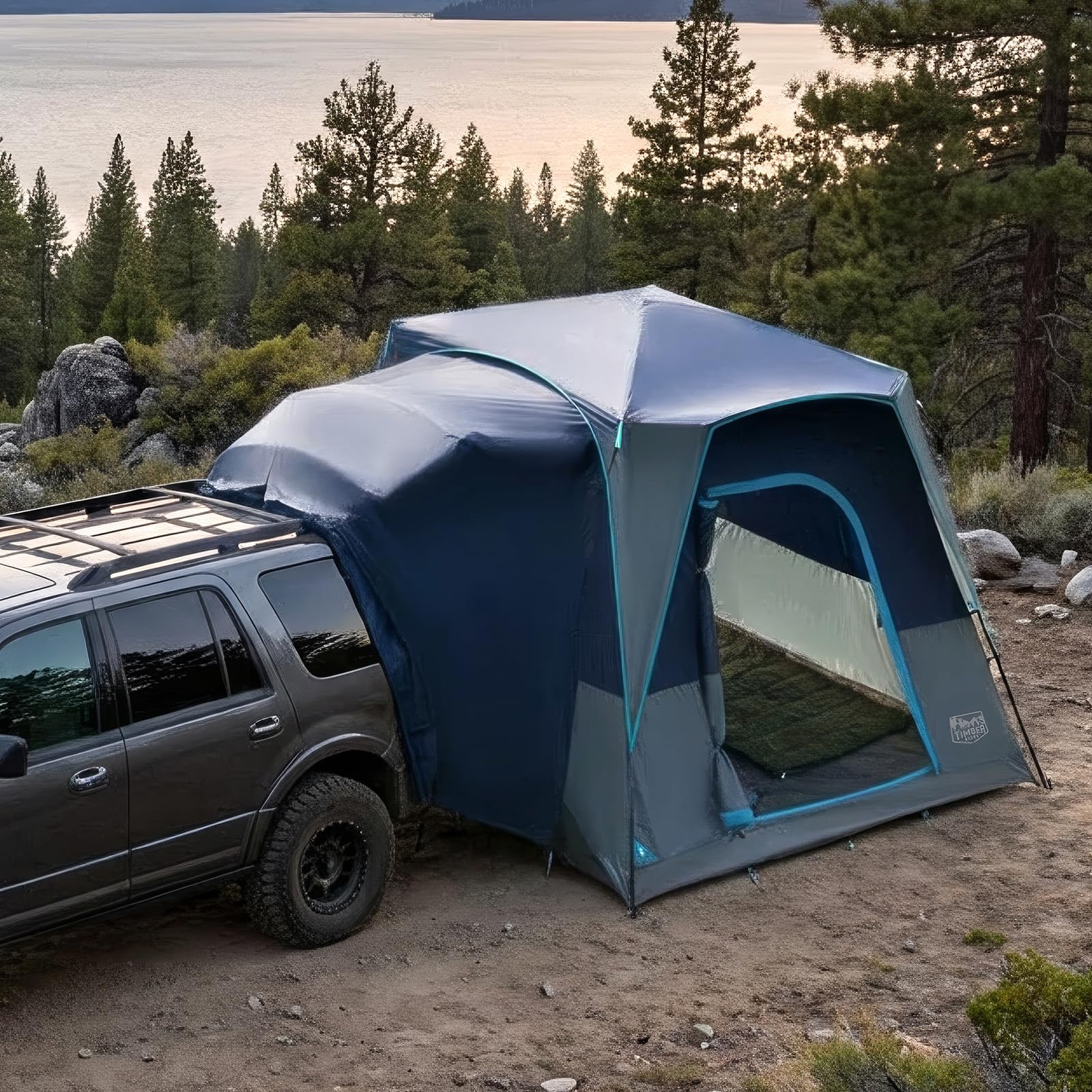
Bottom line: Choose this model if you want tall headroom in a narrower 10′ x 8′ footprint. It gives smaller groups useful standing space without requiring the width of the larger porch tent.
- Capacity: 5 people, fewer with bulky winter bedding
- Floor size: 10′ x 8′, easier to place on smaller sites
- Center height: 86", generous standing room
- Weather protection: PU2000 coating and rainfly, for regular campsite rain
The current linked listing gives this tent an 86-inch maximum height, one large door, a top mesh skylight, two mesh windows, and an e-port. Those openings are useful for airflow, which matters when cold air and damp clothing increase condensation inside the shelter.
The listing also says the tent can be used without the vehicle. That is useful on a road trip because you can detach the SUV for a day drive after closing and securing the tent.
Its tall walls expose more fabric to wind than a lower shelter. Use all required stakes and guylines, tension the tent evenly, and avoid exposed sites when strong gusts are forecast.
- 10′ x 8′ footprint fits smaller developed sites
- 86-inch maximum height gives generous headroom
- PU2000 coating with included rainfly
- Mesh skylight and windows support airflow
- Can stand without the vehicle
- Tall profile can catch more wind
- Five-person rating becomes tight with winter gear
- No verified snow-load rating
This source-article chart is retained as originally supplied. It is not used as live rating data or as evidence for the current ranking.
Check Product Details on Amazon
3. GoHimal SUV Tent

Bottom line: The GoHimal is the value pick for campers who want a compact 8′ x 8′ floor and the highest seller-listed PU coating in this group. It works best for smaller sleeping layouts where campsite space matters.
- Capacity: Listed for 5–8 people, use fewer with winter gear
- Floor size: 8′ x 8′, compact for tighter campsites
- Center height: 86.4", tall enough for standing
- Weather protection: PU3000 coating and rainfly, highest listed coating here
The current listing identifies 210T polyester with a PU3000 mm coating, plus a rainfly and storage bag. The number is useful for comparing the fabric claim, but it does not guarantee that the hatch connection, zippers, or every seam will stay dry in all conditions.
Its 8′ x 8′ floor is easier to place than the larger UNP tents and the porch model. The trade-off is less room for thick pads, winter sleeping bags, boots, and luggage, so the advertised occupancy should not be treated as comfortable winter capacity.
For cold-weather use, pitch on well-drained ground and keep the rainfly tensioned away from the inner wall. Test the sleeve at home so runoff cannot funnel toward the open hatch.
- Compact 8′ x 8′ footprint
- 86.4-inch listed height keeps useful standing room
- Seller-listed PU3000 mm coating
- Rainfly and storage bag included
- Less floor area than the other full-size picks
- Advertised capacity is optimistic with winter bedding
- No verified snow-load rating
This source-article chart is retained as originally supplied. It is not used as live rating data or as evidence for the current ranking.
Check Product Details on Amazon
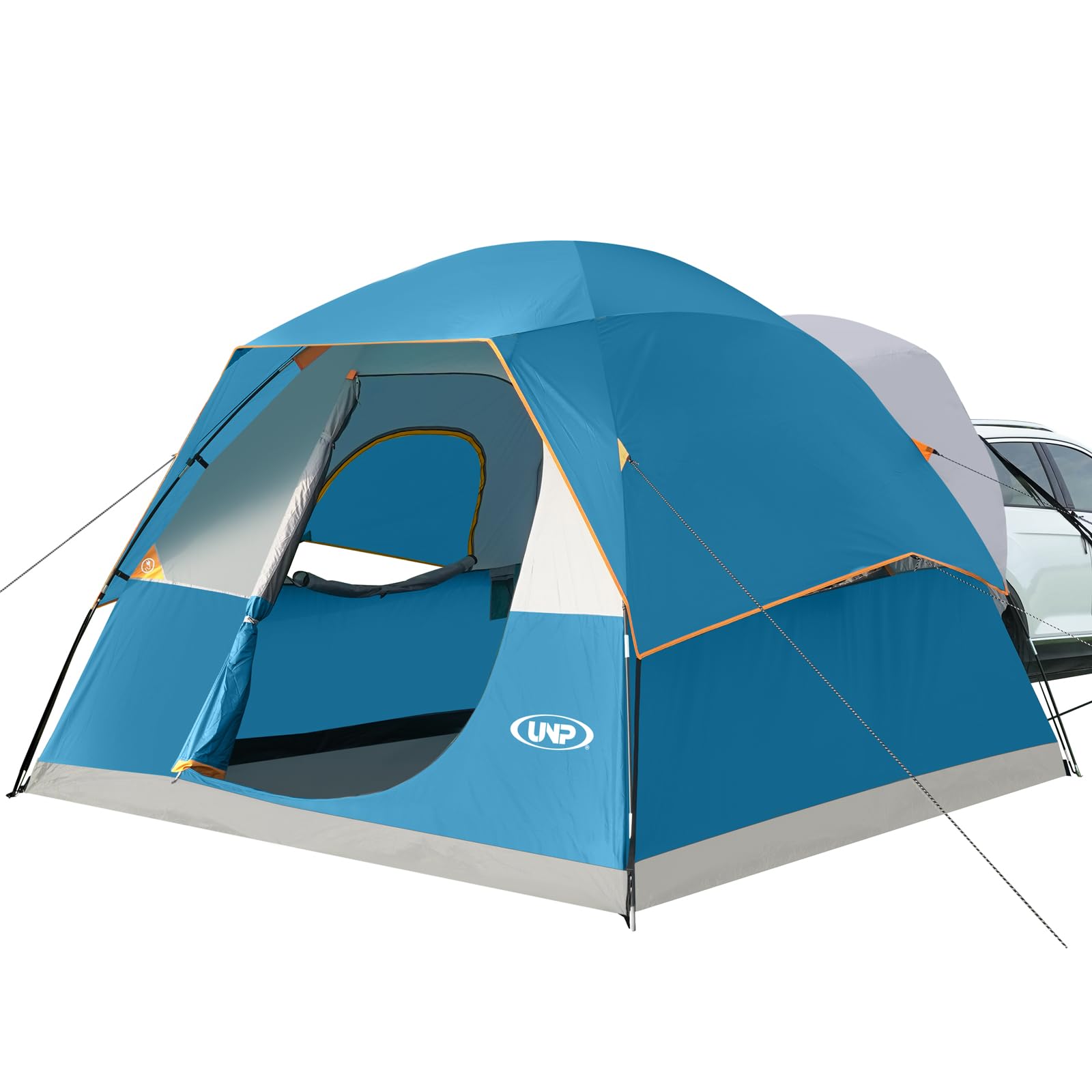
4. UNP SUV Dome Tent
Bottom line: Pick the UNP SUV Dome Tent if your priority is an open main room for winter bedding, luggage, and changing. Its 10′ x 10′ floor is the largest main sleeping floor in this roundup.
- Capacity: 4–6 adults, plan for fewer with bulky gear
- Floor size: 10′ x 10′, largest main floor here
- Center height: 84", roomy standing height
- Weather protection: Rainfly and double-layer coverage, for campsite precipitation
UNP lists the current model at 120 by 120 by 84 inches and 18.22 lb. The broad floor makes it easier to separate sleeping gear from boots, dry bags, and clothing without stacking everything beside your mattress.
The dome layout includes a rainfly, mesh roof, and four mesh windows in the linked listing. That mix gives you useful airflow in dry weather while letting you close the outer layer when rain or light snow is possible.
The downside is campsite size. A 10′ x 10′ body needs a larger flat area, and aligning the vehicle sleeve is easier with a second person when the ground is cold, uneven, or windy.
- Largest 10′ x 10′ main floor in this roundup
- 84-inch center height supports standing
- Rainfly plus mesh roof and four mesh windows
- Manufacturer lists an 18.22 lb item weight
- Needs a larger flat campsite
- Broad body can be harder to manage solo
- No verified snow-load rating
This source-article chart is retained as originally supplied. It is not used as live rating data or as evidence for the current ranking.
Check Product Details on Amazon
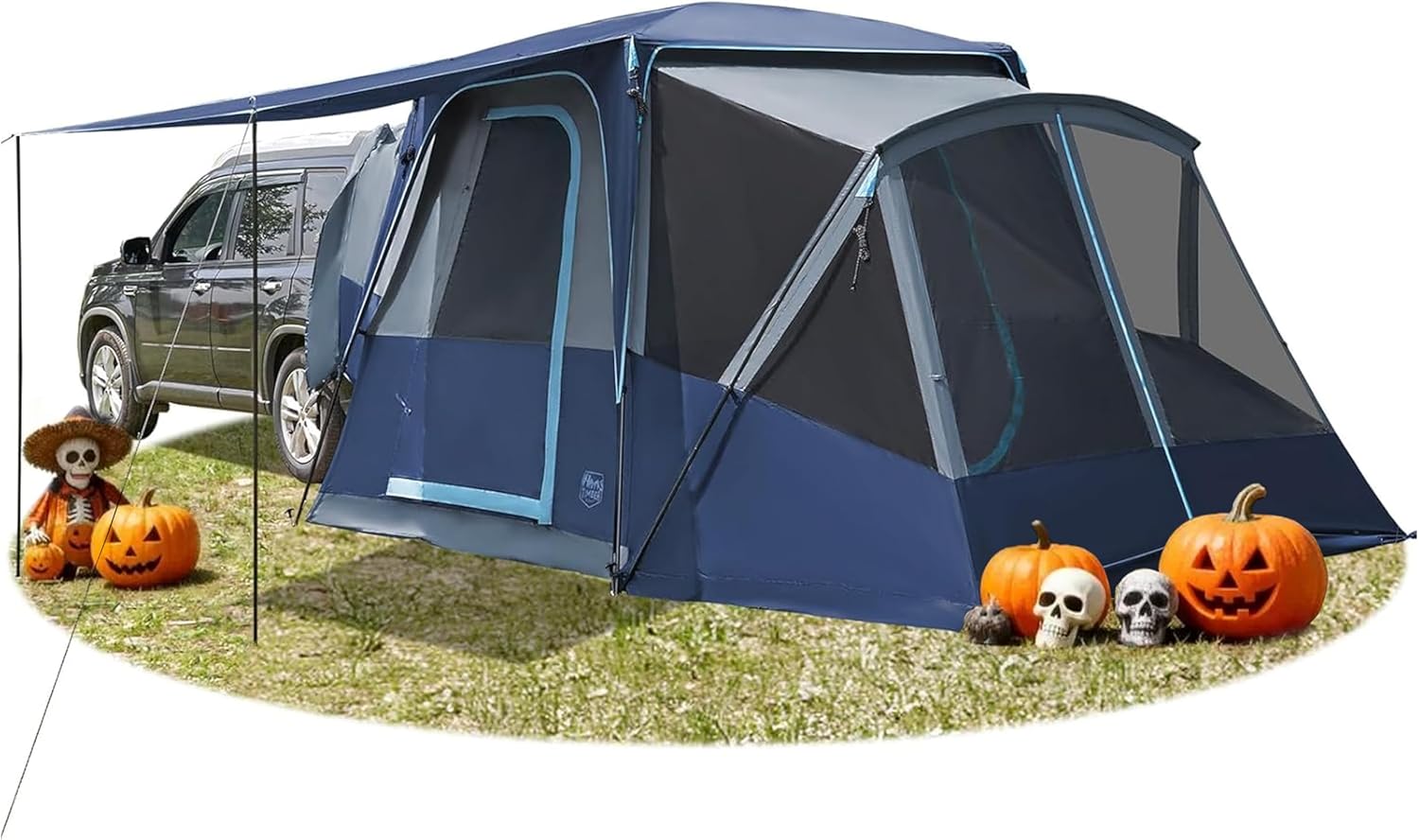
5. TIMBER RIDGE SUV Tent with Screen Porch
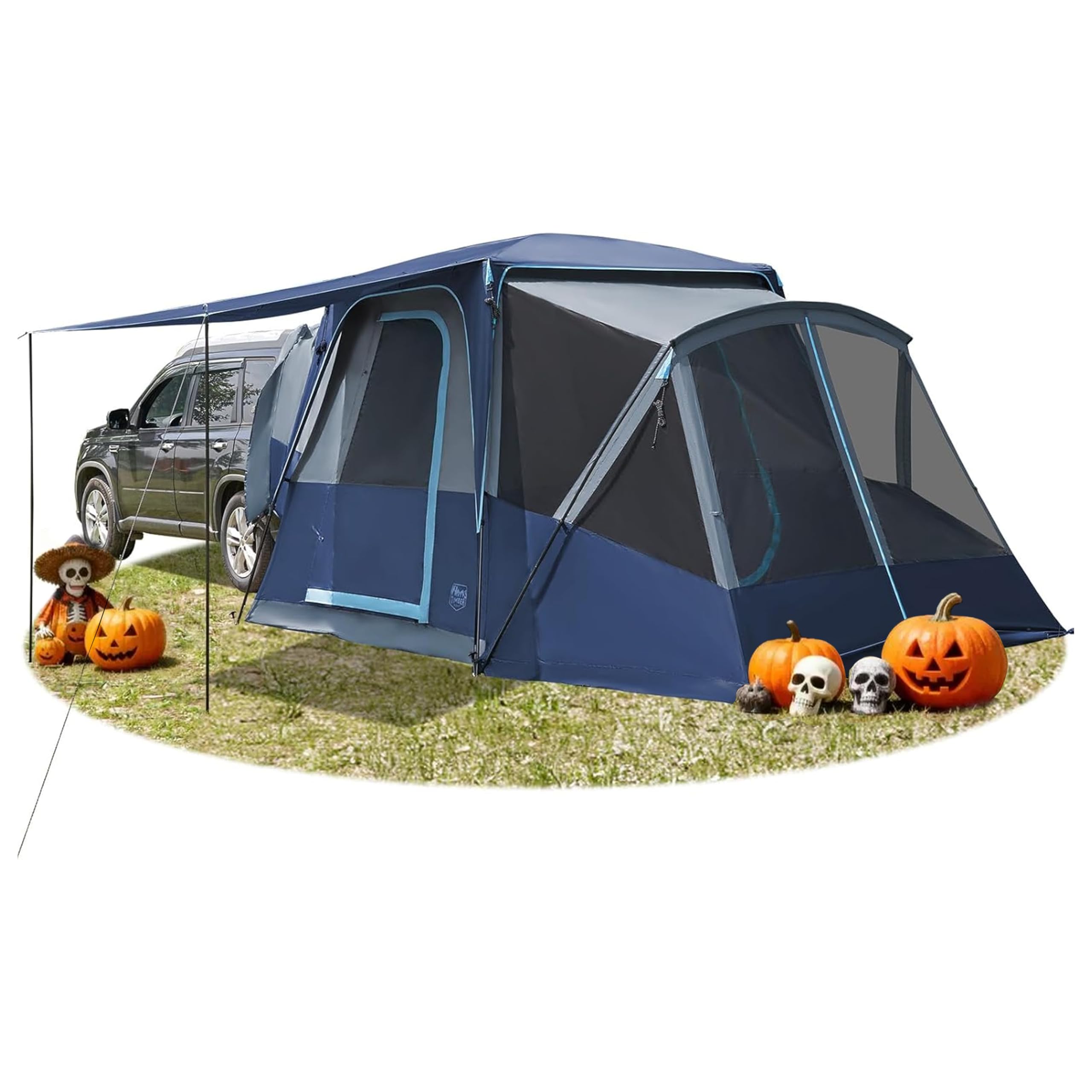
Bottom line: This is the pick for longer family stays where separating wet boots, coolers, chairs, and other gear matters more than packed size. The screened porch gives it a type of organization the other tents do not provide.
- Capacity: Main tent fits up to 5 campers, despite broader title wording
- Floor size: 13′ x 10′, largest overall footprint here
- Center height: 87", tallest model in this group
- Weather protection: PU2000 fabric and rainfly, plus porch and awning
The linked listing says the main tent fits up to five campers or two air mattresses. It also specifies a 6′ x 8′ screened porch and an 87-inch center height. For winter packing, it makes more sense to treat the porch as a gear zone than as extra sleeping capacity.
The porch and awning are useful for keeping wet equipment away from bedding, but they also add fabric that needs careful tension. Water or wet snow should be able to shed instead of pooling on horizontal surfaces.
This is also the least convenient option for tight sites or frequent one-night stops. Amazon now labels a newer TIMBER RIDGE generation on the linked page, so compare the current model details before ordering.
- 13′ x 10′ overall footprint with 87-inch center height
- Separate 6′ x 8′ screened porch
- PU2000 fabric with rainfly
- Porch creates a dedicated wet-gear zone
- Can be used as a vehicle-connected shelter
- Largest footprint is harder to place
- Porch and awning add setup and tensioning work
- No verified snow-load rating
This source-article chart is retained as originally supplied. It is not used as live rating data or as evidence for the current ranking.
Check Product Details on Amazon
UNP 6-Person SUV Tent vs GoHimal SUV Tent: Is the Upgrade Worth It?
The core trade-off is space versus compactness. The UNP gives you a larger 10′ x 9′ floor, while the GoHimal uses an 8′ x 8′ footprint and carries the higher seller-listed PU coating.
- Floor area: UNP gives more room for bedding and luggage.
- Height: GoHimal is taller at a listed 86.4 inches.
- Weather claim: GoHimal lists PU3000; UNP relies on its rainfly and double-layer design.
- Campsite fit: GoHimal is easier to place on a smaller pad.
Which SUV Tent Should You Buy?
- Best overall balance: get the UNP 6-Person SUV Tent.
- Smaller family footprint: get the TIMBER RIDGE 5-Person SUV Tent.
- Value and higher listed PU coating: get the GoHimal SUV Tent.
- Maximum main-floor room: get the UNP SUV Dome Tent.
- Separate wet-gear space: get the TIMBER RIDGE SUV Tent with Screen Porch.
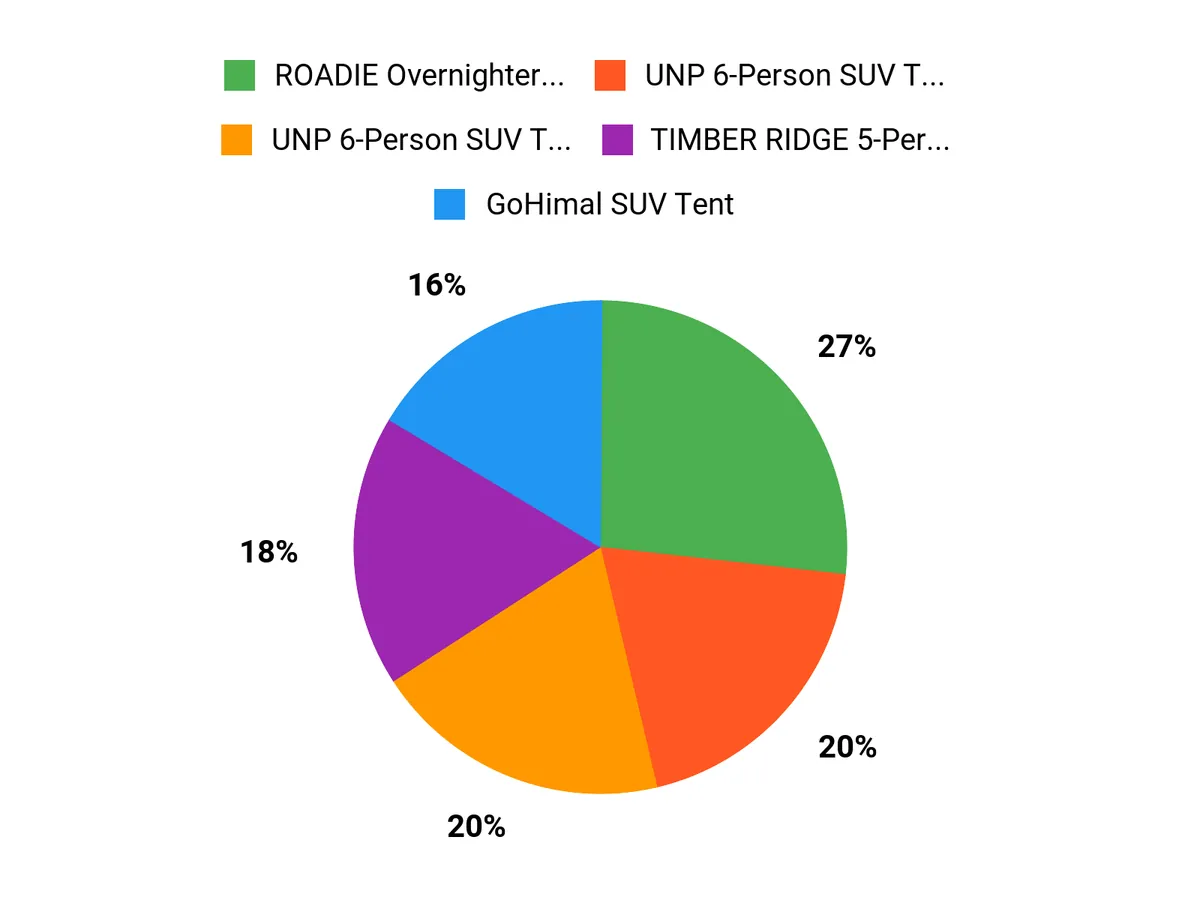
This source-article chart is retained as originally supplied. It is not a current scientific survey and is not used as evidence for the rankings above.
How We Chose
- Vehicle fit: sleeve design, hatch access, and the need to clear spoilers, rails, struts, and exhaust areas.
- Usable space: verified floor dimensions, center height, and realistic room for winter bedding and luggage.
- Weather management: rainfly coverage, listed PU coatings, ventilation, and condensation control.
- Road-trip practicality: standalone use, campsite footprint, and likely setup effort in cold conditions.
- Verification: current Amazon listings, manufacturer pages where available, and CPSC recall searches; we did not treat marketplace “4 season” wording as proof of severe-winter capability.
Before You Buy: Vehicle Fit and Winter Checklist
- Measure the hatch: Check width, opening height, roofline, spoiler, rails, liftgate struts, and bumper depth.
- Inspect strap routing: Keep straps away from sharp bodywork and powered-liftgate hardware.
- Check exhaust clearance: Keep fabric and occupied space away from the exhaust outlet.
- Plan realistic capacity: Thick pads, winter bags, boots, and luggage take more room than summer sleeping bags.
- Test it at home: Complete a full setup and hose-test the sleeve area before travel.
- Bring suitable anchors: Frozen, sandy, or loose ground may require different stakes or approved weights.
- Watch the forecast: Move to hard-sided shelter for severe wind, freezing rain, deep snow, or dangerous temperatures.
Important Carbon-Monoxide and Fire Safety
Never idle a fuel-powered vehicle to heat an attached SUV tent. Exhaust can enter through the hatch connection, vents, windows, or gaps around the shelter.
Never operate a fuel-burning heater, stove, lantern, charcoal device, or generator while sleeping in a tent or vehicle. Use insulated sleeping pads, appropriately rated sleeping bags, dry layers, and ventilation as your primary cold-weather system.
For more precautions, see the U.S. Consumer Product Safety Commission camping-equipment guidance.
SUV Tent Maintenance After Cold-Weather Camping
Dry the shelter fully before storage, clean dirt from zippers, inspect pole joints and sleeve straps, and store stakes and poles dry. If seam tape lifts, use a repair product compatible with the fabric. Repeat the vehicle-fit test after changing cars or adding accessories that alter the hatch area.
How to Choose an SUV Tent for a Winter Road Trip
Start With Hatch Compatibility
Do not rely on a “universal” label alone. Measure the liftgate opening, bumper, roofline, spoiler, rails, and struts. Check whether straps can be routed without damaging paint or blocking a powered hatch. If fit uncertainty is your main concern, the adjustable-sleeve design of the UNP 6-Person SUV Tent is a sensible place to start, but you still need a home test.
Choose Realistic Sleeping Capacity
Manufacturer capacity numbers assume a tight sleeping layout. Winter pads, thick bags, boots, jackets, and luggage use much more floor area. A six-person shelter can feel far more comfortable for two to four people in cold weather. Choose by your actual sleeping system, not the largest number in the product title.
Compare Floor Area and Standing Height
An 8′ x 8′ body is easier to place, while 10′ x 9′ and 10′ x 10′ tents give you more room to separate sleep and storage zones. The UNP SUV Dome Tent is the best fit here when open floor area matters most.
Treat Waterproof Ratings as One Part of the System
PU figures describe a fabric or coating claim, not the whole shelter. Dryness also depends on seams, zipper covers, floor material, rainfly coverage, sleeve fit, drainage, and tension. The GoHimal SUV Tent has the highest listed PU number here, but the hatch connection still needs careful setup.
Prioritize Ventilation
Cold air does not remove the need for ventilation. Your breath, damp clothing, and the temperature difference between inside and outside can create heavy condensation. Use covered vents and mesh panels without exposing bedding directly to precipitation, and keep wet gear in the cargo area or porch when possible.
Check Standalone Mode
A freestanding SUV tent is useful when you need to drive away during the day. Confirm the rear opening can be closed after detachment and practice the sequence before travel. The TIMBER RIDGE 5-Person SUV Tent is explicitly listed for standalone use.
Plan for Wind and Snow
Tall SUV tents catch more wind than low-profile shelters. Use every required stake and guyline, face a smaller wall toward the prevailing wind where practical, and avoid exposed sites in severe weather. None of these retained tents has a verified snow-load rating, so brush off light accumulation early and move to hard-sided shelter when significant snowfall is expected.
Mistakes to Avoid When Buying an SUV Tent
- Buying by capacity alone: allow extra floor area for winter bedding and gear.
- Trusting “universal fit” blindly: measure the hatch and test the sleeve at home.
- Choosing by PU rating alone: check rainfly coverage, drainage, and connection points.
- Ignoring wind exposure: tall walls and awnings need careful anchoring.
- Treating it as an expedition tent: use hard-sided shelter for severe winter weather.
FAQs
Will an SUV Tent Keep Me Warm in Winter?
An SUV tent can block some wind and precipitation, but it does not provide meaningful insulation by itself. Use an insulated sleeping pad, a temperature-appropriate sleeping bag, dry layers, and ventilation. Never idle a fuel-powered vehicle for heat while the tent is attached, and never sleep with a fuel-burning heater, stove, lantern, or charcoal device operating inside.
Are These True Four-Season Tents?
No severe-winter capability should be assumed from a marketplace “4 season” label. These are tall vehicle-connected camping tents, and none of the retained models has a verified snow-load or high-wind rating. They are better suited to mild winter road trips and developed campgrounds where you can move to a hard-sided shelter if the forecast turns dangerous.
How Do I Know Whether the Sleeve Will Fit My SUV?
Measure the liftgate opening, bumper width, roofline, spoiler, roof rails, and liftgate struts, then compare those dimensions with the current listing. Check where straps will sit and make sure they do not block doors or stress powered-hatch hardware. A full practice setup at home is the safest way to find fit problems before a trip.
Can I Drive Away Without Taking Down the Tent?
Yes, the retained tents are marketed for standalone use after detachment, but the closing method varies by model. Before driving away, remove every strap, suction cup, sleeve section, or line connected to the vehicle. Close the tent’s rear panel and confirm the shelter remains fully staked and stable without the vehicle supporting any part of it.
How Do I Reduce Condensation in an SUV Tent?
Keep covered vents and mesh panels open whenever weather allows, and avoid bringing snow-covered or wet gear into the sleeping area. Change out of damp clothing before bed and keep bedding away from the tent walls. Good airflow matters even in cold weather because breathing and wet clothing can create heavy condensation inside a sealed shelter.
Should I Put a Tarp Under an SUV Tent?
A correctly sized footprint or tarp can protect the tent floor from abrasion, frozen ground, and campsite debris. Keep every edge underneath the tent so the tarp cannot collect rain or melting snow. Clear sharp objects first, and choose a site where water drains away from both the shelter and the parked vehicle.
How Should I Maintain an SUV Tent After a Winter Trip?
Dry the tent completely before storage, remove dirt from zippers, and inspect poles, clips, guylines, stakes, and vehicle-sleeve straps. Repair damaged seam tape with a product compatible with the fabric. Store all parts dry, and repeat your vehicle-fit test after changing vehicles or adding accessories such as roof racks or spoilers.
Final Verdict: Best SUV Tent for a Winter Road Trip
For a mild-winter road trip, the best SUV tent is the one that fits both your vehicle and your campsite. The UNP 6-Person SUV Tent offers the strongest overall mix of room, standing height, weather coverage, and road-trip flexibility.
Whatever you choose, test the hatch connection before departure, keep the engine off while the attached shelter is occupied, and move to hard-sided shelter when winter conditions become severe.
For a lower-priced compact option, see the GoHimal SUV Tent. If you want the roomiest feature set with a separate porch, see the TIMBER RIDGE SUV Tent with Screen Porch.
| Product | Image | Best For | Stated Capacity | Listed Dimensions | Weather Notes | Amazon Link |
|---|---|---|---|---|---|---|
| UNP SUV Tent for Camping, 6-Person |
 |
Best overall balance | 6 people; fewer with bulky winter gear | 120″L x 108″W x 78″H | Rainfly and mesh ventilation; no verified snow-load rating | Check Details |
| TIMBER RIDGE 5-Person SUV Tent |
 |
Smaller groups and tall headroom | 5 people; fewer with winter equipment | 120″L x 96″W x 86″H | Seller-listed PU2000 mm; tall walls require careful anchoring | Check Details |
| GoHimal SUV Tent |
 |
Higher seller-listed rain rating | Listed for 5–8; plan for fewer with gear | 96″L x 96″W x 86.4″H | Seller-listed PU3000 mm and taped seams; sleeve fit still affects dryness | Check Details |
| UNP SUV Dome Tent |
 |
Maximum main-floor space | 4–6 adults; fewer with winter bedding | 120″L x 120″W x 84″H | Rainfly and taped seams; large footprint needs a well-drained site | Check Details |
| TIMBER RIDGE SUV Tent with Screen Porch |
 |
Screened gear and sitting space | Detailed listing says up to 5 sleepers | 156″L x 120″W x 87″H | Seller-listed PU2000 mm; porch and awning require careful tensioning | Check Details |