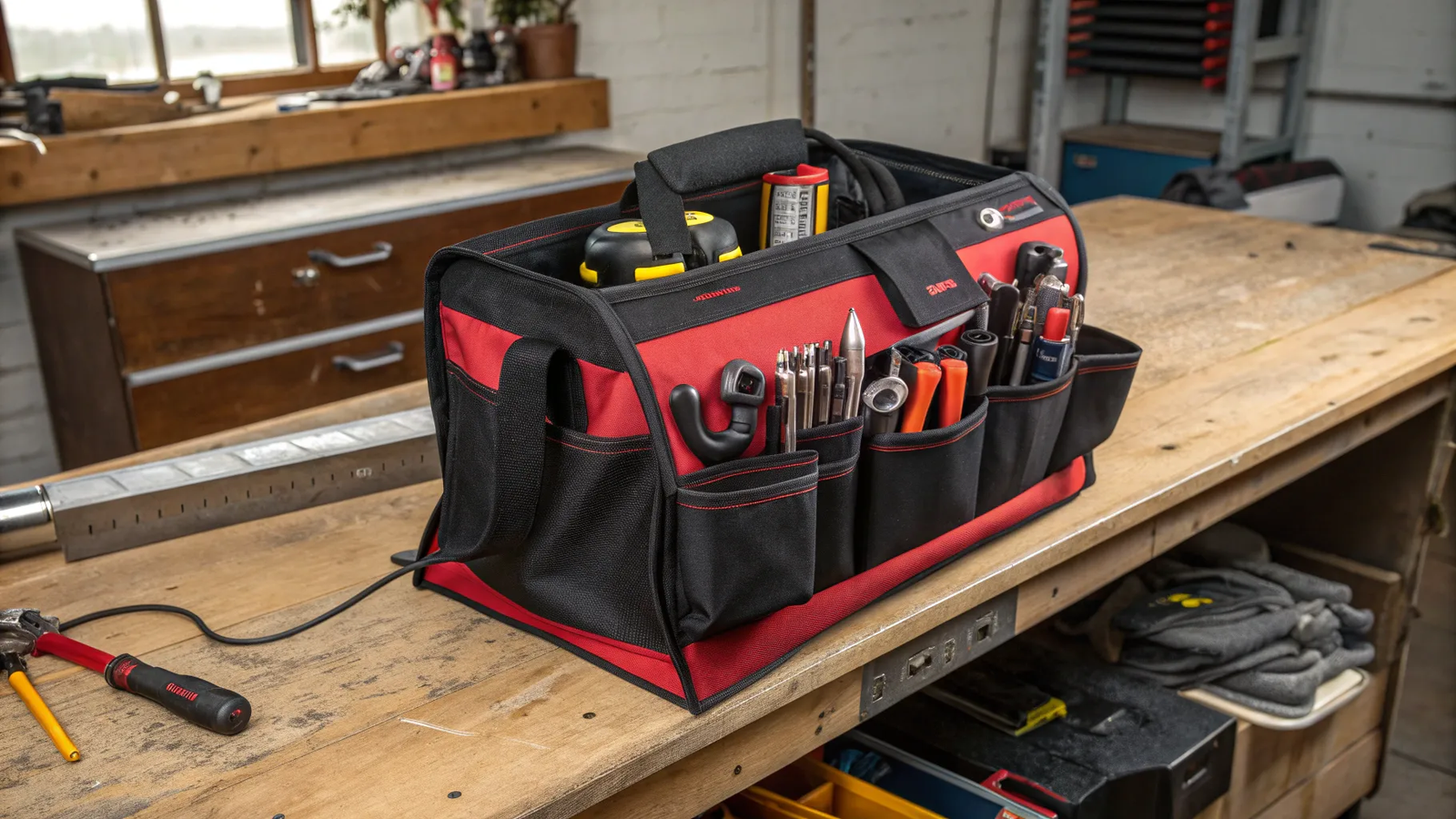
If you want one tool bag that handles most day-to-day residential and light commercial jobs, the Veto Pro Pac TP-XXL is a strong starting point. This guide breaks down my full everyday carry setup, including the testers, lights, drivers, cutters, pliers, sockets, consumables, and small helper tools I keep inside the bag. You’ll also see how I organize everything by task zone so I can work faster without digging through pockets.
Quick Answer
My Veto Pro Pac TP-XXL setup is built around fast access, tool protection, and 75–80% job coverage. I standardize on 3/8″ drive sockets and hex-shank bits, keep testers and lights easy to grab, and use small containers for parts so the bag works like a portable mini workbench.
Key Takeaways
- The TP-XXL works well when you want covered protection but still need open-top style access on the job.
- A smart EDC bag should cover your most common work, not every rare task.
- Standardizing 3/8″ sockets and hex-shank bits makes the whole kit more flexible.
- Keep testers, safety gear, lights, and repeat-use bits in quick-access pockets.
- Audit the bag every few months so weight stays under control and dead tools do not waste space.
Disclosure: This article contains affiliate links. If you buy through these links, I may earn a commission at no extra cost to you.
At a Glance
| Best For | Residential service, light commercial jobs, HVAC, electrical, plumbing, maintenance, and general repair work |
| Bag Style | Covered tool pouch with quick-access pocket layout |
| Core Setup | Meters, lights, driver bits, impact driver, cutters, pliers, sockets, hand tools, fasteners, and consumables |
| Estimated Loaded Weight | About 40 pounds with this full loadout |
Last updated: June 30, 2026
Table of Contents
- Why I Chose the Veto Pro Pac TP-XXL
- My Carry Philosophy: 75–80% Coverage
- Exterior Pockets & Everyday Wear Items
- Electronics, Testers & Measuring Tools
- Lights & Portable Worklights
- Driver Tools & Power Drivers
- Hand Saws, Cutters & Scrapers
- Fasteners, Consumables & Small Parts
- Wrenches, Sockets & Ratchets
- Pliers & Specialty Gripping Tools
- Screwdrivers, Punches & Specialty Drivers
- Bits, Drill Bits & Step Bits
- Specialty Tools & Small Helpers
- Organization Inside the Bag
- Load Weight & Portability
- Maintenance, Replacement & Evolution
- Complete Gear & Product Links
- Frequently Asked Questions
- Sources
- Conclusion
Why I Chose the Veto Pro Pac TP-XXL
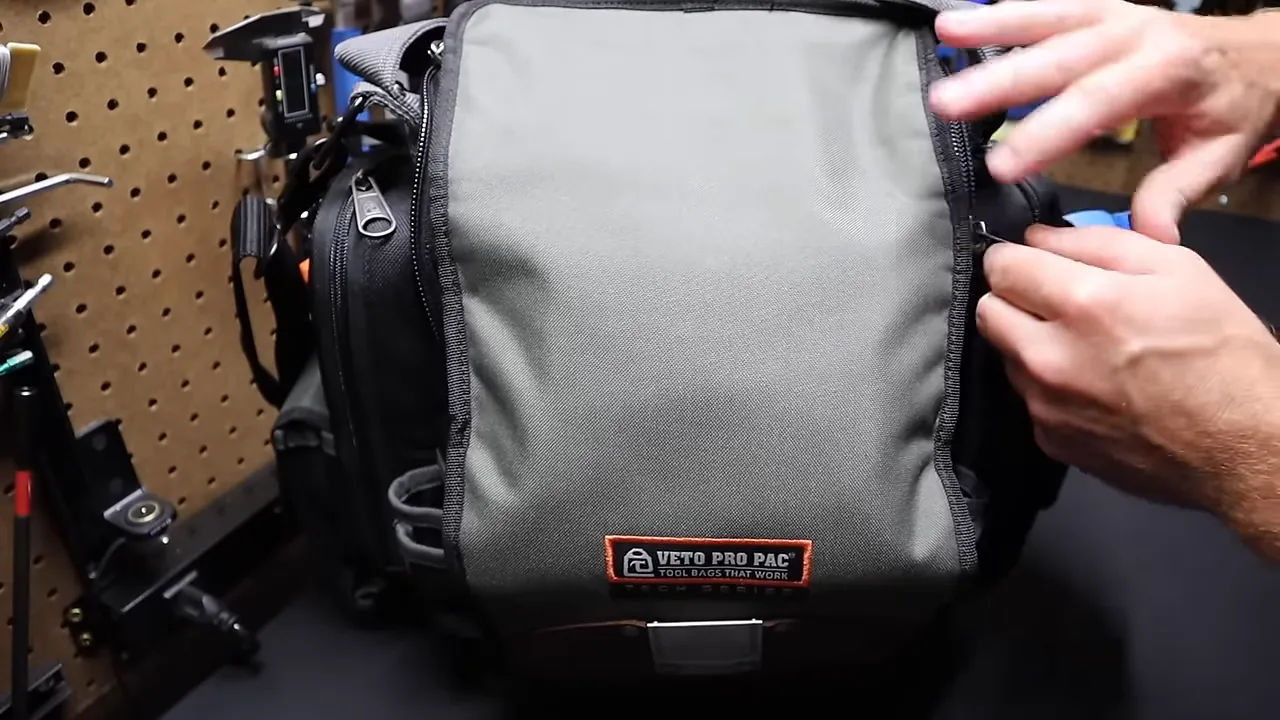
I’ve worked with a few Veto bags over the years, including the Pro Pac Tech MCT and the Tech LC. The TP-XXL is my current favorite because it gives me the access of an open-top bag with the protection of a closed-top design. The top can flip fully back when I’m working, then zip shut when I need to carry the bag through a house, truck, ladder area, or jobsite.
The big win is speed. I can reach in from several angles, grab the tool I need, and put it back without rebuilding the bag every time. That matters when I’m moving between small tasks all day.
Key advantages I rely on:
- Open access with covered protection: The flip-back top gives immediate access without leaving everything exposed during transport.
- Dedicated meter/tester pockets: The meter pockets are useful for clamp meters, circuit testers, and compact measuring tools.
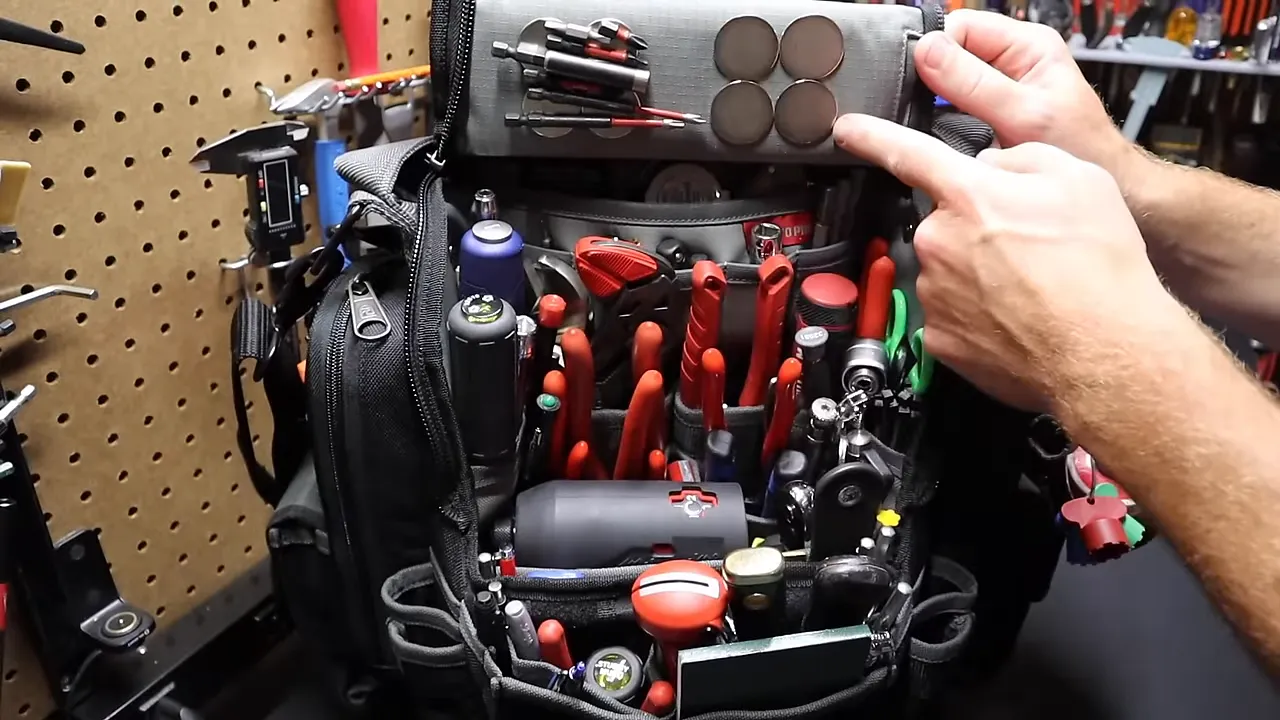
- Top metal plate: The metal plate gives me a handy place to attach magnetic lights or use rare-earth magnets as a small screw catch.
- Robust build: The bag feels built for field use, while still protecting delicate electronics and smaller parts.
My Carry Philosophy: 75–80% Coverage
I don’t try to carry everything. The idea behind this loadout is to cover roughly 75–80% of what I need for common residential and light commercial work. Heavy, specialized, or site-specific tools stay in the truck. This bag is meant to be a portable, reliable workbench that saves steps and keeps my core tools within reach.
Interchangeability is the rule that keeps the bag useful without making it too heavy. I standardize many sockets around 3/8″ drive and many driver tools around hex-shank bits. That way, the ratchet, impact driver, cordless screwdriver, adapters, extensions, and bit holders all work together instead of creating several separate systems.
Pro Tip: Build your bag around jobs you actually do every week. A tool you use once a year may belong in the truck, not in your daily carry.
Exterior Pockets & Everyday Wear Items
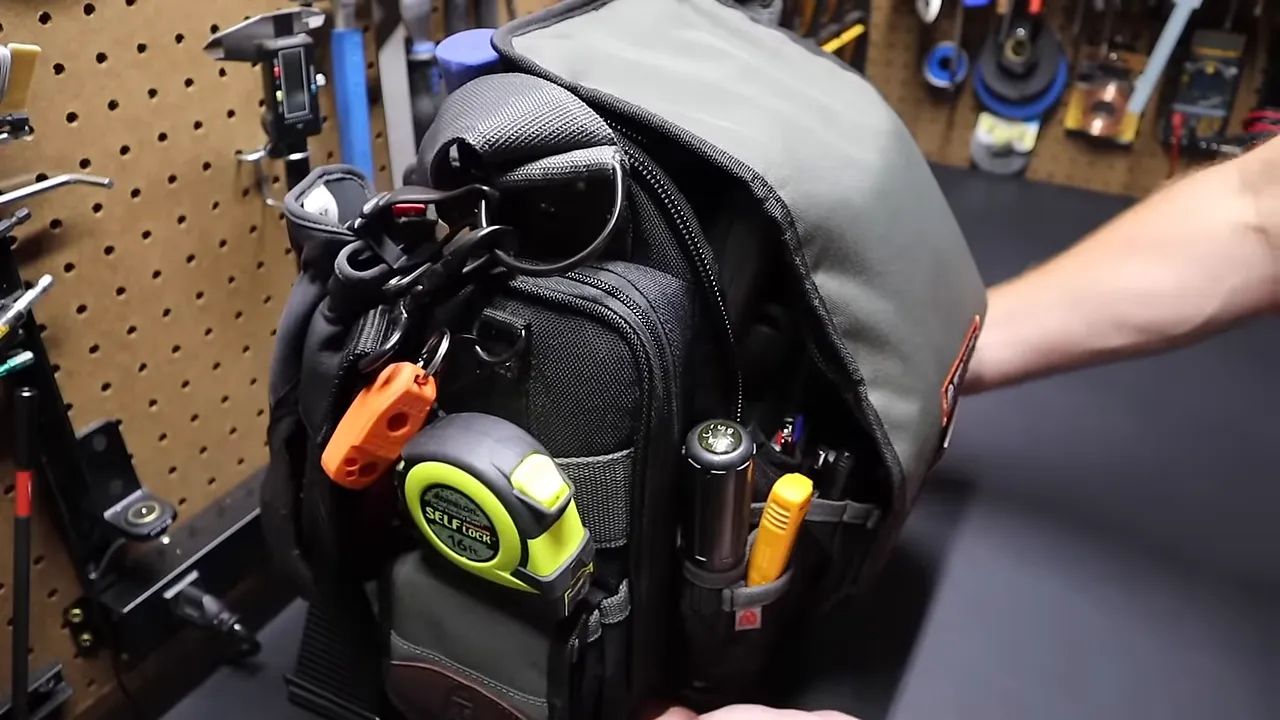
I keep high-use items in the outside pockets so they’re available the moment I set the bag down. These are the tools and accessories I reach for before I even open the main compartment.
- Cleaning cloth: A terry cloth helps wipe tools, clean surfaces, remove grit, and handle final inspections without hunting for a rag.
- Safety glasses: Carhartt Spokane Safety Glasses stay clipped where I can grab them quickly before cutting, drilling, or working overhead.
- Gloves: Mechanix FastFit work gloves hang on a Squids Grabber glove clip so they stay out of the way until I need hand protection.
- Magnetizer/demagnetizer: The Klein MAG2 demagnetizer/magnetizer is small, but it saves time when I need bits to hold screws or stop picking up metal debris.
- Tape measure: A Komelon tape measure gives me a compact blade with easy-to-read markings for quick layout and checking.
- Quick access bits: Small bit racks and a Milwaukee keychain bit holder live outside the bag for repeat screwdriving tasks.
Warning: Keep safety glasses and gloves easy to reach, not buried in the main compartment. Protective gear only helps when you actually use it before the task starts.
Electronics, Testers & Measuring Tools
Testing and measuring tools take up several dedicated pockets because they are mission-critical. I want meters, probes, non-contact testers, temperature tools, and laser measures protected, but I also want them easy to pull out without disturbing the rest of the bag.
- Laser distance measure: BOSCH Blaze 165 ft. This is useful for ceilings, long rooms, rough measurements, and spots where a tape measure is awkward. (See my link list below: BOSCH Blaze Laser Measure: Amazon)
- Clamp meter: Klein CL800. I prefer a clamp meter because it can measure current without breaking the circuit when used correctly. (Klein Multimeter CL800: Amazon)
- Test leads & probes: Fluke TwistGuard leads are long, insulated, and dependable for meter work. (Fluke TwistGuard Leads: Amazon)
- Non-contact voltage testers: I carry two: the Klein NCVT-4IR, which also reads surface temperature, and a Fluke VoltAlert for quick checks. (Klein NCVT-4IR: Amazon, Fluke VoltAlert: Amazon)
- UEi PDT-650 pocket thermometer: This helps with HVAC checks, surface readings, and quick temperature verification. (UEi Thermometer: Amazon)
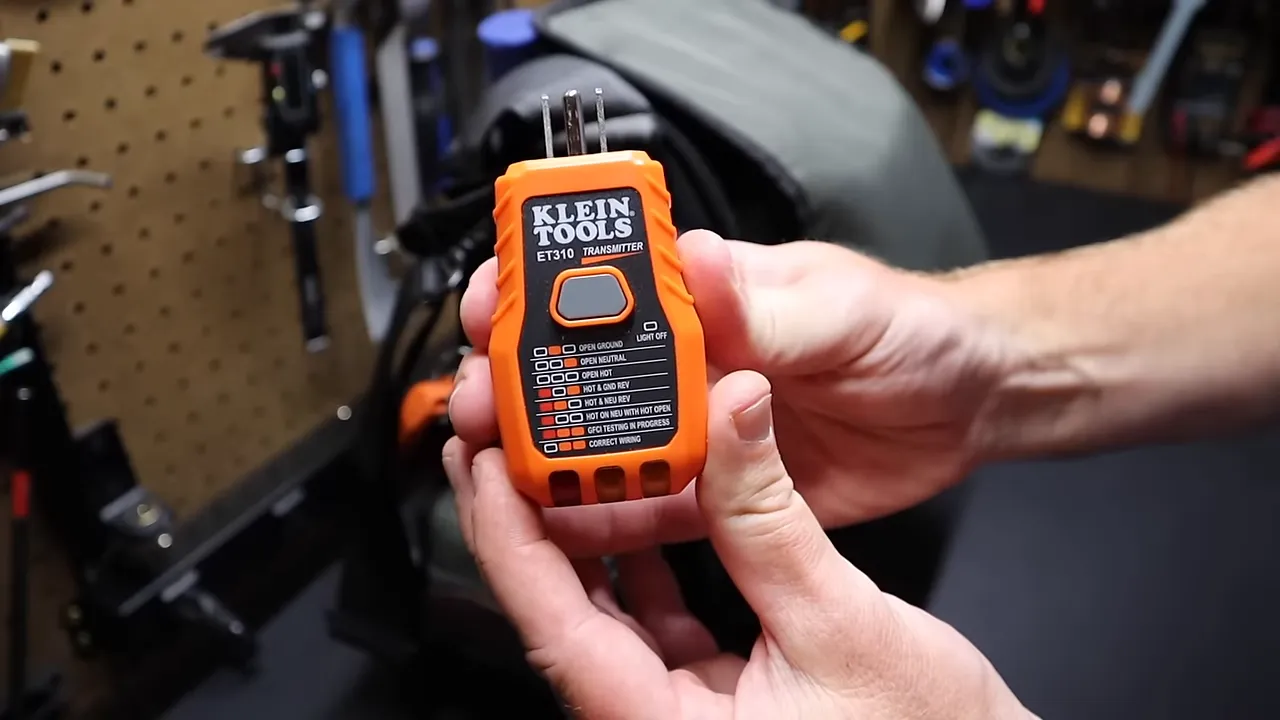
- GFCI/circuit breaker finder combo: A Klein circuit breaker finder with transmitter helps identify breakers faster when the panel is not clearly labeled. (Klein Tools Circuit Breaker Finder: Amazon)
For electrical work, I treat testers as helpers, not shortcuts. I still verify the tool is working, check the correct setting, and use safe work habits before touching conductors or equipment.
Lights & Portable Worklights
Lighting changes how fast and accurately I work. A single flashlight is not enough for every job, so I keep a few lighting options for crawlspaces, panels, cabinets, attics, and tight corners.
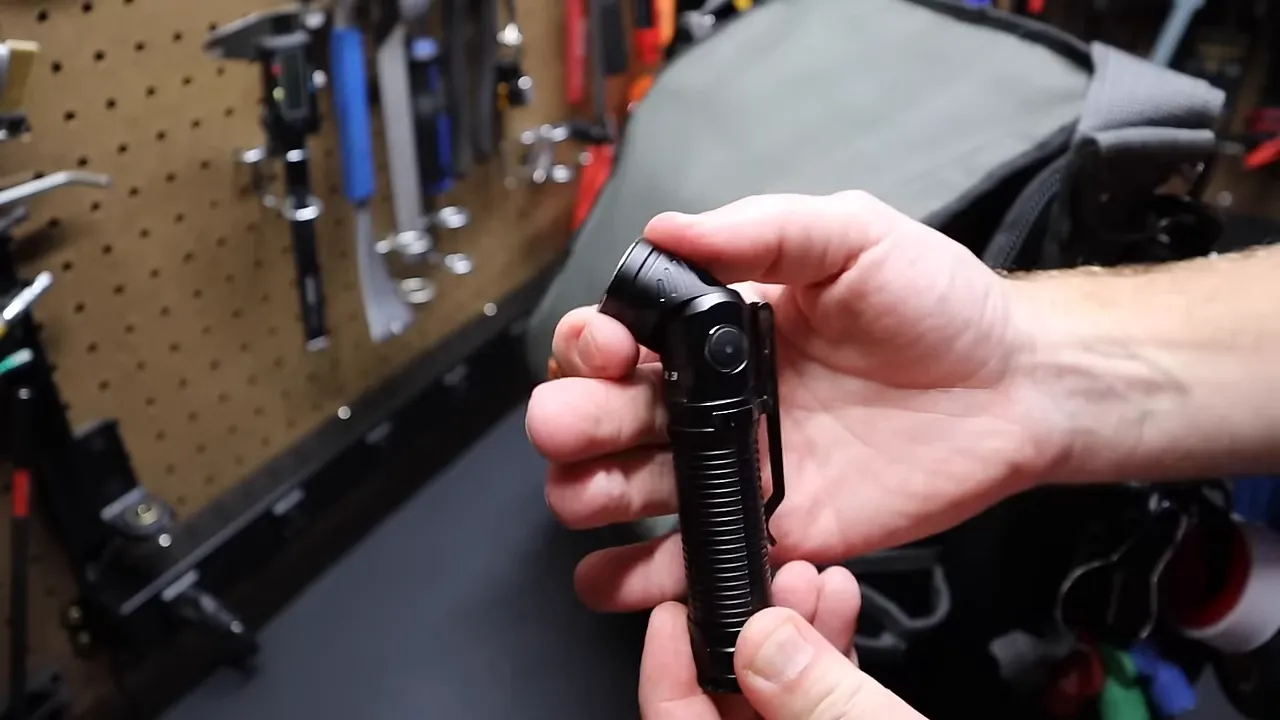
- Rofis R3 flashlight: The angle head, rechargeable 18650 battery, and magnetic base make it useful for tight or awkward spaces.
- Olight Baton 4: This compact Baton-series light is clip-ready and works well as a pocket light or hat light. (Olight Baton 4 Flashlight: Amazon)
- Klein LED worklight: This is useful because it can stand, hang, clip, or attach magnetically, depending on the work area. (Klein Worklight: Amazon)
- BOSCH laser level: A compact laser level is handy for shelves, cabinets, fixtures, and quick level lines. (Bosch Laser Level: see product links)
I like having one small personal light and one larger worklight. The small light moves with me, while the larger light stays fixed on the task area.
Klein Tools 32940 SAE Magnetic Hollow Impact Nut Drivers Set

Hand Saws, Cutters & Scrapers
Even in a bag built around drivers and pliers, cutting and scraping tools earn their place. I use them for drywall, trim, adhesive, tape, packaging, old caulk, and small finish tasks.
- Milwaukee folding jab saw / drywall saw: This folds down to protect the blade and the bag, and it works for drywall cuts and small openings. (Milwaukee Folding Jab Saw: Amazon)
- Plastic razor scraper & plastic putty knife: These are useful on delicate surfaces where steel could scratch the finish. (Plastic Razor Blade Scraper: Amazon, Plastic Putty Knife: Amazon)
- Red Devil flexible putty knife: The flexible blade is useful for finishing mud, working caulk, and scraping without being too aggressive. (Putty Knife – Flexible: Amazon)
- Heavy-duty shears: I replaced old scissors with these because they handle cardboard, strapping, and tougher jobsite materials better. (Heavy Duty Shears: Amazon)
I keep cutting tools covered or folded whenever possible. Sharp tools that float loose in a tool bag damage pockets, nick wires, and create avoidable hand injuries.

Fasteners, Consumables & Small Parts
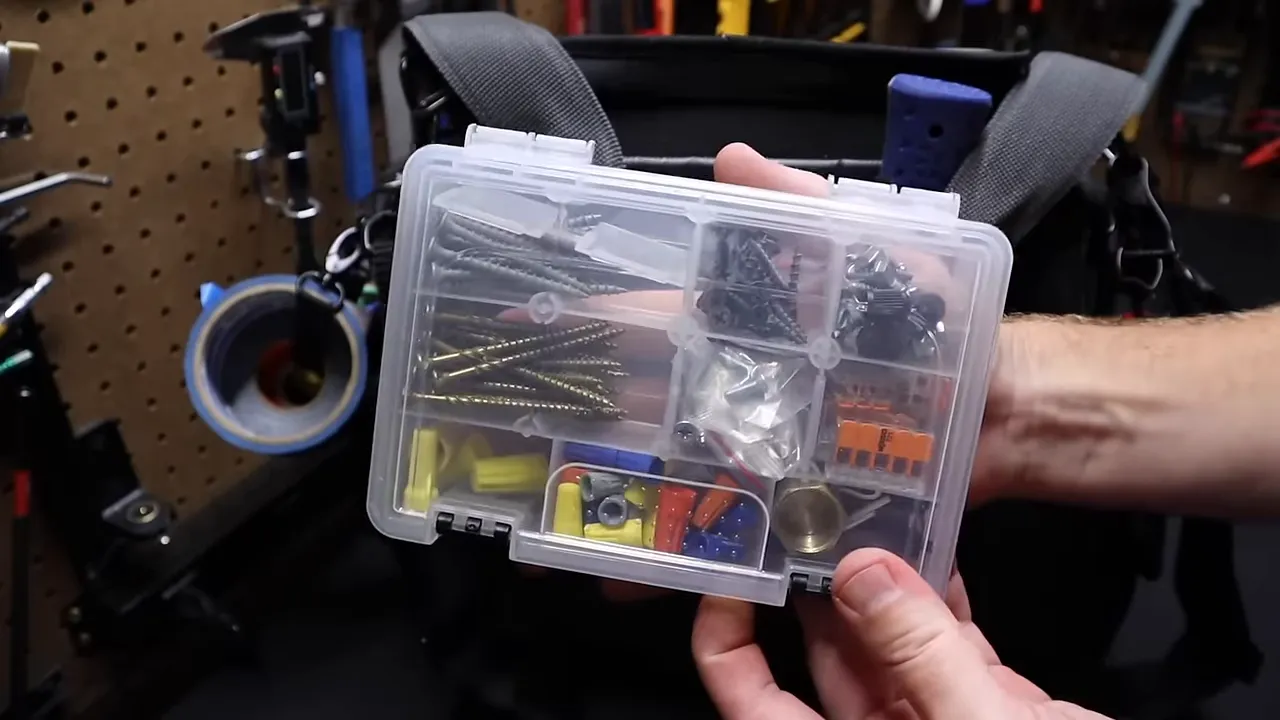
Small parts are the hidden heroes of this setup. A missing screw, wire connector, zip tie, tape roll, or removal clip can turn a quick task into a truck trip. I keep small consumables organized so they save time instead of becoming pocket clutter.
- Tapes: Blue painter’s tape, a small Gorilla-brand duct tape roll, Scotch Super 88 vinyl electrical tape in red and black, and Teflon tape for plumbing tasks. (Scotch Super 88 Vinyl Tape: Amazon)
- Zip ties & screw catch magnets: Small zip ties live in a pocket, and neodymium magnets on the metal top plate work as a screw catch. (Neodymium Magnet: Amazon)
- Socket sets: Makita impact socket sets, metric and imperial, stay in my side pouch for quick impact work. (Makita Socket Set Metric: Amazon, Makita Socket Set Imperial: Amazon)
- Husky clear parts container: This small parts box is easy to refill and works well for screws, wire nuts, Wago connectors, and other consumables.
The clear container is important because I can see what needs refilling before I’m stuck on a job with an empty compartment.
Wrenches, Sockets & Ratchets
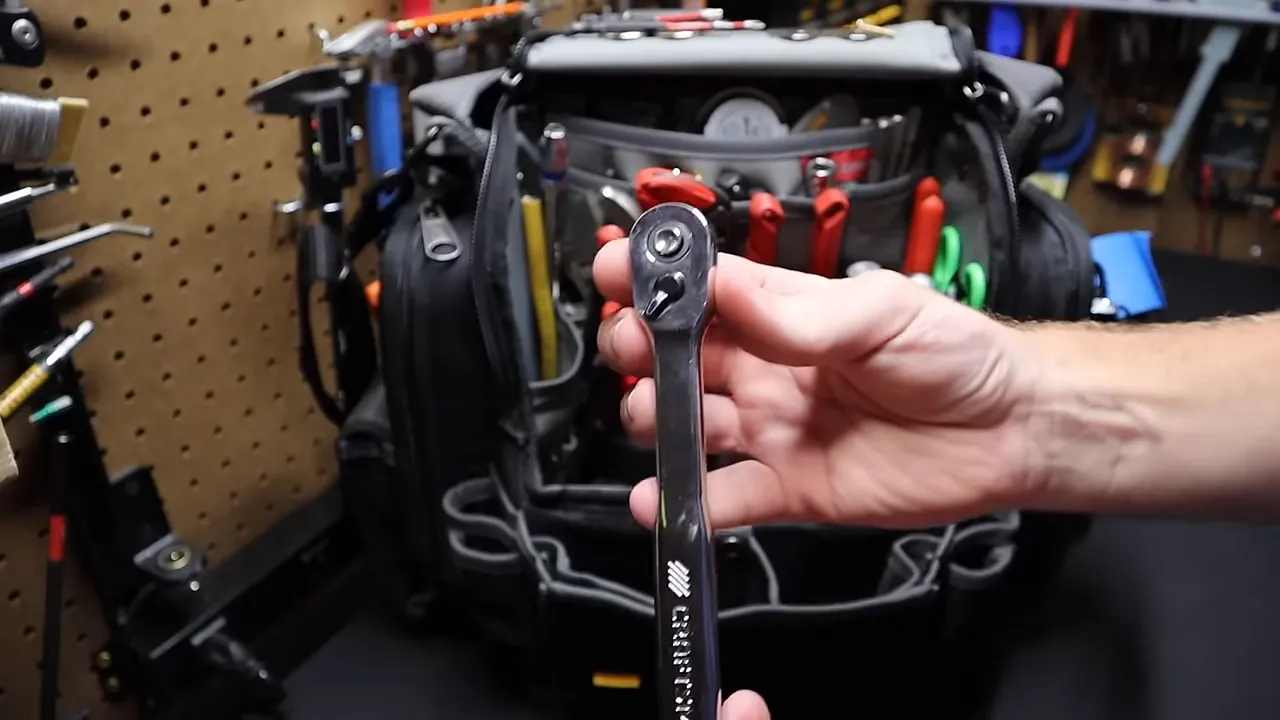
I standardize many sockets to 3/8″ drive because it gives me a good balance of strength, compact size, and flexibility. A small ratchet, extension, and a few wrenches cover most mechanical fastening tasks I run into during service work.
- 3/8″ drive extension & sockets: I keep a 3/8″ drive extension and a Craftsman 3/8″ ratchet because they are reliable, compact, and easy to stash.
- Adjustable wrenches: A forged Craftsman adjustable wrench and a smaller adjustable wrench cover fittings, nuts, and odd sizes when I do not want to carry a full wrench roll.
- Nested Torx set & countersink: For trim, finish work, and occasional hardware tasks, I keep a nested Torx set and a 1/2″ countersink bit. (Nested Torx: Amazon, 1/2″ Countersink bit: Amazon)
I avoid packing every socket size I own. The goal is to carry the sizes I reach for most often, then leave specialty and duplicate sets in the truck.
Pliers & Specialty Gripping Tools
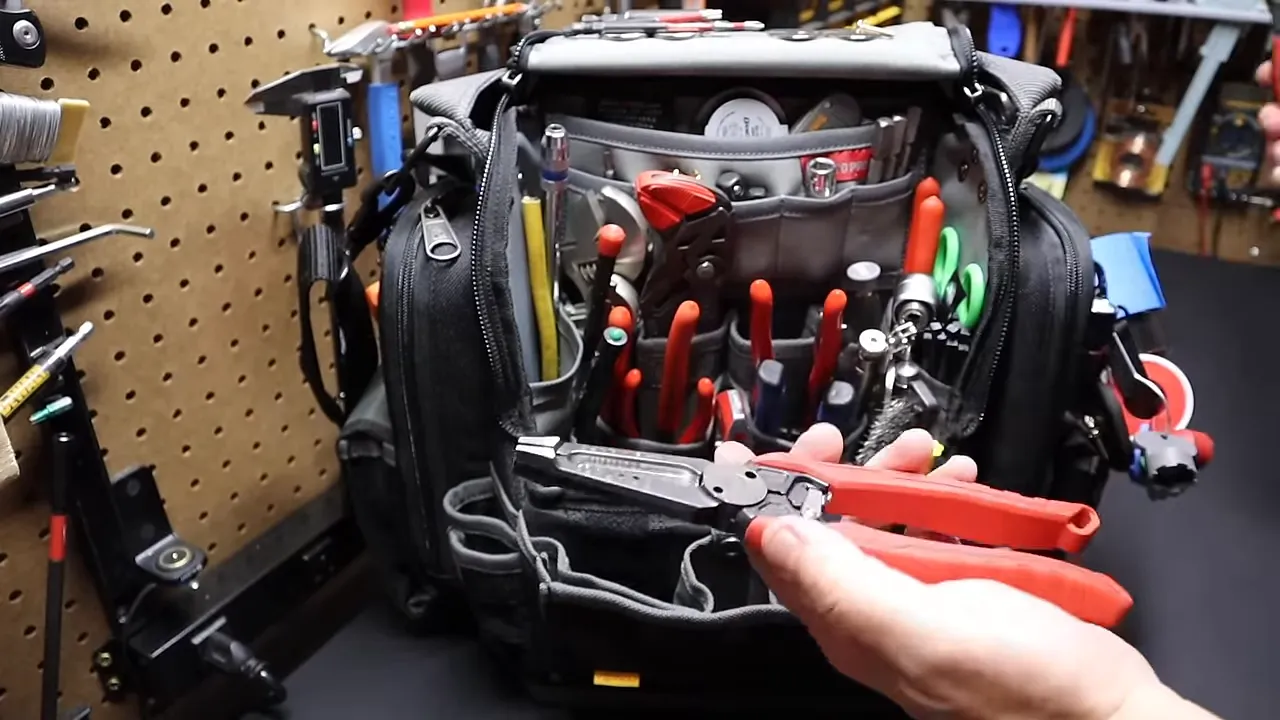
Pliers are some of the most useful tools in the bag. They grab, twist, hold, bend, cut, and protect finished surfaces when I choose the right pair. For me, Knipex tools dominate this category because they combine strong grip with precise adjustment.
- Knipex Cobra 10″ pliers: Fast adjustment and strong grip make these useful on hex nuts, round stock, pipes, and stubborn fittings. (Knipex 10″ Cobra Pliers: Amazon)
- Knipex Pliers Wrench 10″ (250 mm): This works like a hybrid adjustable wrench and pliers, especially when paired with jaw protectors for delicate finishes. (Knipex 10″ Pliers Wrench: Amazon)
- Milwaukee multi-tool wire strippers (7-in-1): This combines several functions, including stripping, cutting, and gripping, so it can replace separate tools on some jobs. (Milwaukee 7-in-1 Wire Strippers: Amazon)
- Knipex CoBolt compact bolt cutters: These help cut screws and heavier material without abusing other cutters. (Knipex 8″ CoBolt: Amazon)
- Klein linemen pliers: I keep a traditional set of Klein linemen’s pliers as well. Mine were inherited and still cut well. (Klein Linemans: Amazon)
The best pliers are the ones that protect both the work and your hands. For finished fixtures, I use jaw protectors or a less aggressive tool before reaching for something that can mar the surface.
Screwdrivers, Punches & Specialty Drivers
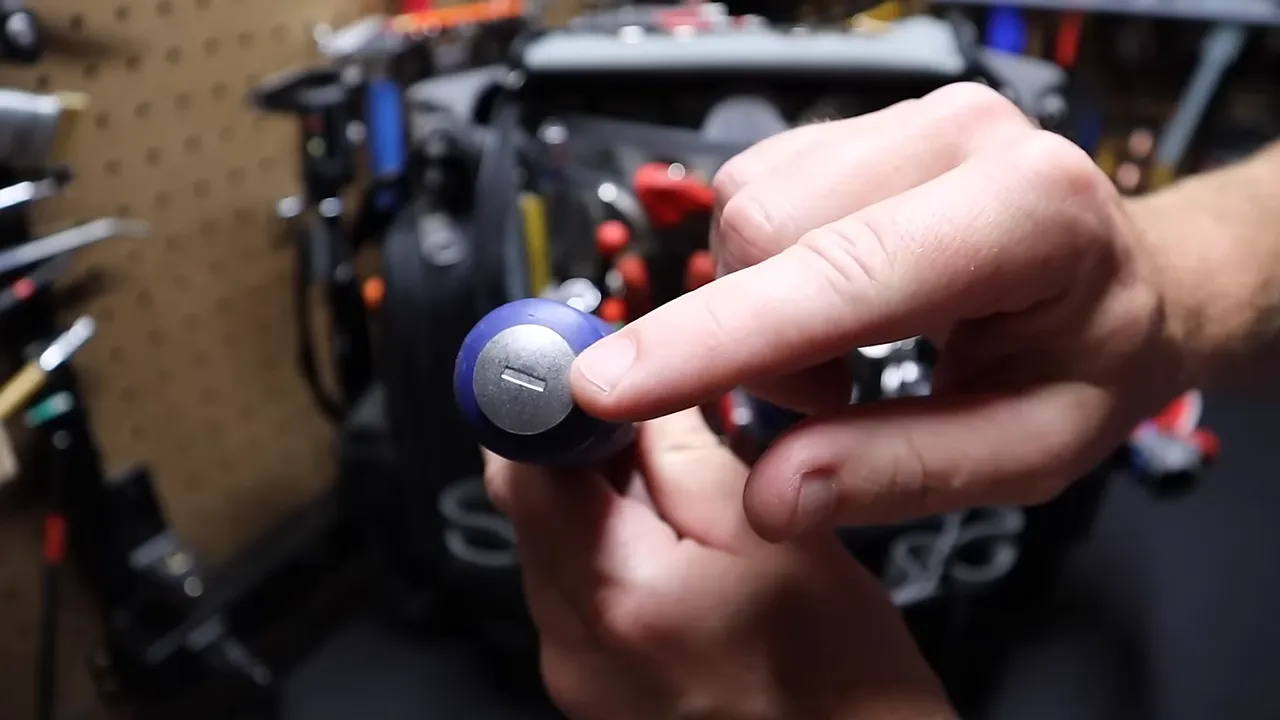
From demolition drivers to precision thermostat screwdrivers, I carry a mix because not every fastener should be handled by an impact driver. Manual drivers give me control, better feel, and less risk of stripping small screws.
- Demolition screwdriver (Klein/Irwin): Full-metal construction allows light striking for stubborn fasteners and rougher work. (Demolition Screwdriver: Amazon)
- Klein multi-length screwdriver: A long-shank adjustable Klein screwdriver helps in deep boxes, behind appliances, and other hard-to-reach spots. (Klein Tools Screwdriver with Adjustable Length: Amazon)
- Precision 4-in-1 screwdriver: A Klein 4-in-1 works for small trim, controls, thermostats, and compact screws. (Klein 4-in-1 Precision Screwdriver: Amazon)
- Center punch (Starrett): This makes quick, accurate divots before drilling. (Starrett Center Punch: Amazon)
- Punches & nail setters: I keep multiple sizes for driving pins or setting nails. (Stanley Nail Setter: Amazon)
This section of the bag covers the small, precise tasks that power tools can make worse. When a screw is tiny, painted over, or set into plastic, hand control matters.
Bits, Drill Bits & Step Bits
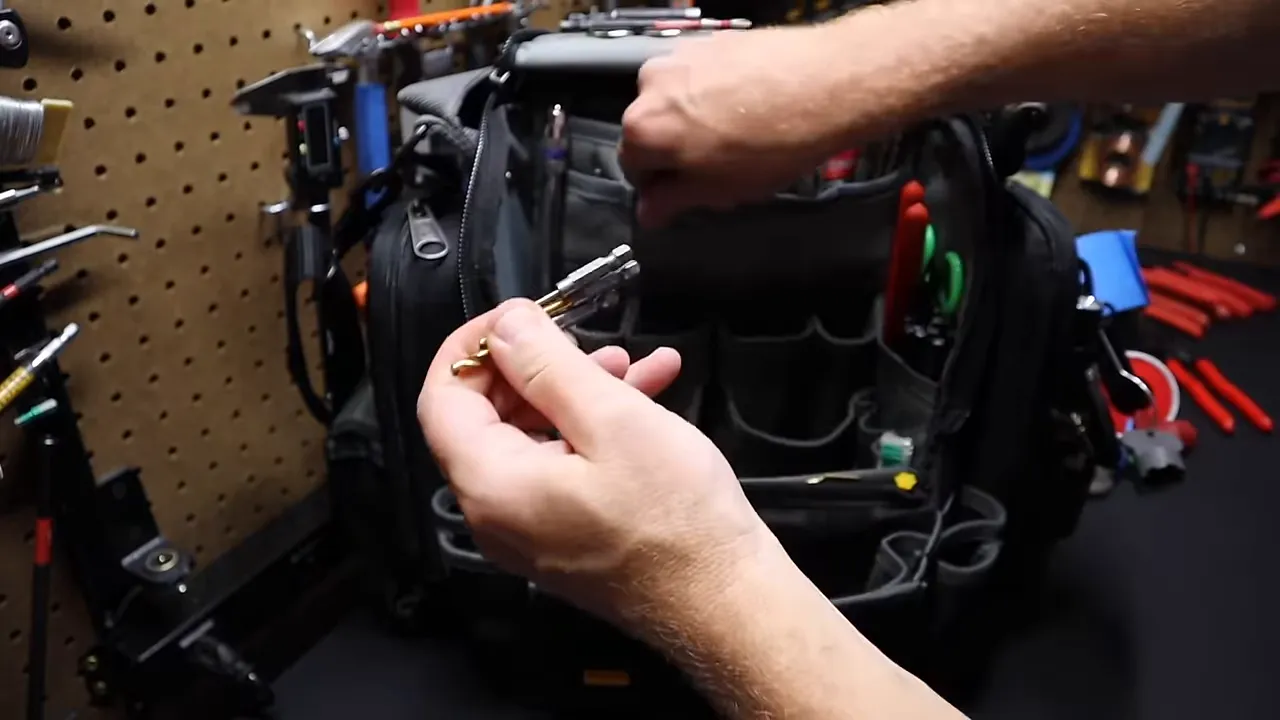
My drills and impact drivers use hex-shanked bits so they are instantly interchangeable. I carry a mix of metal bits, masonry bits, Torx bits, hex bits, step bits, impact sockets, and adapters so I can handle common fastening and hole-making tasks without overloading the bag.
- DeWalt step bit: A step bit is useful for making clean holes in thin metal, boxes, and light-gauge materials. (DeWalt Step Bit: Amazon)
- Bosch concrete bits: I keep a handful of SDS or masonry bits for site work where I may hit concrete, block, or masonry. (Bosch Concrete Bits: Amazon)
- Harbor Freight / full bit sets: A full Torx and hex set helps with odd security bits and rare fasteners. (Full Bit Set: Amazon, Torx Bit Set: Amazon)
- Impact sockets & adapters: Milwaukee socket adapters and Makita impact sockets help with heavier fastening tasks. (Milwaukee Socket Adapters: Amazon)
I keep the most common bits accessible and the less common ones contained. Loose bits disappear quickly, so organizers matter almost as much as the bits themselves.
Specialty Tools & Small Helpers
Specialty tools rarely get attention, but they often save the day. Screw retrieval tools, magnetic retrievers, SharkBite removal clips, small pipe cutters, terminal cleaners, and socket adapters can turn an annoying delay into a quick fix.
- Magnetic screw retriever: A telescoping magnetic retriever helps recover dropped screws from behind equipment, inside cabinets, and under appliances. (Magnetic Screw Retrieval: Amazon)
- SharkBite removal tools: I carry two sizes, 1/2″ and 3/4″, for disconnecting common push-to-connect fittings. (Sharkbite/Slip Removal Disconnect Clips: Amazon)
- Ridgid compact pipe cutter: A compact pipe cutter is useful in tight spaces where a larger cutter will not fit. (Rigid Compact Pipe Cutter: Amazon)
- Battery terminal cleaner: This helps with auto work, battery maintenance, and corroded terminal cleanup. (Battery Terminal Cleaner: Amazon)
- Socket to light-socket adapter: This can turn a light socket into a temporary receptacle in attics, basements, or crawlspaces when it is safe and appropriate to do so.
Small helpers are worth carrying when they prevent repeat trips. I do not need them on every job, but when I do need them, they usually save real time.

Organization Inside the Bag
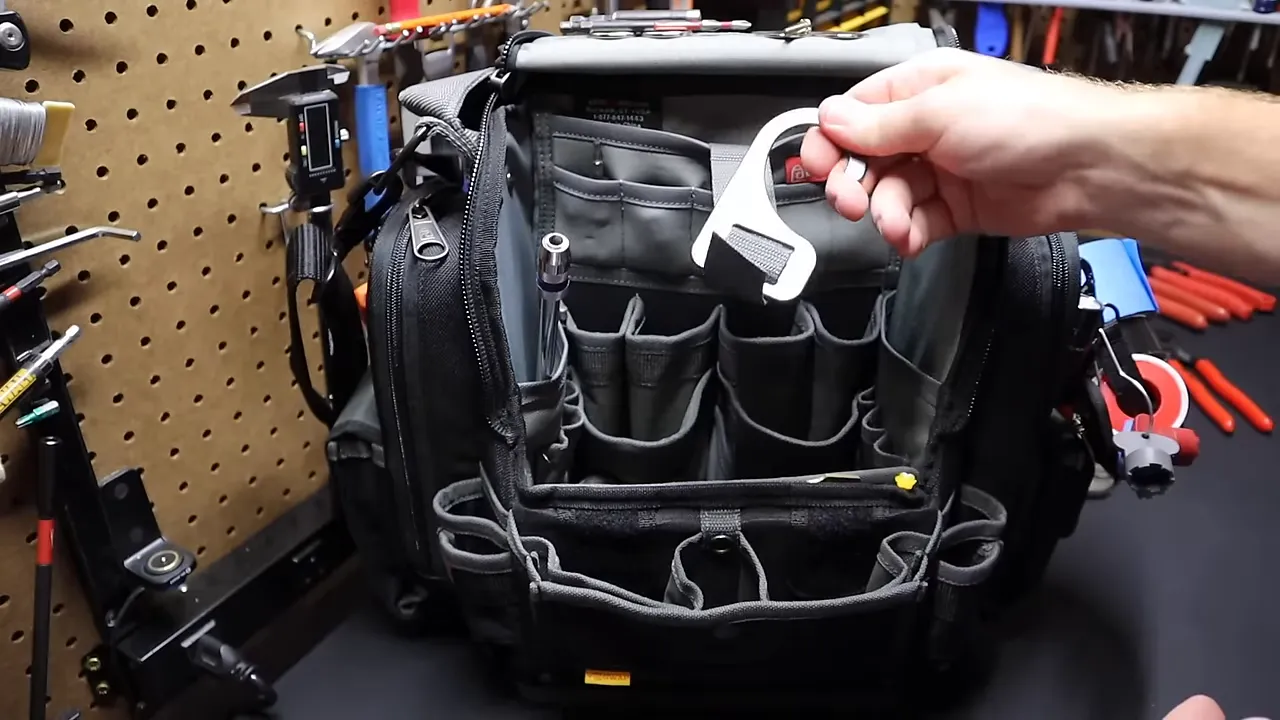
Organization is more than pockets. It is a mental map. I keep items grouped by function and frequency of use so my hands know where to look before my eyes even scan the bag.
- Exterior pockets: Safety gear, tape, quick-access bits, small lights, and repeat-use accessories.
- Meter pockets: Clamp meter, laser measure, non-contact testers, probes, and temperature tools.
- Side pouches: Sockets, impact sockets, small parts containers, and compact power tools.
- Main compartment: Drivers, impact driver, pliers, wrenches, cutters, and heavier hand tools.
- Top pouch: Sharpeners, grease, small consumables, band-aids, socket adapters, and items I want separated from the main pocket.
I also hang a silica gel packet in the top pouch to help reduce humidity inside the bag. It is a small habit, but it can help slow corrosion on blades, bits, sockets, and small steel tools.
Note: The best pocket layout is the one you can repeat without thinking. If you keep moving the same tool around, give it a permanent home.
Load Weight & Portability
Loaded as I have it, this bag is roughly 40 pounds. That sounds heavy, but it is a compact 40 pounds. The weight is dense, balanced, and carried in shorter bursts rather than across long distances all day.
If I need to carry lighter, I remove heavier items first. Extra sockets, the larger hammer, duplicate lights, and rarely used specialty tools are the first things I would move back to the truck.
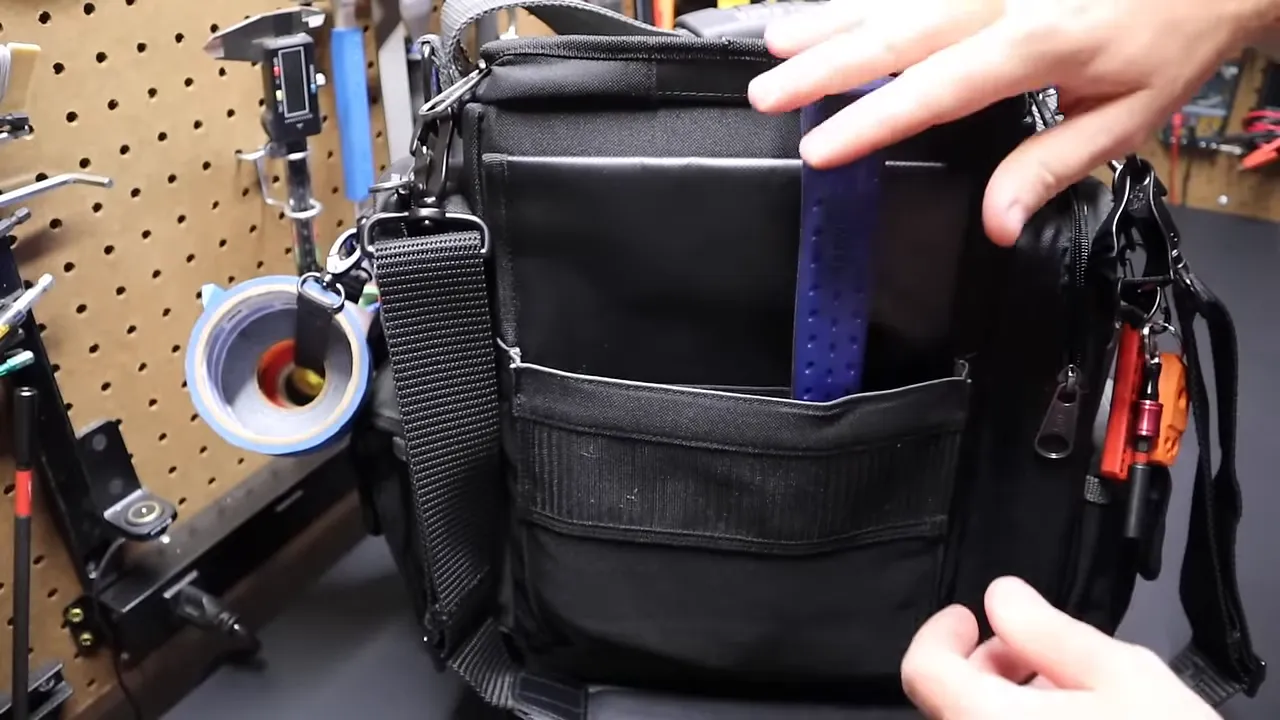
Veto’s strap and top handle feel sturdy for this kind of load. The built-in hook is also useful because I can hang the bag on a ladder rung or wall hook when I’m working elevated or trying to keep the bag off a dirty floor.
A good service bag should save more steps than it creates. If the weight starts slowing you down, the loadout needs another audit.
Maintenance, Replacement & Evolution
This bag is not static. I change items out based on season, project type, and what I learn on the job. A good loadout should evolve as your work changes.
Maintainability is part of the system. I sharpen knives, check light batteries, organize bit sets, replace dull blades, refill consumables, and remove tools that no longer earn their place.
Replace or upgrade when:
- A tool wears out or fails, because marginal gear wastes time and creates frustration.
- You find a new tool that genuinely replaces multiple older items.
- Your workflow changes and the bag no longer matches the jobs you do most often.
- A tool keeps damaging finishes, slowing you down, or forcing extra trips to the truck.
Every few months, I audit the bag. I remove rarely used items, add items that solved a recent problem, check batteries and chargers, refill small parts, and make sure the bag still matches my actual work.
Complete Gear & Product Links
Below are the tools and product links mentioned in this setup, plus other close matches from the bag. Use the list as a checklist, not a rulebook. Your trade, budget, and common tasks should decide what goes in your version.
- Veto Pro Pac TP-XXL: Amazon
- Carhartt Spokane Safety Glasses: Amazon
- Mechanix FastFit Work Gloves: Amazon
- Squids Grabber glove Clip: Amazon
- Klein Tools MAG2 Demagnetizer/Magnetizer: Amazon
- Komelon Tape Measure: Amazon
- Milwaukee Bit Set: Amazon
- Keychain Bit Holder: Amazon
- BOSCH Blaze Laser Measure: Amazon
- Klein Tools Circuit Breaker Finder: Amazon
- Klein CL800 Digital Clamp Meter: Amazon
- Fluke TwistGuard Leads: Amazon
- Klein NCVT-4IR Non-Contact Volt Tester: Amazon
- UEi PDT650 Thermometer: Amazon
- Klein HVAC 8-in-1: Amazon
- Fluke VoltAlert: Amazon
- Milwaukee Fastback knife: Amazon
- Olight Baton 4 Flashlight: Amazon
- Scotch Super 88 Vinyl Tape: Amazon
- Klein Worklight: Amazon
- Makita Socket Set Metric: Amazon
- Makita Socket Set Imperial: Amazon
- Bosch Concrete Bits: Amazon
- Estwing 16oz Hammer: Amazon
- Neodymium Magnet: Amazon
- Milwaukee Folding Jab Saw: Amazon
- Putty Knife – Flexible: Amazon
- Hyde 5-in-1 Painter’s Tool: Amazon
- Tire Pressure Gauge: Amazon
- Klein Stubby Screwdriver: Amazon
- Klein Flush Cutter: Amazon
- Silver Sharpie Marker: Amazon
- DeWalt Step Bit: Amazon
- Sanding Cloth: Amazon
- Nested Torx: Amazon
- Ullman Pick Set (inspection picks & mirrors): Amazon
- Right Angle Screwdrivers: Amazon
- Klein Tools 7-in-1 Flip Socket SAE: Amazon
- Klein Tools 7-in-1 Flip Socket METRIC: Amazon
- Magnetic Screw Retrieval: Amazon
- Plastic Razor Blade Scraper: Amazon
- Plastic Putty Knife: Amazon
- Brass Calipers: Amazon
- Craftsman Cordless Screwdriver: Amazon
- Klein Tools Screwdriver with Adjustable Length: Amazon
- Milwaukee Surge Impact Driver: Amazon
- Demolition Screwdriver (Klein 602-4DD or Irwin equivalent): Amazon
- Williams Punch: Amazon
- 3/8″ Drive Extension: Amazon
- 3/8″ Ratchet: Amazon
- Klein Linemans: Amazon
- Milwaukee 7 in 1 Wire Strippers: Amazon
- Knipex 10″ Cobra Pliers: Amazon
- Knipex 10″ Pliers Wrench: Amazon
- 10″ Adjustable Wrench: Amazon
- 6″ Adjustable Wrench: Amazon
- Knipex 8″ CoBolt: Amazon
- Knipex 8″ Long Nose Pliers: Amazon
- Pocket Screwdriver: Amazon
- Irwin 12″ Bit Extension: Amazon
- Long shank precision screwdriver: Amazon
- Bondhus Hex Wrenches: Amazon
- Wera Tools Hex Wrenches: Amazon
- Wire Brush: Amazon
- Heavy Duty Shears: Amazon
- Irwin long nose 9″ vise grips: Amazon
- DeWalt Right Angle Attachment: Amazon
- Klein 4-in-1 Precision Screwdriver: Amazon
- Inspection Mirror: Amazon
- Starrett Center Punch: Amazon
- Milwaukee Socket Adapters: Amazon
- Malco 4″ Bit: Amazon
- 1/2″ Countersink bit: Amazon
- Stanley Nail Setter: Amazon
- Knipex TwinGrip Pliers: Amazon
- Bastard File: Amazon
- Full Bit Set: Amazon
- Torx Bit Set: Amazon
- Smith’s Knife Sharpener: Amazon
- Plumbers Grease: Amazon
- Knipex Pliers Wrench Jaw Protectors: Amazon
- Sharkbite/Slip Removal Disconnect Clips: Amazon
- Milwaukee Razor Blades: Amazon
- Valve Stem Remover: Amazon
- Battery Terminal Cleaner: Amazon
- Rigid Compact Pipe Cutter: Amazon
- Nitrile Gloves: Amazon
- Alligator Clips: Amazon
Frequently Asked Questions
How heavy is the bag fully loaded?
This setup is about 40 pounds with the configuration shown. It is dense but balanced. If you need to carry lighter for long walks or stairs, remove heavier sockets, duplicate lights, the hammer, or rarely used specialty tools.
Why standardize on 3/8″ drive and hex-shanked bits?
Standardization makes the bag more efficient. With 3/8″ sockets, a compact ratchet, extensions, and adapters can handle many mechanical fasteners. Hex-shanked bits let me use the same bit in an impact driver, cordless screwdriver, right-angle attachment, or manual driver.
Do you include expensive tools like Fluke multimeters in the bag?
I carry what I need for the work I expect. In this setup, that means a reliable clamp meter, Fluke probes, and compact testers. I keep delicate or higher-value gear protected, and I may swap in a higher-end meter from the truck when the job calls for it.
How often do you change the setup?
I treat it as a living kit. I audit it every few months and after jobs where something missing slowed me down. I remove tools that do not earn their weight and add tools that solve repeat problems.
Where should I start if I want to build this setup?
Start with a reliable bag, then add a compact impact driver, a quality clamp meter, a worklight, a multi-bit set, a tape measure, and good pliers. Build slowly around the jobs you do most often instead of buying everything at once.
What should stay in the truck instead of the TP-XXL?
Keep heavy, duplicate, and rarely used tools in the truck. Large socket sets, specialty pullers, bulky power tools, extra batteries, trade-specific tools, and backup meters usually make more sense in a vehicle kit than in a daily carry bag.
How do you keep small parts from becoming clutter?
Use clear containers, small bit holders, and dedicated pocket zones. I keep fasteners, wire connectors, zip ties, tapes, and specialty clips grouped by task so I can refill them quickly and avoid loose parts rolling around the bag.
Sources
- Veto Pro Pac — manufacturer information for Veto tool bags and pouch designs.
- Klein Tools — manufacturer information for meters, testers, drivers, and electrical hand tools.
- OSHA Personal Protective Equipment — general workplace safety guidance for protective gear.
- OSHA Electrical Safety — general safety guidance for electrical hazards and work practices.
- Bosch Tools — manufacturer information for laser measuring and drilling accessories.
Conclusion
This Veto Pro Pac TP-XXL setup is the result of years of field work, tool swaps, and trial-and-error organization. The bag gives me the mix of protection and access I want, but the real advantage comes from how the loadout is built: standardized sockets, hex bits, quick-access testers, practical lighting, useful pliers, and small parts that prevent wasted trips.
If something in your bag is not pulling its weight, remove it. If you keep missing the same tool, add it. Your bag should reflect how you actually work, not how a perfect catalog setup looks on a bench.
Thanks for sticking with this long-form breakdown. If you want to tailor a version of this bag for HVAC, plumbing, electrical, carpentry, maintenance, or general repair, use this setup as a framework and adjust the tools around your daily tasks.
