Last updated: September 22, 2026. Airline stroller policies below were rechecked against current official carrier pages.
How big can a stroller be on an airplane? There is no universal stroller size limit. If you want to take a stroller into the cabin, the fully folded stroller must meet your operating airline’s cabin-baggage rules and the airline must allow that type of stroller onboard. If it is too large for the cabin, you may still be able to gate-check it or check it at the ticket counter. Measure the stroller fully folded before your trip and compare those measurements with your airline’s current stroller policy instead of relying on one generic “airline-size” number.
Quick Answer
There is no single maximum stroller size that applies to every airline. Cabin-size strollers must meet the operating carrier’s onboard baggage rules. Gate-check limits can be different: for example, Air Canada currently defines a small gate-check stroller as no more than 10 inches in collapsed diameter and 36 inches long, while British Airways uses 117 x 38 x 38 cm as the maximum size for its aircraft-door return service at eligible destinations. If your stroller does not qualify for cabin or gate handling, plan to check it at the ticket counter.
Key Takeaways
- There is no universal carry-on or gate-check stroller size that works for every airline.
- Measure the stroller fully folded, including wheels, handlebar, and any attached parts that remain in place.
- Treat cabin storage, gate-checking, and ticket-counter checking as three different sets of rules.
- Many airlines transport a stroller for a child without a standard checked-bag fee, but the allowance and handling process are carrier-specific.
- Ask where a gate-checked stroller will be returned, especially if you have a connection or a long walk from the aircraft to baggage claim.
- Remove loose accessories, label the stroller clearly, and use a protective travel bag when practical.
How Big Can a Stroller Be on an Airplane?
The key point is that airline stroller size limits depend on how you plan to transport the stroller. A stroller stored in the passenger cabin must fit the airline’s approved storage space and comply with its cabin-baggage policy. A stroller handed over at the gate goes into the aircraft hold, so the carrier may apply a different stroller-specific rule. Large, heavy, non-collapsible, or restricted stroller types may need to be checked at the ticket counter before you go through security.
Do not treat a single number such as 22 x 14 x 9 inches, 22 x 18 x 10 inches, or a specific weight as a universal stroller limit. Airlines publish different baggage dimensions, stroller rules, and handling procedures. A stroller manufacturer’s “cabin-size” or “airline-approved” description also does not override the operating carrier’s policy or guarantee that cabin storage will be available.
The safest approach is to measure your stroller at home, save the folded measurements in both inches and centimeters, and check the operating airline’s current policy before departure. If your itinerary includes more than one airline, check each operating carrier because a stroller accepted one way on the first flight may be handled differently on the next segment.
Policy check: The airline examples in this guide were reviewed on September 22, 2026 against current published guidance from American Airlines, Delta Air Lines, Southwest Airlines, Air Canada, and British Airways. Airline policies can change, so recheck your operating carrier before travel.
What Size Stroller Can Be a Carry-On?
A stroller can travel in the cabin only when the airline permits it and the fully folded stroller fits the carrier’s approved cabin-storage dimensions. Some ultra-compact travel strollers are designed around common overhead-bin sizes, but a product being marketed as “travel-friendly” does not guarantee acceptance. Check the airline first, then compare its published limit with the exact folded dimensions of your stroller.
At a Glance
| Best Stroller Type | Ultra-compact, fully collapsible stroller that fits your airline’s published cabin rules |
| Measure Before Flying | Fully folded length, width, depth, total weight, and protruding wheels or handles |
| Cabin Test | The airline allows a stroller onboard and the folded stroller fits the permitted storage dimensions |
| Fallback | Gate-check if permitted; otherwise check the stroller at the ticket counter |
| Main Risk | A “cabin-size” marketing label does not guarantee airline acceptance or overhead-bin space |
Is There a Universal Carry-On Stroller Size?
No. Airlines set their own cabin-baggage dimensions and decide whether a compact stroller can be brought onboard, counts toward an allowance, or must be checked. The same stroller can therefore qualify for cabin storage on one itinerary but require gate-checking on another.
Weight also matters differently from airline to airline. A lighter stroller is easier to lift through security and boarding, but low weight by itself does not make a stroller cabin-compliant. The folded dimensions, storage policy, fare rules, aircraft configuration, and available space can all affect what happens at the gate.
If your main goal is to keep the stroller with you in the cabin, start with the airline—not the stroller advertisement. Compare the carrier’s current cabin rules with your stroller’s manufacturer-published folded measurements and your own measurement of the stroller as you will actually hand it to airline staff. For more detail on this specific question, see the guide to taking a stroller as a carry-on.
How Should You Measure a Stroller for a Flight?
Fold the stroller completely before measuring it. Measure its longest length, widest width, and deepest or tallest point in the folded position. Include wheels, fixed handlebars, hinges, bumper bars, and any component that remains attached and sticks out beyond the main frame.
Remove detachable accessories that you do not plan to leave attached, such as cup holders, snack trays, toys, organizers, or removable rain covers. Then weigh the stroller if your airline publishes a weight restriction or if you want to know how manageable it will be while carrying a child and luggage.
Write the measurements down in both inches and centimeters. International airlines frequently publish metric limits, and having both units ready makes policy comparisons faster. A photo of the fully folded stroller next to a tape measure can also help you remember the exact packed configuration.
Should You Carry On, Gate-Check, or Counter-Check?
Carry-on is the most restrictive option because the stroller has to meet the airline’s cabin rules and fit in approved storage. It can be convenient on arrival because you avoid waiting for the stroller to be returned from the hold.
Gate-checking lets you use an eligible stroller through much of the terminal and hand it over near boarding. The stroller still travels in the aircraft hold. Ask where it will be returned: aircraft door, jet bridge, or baggage claim procedures vary by airline and airport.
Counter-checking means handing the stroller over with checked baggage before security. This is often required for large, heavy, non-collapsible, or otherwise restricted stroller types. It also means you need another way to carry or guide your child through the airport. If baggage allowances are your main concern, see whether a stroller counts as luggage.
Note: Even when a compact stroller meets published cabin dimensions, the operating carrier still controls onboard acceptance. Aircraft type, fare rules, and available storage can affect the final handling decision.
How Big Can a Gate-Checked Stroller Be?
There is no universal gate-check stroller size either. Gate-check rules are separate from cabin baggage rules, and some airlines publish stroller-specific dimensions while others mainly describe which stroller types can be accepted at the gate. A stroller can therefore be too large for the overhead bin but still qualify for gate-checking.
Large double strollers, jogging strollers, stroller wagons, heavy models, and non-collapsible designs deserve extra attention because some carriers direct them to the ticket counter. Always check the operating carrier’s rule before arriving at security if you need the stroller inside the terminal.
Do Gate-Checked Strollers Have a Standard Size Limit?
No standard international or U.S.-wide gate-check dimension applies to every carrier. Air Canada, for example, currently publishes a specific small-stroller limit for gate or counter checking, while Delta’s current family-baggage guidance allows strollers to be checked free at curbside, the ticket counter, or the gate without publishing one equivalent stroller dimension on that page.
The practical goal is therefore not to hit one universal number. It is to bring a stroller that folds securely, falls within your carrier’s published policy, and can be handed over without loose accessories. If the airline does not publish a clear size limit, confirm whether your exact stroller type must be checked at the counter.
Which Airline Rules Matter Most?
Check five things: whether the stroller can enter the cabin, whether it can be gate-checked, whether its size or design forces counter-checking, whether the stroller is transported free, and where it will be returned after landing. On partner-airline or codeshare itineraries, check the operating carrier for each segment rather than assuming the marketing airline’s policy controls the entire trip.
Stroller wagons deserve separate attention because some airlines distinguish them from standard strollers. Non-collapsible models may also be handled differently from fully collapsible designs.
The most useful question to ask the airline is not simply “Can I bring a stroller?” Ask: “Can this stroller be carried on, gate-checked, or does it need to be checked at the ticket counter, and where will I collect it after the flight?”
Warning: Do not leave loose toys, blankets, bottles, electronics, cup holders, or clip-on accessories attached before handing a stroller to airline staff. Loose pieces can fall off, snag during handling, or become separated from the stroller.
Airline Stroller Policies: Current Examples
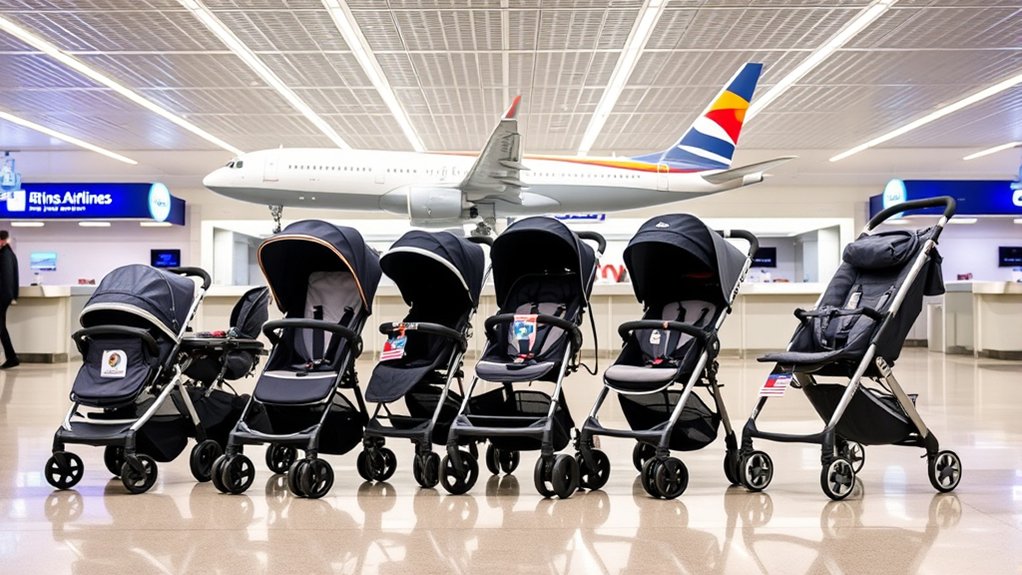
The examples below show why one universal stroller-size recommendation is unreliable. These are planning references based on current published policies reviewed September 22, 2026. Recheck the operating airline immediately before travel because baggage and family-travel rules can change.
| Airline | Current Published Stroller Rule | What It Means for You |
|---|---|---|
| American Airlines | One stroller and one car seat may be checked free when traveling with a child or to adopt. Both may be checked at the ticket counter, or one at the gate and one at the counter. Non-collapsible strollers and stroller wagons without built-in child safety straps must be checked at the ticket counter; American says all other strollers should be checked at the gate. | Do not rely on an old universal weight cutoff. Check the current stroller type and handling rule. |
| Delta Air Lines | Delta says children’s strollers and child safety seats do not count as standard baggage and may be checked free at curbside, the ticket counter, or the gate. | Delta’s family-baggage page emphasizes free handling locations rather than one universal gate-check stroller dimension. |
| Southwest Airlines | Each ticketed customer traveling with a child may check one stroller and one car seat or child-restraint system free. The items may be checked at the curb, ticket counter, or gate. | Southwest says gate-checked items normally go to baggage claim; ask the agent if you want stroller return at the jet bridge where available. |
| Air Canada | A small stroller with a collapsed diameter no more than 25.5 cm (10 in) and length no more than 92 cm (36 in) can be checked free at the baggage counter or boarding gate. Large heavy strollers must be checked at the baggage counter. | This is an example of a stroller-specific gate-check dimension that is completely different from a normal cabin-bag rectangle. |
| British Airways | Each infant or child may check up to two qualifying essential extras, including a fully collapsible stroller. For aircraft-door return at eligible destinations, British Airways publishes a maximum stroller size of 117 x 38 x 38 cm including wheels. | A stroller larger than the aircraft-door-return dimensions may still travel, but British Airways says it will be collected from the baggage carousel instead. |
The comparison also shows why you should check return location, not just size. A stroller accepted at the gate is not automatically guaranteed to appear at the aircraft door after landing. That difference can matter during a short connection or at an airport with a long walk to baggage claim.
What Stroller Size Is Best for Air Travel?
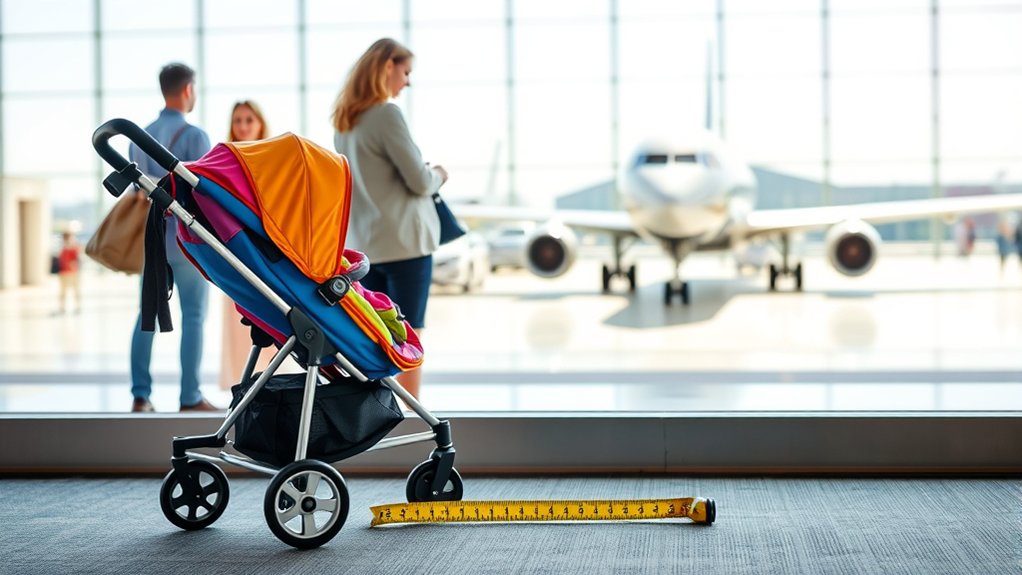
The best stroller size depends on how you want to use it. If cabin storage is the priority, choose the smallest fully folded stroller that meets your specific airline’s current cabin rules. If you are comfortable gate-checking, you can choose a larger stroller as long as the carrier accepts that stroller type at the gate. If comfort, storage, suspension, or rough-terrain performance matters more at your destination, a larger stroller may be worth counter-checking in a protective bag.
Weight is a practical consideration rather than a universal rule. A lighter stroller is easier to carry through security, lift into storage, manage on stairs, and handle while holding a child. However, never use a generic weight target as a substitute for your airline’s actual policy.
| Travel Goal | Size Rule to Use | Best Planning Approach |
|---|---|---|
| Keep stroller in cabin | Operating airline’s current cabin-baggage/stroller limit | Measure fully folded and confirm onboard stroller acceptance |
| Use stroller until boarding | Operating airline’s gate-check rule | Confirm stroller type, size or weight restrictions, and return location |
| Bring a large stroller | Operating airline’s checked/special-item policy | Plan for ticket-counter check-in and protective packing |
A compact travel stroller is often the easiest option for airports, but it is not automatically the best stroller for every trip. If your destination involves rough sidewalks, long walking days, naps, or lots of child gear, a larger stroller may serve you better even if you need to check it.
Why Is a Compact Stroller Easier to Fly With?
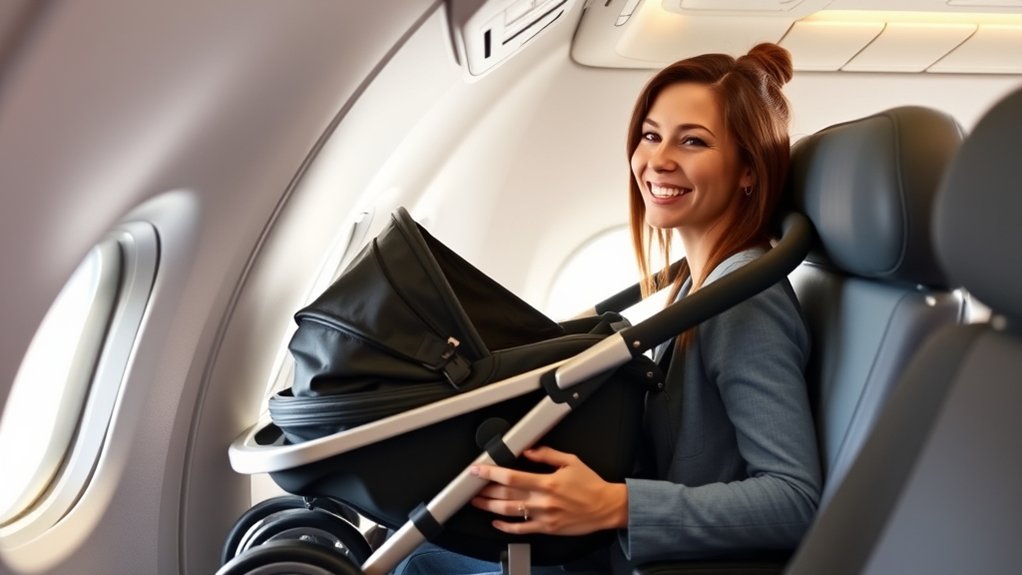
A compact stroller is easier to manage because it takes up less space when folded and is usually easier to carry while you handle a child, documents, and luggage. A fast folding mechanism is particularly useful at security checkpoints, shuttle buses, jet bridges, stairs, and boarding areas.
Smaller folded dimensions also give the stroller a better chance of meeting an airline’s cabin or gate-handling requirements. That does not guarantee onboard acceptance, but it gives you more options than a bulky stroller that can only be counter-checked.
The tradeoff is that ultra-compact strollers may have smaller baskets, lighter wheels, less suspension, or less nap-friendly seating than a full-size model. Choose based on the entire trip rather than the flight alone: airport convenience matters, but so do sidewalks, weather, terrain, child comfort, and how much gear you need after landing.
Pro Tip: Practice folding and unfolding your stroller before the trip, including while holding a bag. Knowing the folding sequence is more useful at a busy gate than discovering it for the first time while boarding.
How Do You Fly With a Large, Double, or Jogging Stroller?
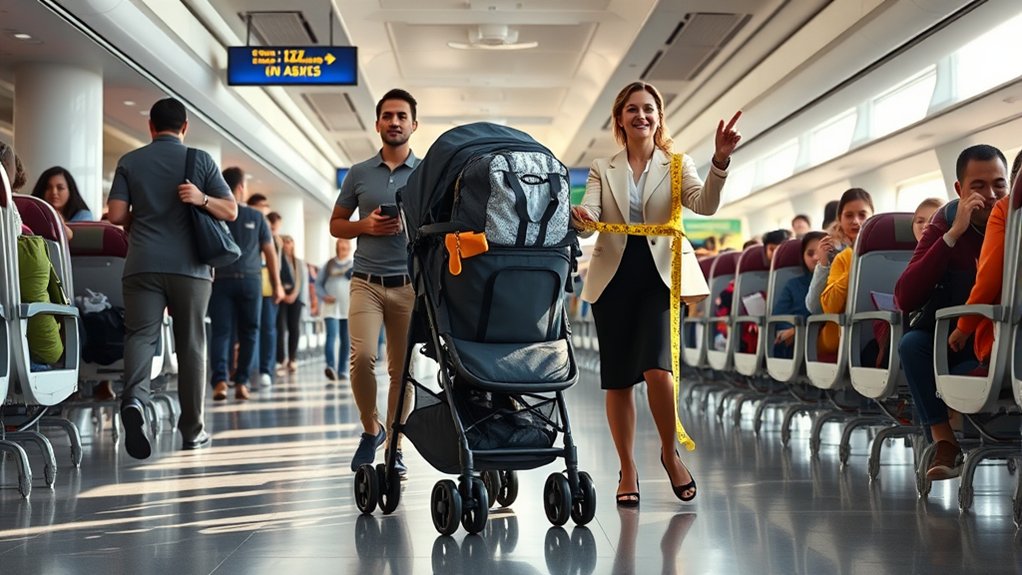
Start by checking whether your airline accepts the stroller at the gate or requires ticket-counter check-in. Do this before travel day if the stroller is large, heavy, non-collapsible, a jogging model, a stroller wagon, or a full-size double stroller. If you are specifically traveling with two children, see the separate guide to taking a double stroller on a plane.
Use a protective travel bag when practical, especially for an expensive stroller or a multi-flight itinerary. A bag can reduce dirt, scuffs, and snagging, but it cannot guarantee protection against impact or crushing. Remove detachable trays, organizers, rain covers, cup holders, and toys before handing the stroller over.
| Tip | Benefit |
|---|---|
| Confirm gate vs. counter rules | Prevents losing stroller access unexpectedly before security |
| Use a protective travel bag | Reduces dirt, scuffs, and loose-part snags |
| Remove detachable accessories | Reduces the chance of pieces being lost or damaged |
| Ask where it will be returned | Helps you plan connections and arrival-terminal walking |
If your stroller has removable wheels, check the manufacturer’s manual before removing them and pack them so they cannot damage the frame or disappear during handling. For more protection guidance, see whether you need a gate-check bag for your stroller.
How Do You Prepare a Stroller for Air Travel?

First, decide whether you are aiming for cabin storage, gate-checking, or ticket-counter checking. Measure the stroller in its fully folded travel configuration and compare it with your operating carrier’s current rule. Save a screenshot or copy of the policy on your phone so you can review the wording while traveling if needed.
Next, empty the storage basket and remove loose accessories. Secure straps, fold and lock the frame according to the stroller manual, and attach a luggage tag with your contact information. If you use a travel bag, label the bag as well. Photograph the stroller before handing it over if you want a record of its pre-flight condition.
At security, be ready to fold the stroller or present it for separate screening as directed by airport security staff. Keep passports, boarding passes, medication, feeding supplies, and other immediate child essentials in a separate bag so you do not have to unpack the stroller while managing the security line.
Frequently Asked Questions
What size stroller can I carry on a plane?
There is no universal stroller size for airplane cabins. A stroller can travel in the cabin only if the operating airline allows it as a cabin item and the fully folded stroller fits that airline’s carry-on size and storage rules. Otherwise, plan to gate-check or counter-check it.
Can I bring a double stroller on the plane?
Yes, you can usually travel with a double stroller, but most full-size double strollers are too large for cabin storage. Depending on the airline and the stroller’s folded size or design, it may be gate-checked or checked at the ticket counter.
What happens if my stroller exceeds size limits?
If your stroller is too large for cabin storage or does not meet your airline’s gate-check rules, airline staff may require you to check it at the ticket counter or baggage desk. That can mean you will not have access to it inside the terminal, so consider a baby carrier or another backup.
Are there fees for checking a stroller?
Many airlines transport a stroller for a child without a standard checked-bag fee, but the allowance and handling rules are airline-specific. Confirm the operating carrier’s current policy, especially for stroller wagons, oversized models, and partner-airline itineraries.
Can I use my stroller until boarding?
Often, yes. If your airline accepts the stroller for gate-checking, you can usually use it through the terminal and hand it over near boarding. Large, heavy, non-collapsible, or otherwise restricted strollers may need to be checked earlier at the ticket counter.
How do I secure my stroller for travel?
Fold and lock the stroller according to its manual, empty the basket, remove loose accessories, secure straps, add a luggage tag, and use a protective travel bag if practical. Keep the airline tag or receipt until the stroller is returned.
Is a stroller counted as carry-on luggage?
It depends on the airline. Some carriers allow an eligible compact stroller as an additional child-related item, some require it to fit within normal cabin baggage rules, and others expect strollers to be checked. Review the operating carrier’s policy before departure.
Should I use a stroller travel bag?
A stroller travel bag is useful when you gate-check or counter-check a stroller because it can reduce dirt, scuffs, and the chance of loose parts catching during handling. It cannot guarantee protection from impact or crushing, so remove detachable accessories and follow the stroller manufacturer’s packing guidance.
Conclusion
There is no universal answer to how big a stroller can be on an airplane. The correct limit depends on whether you want the stroller in the cabin, at the gate, or checked at the ticket counter—and on the rules of the airline actually operating your flight. Measure the stroller fully folded, check every operating carrier on your itinerary, and confirm where a checked stroller will be returned.
If keeping the stroller with you as long as possible is the priority, a compact fully collapsible model gives you the most flexibility. If comfort, storage, suspension, or destination terrain matters more, a larger stroller can still be practical when you plan for counter-checking and protect it properly for baggage handling.

