
Your Toyota RAV4 can tow many small utility, camping, sport, and boat trailers, but the safe limit depends on the model year, powertrain, drivetrain, grade, payload, and installed towing equipment. Before choosing a trailer, compare its fully loaded weight and tongue weight with every rating listed for your exact RAV4.
Quick Answer
Yes, a Toyota RAV4 can tow a small trailer when properly equipped. For 2026 U.S. models, all FWD versions and the LE AWD are rated for 1,750 pounds, while selected AWD grades can tow up to 3,500 pounds. Earlier RAV4 ratings range from 1,500 to 3,500 pounds.
Last updated: September 19, 2026. This update rechecked current 2026 U.S. towing grades, clarified the 2025 lineup, and aligned tongue-weight and trailer-sway guidance with Toyota owner-manual instructions.
Key Takeaways
- Your RAV4’s model year, powertrain, drivetrain, and grade determine its maximum towing capacity.
- Use the trailer’s loaded weight, not only its advertised dry weight, when checking compatibility.
- Tongue weight, passengers, cargo, and accessories all use part of the vehicle’s available payload.
- The vehicle, receiver, ball mount, hitch ball, and trailer each have separate ratings. The lowest rating controls the setup.
- Verify your owner’s manual, door-jamb label, trailer documentation, and local brake and lighting laws before towing.
Understanding Toyota RAV4 Towing Capacity

Toyota RAV4 towing capacity is not one number that applies to every vehicle. The rating has changed between generations, and different drivetrains within the same model year can have different limits.
The following figures apply to U.S.-market vehicles. Specifications in Canada, Europe, Australia, and other markets may differ because of equipment, testing methods, and local regulations.
2026 Toyota RAV4 Towing Capacity
Toyota’s current information lists a 1,750-pound rating for all 2026 FWD models and the LE AWD. Selected AWD Hybrid and Plug-in Hybrid grades can tow up to 3,500 pounds when properly equipped. You can review Toyota’s 2026 RAV4 grade and capability information for the manufacturer’s published details.
| 2026 U.S. Configuration | Maximum Trailer Weight | Important Detail |
|---|---|---|
| All FWD grades | 1,750 lb | Confirm the rating and required equipment in the exact vehicle manual. |
| LE AWD | 1,750 lb | AWD alone does not automatically provide the higher rating. |
| XLE Premium, SE, XSE, Limited, and Woodland AWD Hybrid grades | Up to 3,500 lb | Capacity applies only to the eligible AWD configuration with the required equipment. |
| SE, XSE, and Woodland AWD Plug-in Hybrid grades | Up to 3,500 lb | Check the current specifications for the exact grade and production configuration. |
The RAV4 badge does not determine your towing limit. Your exact model year, drivetrain, grade, vehicle label, equipment, and owner’s manual do.
Typical 2019–2025 RAV4 Towing Ratings
The previous RAV4 generation used several different ratings. From 2019 through 2024, many gas grades were rated at 1,500 pounds, Hybrid models commonly at 1,750 pounds, RAV4 Prime at 2,500 pounds, and applicable Adventure and TRD Off-Road models at up to 3,500 pounds. For 2025, Toyota did not offer the gas Adventure or TRD Off-Road grades; the U.S. lineup instead topped out at 2,500 pounds for the RAV4 Plug-in Hybrid, while gas grades were rated at 1,500 pounds and Hybrid grades at 1,750 pounds.
| Previous-Generation RAV4 Type | Common Maximum Rating | What to Verify |
|---|---|---|
| 2019–2025 standard gas LE, XLE, XLE Premium, and Limited configurations | Often 1,500 lb | Model year, drivetrain, installed equipment, and manual. |
| 2019–2025 RAV4 Hybrid | Often 1,750 lb | Payload, tongue-weight allowance, and hitch compatibility. |
| 2021–2024 RAV4 Prime / 2025 RAV4 Plug-in Hybrid | Often 2,500 lb | Exact model-year specifications and required trailer brakes. |
| 2019–2024 Adventure and TRD Off-Road | Up to 3,500 lb | Tow-prep equipment, payload, receiver rating, and model year. |
Note: Use Toyota’s manual and warranty lookup to confirm the limit for your exact model year and configuration. A rating from a dealer advertisement or another RAV4 trim is not enough.
For a broader year-by-year breakdown, see our Toyota RAV4 towing capacity guide. This page focuses on whether a specific small trailer is a workable match once trailer weight, tongue load, payload, equipment, and driving conditions are considered together.
Can My RAV4 Tow This Trailer? Use This 4-Number Check
Start with four numbers before you buy or hitch a trailer: the RAV4’s trailer weight rating, the trailer’s actual loaded weight, the RAV4’s available payload, and the permitted tongue weight. The setup passes only when every applicable limit remains within its rating. A trailer can be under the advertised towing-capacity number and still overload the RAV4 through tongue weight, passengers, cargo, an undersized receiver, or an axle limit.
- Confirm the vehicle rating: Use the owner’s manual and vehicle labels for your exact model year, grade, drivetrain, and equipment.
- Use loaded trailer weight: Include water, propane, batteries, food, tools, options, and cargo.
- Check tongue weight and payload: Toyota RAV4 manuals commonly specify a tongue-weight target of 9% to 11% of gross trailer weight. For a 1,500-pound loaded trailer, that is about 135 to 165 pounds, subject to the exact manual and trailer instructions.
- Check every remaining limit: Verify GVWR, GAWR, GCWR when listed, receiver and ball ratings, tire limits, trailer-brake requirements, and local law.
Decision rule: The lowest applicable rating controls. If one limit fails, the combination is not within the published limits even if the RAV4 can physically move the trailer.
[Amazon Products Picked for You]
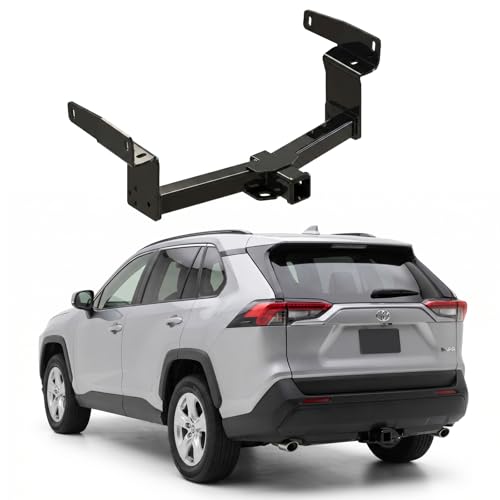
【Fits All 2019–2023 RAV4 Models】 — Specifically designed for all 2019–2023 Toyota RAV4 models, including gas, Hybrid and RAV4 Prime/PHEV configurations. Vehicle-specific design provides a precise and secure fit. Please verify your vehicle year before ordering.

【COMPATIBLE WITH】— The TangMiGe Class 3 Trailer Hitch offers a custom, factory fit on select model years of the Toyota RAV4 2019 2020 2021 2022 2023 2024 2025, RAV4 Prime/Venza 2021 2022 2023 2024, Lexus NX Excludes F Sport 2022 2023 2024 2025 2026, Easy to install
Best Small Trailer Types for a Toyota RAV4
A trailer category does not determine whether it is suitable. Two teardrop campers of similar size can have very different frames, batteries, water tanks, options, cargo capacities, and loaded weights.
Choose by the trailer’s actual specifications rather than its name or appearance. Suitable possibilities may include:
- Small open utility trailers: Useful for yard equipment, furniture, building supplies, or camping gear when the trailer and cargo remain within all ratings.
- Compact teardrop or micro campers: Some lightweight models fit RAV4 limits, but air conditioners, batteries, propane, water, food, and camping gear can add substantial weight.
- Small boat or personal-watercraft trailers: Include the boat, motor, fuel, battery, equipment, trailer, and carried gear in the total.
- Light motorcycle, scooter, or small-ATV trailers: Check both the trailer’s empty weight and the secured vehicle’s weight.
- Small enclosed cargo trailers: The empty weight may fit, but a tall, box-shaped body can create considerable aerodynamic drag and crosswind sensitivity.
A trailer that appears small can still be unsuitable if its loaded weight, tongue weight, frontal area, or braking requirements exceed your RAV4’s limits.
[Amazon Products Picked for You]

Lightweight Design: Tailored for motorcycles and small cars, ensuring easy towing.

⛺️King of the Camper Keychain/Queen of the Camper Keychain/Camper Gifts for Couple: This 2pcs camper keychain is a sweet tribute to camping lovers! One reads “King of The Camper,” the other “Queen of The Camper”. Perfect as camper gifts for RV owners, travel trailer fans, couples, RV enthusiasts, and camping lovers.

TEAR-RESISTANT FABRIC: Featured an upgraded 7-ply top non-woven fabric, it offers enhanced softness, stretch, and protection. The waterproof membrane and UV coating reduce aging, providing superior defense against dust, dirt, and scratches for your RV
Dry Weight Versus Loaded Trailer Weight
Dry or unloaded weight is not the number you tow down the road. It normally excludes at least some cargo and dealer-installed equipment and, depending on the trailer, may also exclude batteries, propane, water, accessories, or optional appliances. Use the trailer’s actual loaded weight for the towing-capacity check.
For a useful estimate, add every item that will travel in or on the trailer:
- Water, fuel, propane, and batteries
- Food, clothing, tools, and camping equipment
- Boats, motorcycles, lawn equipment, or other cargo
- Dealer-installed options and aftermarket accessories
- Spare tires, racks, coolers, generators, and recovery equipment
The trailer’s gross vehicle weight rating, or GVWR, is the maximum the trailer itself may weigh when loaded. Your RAV4 must be able to tow the actual loaded weight, but using a trailer with a GVWR above the vehicle’s rating can make accidental overloading easier.
Pro Tip: Load the RAV4 and trailer as they will travel, then use a certified public scale. A scale ticket is more reliable than adding catalog weights or relying on the trailer’s advertised dry weight.
Weight Limits for Safe Towing
The published trailer rating is only one part of a safe setup. You must stay within every applicable vehicle, axle, hitch, tire, trailer, and component limit at the same time.
Important Towing Weight Terms
- Maximum trailer weight: The greatest loaded trailer weight Toyota permits for the specific RAV4 configuration.
- Vehicle payload: The combined weight of occupants, cargo, accessories, and trailer tongue load that the RAV4 can carry.
- Tongue weight: The downward force the trailer applies to the hitch. It counts against the RAV4’s payload and rear-axle capacity.
- GVWR: The maximum permitted loaded weight of the RAV4 or trailer, depending on which label you are reading.
- GAWR: The maximum permitted weight carried by an individual axle.
- GCWR: The maximum permitted combined weight of the loaded RAV4 and loaded trailer when Toyota specifies one.
How Payload Affects RAV4 Towing
Suppose your door-jamb label permits 1,100 pounds of occupants and cargo. If the people, luggage, hitch equipment, and other items in the RAV4 total 850 pounds, only 250 pounds remain for trailer tongue weight.
That payload limit may restrict the trailer before you reach the maximum advertised tow rating. Rear-axle, receiver, tire, and tongue-weight limits can also become the controlling factor.
Toyota RAV4 owner-manual guidance specifies distributing gross trailer weight so that tongue weight is generally 9% to 11% for the applicable RAV4 towing setup. Follow the exact model-year manual and the trailer and hitch manufacturers’ instructions if they set additional or different requirements.
Warning: Never reduce tongue weight below the trailer manufacturer’s requirement merely to pass a payload calculation. Too little tongue load can promote sway, while too much can overload the RAV4’s rear axle, tires, suspension, or receiver. Correct the load or choose a lighter trailer.
How to Tow Safely With Your RAV4
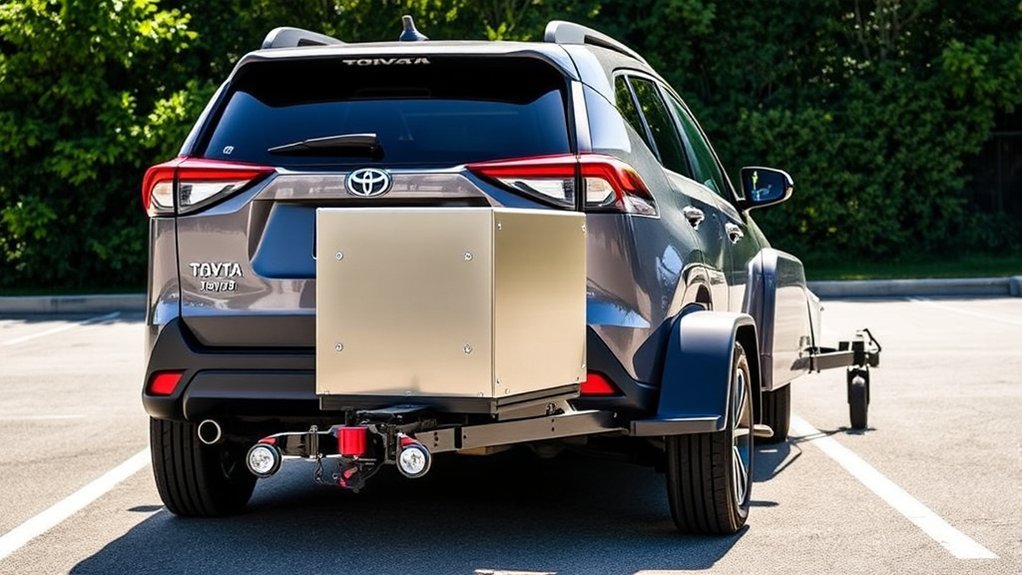
Safe towing starts before the vehicle moves. Inspect the RAV4, towing equipment, trailer, and load before each trip, even when you used the same setup recently.
RAV4 Pre-Trip Towing Checklist
- Confirm the RAV4, receiver, ball mount, hitch ball, coupler, and trailer ratings.
- Check that the hitch ball matches the coupler size and that the coupler is fully latched.
- Install the receiver pin and retaining clip correctly.
- Cross the safety chains under the trailer tongue and leave enough slack for turns without allowing them to drag.
- Connect the electrical plug and test the running lights, brake lights, turn signals, and hazard lights.
- Test the trailer brakes and breakaway system when the trailer is equipped with them.
- Check cold tire pressure on the RAV4 and trailer using each manufacturer’s specified pressure.
- Inspect tire condition, wheel bearings, wheel fasteners, suspension, and visible wiring.
- Secure all cargo so it cannot slide and change the trailer’s balance.
- Raise and lock the trailer jack, steps, stabilizers, doors, windows, and roof accessories.
- Confirm that mirrors provide a legal and useful view along both sides of the trailer.
- Check the loaded RAV4 and trailer on a scale when weight or balance is uncertain.
- If the RAV4 is new or has a new powertrain component, follow the break-in towing restrictions in the exact owner’s manual before towing.
The U.S. Environmental Protection Agency provides a useful trailer-towing pre-trip inspection checklist covering the vehicle, hitch, electrical equipment, tires, brakes, and load.
Driving With a Trailer
- Accelerate gradually: Added weight increases the time and distance needed to build speed.
- Leave more following distance: The combined vehicle and trailer need more room to stop.
- Slow before turns: The trailer’s wheels track inside the RAV4’s path and need extra clearance.
- Reduce speed in wind: Tall or box-shaped trailers can react strongly to crosswinds and passing trucks.
- Use lower speeds on descents: Avoid riding the brakes continuously. Follow the owner’s manual for appropriate downhill operation.
- Plan fuel and charging stops: Towing normally increases energy use and can reduce driving range.
- Practice reversing: Use small steering inputs and stop before the trailer approaches a jackknife angle.
- Recheck the setup: Stop after the first few miles to inspect the coupler, chains, cargo, tires, and electrical connection.
If the trailer begins to sway, follow Toyota’s owner-manual procedure for your exact RAV4. Current Toyota guidance tells the driver to grip the steering wheel firmly, steer straight ahead, and release the accelerator very gradually to reduce speed. Do not increase speed, make abrupt steering corrections, or apply the vehicle brakes while the sway is occurring. After the combination stabilizes, stop in a safe place and check the trailer tires, cargo position, tongue weight, and vehicle load before continuing.
Recommended Equipment for Towing With a RAV4
The right equipment depends on the RAV4’s year and configuration, the trailer, local laws, and the trailer’s braking system. Buy towing parts by verified rating and compatibility rather than appearance.
[Amazon Products Picked for You]

Hitch Wire for RAV4: - This flat 4 pin custom RAV4 vehicle side trailer wiring harness kit compatible with 2019-2024 Toyota RAV4, 2021-2024 Toyota RAV4 Prime and Mitsubishi Outlander PHEV 2023 2024 (You will need to run the hot lead up to your vehicle battery, 12V is required for proper operate)
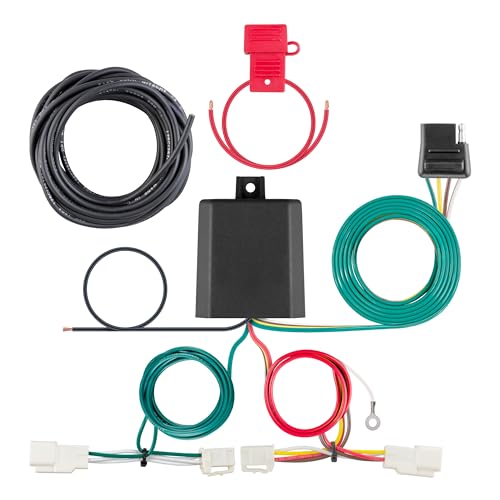
Plugs into vehicle tail light assembly to provide a 4-way flat socket
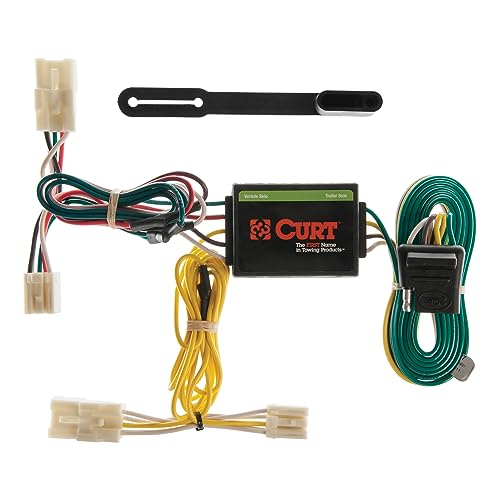
Plugs into vehicle tail light assembly to provide a 4-way flat socket
Essential Towing Equipment
- Vehicle-compatible receiver: Use a receiver approved for the exact model year and configuration. Toyota notes that the maximum towable weight also depends on occupants, cargo, and added equipment.
- Correct ball mount and hitch ball: Both must have ratings at least as high as the permitted trailer load, and the ball must match the coupler size.
- Rated hitch pin and retaining clip: These secure the ball mount inside the receiver.
- Trailer wiring harness: The trailer needs operating tail, stop, and turn lights.
- Safety chains: Use properly rated chains attached to the designated receiver points.
- Tongue-weight scale: This helps you check trailer balance before driving.
- Trailer brakes and controller: Install the system required by the vehicle manual, trailer manufacturer, equipment instructions, and local law. Toyota manuals distinguish between braked TWR and unbraked TWR, so do not assume a trailer is permitted to run without service brakes merely because its total weight is below the vehicle’s maximum braked tow rating.
- Breakaway system: Braked trailers may require a system that applies the trailer brakes if the trailer separates.
- Extended mirrors: Use them when the trailer blocks the legally required rearward view.
- Wheel chocks: Chock the trailer before coupling, uncoupling, loading, or parking on a grade.
Toyota’s genuine RAV4 tow-hitch information warns owners not to exceed any weight rating and explains that occupants, cargo, accessories, and equipment can reduce the maximum available capacity.
Weight-Distribution Tools
A weight-distribution hitch transfers part of the hitch load across the tow vehicle and trailer axles. However, it is not a universal RAV4 upgrade.
Use one only when Toyota approves it for your exact model year and configuration and when the receiver, ball mount, trailer frame, and weight-distribution system manufacturers also permit the combination. Do not assume that a receiver’s basic trailer rating means it can accept spring bars or a weight-distribution system.
A tongue-weight scale, certified vehicle scale, correct ball-mount height, and properly positioned cargo are safer starting points for a small RAV4 trailer setup.
Additional Safety Equipment
A tire-pressure gauge, torque wrench used to the equipment manufacturer’s procedure, spare trailer tire, jack, reflective triangles, wheel chocks, flashlight, and basic tool kit can help you identify or manage common problems.
Anti-rattle devices may reduce receiver noise, but they do not increase towing capacity or correct trailer sway. Cargo carriers also add weight behind the vehicle and consume payload, so include the carrier and its contents in your calculations.
Practical Factors Owners Commonly Notice When Towing
Owner reports can reveal practical concerns, but they cannot change Toyota’s ratings. An anecdote may omit the RAV4’s model year, trailer’s loaded weight, tongue weight, payload, equipment, road conditions, or maintenance history.
How to Interpret Owner Experiences
Useful reports tend to include scale tickets, exact vehicle and trailer configurations, hitch and brake details, terrain, speed, weather, and fuel or energy use. Statements such as “it towed fine” provide little evidence without those details.
Common practical observations are still worth considering:
- A light, low-profile trailer usually places less demand on the vehicle than a tall trailer of the same weight.
- Headwinds, crosswinds, steep grades, high temperatures, and highway speeds can make towing feel more demanding.
- A trailer that feels stable when empty may handle differently after water, batteries, propane, and cargo are added.
- Trailer brakes can improve control when correctly installed, adjusted, and permitted for the setup.
- Fuel economy or electric range normally falls, but the size of the change varies widely.
Weight Challenges While Towing
Hills increase the power required to climb and the braking demand during descents. Added trailer weight can also lengthen stopping distance, increase transmission and cooling loads, and reduce acceleration.
Wind resistance can matter as much as weight at highway speeds. A tall enclosed trailer may demand more energy than a lower trailer with a similar scale weight.
Do not use another owner’s overloaded setup as proof that yours is safe. A vehicle may move a trailer while still exceeding its receiver, payload, axle, tire, braking, or manufacturer limits.
Related Guides
Frequently Asked Questions
Can a Toyota RAV4 tow a teardrop camper?
Some teardrop campers fit within RAV4 towing limits, but you must compare the camper’s loaded weight, tongue weight, GVWR, frontal area, and braking requirements with your exact RAV4. Include batteries, propane, water, food, options, and camping gear rather than relying only on dry weight.
Can a RAV4 Hybrid tow a small trailer?
Yes. Previous-generation RAV4 Hybrid models commonly have a 1,750-pound maximum rating. For 2026, LE AWD and all FWD configurations are rated at 1,750 pounds, while selected AWD Hybrid grades can tow up to 3,500 pounds. Verify the exact vehicle manual before choosing a trailer.
Which Toyota RAV4 models can tow 3,500 pounds?
Applicable 2019–2024 Adventure and TRD Off-Road models can tow up to 3,500 pounds. Toyota did not offer those gas grades for 2025. For 2026, Toyota lists up to 3,500 pounds for selected AWD Hybrid and Plug-in Hybrid grades, while all FWD versions and the LE AWD are rated at 1,750 pounds.
Does the Toyota RAV4 come with a trailer hitch?
Equipment varies by model year and grade. The 2026 Woodland includes a two-inch rear receiver and wiring harness, while many other RAV4 configurations require compatible towing equipment to be added. Confirm the vehicle’s original equipment and installation requirements before purchasing parts.
Do I need trailer brakes when towing with a RAV4?
You may need trailer brakes based on the trailer’s weight, Toyota’s braked and unbraked trailer ratings, the trailer manufacturer’s requirements, and local law. Requirements differ between states, provinces, and countries. Any controller, wiring, breakaway device, and brake system must be compatible and correctly adjusted.
Does towing affect RAV4 fuel economy or electric range?
Yes. Towing normally increases fuel or electricity use, but no fixed percentage applies to every setup. Trailer weight, height, frontal area, speed, wind, temperature, terrain, tire pressure, and driving style all affect the result.
Does Toyota’s warranty cover towing-related damage?
Toyota’s warranty covers qualifying defects in materials or workmanship, subject to its terms and exclusions. Damage caused by overloading, misuse, improper maintenance, unsuitable parts, alterations, or incorrect installation may not be covered. Toyota’s towing-service provision concerns transport to a dealership when a warranted failure makes the vehicle inoperable.
Conclusion
Your Toyota RAV4 can tow a small trailer when the fully loaded combination fits the ratings for your exact vehicle. Start with the model-year manual, then check trailer weight, tongue load, payload, axle limits, receiver capacity, equipment compatibility, and local laws.
A lightweight utility trailer, micro camper, small boat trailer, or sport trailer may work well, but the category alone does not make it safe. Weigh the loaded setup, inspect it before each trip, and choose a lighter trailer whenever the numbers or handling leave little room for changing conditions.
Sources
- Toyota: The Next Adventure Begins, 2026 RAV4 — current grade, drivetrain, hitch, and towing-capacity information.
- Toyota 2024 RAV4 Brochure — previous-generation towing, payload, and configuration specifications.
- Toyota: 2025 RAV4 — confirms 2025 gas and Hybrid lineup changes, including the absence of Adventure and TRD Off-Road grades.
- Toyota: 2025 RAV4 Plug-in Hybrid — confirms the Prime-to-Plug-in-Hybrid naming change and 2025 PHEV lineup.
- Toyota Fleet Guide — lists the 2025 RAV4 Plug-in Hybrid at a 2,500-pound towing capacity.
- Toyota Owner’s Manuals and Warranties — model-year-specific towing limits, tongue-weight guidance, break-in restrictions, hitch requirements, and trailer-sway instructions.
- Toyota Genuine RAV4 Tow Hitch Receiver — equipment compatibility and weight-rating cautions.
- Toyota 2026 RAV4 Warranty and Maintenance Guide — warranty coverage, exclusions, owner responsibilities, and towing service.
- U.S. EPA Trailer Towing Pre-Trip Safety Checklist — vehicle, hitch, brake, tire, electrical, and trailer inspection guidance.
