
Last updated: September 16, 2026
Yes, Toyota RAV4 back seats fold down to create more cargo room. Recent RAV4s use a 60/40 split rear seat, so you can fold one section or both. On many 2019–2025 U.S. models, you lower a seatback by pulling its seatback angle-adjustment lever and guiding the seatback forward. The redesigned 2026 RAV4 has a newly designed rear seatback that Toyota says folds flat, so the exact procedure and cargo measurements should be matched to your model year.
Quick Answer
- Recent Toyota RAV4 rear seats use a 60/40 split-folding design, allowing one section or both sections to be lowered.
- Before folding the seats, park safely, shift to Park, apply the parking brake, clear the seat area, and make sure seat belts and head restraints will not interfere.
- On the 2025 RAV4, Toyota instructs you to pull the seatback angle-adjustment lever and fold the selected seatback forward.
- After returning a recent RAV4 seatback upright, make sure it is locked. On the 2025 model, a visible red marking means the seatback is not securely locked.
- Toyota’s 2026 RAV4 Sales Consultant Guide lists 70.4 cubic feet of cargo volume behind the front row with the second row folded and 37.8 cubic feet behind the second row.
How to Fold Down the RAV4 Back Seats
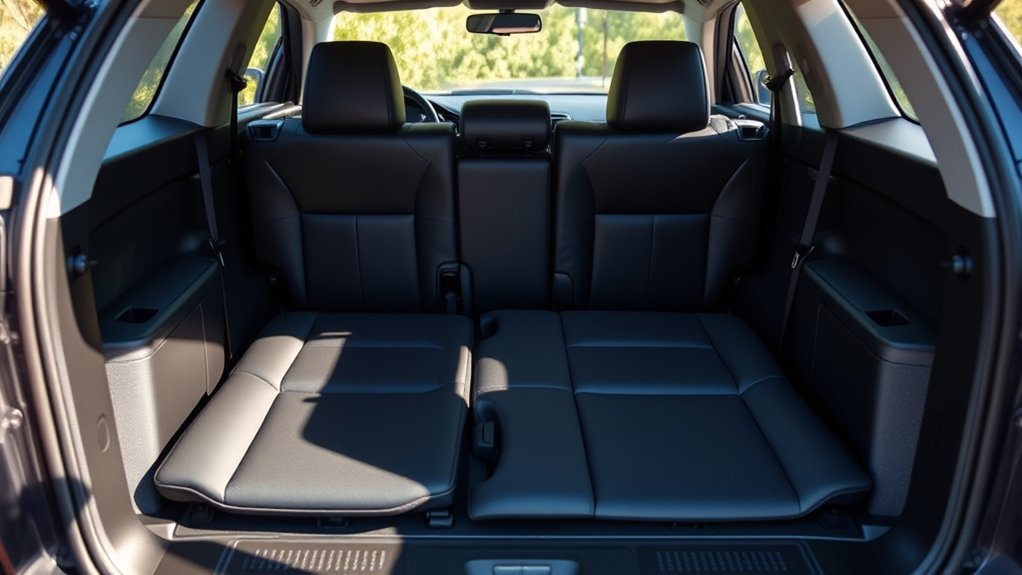
The safest folding procedure is to prepare the vehicle first, then release and guide the seatback down instead of forcing it.
- Park on level ground. Shift the vehicle into Park and apply the parking brake before operating the rear seatbacks.
- Clear the rear seat. Remove loose items and make sure no passenger is sitting against the seatback you want to fold.
- Check the front-seat position. Move the front seat if necessary so the rear seatback or head restraint does not hit it while folding.
- Prepare the head restraints and armrest. On the 2025 RAV4, Toyota instructs owners to lower the rear center head restraint, position the outboard head restraints as directed, and stow the center armrest when necessary.
- Keep the seat belts clear. Make sure belts and buckles will not become trapped in the seat hinge or latch area.
- Pull the seatback lever. On the 2025 U.S. RAV4, pull the seatback angle-adjustment lever for the section you want to lower and guide the seatback forward.
- Repeat for the other section if needed. The 60/40 split lets you lower one side for a long item or both sides for maximum cargo room.
Release-control shape and placement can differ across RAV4 generations. If your seat does not match this description, do not force it; use the owner instructions for your exact model year.
[Amazon Products Picked for You]

【𝐏𝐥𝐞𝐚𝐬𝐞 𝐍𝐨𝐭𝐞】①Fit for Cargo with Subwoofer. The trunk mat can be cut to size as needed. Please refer to the main image and crop according to the guidelines. ②Only fit when the cargo deck is in the higher position. ③𝐍𝐨𝐭 𝐅𝐢𝐭 𝐏𝐥𝐮𝐠-𝐢𝐧 𝐇𝐲𝐛𝐫𝐢𝐝. Only Fit 2026 RAV4 Hybrid. ④Precisely designed for RAV4 2026 Hybrid, including Hybrid XLE/Hybrid LE/Hybrid XSE/Hybrid SE/Hybrid Limited/Hybrid XLE Premium/Hybrid Woodland Edition models

Especial Fitment:This cargo mat compatible with 2013 2014 2015 2016 2017 2018 Toyota RAV4 model (Not fit electric or hybrid models).Meet your expectations.Please choose the model you need carefully.
Understanding the Safety Mechanism for Rear Seats
After returning a RAV4 rear seatback to the upright position, make sure it is fully locked before driving.
For the 2025 RAV4, Toyota says to lightly push the upright seatback forward and rearward to confirm it is secure. If the seatback is not locked, a red marking remains visible. The red marking should not be visible once the seatback is properly secured.
Also check that the seat belts are not twisted or trapped in the seatback. A trapped belt can be damaged and may not operate correctly.
The rear seatbacks on recent RAV4 models can also recline. Adjust the seatback only while the vehicle is stopped, and do not recline it farther than necessary for passenger comfort.
After returning a folded seatback upright, verify the lock and make sure no seat belt is caught in the seatback.
Toyota also warns against allowing children to operate the rear seat and against carrying anyone on a folded seatback or in the luggage compartment.
Cargo Space Dimensions: Key Measurements
RAV4 cargo measurements depend on model year, powertrain, trim, roof configuration, and cargo-floor position. Do not apply one set of dimensions to every RAV4 generation.
| Reference | Behind Second Row | Behind Front Row / Rear Seats Folded | Important Note |
|---|---|---|---|
| 2024 U.S. RAV4 | About 37.5–37.6 cu. ft. on most gas/hybrid configurations; 33.5 cu. ft. on Prime | 69.8 cu. ft. | Toyota also published 40.0 in. cargo length behind the rear seat, 39.4/59.0 in. minimum/maximum width, and 34.5/36.6 in. minimum/maximum height on most configurations. |
| 2026 RAV4 sales-guide specification | 37.8 cu. ft. | 70.4 cu. ft. | The 2026 model is a redesigned generation with a newly designed fold-flat rear seatback. |
Toyota’s current figures show why model year matters. A 69.8-cubic-foot figure is useful for many fifth-generation RAV4s, but it should not automatically be treated as the specification for every newer or older model.
[Amazon Products Picked for You]

EXTRA-LARGE STORAGE: Equipped with 3 large compartments, 8 additional pockets, and a cooler bag, the HOTOR car trunk organizer offers extra storage space up to 69L+23L for effectively arranging and storing various items such as groceries, drinks, tools, sports gear, and other belongings. Maintain a tidy and well-organized car trunk throughout all your journeys.

[ORGANIZE YOUR CAR TRUNK]: When you open the trunk after grocery shopping, you definitely don't want to have a mess of groceries splattered around the trunk. Our trunk organizer is secured with Velcro. It does a great job of helping you organize groceries

【Install Easily & Fit 90% Cars】The car trunk organizer holds with 3 strong straps and clip on and off buckles to install easily in seconds. Also fits 90% car types, this hanging trunk organizer for suv,jeep, trunk, minivan,ect.And it is perfect choice as car accessories for women and men.
Measuring Cargo Length for Optimal Use
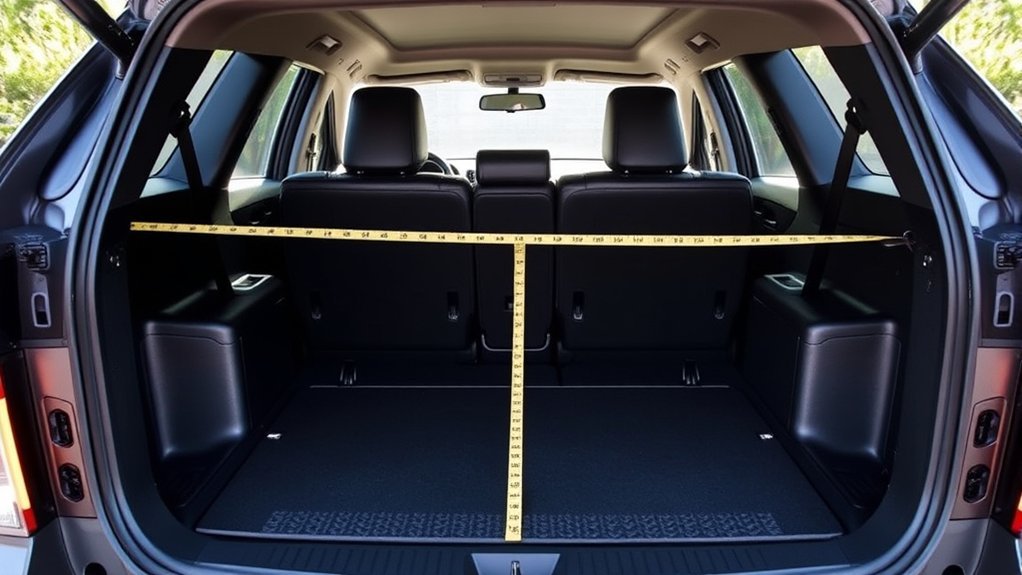
Published cargo volume does not tell you whether one specific bicycle, box, shelf, pet crate, or piece of furniture will fit. Straight-line usable length changes with the front-seat position and the shape of the item.
- Set the driver and front-passenger seats in positions that can be used safely while driving.
- Fold the required rear-seat section or sections.
- Close the liftgate and measure from the inside of the liftgate to the nearest front-seatback at the shortest usable point.
- Measure the narrowest width between the cargo-area trim and wheel housings.
- Measure the liftgate opening separately. An item can fit inside the cabin but still be too large to pass through the opening.
For reference, Toyota’s 2024 U.S. specifications list 40.0 inches of cargo length behind the rear seat. That number is not cargo height and does not represent the full folded-seat floor length.
[Amazon Products Picked for You]

Large Size & Universal Fit: Featuring expansive 53" x 79" dimensions, this foldable pet cargo cover is designed for a custom fit in full-size SUVs, mid-size SUVs, compact crossovers, minivans, and sedans. Ensure your pet has ample room to sit or lie down comfortably. Please measure your vehicle's cargo area before ordering.

Custom Fit: Compatible with 2019 2020 2021 2022 2023 2024 2025 Toyota RAV4 all gas and hybrid model, no need to cut, offering seamless fit and full coverage, ensuring all-round protection. Please confirm model years before purchasing

【Accessories for RAV4】The CARTIST trunk mat designed for Toyota RAV4 2019 2020 2021 2022 2023 2024 2025, Hybrid and Non-Hybrid all models. If your vehicle has a JBL speaker in the rear cargo area, please tuck it under the speaker panel.
How to Maximize Your RAV4’s Cargo Space
Use the 60/40 rear seat and cargo-floor configuration together instead of automatically folding everything.
- Fold only the section you need. A long narrow item may fit with one rear-seat section lowered while another rear seating position remains available.
- Use the cargo deck at the appropriate height. On fifth-generation RAV4s, Toyota introduced a two-level cargo deck. The upper position helps create a smoother transition to the folded seatbacks, while the lower position increases vertical room.
- Use the reversible surface where equipped. Toyota designed the fifth-generation deck board with a plastic reverse side for wet or dirty cargo.
- Measure rectangular items. Cubic-foot capacity does not guarantee that a rigid box will clear the hatch opening or wheel housings.
- Secure the load. Keep heavy objects low and prevent cargo from moving forward during braking or cornering.
RAV4 60/40 Split Seat: What It Means for You
A 60/40 split rear seat divides the second-row seatback into two independently folding sections. This gives you more flexibility than an all-or-nothing bench.
You can keep both sections upright for normal passenger use, lower one section to create a lane for a long item, or lower both sections when you need maximum cargo volume.
The exact orientation of the larger and smaller sections and the release-control design can vary by market or model year, so use your vehicle’s seating layout rather than assuming one side is always the 60% section.
Using the RAV4’s Reversible Cargo Floor for Pets and Dirty Gear
Some recent RAV4 cargo decks are designed to make messy loads easier to manage. Toyota’s fifth-generation design used a reversible deck board with a plastic surface on one side.
- Use the easy-clean side for dirty loads: The plastic surface is better suited to wet shoes, muddy equipment, or pet-related messes than exposed carpet.
- Choose the deck height for the load: The upper position can make the cargo floor transition smoother, while the lower position can increase vertical clearance.
- Add a fitted cargo liner when needed: A liner can protect the floor and rear seatbacks from moisture, dirt, and pet hair.
- Restrain animals safely: Do not rely on the cargo floor itself as a pet-restraint system. Use an appropriate secured carrier or vehicle restraint.
Feature availability and deck-board design can differ by year and configuration, so inspect your own cargo floor before assuming it is reversible.
Tips for Transporting Larger Items
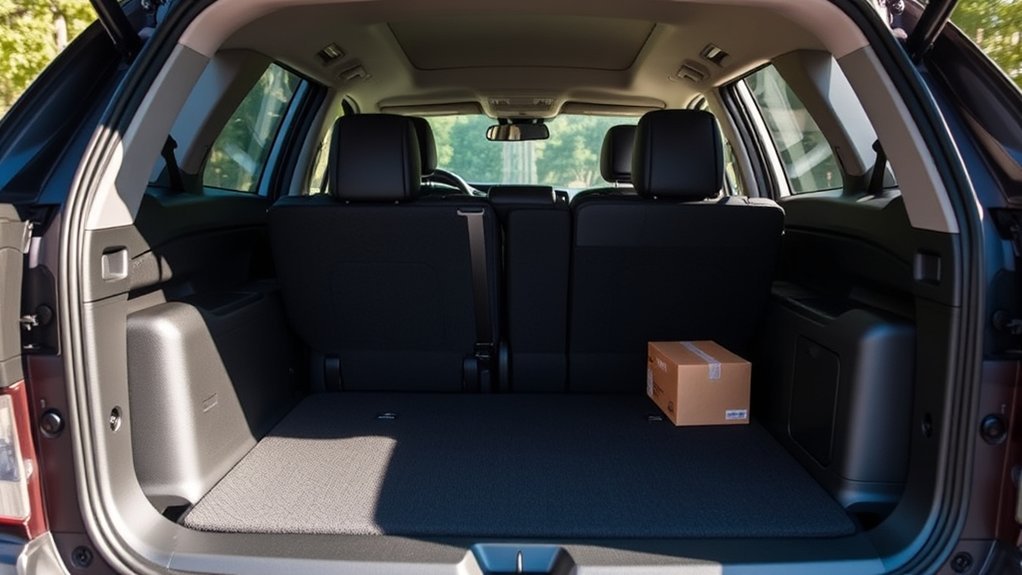
For furniture, bicycles, shelving, camping equipment, or other bulky cargo, measure the object and the vehicle instead of relying only on total cargo volume.
- Measure the item’s maximum length, width, and height, including handles, wheels, pedals, packaging, or protruding hardware.
- Measure the RAV4’s liftgate opening as well as its interior cargo area.
- Fold only as much of the 60/40 rear seat as necessary.
- Move the front passenger seat only if it can remain in a safe position and the cargo will not interfere with the driver, controls, airbags, mirrors, or windshield.
- For bicycles, turning the handlebars or removing a front wheel may make loading easier, but actual fit depends on bicycle dimensions and RAV4 model year.
- Secure long or heavy cargo so it cannot slide into the front seating area.
Common Mistakes to Avoid When Folding RAV4 Seats
Most folding problems come from an obstruction, a trapped belt, incorrect head-restraint position, or an unlocked seatback rather than from the seat needing extra force.
Ensure the Seatback Locks Before Driving
When you return a rear seatback upright, verify the latch before anyone sits there.
- Push the seatback lightly forward and rearward: It should remain securely latched.
- Check the lock marking: On the 2025 RAV4, a visible red marking indicates the seatback is not securely locked.
- Inspect the seat belt: Make sure the belt is not twisted or caught in the latch area.
- Do not force the seat: If it will not latch, check for cargo, a buckle, a head restraint, or another obstruction before trying again.
Check Seat Belts, Head Restraints, and Front-Seat Clearance
Before lowering a seatback, clear anything that can interfere with its movement. The front seat may need to be moved temporarily, and the rear center armrest should be stowed when required.
Keep the seat belts and buckles away from the hinge and latch areas. When returning the seat upright, make sure the belt follows its normal path and is not pinched behind the seatback.
If a seatback resists movement, stop and look for an obstruction instead of pressing harder.
Avoid Overloading the Vehicle
Cargo volume and allowable cargo weight are different measurements. A RAV4 may have dozens of cubic feet of available space while reaching its load limit before that space is physically full.
- Check the Tire and Loading Information label: Use the label on the driver-side doorjamb for your vehicle’s occupant-and-cargo guidance.
- Include passenger weight: Passengers, luggage, accessories, and other carried items all contribute to vehicle load.
- Keep heavy items low: Place dense cargo close to the floor and distribute it securely.
- Secure loose objects: Prevent luggage or equipment from moving into the passenger compartment during hard braking.
Do not treat a 69.8- or 70.4-cubic-foot cargo-volume figure as a payload limit.
Benefits of Flipping the Trunk Floor for Cleanliness
On fifth-generation RAV4s equipped with Toyota’s reversible cargo deck, flipping the board exposes a plastic surface designed for wet or dirty items.
This can be useful after hiking, camping, gardening, beach trips, or transporting a pet because dirt and moisture are easier to remove from a hard surface than from carpet.
The cargo deck can also be placed at different heights on applicable models. The upper position helps align the deck with surrounding surfaces, while the lower position provides additional vertical clearance.
Check the deck in your exact RAV4 before flipping or repositioning it because cargo-floor construction can vary by generation and equipment.
Maximizing Your RAV4’s Features for Everyday Use
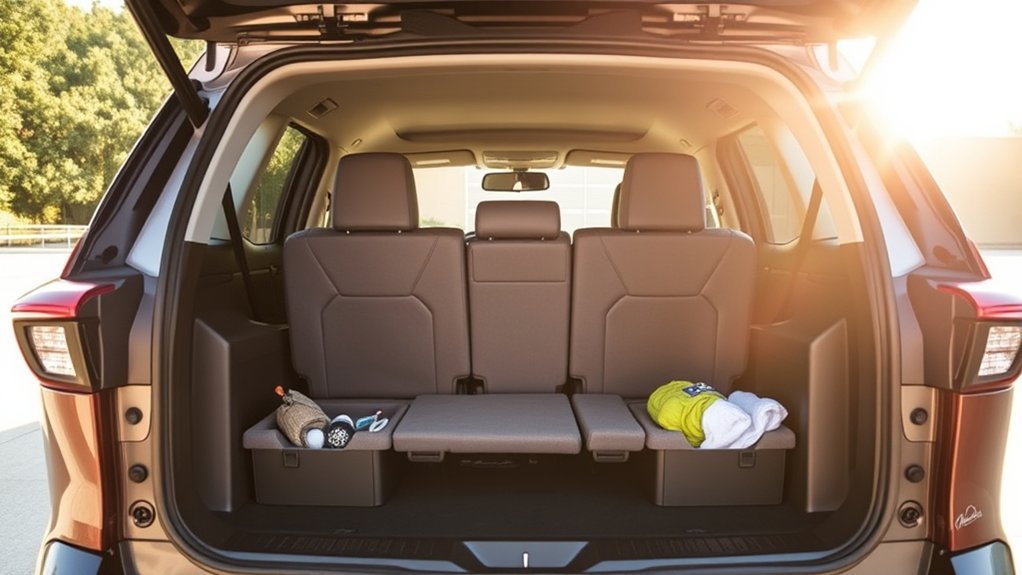
The most practical cargo setup depends on what you are carrying, not just the maximum cubic-foot number.
- Keep both rear sections upright when you need maximum passenger seating.
- Fold one section for skis, flat-packed furniture, a bicycle, or another long object while retaining part of the second row.
- Fold both rear sections when you need the largest continuous cargo area.
- Adjust the cargo deck when your RAV4 provides upper and lower positions.
- Measure awkward cargo at the liftgate opening, wheel housings, and front-seat transition before loading.
- Check the load label whenever passengers and heavy cargo are being carried together.
Related Guides
Frequently Asked Questions
Can the RAV4 Back Seats Fold Flat Completely?
Toyota describes recent RAV4s as having fold-flat rear seats, but the floor transition depends on model year and cargo-deck position. For 2026, Toyota specifically says the redesigned rear seatback was newly designed to fold flat. Earlier fifth-generation models use a two-level cargo deck that can help create a flatter transition when placed in its upper position.
Are the Back Seats Easy to Fold for Children?
Children should not operate the RAV4 rear seats. Toyota’s recent owner instructions warn against allowing children to operate the seat. An adult should fold or return the seatback and verify that it is securely locked before driving.
Will Folding the Seats Affect Passenger Safety?
The rear seatbacks are designed to fold for cargo use, but no one should sit on a folded seatback or ride in the luggage compartment. Every passenger must use a designated seating position and seat belt, and cargo should be secured so it cannot move into the passenger area.
How Do I Clean the Seat Fabric After Folding?
Vacuum loose dirt first, then use an upholstery cleaner that is compatible with your RAV4’s seat material. Apply cleaner according to its instructions, avoid saturating the seat, and allow the surface to dry fully before folding or using it again.
Do the RAV4 Back Seats Recline or Adjust?
Yes. Recent RAV4 rear seatbacks can recline as well as fold. On the 2025 RAV4, Toyota identifies the control as the seatback angle-adjustment lever. Adjust the seat only while the vehicle is stopped and make sure it locks securely afterward.
Toyota Sources Used
- Toyota 2025 RAV4 Owner’s Manual resources
- Toyota USA Newsroom: 2026 RAV4 redesign
- Toyota 2026 RAV4 Sales Consultant Guide
- Toyota 2024 RAV4 brochure and specifications
- Toyota USA Newsroom: fifth-generation cargo deck design
Conclusion
Yes, Toyota RAV4 rear seats fold down, but the correct release procedure, load-floor shape, and cargo capacity depend on model year. For recent fifth-generation models, prepare the seat area, operate the seatback lever, keep belts clear, and verify the lock before driving. The redesigned 2026 RAV4 adds a newly designed fold-flat rear seatback and updated cargo specifications. For bulky cargo, measure your actual vehicle and use the driver-side loading label rather than relying on cubic feet as a weight limit.
