
Yes, many Toyota RAV4 models have electronic systems that can warn the driver and apply the brakes in certain situations. However, “brake sensor” is not one specific RAV4 component. Depending on what you mean, you may be asking about the forward camera and radar used for collision detection, bumper-mounted parking sensors, ABS wheel-speed sensors, or a brake-system warning device.
Quick Answer
Late-model Toyota RAV4s use a forward-facing camera and radar for the Pre-Collision System, which can warn you and provide automatic emergency braking under certain conditions. Some trims also have parking sensors with automatic braking. Equipment, detection abilities, controls, and operating speeds vary by model year and trim.
Key Takeaways
- The RAV4 Pre-Collision System normally relies on a forward camera and radar, not a single component officially called a “brake sensor.”
- Parking sensors and Parking Assist with Automatic Braking are separate features and may be limited to certain trims or packages.
- Automatic emergency braking can help avoid or reduce the severity of some collisions, but it does not detect every hazard or guarantee a stop.
- A blocked or malfunctioning collision sensor does not automatically mean the RAV4’s conventional brakes have failed.
- Always confirm the equipment and operating limits for your exact model year in the owner’s manual.
What Does “Brake Sensor” Mean on a Toyota RAV4?
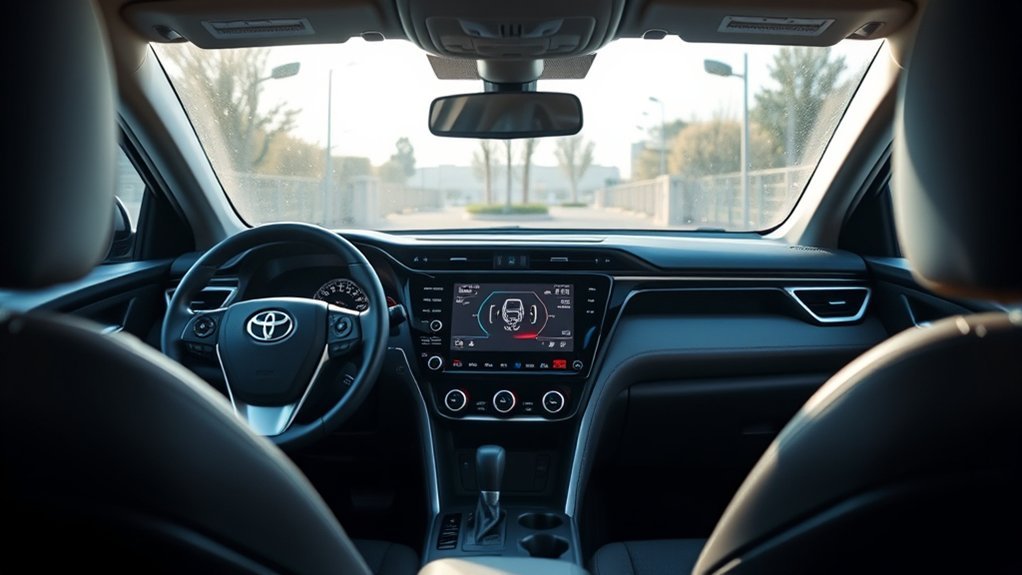
A Toyota RAV4 can contain several sensors that affect braking or produce brake-related warnings. They perform different jobs and should not be treated as one system.
| System or component | What it does | Typical sensor type |
| Pre-Collision System | Detects certain forward collision risks and may warn the driver, increase braking support, or provide automatic emergency braking. | Forward-facing camera and radar |
| Parking Assist with Automatic Braking | Warns of certain nearby objects during low-speed maneuvers and may reduce power or apply the brakes. | Front and rear bumper sonar or parking sensors |
| Anti-lock Brake System and stability control | Measures wheel rotation so the vehicle can manage wheel lock, traction, and stability. | Wheel-speed sensors |
| Brake-system indicators | Monitors conditions such as the parking brake, brake-fluid level, or faults detected by the braking control system. | Switches, fluid-level sensors, and electronic control inputs |
The exact combination depends on the RAV4’s model year, trim, options, and market. For example, Toyota lists Toyota Safety Sense 4.0 on the 2026 U.S. RAV4, while Front and Rear Parking Assist with Automatic Braking is identified as trim-dependent equipment rather than a feature installed on every version.
Note: A parts store or repair shop may also use “brake sensor” to describe an ABS wheel-speed sensor, brake-light switch, fluid-level sensor, or pad-wear indicator. Ask for the diagnostic trouble code or exact component name before authorizing a repair.
How the RAV4 Pre-Collision System Works
The Toyota RAV4’s Pre-Collision System is part of Toyota Safety Sense on many recent models. According to Toyota’s Safety Hub, the system is designed to detect specified road users or vehicles and provide an audio and visual forward-collision warning under certain circumstances.
If the driver begins braking, the system may provide additional brake assistance. If the driver does not react and the system determines that a collision risk is high, it may provide automatic emergency braking. The goal is to help avoid a collision when possible or reduce impact severity when avoidance is not possible.
Automatic emergency braking is a backup aid. It cannot guarantee that the RAV4 will recognize every hazard or stop before every collision.
Detection capabilities vary by Toyota Safety Sense generation. Depending on the model year, the system may be designed to recognize certain vehicles, pedestrians, bicyclists, motorcyclists, or intersection risks. A capability listed for a new RAV4 should not be assumed to exist on an older one.
Where Are the Collision Sensors Located?
The forward-facing camera is normally mounted near the top center of the windshield, close to the rearview mirror. The forward radar unit is commonly positioned behind the Toyota emblem, grille, or another designated area at the front of the vehicle. The exact locations differ by generation.
These areas must remain unobstructed. Dirt, ice, snow, heavy condensation, stickers, accessories, grille coverings, windshield tint placed in a restricted area, or collision damage can interfere with detection.
Pro Tip: If a PCS or radar-unavailable message appears during bad weather, safely clean the windshield camera area and the front emblem or radar area. Do not use sharp tools, boiling water, harsh abrasives, or excessive force.
When Automatic Braking May Not Work as Expected
The Pre-Collision System does not work at all speeds or in every environment. Its operating range and targets depend on the vehicle’s Toyota Safety Sense generation and the conditions described in the owner’s manual.
Performance may be reduced when:
- The windshield camera or front radar area is dirty, iced over, fogged, covered, or damaged.
- Heavy rain, snow, fog, spray, dust, smoke, or direct glare limits sensor visibility.
- The road curves sharply, rises, falls, or has an unusual surface.
- A target suddenly cuts into the lane or is partly hidden by another vehicle or object.
- The vehicle ahead has an unusual shape, carries an overhanging load, or has limited radar reflectivity.
- The RAV4 is towing, being towed, driving off-road, or operating under another condition excluded by the manual.
- Tires, suspension height, alignment, windshield, front emblem, bumper, or sensor mounting positions have been changed or damaged.
Warning: Keep your hands on the steering wheel, watch the road, maintain a safe following distance, and be ready to brake. Never test automatic emergency braking by intentionally driving toward a person, vehicle, wall, or other object.
Lane Departure Alert and Lane Tracing Assist

Lane Departure Alert and Lane Tracing Assist are related but separate functions.
Lane Departure Alert with Steering Assist
When the system detects suitable lane markings or recognized road edges and its operating conditions are met, Lane Departure Alert can warn you if the RAV4 appears to be leaving its lane without an intended turn signal. On vehicles equipped with Steering Assist, it may also provide a small corrective steering input.
This is not an emergency lane-change system. Faded markings, road repairs, shadows, snow, construction zones, merging lanes, sharp curves, and poor visibility can prevent accurate lane detection.
Lane Tracing Assist
Lane Tracing Assist is designed to provide lane-centering support while Dynamic Radar Cruise Control is operating and the system can detect lane markings or, on some versions, a preceding vehicle. The driver must continue steering and supervising the road.
Therefore, it is inaccurate to say that Lane Departure Alert only steers when adaptive cruise control is active. That description mixes the steering-assist function of Lane Departure Alert with the lane-centering role of Lane Tracing Assist.
Dynamic Radar Cruise Control and Automatic Braking
Dynamic Radar Cruise Control uses forward sensing to help maintain a selected following distance from a detected vehicle ahead. When traffic slows, the system can reduce throttle and apply the brakes. Depending on the RAV4 and Toyota Safety Sense generation, a full-speed-range version may also manage lower-speed traffic and stops under specified conditions.
The number of following-distance choices, the minimum set speed, stop-and-resume behavior, and speed-adjustment increments are not identical across all RAV4 model years. Follow the prompts shown in your instrument display and the instructions in the exact owner’s manual.
Dynamic Radar Cruise Control is intended mainly as a convenience feature for appropriate roads. It may not respond correctly to every stopped vehicle, motorcycle, sharply cutting-in vehicle, toll booth, construction barrier, or object beside a curve. The driver remains responsible for speed and following distance.
Road Sign Assist and Automatic High Beams

Road Sign Assist
Road Sign Assist uses the forward-facing camera to recognize certain traffic signs and display information in the driver display. The supported sign types vary by system generation and market.
The feature does not guarantee that every sign will be detected or interpreted correctly. Signs may be obscured, damaged, temporary, unusually positioned, poorly lit, or different from the data the system expects. Always follow the actual signs and road conditions rather than relying only on the display.
Automatic High Beams
The relevant Toyota Safety Sense feature is generally called Automatic High Beams. When operating conditions are met, it detects certain headlights and taillights and switches between high and low beams.
Automatic High Beams should not be confused with an adaptive front-lighting system that changes the beam direction or pattern. Control locations and activation steps vary by model year, so a universal instruction such as pressing a button “near your right knee” is unreliable.
Are RAV4 Parking Sensors the Same as the Pre-Collision System?
No. Parking sensors are separate from the forward camera-and-radar system used for road-speed collision assistance.
Available Front and Rear Parking Assist with Automatic Braking uses sensors around the bumpers to monitor certain nearby objects during low-speed maneuvers. If it detects a possible contact, the system may sound a warning, reduce propulsion power, or apply the brakes under qualifying conditions.
Parking sensors may have difficulty detecting:
- Very low, thin, narrow, soft, or angled objects
- Objects directly below or above the sensor’s detection area
- Open gates, chains, wires, curbs, drop-offs, or holes
- Objects close to the vehicle before the system finishes initializing
- Surfaces covered by snow, mud, water, ice, wax, or accessories
Because parking-assist equipment is trim-dependent, visible circular sensor faces in the front or rear bumper are one clue, but the build sheet, vehicle settings, and owner’s manual provide better confirmation.
How to Check Which Sensors Your RAV4 Has
- Identify the exact model year and trim. Equipment can change even when two RAV4s look similar.
- Review the window sticker or original build sheet. Look for Toyota Safety Sense, Pre-Collision System, Parking Assist, Blind Spot Monitor, or automatic braking terminology.
- Open the vehicle settings. Driver-assistance menus may show PCS, LDA, LTA, parking sonar, or related options.
- Inspect the bumpers. Parking sonar sensors usually appear as small circular inserts, although their presence does not identify every function.
- Use Toyota’s manual portal. Select the correct vehicle at Toyota Manuals and Warranties.
- Ask a Toyota dealer to check the VIN. The VIN can identify factory-installed packages and applicable service information.
What to Do if a PCS or Sensor Warning Appears
A message such as “Pre-Collision System Unavailable,” “Radar Cruise Control Unavailable,” or “Clean Sensor” may indicate a temporary obstruction rather than a failed braking system.
- Continue driving cautiously without relying on the affected assistance feature.
- When safe, park and inspect the windshield camera area and the front radar or emblem area.
- Remove dirt, snow, ice, condensation, or other visible obstruction using safe cleaning methods.
- Restart the vehicle only after it is safely parked, if the manual recommends doing so.
- Arrange an inspection if the warning remains, returns frequently, or appeared after glass, bumper, grille, suspension, alignment, or collision work.
Camera or radar calibration may be necessary after windshield replacement, front-end repair, sensor removal, alignment changes, or damage near a sensor mounting point. Calibration requires the correct equipment and procedures and should not be attempted through visual alignment alone.
Note: A PCS warning usually means the collision-assistance feature is limited or unavailable. A red brake warning, ABS warning, unusual pedal feel, fluid leak, grinding noise, or reduced stopping ability may indicate a separate brake-system problem that needs immediate attention.
When Should You Stop Driving?
Stop in a safe place and seek qualified assistance if:
- The red brake warning remains on after the parking brake is fully released.
- The brake pedal feels unusually soft, sinks toward the floor, or requires much more force.
- Stopping distance has noticeably increased.
- You see a brake-fluid leak or the brake-fluid level is very low.
- Multiple brake, ABS, or stability-control warnings appear with abnormal braking behavior.
- The vehicle has sustained damage near a wheel, brake line, windshield camera, front radar, bumper, or grille.
Can You Adjust or Turn Off the Pre-Collision System?
Some RAV4 model years allow the driver to change the forward-collision warning timing or temporarily disable part of the Pre-Collision System through the instrument-cluster or multimedia settings. Other versions have different menus, restrictions, or automatic reactivation behavior.
There is no universal procedure for every RAV4, and disabling PCS does not switch off every sensor associated with the brakes, ABS, stability control, or parking assistance. Consult the exact manual before changing a safety setting.
Keep the system enabled during normal driving unless the manual identifies a situation in which deactivation is appropriate. If the system repeatedly activates without an apparent hazard, have the sensors, alignment, vehicle modifications, and diagnostic codes inspected rather than leaving the feature disabled.
Check for Recalls and Service Information
Sensor and braking concerns should also be checked against active recalls or service campaigns. Enter the RAV4’s 17-character VIN in the NHTSA recall lookup. NHTSA notes that very recent recalls may not immediately include every affected VIN, so check again if a campaign has just been announced.
You can also contact a Toyota dealer with the VIN to ask about open recalls, calibration requirements, software updates, and model-specific diagnostic procedures.
Frequently Asked Questions
Does every Toyota RAV4 have automatic emergency braking?
No. Availability depends on the model year, market, trim, and installed equipment. Automatic emergency braking is common on recent RAV4s equipped with Toyota Safety Sense, but an older RAV4 may have a different system or no forward automatic braking. Check the vehicle’s manual, build sheet, or VIN-specific equipment information.
Can the RAV4 Pre-Collision System be turned off?
Some model years allow PCS to be temporarily disabled or let you adjust the warning timing through the vehicle settings. The procedure and reactivation behavior vary. Disabling PCS does not turn off the conventional brakes, ABS, or every parking sensor. Follow the instructions for your exact model year.
How does the system distinguish pedestrians from other objects?
The system combines information from its camera, radar, and control software to evaluate characteristics such as shape, position, movement, distance, and relative speed. Detection categories depend on the Toyota Safety Sense generation, and the system may fail to classify a person or object when visibility or positioning is unfavorable.
What happens if a collision sensor malfunctions?
The RAV4 may display a warning and disable PCS, radar cruise control, lane assistance, or another connected feature. Conventional braking may remain available, but you should not rely on the disabled assistance system. A separate brake or ABS warning, unusual pedal feel, or reduced stopping performance requires more urgent inspection.
Are the sensors effective in rain, snow, or fog?
They may continue operating in light weather, but heavy rain, snow, fog, road spray, ice, glare, darkness, or a blocked sensor can reduce performance or make the system temporarily unavailable. Drive according to visibility and road conditions rather than assuming the system will intervene.
Does automatic emergency braking work at all speeds?
No. The applicable speed ranges, target types, and intervention limits vary by model year and system generation. Even within an operating range, the system may not detect a hazard early enough to avoid a crash. Consult the owner’s manual for the exact limitations.
Do the camera or radar need calibration after a windshield replacement?
They may. Windshield replacement can affect the forward camera’s mounting or view, while bumper, grille, emblem, alignment, suspension, or collision repairs can affect radar aim. Ask the repair facility to follow Toyota’s model-specific inspection and calibration procedures.
Conclusion
The Toyota RAV4 can have several sensors connected to braking and driver assistance, but there is no single universal component called the RAV4 “brake sensor.” The Pre-Collision System generally relies on a forward camera and radar, while available parking automation uses separate bumper sensors. ABS wheel-speed sensors and brake-system indicators perform different functions again.
These technologies can provide useful warnings and braking support, but their features and limitations vary by model year and trim. Keep sensor areas clean, investigate persistent warnings, check recalls by VIN, and use the exact Toyota owner’s manual as the final authority. Most importantly, remain prepared to steer and brake without assistance at all times.
Sources
- Toyota Safety Hub — official descriptions of Pre-Collision System, Dynamic Radar Cruise Control, Lane Departure Alert, Lane Tracing Assist, Road Sign Assist, and Automatic High Beams.
- Toyota 2026 RAV4 — current U.S. Toyota Safety Sense generation and trim-dependent parking-assist information.
- Toyota Manuals and Warranties — model-specific owner’s manuals, controls, warnings, and operating limitations.
- National Highway Traffic Safety Administration Recall Lookup — VIN-based safety recall and investigation information.
- Insurance Institute for Highway Safety: Advanced Driver Assistance — independent information about automatic emergency braking and other driver-assistance technologies.
