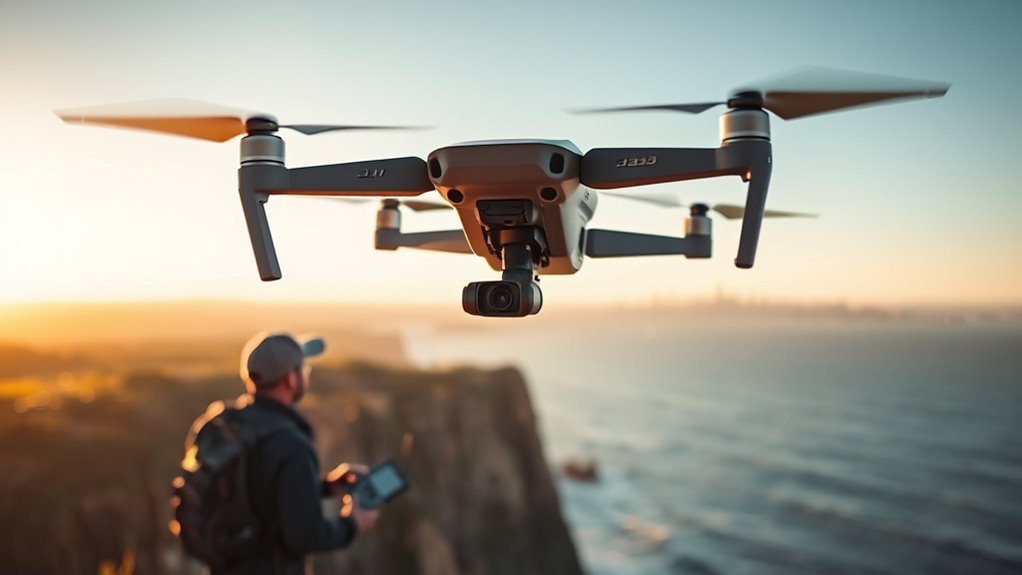
The DJI Air 3S remains a notable option in 2026, combining a dual-camera system, long flight endurance, and strong transmission performance in a compact frame. Its 50 MP main sensor and 48 MP telephoto lens support flexible aerial capture, while the 45-minute rated flight time broadens its practical use. For buyers comparing mid-range drones, its balance of image quality, safety features, and usability raises a key question that deserves closer examination.
DJI Air 3S Specs Overview
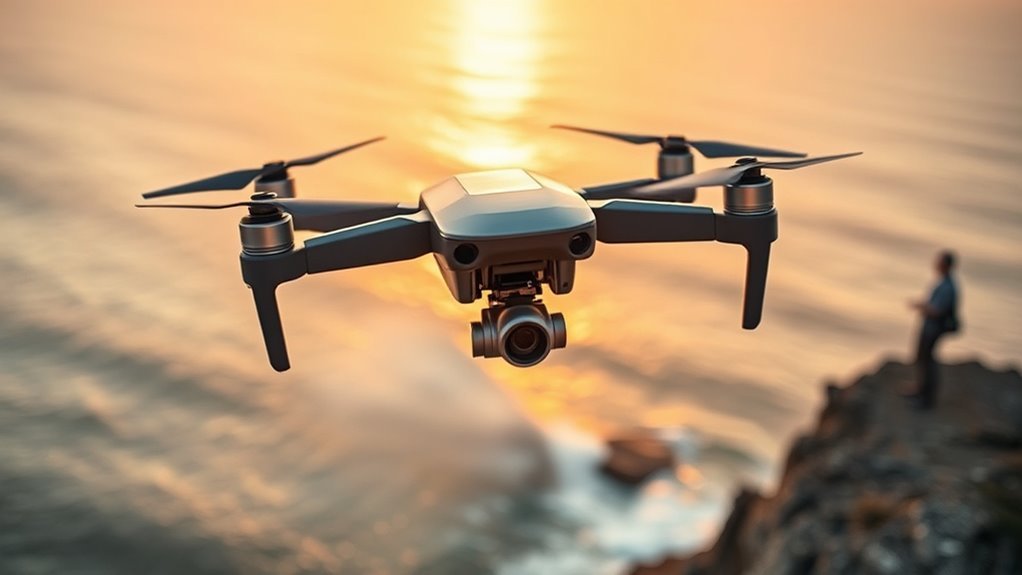
The DJI Air 3S presents a dual-camera configuration centered on a 50 MP primary sensor and a 48 MP medium telephoto camera, with 4K video capture available at up to 120 fps. This dual-camera system gives the aircraft flexibility for wide establishing shots and tighter framing without changing airframes.
The 50 MP primary camera supports detailed stills, while the medium telephoto module extends compositional control. Omnidirectional obstacle sensing adds spatial awareness in constrained environments, and advanced flight modes, including subject tracking, expand autonomous maneuvering options.
The compact design remains foldable for transport, and the 4276 mAh battery capacity supports the stated maximum flight time in a portable form factor. Connectivity is reinforced by a maximum transmission distance of 20 km and a 1080p live feed at 60 fps, allowing the pilot to preserve situational clarity at range.
The DJI Air 3S thus combines imaging, control, and portability in a technically efficient package.
DJI Air 3S Flight Time and Range
With up to 45 minutes of maximum flight time under ideal conditions, the DJI Air 3S offers enough endurance for extended capture sessions.
Typical real-world operation tends to fall in the 30–35 minute range depending on wind, payload, and flight mode. That profile gives operators practical freedom to plan longer missions without constant battery anxiety.
The maximum transmission distance reaches 20 kilometers in perfect conditions, supporting a broad operational range for scouting, mapping, and distant camera positioning.
The aircraft can also climb to a maximum altitude of 6,000 meters, which expands access to elevated terrain and high-angle perspectives.
Recharging is relatively efficient: charging time is approximately 80–90 minutes with the standard charger, reducing downtime between sorties.
For users who value autonomy and mobility, these figures make the DJI Air 3S a capable tool for sustained, independent aerial work.
DJI Air 3S Camera and Video Specs
DJI’s Air 3S pairs a dual-camera setup with a 50 MP primary sensor and a 48 MP medium tele camera, giving the aircraft broad framing flexibility for both general scenes and tighter subject isolation. The DJI Air 3S dual-camera system is built for controlled composition and stable tonal output.
- The 50 MP primary camera uses a 24mm f/1.8 lens, supporting 4K video recording at 60fps and 4K at 120fps for slow motion while improving low-light performance and dynamic range.
- The 48 MP medium tele camera adds 3x optical zoom, enabling cleaner perspective compression and closer framing without sacrificing image consistency with the main camera.
- Both cameras support 10-bit D-Log M color mode, preserving detail and color depth for postproduction flexibility across mixed lighting.
DJI Air 3S Transmission Range Explained
The DJI Air 3S uses the O4 transmission system to deliver a stable 1080p/60fps live feed, with a rated maximum range of up to 20 kilometers under FCC regulations and 10 kilometers in CE/SRRC/MIC regions.
Its dual-band operation across 2.4000-2.4835 GHz and 5.725-5.850 GHz, combined with a 2T4R six-antenna design, supports strong signal integrity and reduced dropouts.
In practice, actual range depends on interference, terrain, antenna orientation, and regulatory power limits, which can greatly affect link quality.
O4 Signal Range
Range performance on the DJI Air 3S is driven by the O4 transmission system, which delivers a 1080p live feed at 60fps and supports a maximum transmission distance of up to 20 kilometers in ideal FCC conditions.
This maximum range is shaped by FCC regulations, the 2.4000-2.4835 GHz and 5.725-5.850 GHz bands, and an antenna configuration built for stability and transmission efficiency.
- Signal stability remains strong, with minimal dropouts during demanding maneuvers.
- The O4 transmission system maintains a clear 1080p live feed even in urban environments.
- Six antennas in a 2T4R layout improve link quality, extending the flying experience with more freedom and confidence.
In practical use, the result is a resilient connection suited to open air and complex terrain.
Band Limits
Operating range on the DJI Air 3S is constrained by regional band limits as much as by antenna design and link stability. The aircraft uses 2.4000-2.4835 GHz and 5.725-5.850 GHz bands, so video transmission can shift between channels to preserve signal strength.
In FCC regions, transmission distance reaches 20 kilometers; in CE, SRRC, and MIC regions, it is capped at 10 kilometers. The O4 transmission system supports a 1080p live video feed at 60 fps, giving pilots precise real-time control. A 6-antenna configuration with 2T4R architecture improves link robustness.
For the strongest result, flight in open areas with minimal interference is preferable, because band access and spectrum congestion directly shape usable range and the DJI Air 3S’s operational freedom.
Real-World Range Factors
Although the DJI Air 3S is rated for up to 20 km of transmission distance in FCC regions and 10 km under CE/SRRC/MIC limits, actual range depends heavily on field conditions rather than the specification alone.
Its O4 transmission system delivers 1080p/60fps video and strong signal strength, yet real-world performance shifts with environmental factors.
- Obstacles such as buildings, trees, and terrain can compress flight range.
- Interference in urban or crowded RF environments may weaken the link despite the six-antenna 2T4R design.
- Weather, altitude, and visual line-of-sight discipline remain decisive for safe control.
For pilots seeking operational freedom, the DJI Air 3S rewards careful monitoring of transmission distance and signal strength, because liberation in the air still depends on disciplined range management.
DJI Air 3S Battery Life and Charging
The DJI Air 3S uses a 4276 mAh battery that delivers up to 45 minutes of flight time under ideal conditions, giving it strong endurance for a drone in its weight class. This battery life supports long sorties while preserving the DJI Air 3S’s lightweight design at 720 grams.
In practical use, the maximum flight time depends on wind, maneuvering, and payload demand. Recharging is straightforward: a 65W charger restores the pack in about 80 minutes, while a 100W adapter reduces charging time to roughly 60 minutes.
A charging hub improves fleet readiness by sequentially replenishing three batteries, reaching full charge in about 6 hours without device charging. The 4276 mAh battery also operates across a temperature range of -10° to 40° Celsius, extending usability in demanding conditions.
DJI Air 3S Safety and Obstacle Sensing
Equipped with an omnidirectional Vision Sensing System, the DJI Air 3S monitors obstacles in all directions to support safer flight and more precise navigation. This omnidirectional obstacle coverage strengthens obstacle avoidance by combining forward sensors with LiDAR technology, giving the aircraft better depth awareness when light is limited.
Advanced Pilot Assistance Systems then refine the flight path in real time, helping the drone redirect around hazards without demanding constant manual correction.
- The Vision Sensing System increases safety by detecting obstacles ahead, behind, above, below, and to the sides.
- Nightscape mode improves low-light operations, supporting clearer returns and more reliable framing after dusk.
- The maximum takeoff altitude of 6,000 meters broadens operational flexibility while remaining within regulated limits.
For operators seeking autonomy with control, these systems reduce exposure to collisions and expand confidence in complex environments.
DJI Air 3S Design, Portability, and Controls
The DJI Air 3S uses a foldable travel design with folded dimensions of 207 × 100.5 × 91.1 mm, supporting compact storage and rapid deployment in the field.
At approximately 720 g, its weight remains low enough to improve handling and transport without sacrificing structural stability.
Control is managed through the DJI RC-N3 remote controller, whose compact layout provides live video and flight-status feedback for users across different skill levels.
Foldable Travel Design
Compact and travel-friendly, the DJI Air 3S uses a foldable frame that measures 214.19 × 100.63 × 89.17 mm when stowed, making it easy to fit in a backpack or carry-on. Its compact foldable design supports portability for travel enthusiasts seeking freedom on the move.
Weighing about 720 g, it stays lightweight without compromising a robust structure for outdoor adventures. The unfolded 266.11 × 325.47 × 106.00 mm form remains manageable, and the layout is easy-to-navigate for efficient operation.
- Quick setup shortens preparation before launch.
- Fast pack-up improves mobility between shooting locations.
- Intuitive controls help maintain consistent handling in varied conditions.
Together, these traits position the DJI Air 3S as a practical tool for mobile aerial work, balancing transport efficiency with durable field readiness.
Compact Control Layout
With its foldable frame and approximately 720 g weight, the DJI Air 3S remains easy to transport while preserving a stable, robust structure for field use.
The DJI Air presents a compact design that supports travel without adding operational complexity. Its DJI RC-N3 controller delivers intuitive control through a clear live feed and flight status display, helping pilots maintain situational awareness.
This layout suits users who want efficient access to advanced features while staying mobile. Omnidirectional obstacle avoidance reinforces safety during autonomous and manual flight, and the airframe is rated for a maximum takeoff altitude of 6000 m, indicating broad environmental capability.
Weight And Handling
At a takeoff weight of 720 g, the DJI Air 3S remains light enough for practical handling while retaining enough mass for stable flight in a range of scenarios. Its lightweight frame supports confident movement without feeling fragile.
The compact dimensions of 207 × 100.5 × 91.1 mm when folded make it portable in a backpack or carry-on. Unfolded, the 258.8 × 326 × 105.8 mm stance improves balance and control.
- Intuitive controls on the DJI RC-N3 simplify navigation.
- Maximum speed of 21 m/s improves responsiveness.
- Handling stays composed across changing flying conditions.
For pilots seeking freedom of movement, the Air 3S combines manageable size, precise control, and agile behavior without sacrificing operational stability.
Is the DJI Air 3S Worth Buying in 2026?
In 2026, the DJI Air 3S remains a strong value proposition for buyers who want near-flagship capabilities without moving into a higher price tier.
The DJI Air 3S combines long flight time, a maximum transmission distance of up to 20 km, and a dual-camera system that records 4K video at 60fps. Its 50 MP main sensor and 48 MP medium tele camera provide flexible framing and reliable detail for aerial imaging.
Omnidirectional obstacle avoidance and ActiveTrack 360° improve safety and reduce pilot workload, which benefits both newcomers and experienced operators seeking greater autonomy.
For users prioritizing performance, the platform offers stable connectivity, efficient power use, and a polished user experience. Its affordability relative to feature set is the central advantage.
Buyers who should buy it are mid-range drone seekers, content creators, and enthusiasts wanting capable hardware without paying flagship premiums.
Frequently Asked Questions
How Far Away Can I Fly My DJI Air 3S?
The DJI Air 3S can fly up to 20 kilometers in FCC regions, or 10 kilometers in CE/SRRC/MIC areas, under ideal conditions.
Actual distance depends on drone regulations, battery life, flight modes, remote control performance, obstacle avoidance, signal interference, user experience, software updates, accessories compatibility, and return home behavior.
In open environments, its O4 link stays stable; obstacles and weather reduce range, so freedom requires cautious, informed operation.
Which DJI Drone to Buy in 2026?
The answer hinges on needs: the Air 3S suits most buyers, while the Mavic 3 Pro serves demanding professional uses.
Like a compass for the unwired, drone comparisons favor analyzing best features, user reviews, price analysis, software updates, battery advancements, portability options, beginner tips, and future trends.
Its dual-camera system, long flight time, and safety tools make it a liberated, technically balanced choice for 2026 aerial work and travel.
What Is the Camera Quality Like on the DJI Air 3S?
The DJI Air 3S camera quality is strong, with dual-camera features that deliver sharp detail, reliable low light performance, and effective image stabilization.
Its video resolution reaches 4K/60fps, while lens quality supports a 24mm wide view and 3x optical zoom.
Shooting modes, photo formats, and editing tools improve flexibility, and drone sensors help maintain consistency.
User reviews generally praise its balanced color, clarity, and versatility.
Which DJI Has the Best Flight Time?
The DJI Mavic 4 Pro has the best flight time, a near-mythic 51 minutes.
In competitive analysis, its long range capabilities reflect flight endurance advancements, battery optimization techniques, and technological innovations.
Drone weight factors, environmental impact, user experiences, charging solutions, and maintenance tips also shape real-world results.
The Air 3S follows closely at 45 minutes, while the Mini 3 and Mavic 3 Pro trail behind, despite impressive efficiency and liberation from frequent landings.
Conclusion
In 2026, the DJI Air 3S stands as a balanced instrument of aerial imaging, pairing a 50 MP primary camera and 48 MP telephoto lens with endurance and range that remain highly competitive. Its 45-minute flight time and 20 km transmission radius give it a wide operational canvas, while obstacle sensing adds a protective net. For creators and enthusiasts seeking capability without excess bulk, it remains a sharp, well-tuned tool rather than a blunt flagship hammer.