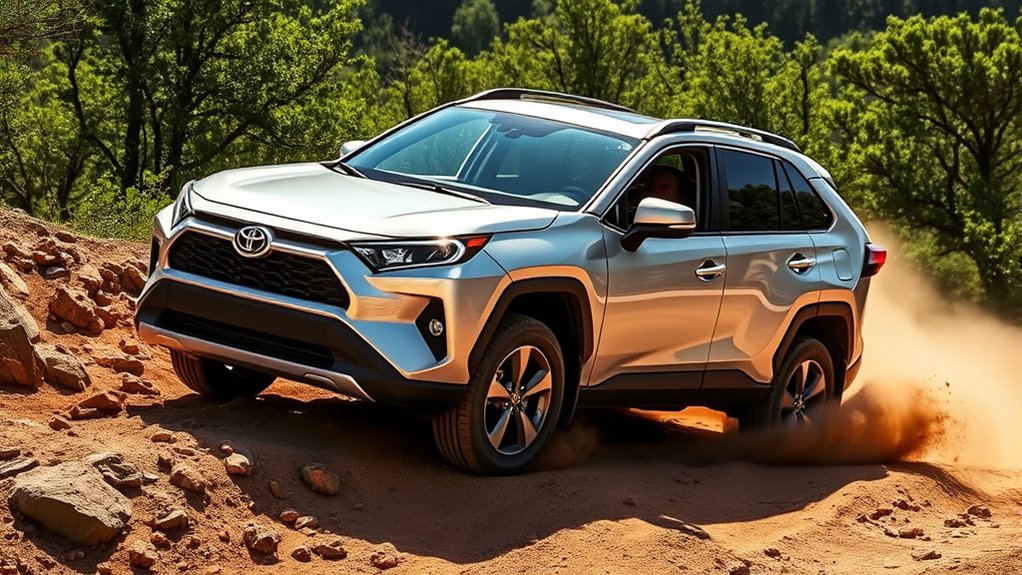
Toyota RAV4 4-Cylinder Uphill Performance: Quick Answer
Yes—the 2024–2025 gas-powered Toyota RAV4 can handle ordinary paved hills, freeway grades, and steep city streets. Its 203-hp 2.5-liter four-cylinder makes peak torque at 5,000 rpm, so a downshift and noticeably higher engine speed are normal when the grade, load, or elevation increases. Sport mode can sharpen response, while S sequential mode can hold a lower shift range for steadier climbing or engine braking downhill.
Last updated: September 19, 2026.
Quick Answer
The 203-hp gas RAV4 can maintain normal road speeds on most hills, but steep grades may require a downshift and noticeably higher engine rpm. Sport mode improves response, while S sequential mode gives you more control over gearing. Cargo, altitude, towing, tire grip, and grade steepness all affect the result.
Key Takeaways
- The 2024–2025 gas RAV4 uses a 203-hp 2.5-liter engine and eight-speed automatic, with peak torque arriving at 5,000 rpm.
- Higher rpm and a firm downshift on a steep hill are usually normal; slipping, shuddering, overheating, or sudden power loss are not.
- Sport mode sharpens response but does not add horsepower. S sequential mode can hold a lower gear for climbing or descending.
- AWD improves traction on wet, snowy, or loose surfaces, but it does not increase the engine’s rated output.
- Payload and towing limits vary by year and grade. Always use the labels and manual for your exact vehicle.
What Is Normal vs. a Sign of a Problem Uphill?
| Usually Normal on a Steep Grade | Needs Closer Attention |
|---|---|
| Engine rpm rises after a downshift and acceleration increases with it. | Engine rpm suddenly flares without a matching increase in road speed. |
| The transmission stays in a lower gear while the grade or load remains high. | Repeated harsh banging, shuddering, persistent hunting on a mild grade, or a warning light appears. |
| Fuel economy drops temporarily during a long climb. | There is sudden power loss, a temperature warning, or a new decline from the vehicle’s usual performance. |
Model-year note: This article applies primarily to fifth-generation gas-powered RAV4 models sold through the 2025 model year. The redesigned 2026 Toyota RAV4 uses hybrid or plug-in hybrid powertrains, so its output, transmission behavior, towing ratings, and AWD operation differ.
| Model Year | Gas-Only RAV4? | Hill-Performance Context |
|---|---|---|
| 2024 | Yes | 203 hp, 184 lb-ft at 5,000 rpm, eight-speed automatic; Adventure and TRD Off-Road were available with higher 3,500-lb tow ratings. |
| 2025 | Yes | 203-hp 2.5-liter gas engine and eight-speed automatic continued, but gas Adventure and TRD Off-Road grades were discontinued for 2025. |
| 2026 | No | U.S. models use hybrid or plug-in hybrid powertrains, so this gas-engine hill guide should not be applied directly to them. |
Is the Gas RAV4 4-Cylinder Powerful Enough for Hills?
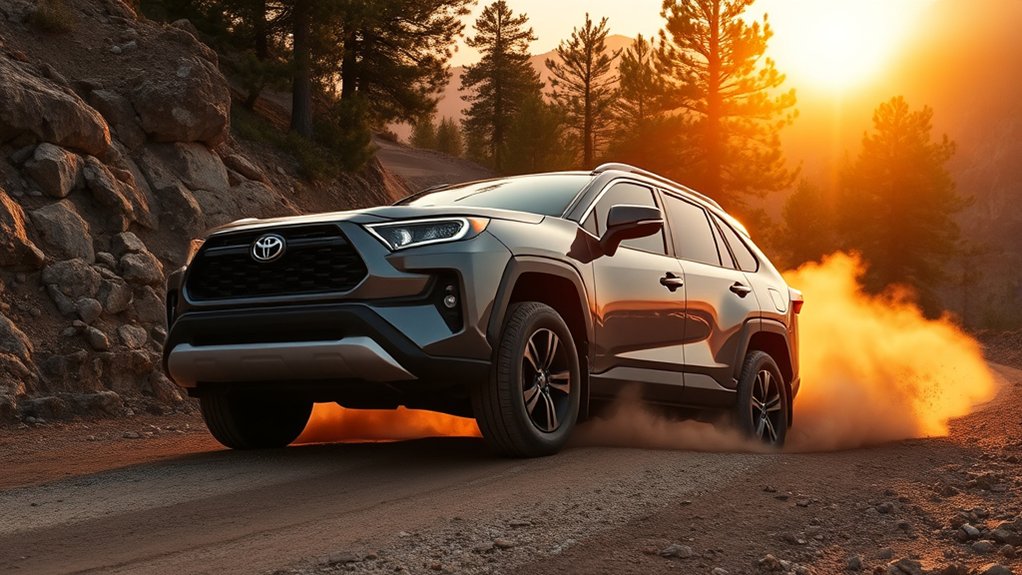
The 2025 gas-powered Toyota RAV4 uses a naturally aspirated 2.5-liter Dynamic Force four-cylinder engine paired with an eight-speed automatic transmission. Toyota rates it at 203 horsepower. The official 2024 specifications list 184 lb-ft of torque at 5,000 rpm and 203 horsepower at 6,600 rpm.
| Specification | 2024–2025 Gas RAV4 | What It Means Uphill |
|---|---|---|
| Engine | 2.5-liter naturally aspirated four-cylinder | Power can decrease at higher elevation because the engine has no turbocharger to compensate fully for thinner air. |
| Horsepower | 203 hp at 6,600 rpm | The engine may need to rev noticeably to deliver its strongest acceleration. |
| Torque | 184 lb-ft at 5,000 rpm | A downshift is often necessary before maximum pulling force is available. |
| Transmission | Eight-speed automatic | Multiple ratios help the engine stay in an effective rpm range, but shifts may feel busy on changing grades. |
What Independent Road Tests Add
Independent testing gives useful context beyond the factory specifications. Car and Driver recorded an 8.3-second 0–60 mph run in a 2024 RAV4 TRD Off-Road and described the gas four-cylinder as noisy under hard acceleration, while noting a hesitant downshift in its test vehicle. CARFAX also reported that its 2024 test vehicle felt more strained climbing a steep interstate hill with additional passengers. These are individual road-test observations, not universal results, but they support the same practical expectation: the gas RAV4 can climb hills, yet heavy loads and steep grades reduce acceleration and make the powertrain more noticeable.
For everyday driving, this is adequate rather than effortless performance. A lightly loaded RAV4 should climb normal highway and urban grades without difficulty. A very steep grade, short passing lane, full passenger load, roof box, or trailer can make acceleration slower and increase the amount of engine noise.
High engine rpm on a steep grade does not automatically indicate a problem. The gas RAV4 produces its peak torque at 5,000 rpm and peak horsepower at 6,600 rpm, so the transmission may downshift to reach the engine’s stronger operating range.
Why Does the RAV4 Rev So High on Steep Hills?
Torque helps accelerate the vehicle and overcome the pull of gravity, but the engine’s advertised peak number does not tell the whole story. The transmission multiplies engine torque through its lower gears. When the RAV4 downshifts, engine speed rises and more force reaches the wheels.
The gas engine’s peak torque occurs at 5,000 rpm, not at very low rpm. That means a quiet, low-rpm climb is not always realistic on a steep hill. Allowing the transmission to downshift is generally better than pressing the accelerator heavily while the engine remains in too high a gear.
Road speed also matters. Climbing from a stop on a steep street requires more immediate acceleration than approaching a long hill with safe momentum. On public roads, maintain a legal, controlled speed and leave enough following distance rather than charging the grade.
Why Does the RAV4 Shift Repeatedly on Hills?
“Gear hunting” describes repeated upshifts and downshifts when the transmission cannot settle on one ratio. On rolling terrain, a changing grade or a cruise-control system trying to hold an exact speed can make the eight-speed automatic feel busy.
An occasional downshift under load is normal. Constant back-and-forth shifting on a mild grade, a sudden increase in engine speed without matching acceleration, harsh banging, shuddering, or a warning light deserves closer attention.
What a Downshift Feels Like
A downshift can create a brief pause before stronger acceleration arrives. The engine then becomes louder as rpm rises. With more passengers or cargo, the transmission may need to remain in a lower gear for longer.
This behavior can feel less smooth than the steady pull of a turbocharged or hybrid powertrain, but it does not necessarily mean the RAV4 lacks the ability to climb the hill. Judge performance by whether it maintains a safe speed and responds consistently—not by engine sound alone.
When Cruise Control Makes Shifting Busier
When cruise control is active, the vehicle may add throttle and downshift aggressively to recover even a small loss of speed. If that produces repeated shifts, disengage cruise control and manage the accelerator smoothly yourself.
A sustained lower gear is often preferable to repeated shifting. Toyota’s 2024 RAV4 Quick Reference Guide states that downshifting in S sequential mode can increase power going uphill and provide engine braking downhill.
Which Driving Strategy Helps Most?
| Strategy | When It Helps | Limitation |
|---|---|---|
| Sport mode | When quicker accelerator response is useful on a winding or steep road | Does not add horsepower or raise towing limits |
| S sequential mode | When you want to hold a lower gear uphill or use engine braking downhill | Higher rpm and fuel consumption are normal |
| Cruise control off | When cruise control causes abrupt throttle changes or repeated shifts | The driver must control speed and spacing carefully |
| Smooth throttle | When traction, passenger comfort, and consistent shifting matter | Acceleration may be slower than with full throttle |
Pro Tip: If the transmission keeps moving between two gears, ease the accelerator slightly or select an appropriate lower range in S mode. A stable gear and steady throttle often feel smoother than repeatedly demanding the exact cruise-control set speed.
How Does the RAV4 Handle Steep City Streets?
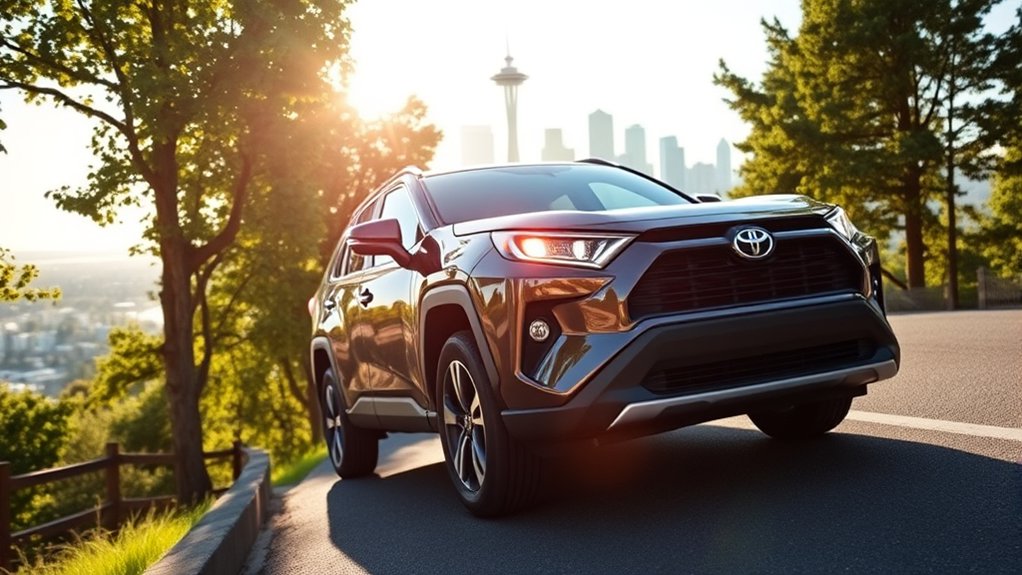
On steep urban streets, the RAV4 must often accelerate from a stop rather than approach the hill with momentum. You may notice a firmer downshift, more engine sound, and slower acceleration when the cabin is full.
Wet pavement changes the situation. Traction and tire condition may matter more than maximum horsepower. An AWD RAV4 can send power to the rear axle when conditions require it, but suitable tires, adequate tread depth, and smooth accelerator input remain essential.
At higher elevations, a naturally aspirated gasoline engine can feel less responsive because lower air density reduces the oxygen available for combustion. The exact change varies with elevation, temperature, fuel, load, and engine management. A RAV4 that feels adequate at lower elevation may require more throttle and more frequent downshifts on a mountain route.
A local test drive remains useful, but make it representative: include the steepest roads you regularly use and, where practical, the number of passengers or amount of cargo you normally carry.
Does Sport Mode Help the RAV4 Climb Hills?
Toyota describes Sport mode as providing increased acceleration response and more precise handling, including for mountain-road driving. It changes how readily the vehicle responds to accelerator and steering inputs, but it does not increase the engine’s rated 203 horsepower.
How Sport Mode Changes Throttle Response
In Sport mode, a given accelerator movement can produce a more immediate response. This may reduce the sensation of hesitation before the vehicle begins climbing or accelerates out of a bend.
Sport mode can be useful when merging onto an uphill freeway, joining faster traffic, or driving a winding grade. Because Sport mode can encourage higher engine speed and quicker accelerator inputs, fuel use may increase depending on how you drive.
Sport Mode vs. S Sequential Mode
Sport mode may make the RAV4 feel more alert, but it cannot overcome an overloaded vehicle, insufficient tire traction, excessive trailer weight, or a mechanical fault. It also does not guarantee that the transmission will remain in one gear.
S sequential mode serves a different purpose. It lets the driver select a lower shift range for climbing or descending. Use the controls only as described in the owner’s manual, and avoid forcing an inappropriate gear at an excessive speed.
Note: Sport mode changes response, not the engine’s hardware output. It does not increase payload, axle, tire, or towing ratings.
How Does Uphill Driving Affect RAV4 Fuel Economy?
Climbing requires the engine to move the vehicle forward while also raising its mass against gravity. The transmission usually selects a lower gear, engine speed rises, and instantaneous fuel economy drops.
The size of the drop depends on the grade, speed, traffic, temperature, elevation, acceleration, and vehicle weight. A descent does not fully repay the fuel used on the climb because aerodynamic drag, tire resistance, braking, and powertrain losses still consume energy.
According to FuelEconomy.gov, aggressive acceleration can substantially reduce fuel economy. The same official resource estimates that an extra 100 pounds may reduce MPG by about 1% in a typical vehicle, although the effect varies with vehicle weight.
- Use smooth acceleration: Build speed progressively rather than alternating between heavy throttle and braking.
- Remove unnecessary weight: Extra cargo affects both acceleration and fuel use.
- Remove an unused roof box: Roof-mounted cargo adds aerodynamic drag, especially at highway speed.
- Maintain correct tire pressure: Use the cold pressure listed on the driver-door label rather than the maximum printed on the tire sidewall.
- Expect lower MPG on mountain trips: A short-term drop does not by itself indicate a fault.
How Do Passengers and Cargo Change Uphill Performance?
Passengers and cargo increase the mass the engine must move uphill. The RAV4 may accelerate more slowly, stay in a lower gear longer, and use more fuel. Braking distance can also increase.
Do not rely on a single generic payload number. As one model-year example, Toyota’s 2024 RAV4 brochure lists payload ratings from 1,025 to 1,230 pounds across gas grades. Equipment, drivetrain, accessories, and model year affect the figure.
The authoritative limit for your vehicle appears on its Tire and Loading Information label, usually on the driver-side door opening. The combined weight of occupants, cargo, accessories added after manufacture, and trailer tongue weight must remain within the vehicle’s limits.
Warning: Never exceed the payload, Gross Vehicle Weight Rating, Gross Axle Weight Ratings, tire limits, or towing limit shown for your exact RAV4. Available cargo space does not mean the vehicle can safely carry that space completely full of heavy items.
What Changes Between Flat Roads and Steep Grades?
On a flat road, the RAV4 can remain in a high gear and use relatively little throttle. On an incline, gravity increases the required power, so the transmission downshifts and the engine operates at higher rpm.
| Condition | Likely RAV4 Behavior | Best Response |
|---|---|---|
| Gentle highway grade | One downshift or modest rpm increase | Maintain steady throttle and spacing |
| Steep climb from a stop | Higher rpm and slower initial acceleration | Use smooth throttle; allow Hill Start Assist to help prevent rollback |
| Long mountain ascent | Sustained lower gear and reduced MPG | Avoid unnecessary speed changes and monitor warning indicators |
| Steep descent | Vehicle gains speed readily | Select an appropriate lower range and use controlled braking |
Does AWD Help the RAV4 Climb Hills?
AWD can improve the RAV4’s ability to begin moving or continue climbing when the available traction is limited. It is most useful on wet, snowy, muddy, sandy, or uneven surfaces. On dry pavement with adequate traction, AWD does not add horsepower and may not make the vehicle accelerate uphill noticeably faster.
The exact system varies by model year and grade. Fifth-generation gas models used either Dynamic Torque Control AWD or available Dynamic Torque Vectoring AWD, depending on configuration. Hybrid models use an electronic on-demand AWD system with a rear electric motor.
How AWD Helps When Grip Is Limited
When the front tires begin to approach their grip limit, AWD can direct some drive force rearward. This can reduce front-wheel slip and help the vehicle start more smoothly on a slippery incline.
Multi-Terrain Select is available on certain gas AWD configurations and adjusts drive-force, brake, and related controls for conditions such as mud, sand, rock, dirt, or snow. It is not an engine-power upgrade and should be used only for the conditions described in the manual.
How Torque Vectoring Changes Traction
Torque Vectoring AWD, where equipped, can vary rear-wheel torque distribution to improve traction and handling. Other AWD grades use a different system, so owners should not assume that every AWD badge represents identical hardware.
| Feature | Primary Benefit | What It Does Not Do |
|---|---|---|
| AWD | Improves available drive traction | Does not increase rated engine horsepower |
| Torque Vectoring AWD | Adjusts torque distribution for grip and handling | Is not fitted to every AWD RAV4 |
| Multi-Terrain Select | Adapts controls for specific loose or slippery surfaces | Does not raise payload or towing capacity |
| Hill Start Assist | Helps limit rollback while moving from the brake to the accelerator | Does not hold the vehicle indefinitely or replace attentive braking |
Can a Gas RAV4 Tow Uphill Safely?
Uphill towing places more demand on the engine, transmission, cooling system, brakes, and tires. Capacity varies substantially by year and grade.
For example, Toyota’s 2024 U.S. brochure lists a 1,500-pound towing capacity for the gas LE, XLE, XLE Premium, and Limited, while the Adventure and TRD Off-Road are listed at 3,500 pounds. That difference reflects more than engine output; cooling equipment, drivetrain configuration, and vehicle hardware also matter.
Do not carry the 2024 Adventure/TRD rating forward to the 2025 gas lineup. Toyota discontinued those two gas grades for 2025, leaving LE, XLE, XLE Premium, and Limited as the gas-powered choices.
Use the limit for your exact model year, grade, drivetrain, and equipment. Include the trailer’s loaded weight—not its empty advertised weight—and remember that tongue weight counts against the RAV4’s available payload.
- Load the trailer so it remains stable and within all hitch and axle limits.
- Allow additional distance for accelerating, passing, and braking.
- Use a lower speed on long grades rather than repeatedly forcing full-throttle acceleration.
- Watch for warning lights, unusual odors, abnormal shift behavior, or rising coolant temperature.
- Use an appropriate lower shift range for downhill engine braking instead of riding the brake pedal continuously.
Warning: If a temperature warning appears, the transmission begins slipping, the engine loses power suddenly, or you smell overheated brakes, move to a safe location and follow the owner’s manual. Continuing a heavily loaded climb or descent can cause damage or loss of control.
When Poor Uphill Performance May Indicate a Problem
A RAV4 that has always needed higher rpm on steep hills may be operating normally. A sudden decline from its usual performance deserves inspection.
- Check Engine light: A misfire, sensor fault, fuel-system issue, or emissions fault can reduce power.
- Engine speed rises without matching acceleration: This may indicate transmission slip rather than a normal downshift.
- Shuddering or hesitation: Possible causes include ignition, fuel, airflow, or transmission problems.
- Temperature warning: Stop safely and follow the manual’s overheating procedure.
- Low tire pressure: Increases rolling resistance and can reduce stability under load.
- Blocked airflow or overdue maintenance: A heavily restricted air filter or other neglected service item can contribute to poor operation.
- Excess load: Compare the actual passenger, cargo, accessory, and tongue weight with the door-label limit.
Do not assume that a generic “performance chip” will solve poor uphill acceleration. There is no universal, verified 20% power gain for the RAV4, and engine-control modifications may affect emissions compliance, fuel requirements, reliability, drivability, or warranty coverage. Diagnose the underlying condition first.
Tips for Maximizing Your RAV4’s Uphill Performance
- Use Sport mode when quicker response helps. It can make accelerator response feel more immediate, particularly on winding grades.
- Select S sequential mode when necessary. Holding an appropriate lower range can provide steadier climbing power and useful engine braking on descents.
- Turn off cruise control if it causes repeated shifts. Manage speed smoothly rather than forcing the vehicle to recover every small speed change.
- Reduce unnecessary weight. Remove cargo and roof-mounted equipment that you do not need.
- Check tire pressure and condition. Use the vehicle placard’s cold-pressure specification and inspect tread before mountain or winter travel.
- Leave more space. A loaded vehicle needs more room to accelerate, merge, and stop.
- Plan passes conservatively. Uphill passing requires more distance than passing on level ground.
- Monitor the vehicle when towing. Watch temperature, warning messages, shifting, and brake performance.
- Test the route realistically. A short solo drive may not represent performance with a family, luggage, or trailer.
Pro Tip: On a long descent, select an appropriate lower shift range before speed builds. Engine braking reduces continuous brake use, but you must still control speed and follow the limits in your owner’s manual.
Related Guides
Frequently Asked Questions
How does the gas RAV4 perform on steep inclines?
It can climb most paved grades at normal road speeds, but expect a downshift, higher engine rpm, and slower acceleration on very steep hills. Performance decreases as passenger, cargo, trailer, temperature, or elevation demands increase.
Does Sport mode add horsepower to the RAV4?
No. Sport mode changes accelerator response and handling calibration, but the gas engine remains rated at 203 horsepower. It can make the vehicle feel more responsive without increasing its mechanical output or weight limits.
Is the 2.5-liter engine suitable for towing uphill?
Only when the loaded trailer and vehicle remain within the limits for the exact model year and grade. As a 2024 example, most gas grades are rated for 1,500 pounds, while Adventure and TRD Off-Road are rated for 3,500 pounds. Uphill towing also reduces acceleration and increases heat and braking demand.
What is the maximum weight a RAV4 can carry uphill?
Use the Tire and Loading Information label on your vehicle. Toyota’s 2024 brochure lists gas-model payload examples from 1,025 to 1,230 pounds, but the exact limit depends on grade, drivetrain, equipment, accessories, and model year. Occupants, cargo, and trailer tongue weight all count.
Does AWD make the RAV4 faster uphill?
AWD can improve acceleration when the tires would otherwise slip, such as on wet, snowy, muddy, or loose surfaces. On dry pavement with enough grip, it does not increase the engine’s rated horsepower and may not make the RAV4 climb noticeably faster.
How does uphill driving affect tire wear?
A hill alone does not automatically cause abnormal wear. Heavy acceleration, hard cornering, extra load, incorrect pressure, poor alignment, and repeated hard braking can increase heat and tread wear. Maintain the recommended pressure and rotate and inspect the tires at the specified intervals.
Are aftermarket upgrades necessary for better uphill performance?
Usually not. Proper maintenance, correct tires, reduced unnecessary weight, suitable drive-mode use, and realistic towing and passing expectations provide safer improvements. Investigate any sudden loss of power before considering an engine-control or exhaust modification.
Why does my gas RAV4 rev so high going uphill?
The gas RAV4 makes its peak torque at 5,000 rpm and peak horsepower at 6,600 rpm, so the eight-speed automatic may downshift and raise engine speed when a steep grade needs more power. Higher rpm that arrives with a normal downshift and matching acceleration is usually expected; rpm that flares without matching road-speed gain can indicate a problem.
Should I use Sport mode or S mode on a steep hill?
Use Sport mode when you want quicker accelerator response. Use S sequential mode when you want to hold an appropriate lower shift range for steadier climbing or stronger engine braking on a descent. Neither mode adds horsepower or raises the vehicle’s payload or towing limits.
Conclusion
The gas-powered Toyota RAV4 is capable of handling ordinary steep streets, highway grades, and mountain roads, but its four-cylinder engine often needs a lower gear and higher rpm to do the job. Sport mode can improve response, while S sequential mode can provide steadier climbing power and downhill engine braking.
Set expectations according to the grade, elevation, weather, tire grip, passengers, cargo, and trailer weight. AWD can improve traction but does not add horsepower. Most importantly, follow the payload and towing limits for your exact model and investigate any sudden change in performance rather than masking it with an unsupported aftermarket modification.
Sources
- Toyota: 2025 RAV4 product release — gas-engine output, transmission, drivetrain choices, and model lineup.
- Toyota: 2024 RAV4 brochure — horsepower and torque rpm, payload, towing limits, AWD equipment, and drive modes.
- Toyota: 2024 RAV4 Quick Reference Guide — Sport mode, S sequential mode, Hill Start Assist, Snow mode, and Multi-Terrain Select operation.
- Toyota: 2026 RAV4 product information — sixth-generation hybrid and plug-in hybrid model-year scope.
- FuelEconomy.gov: Driving More Efficiently — effects of driving behavior, excess weight, speed, and external cargo on fuel use.
- SAE International: Vehicle net power at high altitude — technical context for altitude-related gasoline-engine performance.
- Car and Driver: 2024 Toyota RAV4 review — independent acceleration and powertrain behavior context.
- CARFAX: 2024 Toyota RAV4 road test — independent observation of hill performance with additional passengers.

