
The Toyota RAV4 can be a capable winter crossover, especially when it has all-wheel drive and tires suited to snow and ice. The important part is understanding what AWD can and cannot do. AWD can help you accelerate and maintain traction, but your tires, speed, braking technique, visibility, and road conditions still determine how safely the vehicle stops and turns.
Quick Answer
Yes, the Toyota RAV4 is generally well suited to snow when properly equipped. AWD models add useful traction, gas AWD models include a Snow setting through Multi-Terrain Select, and the RAV4 offers up to 8.6 inches of ground clearance. For frequent snow and ice, appropriate winter tires make a bigger difference to braking and cornering than AWD alone.
Key Takeaways
- AWD improves traction when accelerating, but it does not eliminate the longer braking distances found on snow and ice.
- The 2025 gas RAV4 offers AWD with Multi-Terrain Select and Snow Mode; the 2025 RAV4 Hybrid uses standard Electronic On-Demand AWD and Trail Mode instead.
- The Michelin CrossClimate2 is a 3PMSF-rated all-season tire, not a dedicated winter tire.
- For regular driving on packed snow, ice, or very cold roads, four dedicated winter tires provide the strongest winter-focused setup.
- The 2025 Adventure and TRD Off-Road grades were discontinued, so 2025 shoppers should compare LE, XLE, XLE Premium, Limited, and the available Hybrid grades instead.
Model-year note: The information below focuses on the U.S.-market 2025 RAV4 where model-specific details are discussed. Toyota introduced a redesigned sixth-generation RAV4 for 2026, so trim names, powertrains, drive modes, safety technology, and equipment can differ on newer models.
How All-Wheel Drive Enhances Snow Performance in the RAV4
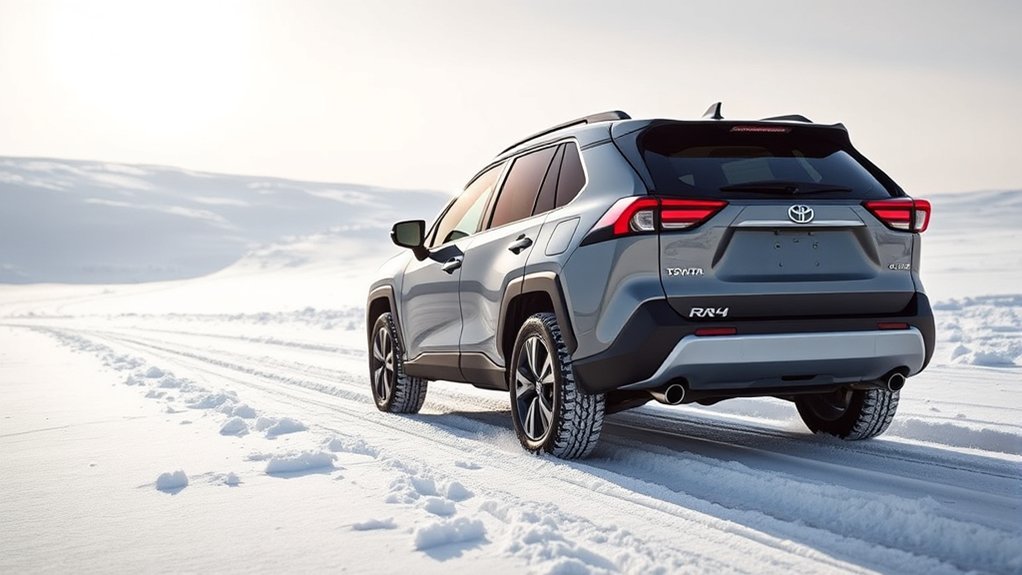
AWD is most useful when you are trying to get moving on a slippery road, climbing a snowy grade, or maintaining traction when conditions vary from one wheel to another.
On the 2025 gas RAV4, AWD is available across the LE, XLE, XLE Premium, and Limited grades. Toyota also offers Dynamic Torque Vectoring AWD on the AWD Limited, which can distribute torque between the rear wheels when needed. You can review Toyota’s official 2025 model information at Toyota USA Newsroom.
All 2025 RAV4 Hybrid grades use Electronic On-Demand AWD as standard equipment. Instead of a conventional driveshaft powering the rear axle, a separate electric motor provides rear-wheel drive when the system determines that extra traction is useful.
Ground clearance also helps. The 2025 RAV4 offers up to 8.6 inches of ground clearance, giving it more ability to travel over accumulated snow than a low-slung passenger car.
Warning: AWD helps the RAV4 accelerate, but all four tires still have limited grip when braking or turning. Do not use AWD as a reason to drive faster on snow or ice.
What AWD Cannot Do
AWD cannot create traction where the tires have very little grip. It also cannot prevent hydroplaning, guarantee short stopping distances, or make deep unplowed snow harmless.
If snow approaches the vehicle’s underbody clearance, the RAV4 can begin pushing snow underneath itself and may become high-centered. For that reason, “good in snow” should not be interpreted as unlimited deep-snow capability.
FWD vs AWD for Snow
A front-wheel-drive RAV4 with excellent winter tires can perform well on plowed winter roads. AWD becomes more valuable if you regularly face steep hills, poorly plowed roads, snowy driveways, or changing traction conditions.
If your winters are mild and roads are cleared quickly, FWD may be sufficient. If snow is frequent or you routinely travel before roads are fully cleared, AWD provides an extra traction advantage.
Choosing the Right Tires for Winter Driving
Tires are one of the most important parts of your RAV4’s winter performance because the tires provide the actual contact with the road.
Ordinary all-season tires are designed for broad year-round use. Some can handle light snow adequately, but the National Highway Traffic Safety Administration notes that winter tires are more effective than all-season tires in deep snow.
All-Season, 3PMSF, and Winter Tires
- Standard all-season tires: Convenient for year-round use and suitable for many mild climates, but their snow and ice capability varies considerably.
- 3PMSF-rated all-season tires: Tires carrying the Three-Peak Mountain Snowflake marking meet a defined snow-traction performance requirement and can be a useful compromise for drivers who want one tire year-round.
- Dedicated winter tires: Designed specifically for cold, snow, slush, and winter conditions. They are generally the strongest choice when severe winter weather is common.
The Michelin CrossClimate2 is a good example of a 3PMSF-rated all-season tire. It should not be described as a dedicated winter tire.
For serious winter driving, choose tires based on the conditions you actually face rather than assuming AWD can compensate for limited tire grip.
Whatever tire you choose, install a matched set of four tires with the correct size, load rating, and inflation pressure specified for your RAV4.
Pro Tip: Check tire pressure when the tires are cold. Outside temperature drops can reduce inflation pressure, so inspect the tires at least monthly during winter and use the pressure shown on the driver’s door placard rather than the maximum pressure molded into the tire sidewall.
Understanding Snow Mode: Gas RAV4 vs Hybrid
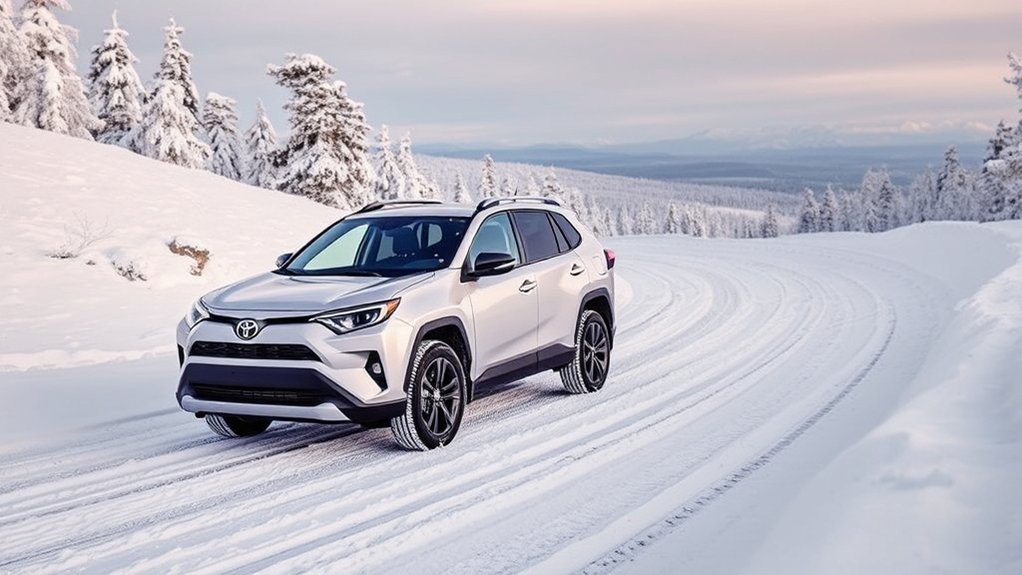
Snow Mode is useful, but it is important to know which RAV4 actually has it.
On the 2025 gas-powered RAV4 with AWD, Toyota’s Multi-Terrain Select system includes NORMAL, MUD & SAND, ROCK & DIRT, and SNOW settings. Toyota describes Snow Mode as a setting intended for slippery road surfaces such as snow. You can see the current vehicle specifications on Toyota’s 2025 RAV4 page.
Snow Mode works with the vehicle’s AWD and traction-management systems to make the vehicle easier to control on slippery surfaces. It does not turn the RAV4 into a specialized off-road snow vehicle, and it cannot overcome the grip limits of the tires.
What About the RAV4 Hybrid?
The 2025 RAV4 Hybrid does not use the same Snow Mode. Hybrid models have standard Electronic On-Demand AWD and include Trail Mode. Toyota explains that Trail Mode coordinates AWD, braking, and drive-force control to reduce excessive wheelspin on rough or low-traction surfaces.
Toyota’s official 2025 RAV4 Hybrid Owner’s Manual also warns that Trail Mode does not expand the physical limits of the vehicle.
Which 2025 RAV4 Trims Are Best for Snowy Conditions?
For the 2025 model year, the gas-powered RAV4 is offered in LE, XLE, XLE Premium, and Limited grades. Toyota did not offer the gas Adventure or TRD Off-Road grades for 2025.
AWD Trim Recommendations
If winter traction is your priority, focus first on drivetrain and tires rather than trim badges.
- LE AWD: A practical choice if you mainly want AWD capability without paying for many comfort upgrades.
- XLE AWD: A useful middle ground with more convenience equipment while retaining available AWD.
- XLE Premium AWD: Adds more comfort and appearance features while keeping the same basic winter-driving advantages of AWD and Multi-Terrain Select.
- Limited AWD: The most feature-rich gas choice and the 2025 gas grade available with Dynamic Torque Vectoring AWD.
- RAV4 Hybrid: A strong option if you want standard Electronic On-Demand AWD along with better fuel economy than the gas AWD models.
- Hybrid Woodland Edition: Worth considering if you want a more outdoor-oriented Hybrid setup, including all-terrain-oriented factory equipment.
Winter Features Comparison
Heated seats, a heated steering wheel, rain-sensing wipers, and a windshield wiper de-icer are available on selected grades and option packages. They improve comfort and visibility but do not increase tire grip.
For winter capability, prioritize your choices in this order:
- Appropriate tires.
- AWD if your conditions justify it.
- Good tread depth and correct tire pressure.
- Visibility and defrosting equipment.
- Comfort features such as heated seats and steering wheel.
Key Safety Features for Navigating Icy Roads in the RAV4
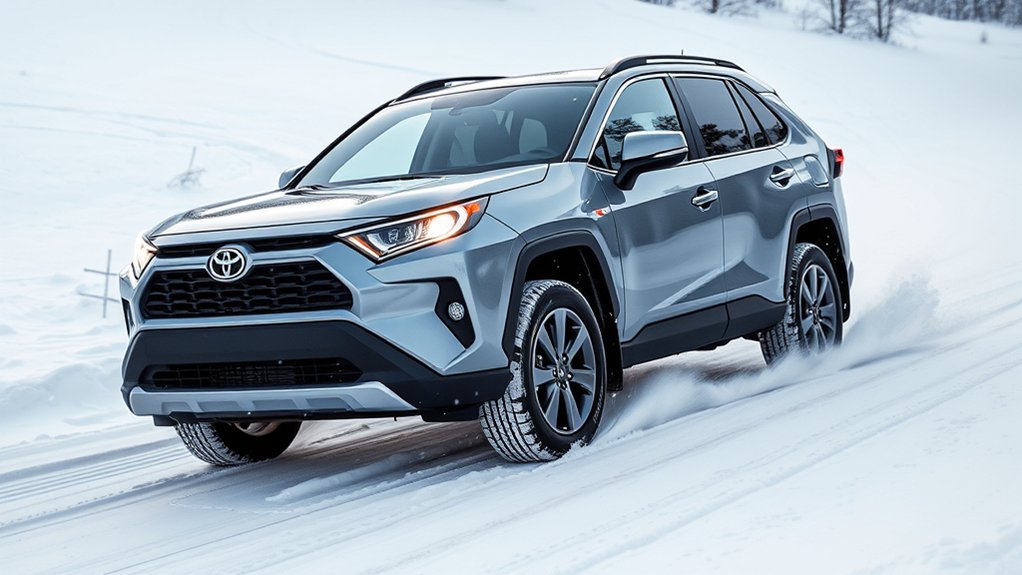
The 2025 RAV4 comes with Toyota Safety Sense 2.5. Its driver-assistance features can be useful in normal driving, but Toyota stresses that the driver remains responsible for controlling the vehicle.
- Pre-Collision System with Pedestrian Detection: Can warn of certain potential frontal collisions and may provide automatic braking under qualifying conditions.
- Lane Departure Alert with Steering Assist: Can warn when an unintended lane departure is detected and may provide gentle corrective steering.
- Lane Tracing Assist: Can provide lane-centering assistance when its operating conditions are met and Dynamic Radar Cruise Control is being used.
- Vehicle Stability Control and Traction Control: Help manage wheelspin and loss of stability when traction begins to break away.
- Anti-lock Braking System: Helps prevent wheel lock during hard braking so the driver can retain more steering control.
- Smart Stop Technology: Is designed to reduce engine power when the accelerator and brake pedals are pressed simultaneously under qualifying conditions.
The RAV4’s electronic safety systems can assist you, but they cannot replace winter tires, appropriate speed, sufficient following distance, or careful steering and braking.
Warning: Snow, ice, fog, road spray, and obscured lane markings can reduce the effectiveness of cameras, radar, and lane-assistance systems. Do not rely on cruise control or lane-centering technology when conditions make those systems inappropriate.
Comfort and Convenience Features for Winter Driving
A number of available RAV4 features make cold-weather driving easier even though they do not directly improve traction.
- Heated front seats and heated steering wheel: Available depending on trim and package.
- Dual-zone automatic climate control: Helps maintain a comfortable cabin temperature and manage window fogging.
- Windshield wiper de-icer: Available with selected Weather Packages and useful when ice collects around the lower windshield.
- Remote Connect: Depending on grade, equipment, trial, and subscription status, Remote Connect can provide vehicle start/stop and other remote functions. Engine Start/Stop is not included on the 2025 LE through Remote Connect.
- All-weather floor liners: Available as accessories and useful for containing melted snow, salt, and slush.
The RAV4’s cargo area also provides useful space for winter equipment such as an ice scraper, snow brush, traction aid, blanket, gloves, shovel, and emergency supplies.
Practical Winter Driving Tips for RAV4 Owners
Good winter preparation matters just as much as choosing AWD.
- Inspect all four tires. Confirm adequate tread depth, correct size, even wear, and proper cold inflation pressure.
- Use four matching winter tires when conditions justify them. Mixing winter and non-winter tires can create an undesirable front-to-rear traction imbalance.
- Clear the entire vehicle. Remove snow and ice from windows, lights, mirrors, cameras, sensors, roof, and around the wheel openings before driving.
- Check cold-weather fluids. Use washer fluid, coolant, and other fluids appropriate for the expected temperatures.
- Inspect the battery and wipers. Cold temperatures increase battery demand and make weak wiper blades more noticeable.
- Accelerate gently. Sudden throttle inputs can overwhelm available traction even with AWD.
- Brake early. Leave substantially more room than you would on dry pavement.
- Make steering inputs smoothly. Abrupt steering can exceed the limited cornering grip available on ice.
- Carry emergency supplies. Include warm clothing or blankets, a flashlight, phone charging equipment, first-aid supplies, water, and other items appropriate for your climate and route.
NHTSA’s winter-driving guidance also recommends inspecting tires regularly, checking inflation when the tires are cold, and preparing the vehicle before severe weather.
Tire Chains and Traction Devices
Do not assume that every RAV4 wheel-and-tire combination can accept conventional tire chains. Clearance restrictions can vary by model year and tire size. Check the owner’s manual for your exact RAV4 and follow both Toyota’s instructions and local chain-control laws before installing any traction device.
Comparing the 2025 RAV4 With Other Vehicles for Snow Performance
The 2025 RAV4 compares well with many compact crossovers because it offers available AWD on gas models, standard AWD on Hybrid models, up to 8.6 inches of ground clearance, and traction-oriented drive modes.
However, drivetrain specifications alone do not tell you which vehicle will perform best in winter. Tire type, ground clearance, stability-control calibration, vehicle weight distribution, snow depth, road surface, and driver technique all matter.
RAV4 Versus Competing SUVs
When comparing the RAV4 with another compact SUV, look beyond whether the specification sheet simply says “AWD.” Compare:
- Available ground clearance.
- Factory tire type and tire size.
- Whether winter-rated replacement tires are readily available.
- How the AWD system distributes power.
- Whether the vehicle provides dedicated low-traction modes.
- Heated windshield, mirror, washer, and seating options.
- Restrictions on tire chains or traction devices.
A competitor with slightly more ground clearance may have an advantage in unplowed snow, while a RAV4 on quality winter tires may outperform another AWD crossover using ordinary all-season tires on packed snow and ice.
All-Wheel Drive Comparison
The 2025 RAV4 uses more than one AWD design. Gas models can use Toyota’s mechanical AWD systems, while Hybrid models use an independent rear electric motor for Electronic On-Demand AWD.
The AWD Limited’s Dynamic Torque Vectoring system can distribute drive force between the left and right rear wheels, while Hybrid AWD can engage the rear electric motor when additional rear-wheel drive force is useful.
Both approaches improve low-traction capability, but neither changes the basic rule of winter driving: tires determine how much usable grip is available between the vehicle and the road.
Tire Performance Analysis
Tire performance should be evaluated in three areas:
- Starting traction: How easily the tire moves the RAV4 from a stop without excessive wheelspin.
- Cornering grip: How much lateral grip remains when turning on snow or ice.
- Braking grip: How effectively the tire can slow the vehicle on a slippery surface.
AWD mainly helps the first category. It cannot provide the same improvement to braking that a better winter tire can.
Related Guides
Frequently Asked Questions
How Does the RAV4 Compare to Other SUVs in Snow Performance?
The RAV4 is competitive with other compact AWD crossovers because it combines available AWD, useful ground clearance, and traction-management systems. The actual difference between two vehicles can depend more on their tires and the road conditions than on the AWD badge alone.
Can the RAV4 Handle Deep Snow Conditions?
The RAV4 can handle moderate accumulated snow when it has suitable tires and sufficient clearance, but it is still a compact crossover. The 2025 model offers up to 8.6 inches of ground clearance, so deep snow approaching the underbody can increase the risk of becoming stuck or high-centered.
What Maintenance Is Needed for Winter Driving?
Check tire condition and cold inflation pressure, test the battery, inspect the brakes and wipers, use winter-appropriate washer fluid and coolant, confirm that lights and defrosters work, and remove snow or ice from cameras, lights, mirrors, and sensors before driving.
How Does the RAV4’s Weight Affect Snow Traction?
Vehicle weight affects traction, braking, and handling, but weight alone does not determine winter performance. Tire compound, tread design, AWD behavior, stability control, road surface, speed, and how the vehicle’s weight is distributed all matter.
Are There Aftermarket Modifications for Better Snow Performance?
Yes, but tires should normally be your first upgrade. A matched set of suitable winter tires can improve acceleration, braking, and cornering grip. Lift kits can add clearance, but they may also affect alignment, handling, component wear, driver-assistance calibration, and warranty considerations, so they are not automatically a better winter solution.
Conclusion
The Toyota RAV4 can be a strong winter vehicle when you match its equipment to the conditions you actually drive in. AWD helps the vehicle get moving and manage changing traction, while the RAV4’s available ground clearance gives it useful capability on snow-covered roads.
The biggest mistake is treating AWD as a substitute for tire grip. If you regularly drive through snow and ice, start with the right four tires, maintain their pressure and tread, slow down for the conditions, and use Snow Mode or other traction features only as driving aids. With that preparation, a properly equipped RAV4 is well suited to most everyday winter driving.
Sources
- Toyota USA Newsroom — 2025 Toyota RAV4 — 2025 grades, AWD systems, Hybrid AWD, drive modes, and available equipment.
- Toyota — 2025 RAV4 — ground clearance, AWD, Multi-Terrain Select, and vehicle specifications.
- Toyota 2025 RAV4 Hybrid Owner’s Manual — Trail Mode — Hybrid traction-mode operation and limitations.
- Michelin — CrossClimate2 — confirms its all-season and 3PMSF classification.
- NHTSA TireWise — tire categories, winter-tire guidance, inflation, tread, and maintenance.
- NHTSA Winter Driving Tips — winter preparation, tire-pressure checks, and cold-weather driving guidance.
