
Yes, you can add heated seats to many Toyota RAV4s after purchase, but the safest option depends on your exact model year, trim, seat construction, upholstery, and factory safety equipment. Aftermarket heating elements are widely available, while factory-style or complete-seat retrofits can be much more complicated because the front seats may contain airbags, sensors, wiring, and occupant-classification components.
Quick Answer
Heated seats can often be added to a Toyota RAV4 using aftermarket heating elements installed beneath the upholstery. However, compatibility is not universal. Because the front seats can contain side airbags and passenger-detection components, verify the kit for your exact RAV4 year and trim and use a qualified installer when safety systems may be disturbed.
Key Takeaways
- An under-upholstery aftermarket heater is usually the most practical retrofit, but the kit must be compatible with your exact seat design.
- A complete OEM or salvage-seat swap is not automatically plug-and-play because airbags, sensors, harnesses, switches, modules, and connectors can differ.
- Do not treat an SRS or passenger-airbag warning after installation as a light that simply needs to be cleared.
- Aftermarket parts do not automatically void a U.S. vehicle warranty, although damage caused by the part or installation may not be covered.
- Get an installed quote for your specific RAV4 rather than relying on a generic nationwide price.
At a Glance
| Time Required | Varies by model year, seat design, switch placement, upholstery work, and electrical integration; ask for a vehicle-specific labor estimate. |
| Difficulty | Moderate to advanced because front-seat upholstery, electrical wiring, airbags, and occupant-detection hardware may be involved. |
| Tools Needed | Depends on the kit and RAV4. Typical installer tools can include trim tools, appropriate sockets, upholstery tools, electrical terminal tools, and diagnostic equipment where required. |
| Cost | Kit price plus upholstery/electrical labor. One current Toyota-style aftermarket kit is listed by its manufacturer at $129.99 before installation; your RAV4’s installed total can be substantially different. |
What Are Your Options for Adding Heated Seats?

If you want to add heated seats to your Toyota RAV4, you generally have three routes: an under-upholstery aftermarket heater, a professionally installed custom interior system, or a factory-style seat/parts retrofit.
Aftermarket heating elements are usually the simplest concept. The heating elements sit beneath the seat upholstery and connect to a properly protected electrical circuit using the components specified by the heater manufacturer. For example, Rostra sells automotive seat-heater systems with heating elements, controls, wiring, temperature monitoring, and fused power components. You can review its Toyota-style seat-heater system for an example of how these products are designed.
A professional upholstery or automotive-accessory installer can often produce a cleaner result because the controls, wiring, upholstery, and element placement can be integrated rather than simply added on top of the seat.
Another option is a more extensive factory-style or complete-seat retrofit. This may involve heated seat assemblies, switches, harnesses, control components, and other trim-specific parts. It can look more original, but it is usually the most complicated route.
Warning: Do not assume that a heated seat from another RAV4 is automatically compatible with your vehicle. Front seats may include side airbags, passenger-detection sensors, wiring harnesses, power-seat electronics, and other safety-related components that differ by year and trim.
Check Compatibility Before Buying Anything
Before purchasing a heater or used seat, confirm all of the following:
- Your exact RAV4 model year and trim.
- Driver versus passenger seat application.
- Cloth, SofTex, leather, ventilated, or other upholstery construction.
- Whether the seat contains side airbags or occupant-classification components.
- Whether the heater manufacturer’s instructions allow installation in that seat design.
- Required electrical load, fuse protection, switch, harness, and power source.
- Whether seat removal, sensor calibration, programming, or diagnostic work is required.
Toyota’s current 2026 RAV4 specifications show that factory heated-seat equipment varies by trim. That is useful evidence that RAV4 seat configurations differ, but factory availability on one trim does not mean another trim is prewired for a simple OEM retrofit.
What Is the Installation Process for Heated Seats?
Adding heated seats to a Toyota RAV4 normally requires access beneath the seat upholstery and an appropriate electrical connection. The exact procedure should come from the heater manufacturer and the service information for your exact RAV4 rather than from a universal step-by-step guide.
- Verify the application first: Confirm that the heater is suitable for your exact seat, upholstery, airbags, sensors, and vehicle electrical system.
- Inspect the seat’s safety equipment: Identify side-airbag, occupant-detection, seat-belt, power-seat, and other wiring before any trim or upholstery is disturbed.
- Install the heating elements correctly: A compatible system normally places heating elements beneath the upholstery in positions allowed by the manufacturer’s instructions.
- Route and protect the wiring: Use the harness, fuse protection, power requirements, connectors, and wire protection specified by the heater manufacturer.
- Reassemble and inspect: Make sure upholstery, connectors, fasteners, seat movement, and wiring routing are correct.
- Verify vehicle safety systems: Check the SRS warning light, passenger-airbag indicators, seat functions, and heater operation before returning the vehicle to normal use.
Some aftermarket products use a dedicated harness and integrated control components, but that design is product-specific. Do not assume that wiring instructions for one heater apply to another.
Pro Tip: Give the installer your VIN, model year, trim, seat material, and clear photos of the seat controls before requesting a quote. That makes it easier to identify potential compatibility problems before the seat is taken apart.
What Are the Costs Involved in Adding Heated Seats?
The cost of adding heated seats to a Toyota RAV4 has two main parts: the heater hardware and the labor needed to integrate it safely.
As one current product-price reference, Rostra lists its Toyota-style seat-heater system at $129.99 on its U.S. manufacturer page. That figure is useful for understanding the cost of one type of hardware, but it is not a universal RAV4 installed price and does not establish compatibility with every RAV4 seat.
Professional labor can vary considerably because an installer may need to work with the upholstery, route wiring, mount controls, remove or reposition seat components, inspect safety-system connections, and test the finished installation.
A factory-style retrofit or complete seat-assembly swap can cost much more because you may need additional switches, harnesses, trim pieces, control electronics, seat assemblies, diagnostic work, or calibration in addition to the heating hardware itself.
For the most useful comparison, ask each installer for a written quote that states:
- Whether the price is for one seat or both front seats.
- The exact heater brand and part number.
- Switch style and number of heat levels.
- Whether upholstery removal and reassembly are included.
- Whether electrical and SRS-system checks are included.
- Parts and labor warranty terms.
- Taxes or other shop charges.
Comparing Heated Seats: Aftermarket vs. OEM Options

When comparing aftermarket and factory-style heated seats, focus on compatibility and installation quality instead of assuming that every OEM system is automatically better or that every aftermarket system is basic.
Aftermarket systems vary significantly. Some provide simple high/low operation, while others use several heat levels, temperature sensors, dedicated harnesses, and integrated controls. Katzkin, for example, offers professionally installed aftermarket heated and ventilated seating systems.
An OEM-style retrofit can provide a more factory-like appearance when all of the correct components are available, but it can also require considerably more vehicle-specific parts and integration work.
Quality Comparison
Instead of judging quality only by whether a system is OEM or aftermarket, compare these factors:
- Verified fit: The heating element must be appropriate for the specific seat construction.
- Temperature control: Compare actual heat levels and temperature-management features rather than assuming one category offers more settings.
- Electrical protection: Look for properly designed harnesses, fuse protection, secure connectors, and temperature controls.
- Installer support: Confirm who will diagnose or repair the heater if a problem develops.
- Warranty: Review both the product warranty and the installer’s labor warranty.
- Safety-system compatibility: The installation must not compromise side airbags, occupancy detection, seat wiring, or normal seat movement.
Cost Analysis
Aftermarket systems can be attractive because you may be able to add heat without replacing the entire seat. That can reduce the number of factory parts required, but professional upholstery and electrical labor still affect the final price.
Factory-style retrofits can make sense when compatible parts are readily available and the owner strongly prefers factory switches or controls. However, buying used heated seats without first checking part numbers, connectors, electronics, and safety-system compatibility can turn an inexpensive purchase into a costly project.
Get a complete quote before choosing either path rather than comparing only the price of the heating elements or the used seat.
Ensuring Safety and Quality During Heated Seat Installation
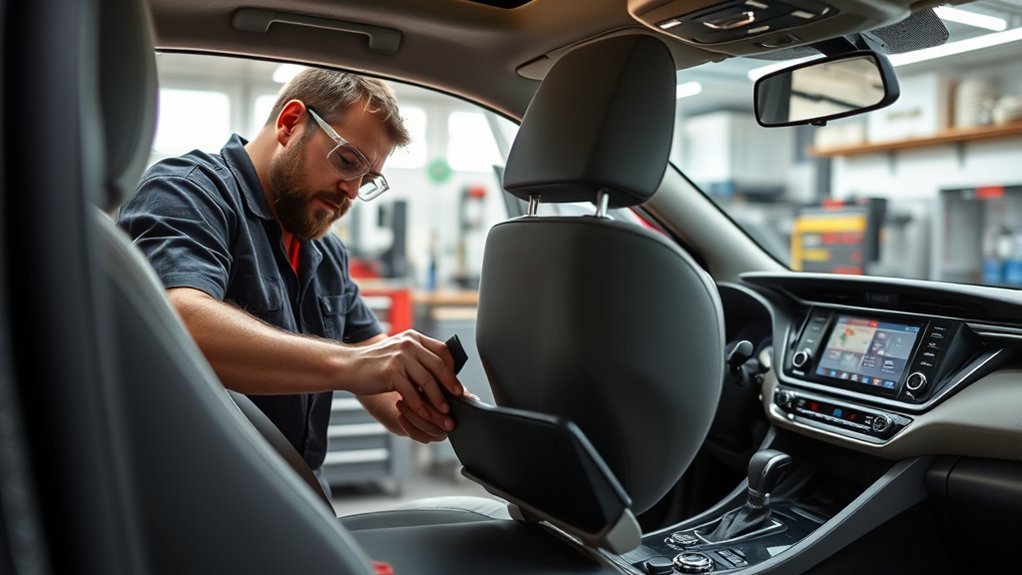
Safety is the most important part of a heated-seat installation. The front-seat area can contain safety-related wiring and components, so the installer needs to understand both the heater and the vehicle.
Toyota has warned in RAV4 owner information that front-seat occupant-classification systems are safety-critical and that owners should not casually modify or remove front seats or modify the upholstery. Toyota also provides specific operating precautions for factory RAV4 seat heaters.
Warning: If the SRS warning light stays on, the passenger-airbag indicator behaves abnormally, or another restraint-system fault appears after seat work, do not treat it as a light that simply needs to be reset. Have the system diagnosed and repaired according to Toyota service information before normal use of the affected seat.
Three priorities matter most:
- Use a compatible heater: Choose a system whose manufacturer or installer confirms that it is appropriate for your exact seat configuration.
- Protect the vehicle’s safety systems: Airbag modules, occupancy sensors, seat-belt wiring, and associated connectors must remain correctly installed and functional.
- Test the completed work: Confirm normal seat operation, heater control, wiring security, SRS warning behavior, and passenger-airbag indicators.
Common Challenges and Easy Solutions for Heated Seat Installation
Installing heated seats in a Toyota RAV4 is more involved than simply connecting a heating pad. The main challenges are access beneath the upholstery, safe element placement, electrical integration, and protecting the seat’s existing systems.
Your best choice depends on your mechanical and electrical experience, the specific RAV4, and how much factory-like integration you want.
Installation Complexity Factors
Three factors often determine how difficult the job becomes:
- Electrical requirements: The heater needs the correct voltage source, fuse protection, grounding, connectors, and wiring capacity specified by its manufacturer.
- Seat construction: Upholstery attachment methods, seams, foam channels, airbags, sensors, ventilation components, and seat frames vary.
- Safety-system verification: Seat work must not leave an SRS fault or interfere with passenger-detection equipment.
Addressing these points before buying the parts helps prevent a low-cost heater from turning into an expensive repair.
Cost-Effective Options Available
An aftermarket under-upholstery heating system is often the most cost-conscious way to add seat heat because it can reuse the existing seat rather than replacing the entire assembly.
However, the cheapest heater is not automatically the best value. Compare temperature controls, electrical protection, documentation, warranty support, heater dimensions, and confirmed compatibility with your seats.
It is also worth comparing quotes from automotive upholstery shops and established accessory installers instead of assuming a dealership is your only option.
Professional vs. DIY Installation
A capable DIYer may be able to install some aftermarket systems, but a RAV4 front seat is not a good place to learn automotive upholstery or SRS-related work for the first time.
Professional installation is especially worth considering when the job requires removing a front seat, disturbing upholstery around a side airbag, working near occupant-detection components, integrating factory-style switches, or diagnosing warning lights after reassembly.
If you do perform permitted work yourself, follow the heater manufacturer’s instructions and the correct Toyota service information for your exact vehicle rather than relying on generic wire colors, fuse locations, seat-removal procedures, or online instructions from a different model year.
Finding Professional Installation: What to Consider
When choosing someone to install heated seats in your Toyota RAV4, look for experience with automotive upholstery, 12-volt accessories, and modern seats containing airbags and sensors.
Ask the installer these questions before approving the work:
- Have you installed heaters in this RAV4 generation or the same seat design?
- What heater brand and exact part number will you use?
- Has compatibility with my seat airbags and sensors been confirmed?
- Where will the switches be mounted?
- How is the circuit protected?
- What checks do you perform on the SRS and passenger-airbag system afterward?
- What parts and labor warranty do you provide?
- What is included in the written installed price?
Customer reviews can help, but experience with safety-equipped seats and clear technical answers matter more than the lowest quote.
Note: A dealership may choose to perform, subcontract, or decline an aftermarket retrofit. An independent specialist can also be appropriate; the important issue is whether the shop can document a safe, compatible installation.
Understanding Warranties for Modifications

Adding aftermarket heated seats does not automatically void the entire vehicle warranty in the United States.
The Federal Trade Commission’s auto-warranty guidance explains that using an aftermarket or recycled part does not, by itself, cancel the warranty. However, if an aftermarket component is defective or is installed incorrectly and causes damage to a covered part, warranty coverage for that resulting damage can be denied.
Keep three things in mind:
- The aftermarket heater itself is separate: Toyota generally is not responsible for repairing a non-Toyota heater simply because the vehicle is under warranty.
- Installation-caused damage matters: Damage caused by incorrect wiring, upholstery work, or another modification may not be covered by the vehicle warranty.
- Documentation helps: Keep the invoice, heater model and part number, installer information, warranty paperwork, and any diagnostic documentation.
If your RAV4 is still under warranty, you can also review its exact Toyota warranty booklet before authorizing the modification.
Essential Tools for Installing Heated Seats
The exact tools needed depend on the heater kit and your RAV4’s seat design. Typical professional work may involve the appropriate socket tools, trim-removal tools, upholstery tools, electrical terminal tools, and test equipment.
A multimeter may be useful where the heater manufacturer’s instructions specifically call for electrical verification. Upholstery clips, fasteners, and electrical terminals should be serviced with the correct tools rather than improvised substitutes.
Do not assume that a heat gun or hairdryer is required for a heater’s adhesive. Follow the specific product instructions because unnecessary heat can damage upholstery, foam, wiring, or nearby components.
The most important “tool” is the correct technical information: use the heater manufacturer’s current instructions and the Toyota service procedure that matches your exact model year and seat configuration.
Tips for Maintaining Your Heated Seats
Proper care helps your heated seats remain comfortable and reliable.
- Avoid punctures: Sharp objects can damage heating elements beneath the upholstery.
- Do not overload the seat: Avoid placing heavy objects with hard or uneven surfaces on the heated area.
- Clean the upholstery correctly: Follow the care instructions for your seat material and avoid soaking electrical seat components.
- Watch for unusual behavior: Stop using the heater if one area becomes excessively hot, the heater cycles abnormally, you smell overheating material, or a fuse repeatedly fails.
- Use heat sensibly: Do not run the heater longer or hotter than necessary.
Toyota specifically cautions that babies, small children, elderly or physically challenged occupants, people with sensitive skin, fatigued people, and those affected by alcohol or medicines that induce sleep may be more vulnerable to minor burns from seat heaters.
A successful heated-seat retrofit is not just one that gets warm—it is one that preserves normal seat movement, electrical protection, SRS operation, passenger detection, and long-term serviceability.
Troubleshooting After a Heated-Seat Retrofit
If a newly installed heater does not work correctly, avoid guessing at the wiring. Start with the symptoms and the installation documentation.
- No heat: Have the installer verify the system’s specified fuse, power supply, ground, switch, connectors, and heater circuit.
- Only part of the seat heats: Stop using the heater until the element and connections are inspected for damage or incorrect installation.
- Heater becomes unusually hot: Switch it off and have the temperature-control system and element inspected.
- SRS warning light appears: Have the restraint system diagnosed rather than simply clearing the warning.
- Passenger AIR BAG indicator behaves differently: Stop using the affected passenger seat until the occupant-classification system has been checked.
- Seat movement is restricted: Inspect wiring routing immediately so a harness cannot be pinched, stretched, or caught in the seat tracks.
Related Guides
Frequently Asked Questions
Will adding heated seats void my Toyota RAV4’s warranty?
Not automatically in the United States. FTC guidance says using an aftermarket part or independent service provider does not by itself void the vehicle warranty. However, the manufacturer can deny coverage for damage caused by a defective aftermarket part or incorrect installation. The aftermarket heater itself also has its own warranty terms.
Can heated-seat kits fit all RAV4 models?
No. Even a product described as universal may not be suitable for every RAV4 seat. Check the exact model year, trim, upholstery, seat construction, airbags, occupant-detection components, electrical requirements, and the heater manufacturer’s application guidance before buying.
How long does heated-seat installation take?
There is no reliable universal installation time. Labor depends on the RAV4 generation, seat construction, upholstery, switch location, electrical work, whether the seat must be removed, and whether diagnostic or calibration work is required. Ask the installer for a vehicle-specific estimate.
Are heated seats safe for all passengers?
Extra care is required for some passengers. Toyota cautions about minor-burn risk for babies, small children, elderly or physically challenged occupants, people with sensitive skin, fatigued occupants, and people affected by alcohol or medicines that cause drowsiness. Do not use more heat or duration than necessary.
Do heated seats consume a lot of electricity?
Seat heaters use the vehicle’s 12-volt electrical system, but the exact current draw depends on the heater. Use the fuse size, wiring, power source, and operating limits specified by the kit manufacturer instead of assuming every heater has the same electrical demand. Avoid extended use when the vehicle is not operating if your vehicle or heater instructions warn against battery discharge.
Can I install heated seats from a wrecked RAV4?
Possibly, but a used seat is not automatically plug-and-play. Verify the exact part numbers, connectors, airbags, occupant sensors, power-seat functions, wiring harnesses, switches, modules, upholstery, and any calibration or programming requirements before attempting the swap.
What should I do if the airbag light comes on after heated-seat installation?
Have the SRS system diagnosed using the correct Toyota service information. Do not simply clear the warning and assume the system is safe. A warning can indicate a connector, wiring, occupant-detection, airbag, or other restraint-system problem that needs to be corrected.
Sources
- Toyota 2026 RAV4 Specifications — current factory heated-seat and heated/ventilated-seat availability.
- Toyota RAV4 Owner’s Manual — Seat Heaters — heater-operation, burn-risk, and seat-care precautions.
- Federal Trade Commission — Auto Warranties and Auto Service Contracts — U.S. warranty treatment of aftermarket and recycled parts.
- Rostra Toyota Vehicle Seat Heater — example aftermarket heater design, controls, features, and current manufacturer reference price.
- Katzkin DegreeZ Heated and Cooled Seats — example of professionally installed multi-level aftermarket seat-temperature systems.
Conclusion
You can add heated seats to many Toyota RAV4s, and a compatible under-upholstery aftermarket system is often the most practical route. The key is confirming the exact seat application before buying anything and treating the front-seat airbags, passenger-detection equipment, upholstery, and wiring as safety-critical systems.
If you want a factory-like result, compare established professional installers and ask exactly what heater, switches, electrical protection, testing, and warranty are included. A complete OEM or salvage-seat retrofit can also work in the right situation, but it requires much more compatibility checking than simply finding another RAV4 seat.
Choose the solution that fits your specific model year and seat design, keep your installation records, and make sure the SRS and passenger-airbag systems operate normally when the work is finished. That gives you the warmth you want without treating safety or reliability as an afterthought.
