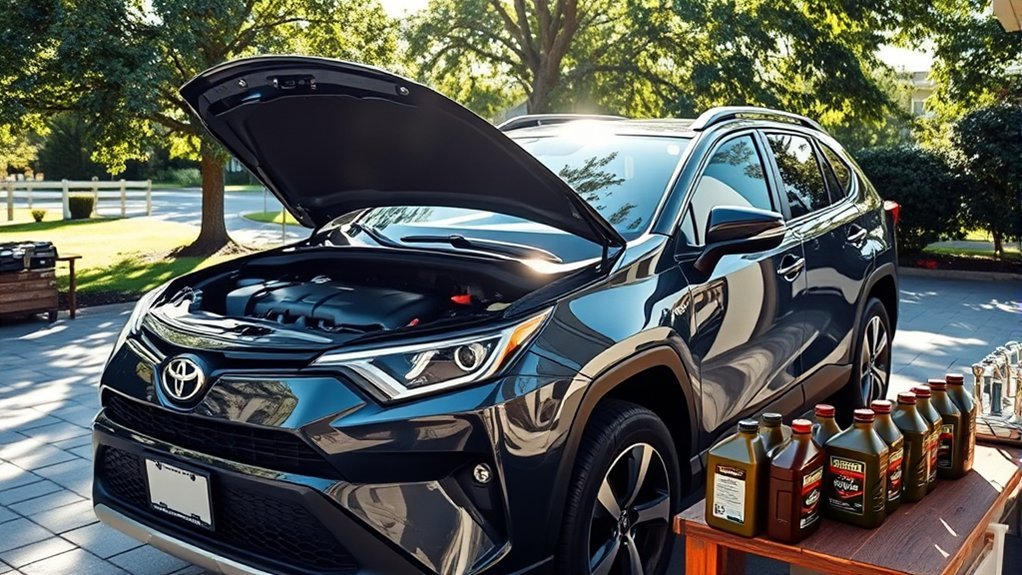
Does a Toyota RAV4 require synthetic oil? Not as a universal label requirement. Toyota specifies the SAE viscosity and performance standard for each model year and powertrain. For U.S.-market examples, most 2019–2025 RAV4 gas and Hybrid models, plus Prime/Plug-in Hybrid models where offered, specify SAE 0W-16. The 2026 RAV4 Hybrid specifies SAE 0W-8 meeting JASO GLV-1, while the 2026 RAV4 Plug-in Hybrid specifies SAE 0W-16 meeting ILSAC GF-6B. Low-viscosity oils in these grades are commonly sold as full synthetic, but the required viscosity and certification matter more than the marketing label.
Last updated: September 11, 2026 — 2026 oil grades, capacities, substitute-oil rules, maintenance intervals, and current ILSAC standards rechecked against the Toyota and API publications linked below.
This guide compares Toyota owner-manual specifications and scheduled-maintenance documents by model year. It also keeps the 5,000-mile maintenance-visit schedule separate from the actual oil-and-filter replacement interval.
Quick Answer
Most U.S.-market 2019–2025 Toyota RAV4 gas and Hybrid models, plus Prime/Plug-in Hybrid models where offered, specify SAE 0W-16 oil that meets the manual’s certification. The 2026 RAV4 Hybrid specifies SAE 0W-8, while the 2026 RAV4 Plug-in Hybrid specifies SAE 0W-16. Use the exact viscosity, performance standard, capacity, substitute-oil rule, and interval listed for your model year.
Key Takeaways
- The 2026 RAV4 Hybrid uses SAE 0W-8 meeting JASO GLV-1; the 2026 Plug-in Hybrid uses SAE 0W-16 meeting ILSAC GF-6B.
- Most 2019–2025 U.S. RAV4 gas and Hybrid models, plus Prime/Plug-in Hybrid models where offered, specify SAE 0W-16, but the exact manual should always be checked.
- Toyota’s 5,000-mile or six-month maintenance visit is not automatically an oil change under normal use. Many recent models list oil and filter replacement at 10,000 miles or 12 months.
- Special operating conditions can shorten the oil-and-filter interval to 5,000 miles or six months.
- Oil capacity varies by engine and model year. Treat the manual’s capacity as a starting reference and verify the final level with the dipstick.
What Oil Does a Toyota RAV4 Take by Model Year?

The RAV4 has used several engines and oil grades over the years. Do not select oil only by the vehicle name. Match the bottle to the model year, engine or hybrid system, SAE viscosity, and required performance standard.
| RAV4 model | Typical U.S. oil specification | Important notes |
|---|---|---|
| 2026 RAV4 Hybrid | SAE 0W-8 meeting JASO GLV-1 | SAE 0W-16 may be used temporarily if 0W-8 is unavailable, but Toyota directs owners to return to 0W-8 at the next change. Reference capacity is 4.5 US quarts with a filter or 4.2 quarts without one. |
| 2026 RAV4 Plug-in Hybrid | SAE 0W-16 meeting ILSAC GF-6B | SAE 0W-20 may be used temporarily if 0W-16 is unavailable, but it should be replaced with 0W-16 at the next change. Reference capacity is 4.5 US quarts with a filter or 4.2 quarts without one. |
| 2019–2025 gas and Hybrid; Prime/Plug-in Hybrid where offered | Generally SAE 0W-16 for U.S. models | Many manuals permit temporary use of 0W-20, followed by a return to 0W-16. Verify the exact year and powertrain because fill quantities and wording can differ. |
| 2013–2018 2.5-liter models | Generally SAE 0W-20 with the required ILSAC certification | Some manuals permit temporary use of SAE 5W-20. A 2018 manual lists a reference capacity of 4.6 US quarts with a filter. |
| 2006–2012 models | Varies by engine | For example, the 2008 manual specifies SAE 5W-20 or 0W-20 for the 2.4-liter four-cylinder and SAE 5W-30 for the 3.5-liter V6. |
2026 model-year change: Do not automatically carry a 2025 oil recommendation into a 2026 RAV4. The U.S. 2026 RAV4 Hybrid specifies SAE 0W-8 meeting JASO GLV-1, while the 2026 Plug-in Hybrid specifies SAE 0W-16 meeting ILSAC GF-6B. Check the exact powertrain before buying oil.
Note: These specifications apply to U.S.-market examples. Canadian and other regional manuals may use different wording, service units, or approved products. Check the oil cap and the exact publication for your VIN or model year through Toyota’s manuals and warranties page.
Does a Toyota RAV4 Require Full Synthetic Oil?
Not as a blanket marketing-label requirement. Toyota’s controlling requirements are the SAE viscosity and performance standard printed in the owner’s manual. For recent RAV4 grades such as 0W-16 and 0W-8, full-synthetic products are common and practical choices, but a bottle marked “full synthetic” is still wrong if its viscosity or certification does not meet the vehicle’s specification.
For 0W-16 applications, oil-standard labeling is also changing. API’s current Motor Oil Guide lists ILSAC GF-7B as the successor to GF-6B for SAE 0W-16 and says GF-7B can be used where GF-6B is recommended. API lists GF-6B as becoming obsolete on October 1, 2026. The SAE viscosity specified by Toyota still matters, so a newer performance standard does not authorize changing 0W-16 to another viscosity.
How to Confirm the Exact Oil for Your RAV4
- Identify the model year and powertrain. A Hybrid, Plug-in Hybrid or Prime, four-cylinder gas model, and older V6 may have different specifications.
- Open the owner’s manual specifications section. Search for “engine oil selection,” “lubrication system,” or “recommended viscosity.”
- Check both viscosity and certification. Examples include SAE 0W-8 with JASO GLV-1 or SAE 0W-16 with the applicable ILSAC specification.
- Read any substitute-oil note. Toyota may allow another grade temporarily but require the preferred grade at the next change.
- Confirm the reference capacity. Use the value for the exact engine and whether the filter is being replaced.
Pro Tip: Photograph the oil-specification page or save the Toyota manual on your phone. You can compare it with the bottle label before buying oil or show it to a service adviser.
How to Check the Oil Level in Your RAV4 Properly
Checking the dipstick between services helps you find a low level, overfill, leak, or unusual consumption before it causes damage. Toyota maintenance guidance for recent RAV4 models recommends checking the engine-oil level about once a month.
At a Glance
| Time Required | About 10 minutes, including time for the oil to drain back into the pan |
| Difficulty | Easy |
| Tools Needed | Lint-free cloth or paper towel, gloves, and a clean funnel if oil must be added |
| Cost | No cost to check; only the cost of the correct oil if a top-off is needed |
Find a Level Surface
Park on flat ground. A slope can move oil toward one side of the pan and distort the dipstick reading.
Turn off the engine and wait at least five minutes unless your manual provides a different procedure. This lets oil drain from the upper engine into the oil pan. Keep hands, clothing, and tools away from hot components.
Use the Dipstick
- Open the hood and locate the engine-oil dipstick.
- Pull it out and wipe it clean with a lint-free cloth or paper towel.
- Insert the dipstick completely.
- Remove it again and hold it level.
- Confirm that the oil film is between the low and full marks.
- If oil is needed, add the exact approved grade in small amounts, wait briefly, and recheck. Do not pour in the entire estimated difference at once.
The distance between the low and full marks represents a specific amount that varies by engine. Consult the manual before deciding how much to add.
Warning: If the red engine-oil-pressure warning appears while driving, move to a safe location and switch off the engine as soon as it is safe. That warning can indicate loss of oil pressure and is not merely a routine oil-change reminder. Do not continue driving until the cause is addressed.
Check Oil Color and Condition
Dark oil does not automatically mean the oil has failed. Detergent oil can darken as it holds contaminants in suspension. Use the required mileage or time interval, the dipstick level, and the vehicle’s operating condition rather than color alone.
Arrange an inspection when you find any of the following:
- A persistent milky, creamy, or foamy appearance after the engine has fully warmed.
- Visible metallic particles or glitter.
- A strong gasoline smell.
- A level that rises without oil being added.
- Repeated low readings, oil spots under the vehicle, smoke, or a burning-oil odor.
- Oil-pressure warnings, new engine noise, or overheating.
Occasional light moisture under the oil cap can occur after repeated short cold trips, but persistent milkiness on the dipstick or continued coolant loss deserves professional diagnosis.
Oil Change Intervals for RAV4 Models
Toyota’s scheduled-maintenance cadence and its oil-change interval are related but not identical. Recent U.S. maintenance guides commonly call for a service visit every 5,000 miles or six months, while the oil and filter may be listed at 10,000-mile or 12-month points under normal use.
For recent RAV4 maintenance charts, a 5,000-mile service visit does not always mean the engine oil is due. Check which items are actually marked for replacement at that mileage.
Recommended Change Intervals
| Situation | Typical recent Toyota guidance | What to do |
|---|---|---|
| Scheduled maintenance | Every 5,000 miles or six months | Perform the items listed at that point, which may include tire rotation, inspections, and fluid checks rather than an oil change. |
| Normal use with the specified oil | Often 10,000 miles or 12 months for recent U.S. RAV4 models | Confirm that your exact maintenance guide lists oil and filter replacement at this interval. |
| Listed special operating conditions | 5,000 miles or six months | Use the shorter interval when most of your driving falls within one of Toyota’s applicable conditions. |
| Older model or substitute oil used | Varies | Follow the exact model-year guide. Some Toyota manuals shorten the interval when the preferred low-viscosity oil was not used. |
The 2025 RAV4 Hybrid Warranty and Maintenance Guide and the 2026 RAV4 Hybrid Warranty and Maintenance Guide show the difference between 5,000-mile maintenance points and oil-replacement points.
For a model-year-focused schedule, see our Toyota RAV4 oil-change interval guide. This page focuses primarily on choosing the correct oil and understanding the specification.
Special Operating Conditions
Toyota does not shorten the oil interval merely because a driver occasionally encounters traffic, cold weather, or a dirt road. The additional service applies when most driving is done under an applicable listed condition.
Recent RAV4 maintenance guides identify conditions such as:
- Driving primarily on dirt or dusty roads.
- Towing, using a car-top carrier, or carrying heavy vehicle loads where permitted.
- Extensive idling or long periods of low-speed operation, such as taxi, police, or door-to-door delivery use.
- Repeated trips of less than five miles in temperatures below 32°F or 0°C.
For these conditions, recent Toyota guides direct owners to replace the engine oil and filter every 5,000 miles or six months, regardless of the oil used. Older models can have different definitions, so their own guides still control.
Common Mistakes to Avoid When Changing Your RAV4 Oil

An oil change is straightforward only when the correct oil, filter, quantity, drain-plug procedure, and final level are used. The most common mistakes are preventable.
The word “synthetic” does not make an oil correct. The bottle must also match the required SAE grade and performance certification.
- Using the wrong viscosity. Do not replace 0W-8, 0W-16, or 0W-20 with a thicker oil based on climate assumptions or general advice unless the exact Toyota manual permits it.
- Ignoring the required standard. Match JASO, ILSAC, or API requirements as well as the viscosity printed on the bottle.
- Using a capacity from another model. Gas, Hybrid, Plug-in Hybrid, four-cylinder, and older V6 engines can hold different quantities.
- Treating capacity as an exact final level. Add slightly less than the reference amount, run the engine only when the service procedure calls for it, wait, and verify the dipstick.
- Overfilling or underfilling. Either condition can cause engine problems. The final dipstick reading must remain within the specified range.
- Reusing an unsuitable filter or sealing washer. Use parts that meet the exact application and replace the drain-plug gasket when the service procedure requires it.
- Resetting the reminder without performing the service. A reset changes the display; it does not evaluate or improve the oil.
- Judging oil life only by color. Darkening can be normal, while contamination symptoms require more than a visual guess.
- Working under a vehicle supported only by a jack. Use properly rated ramps or jack stands on solid, level ground and follow the vehicle’s approved lifting points.
If you plan to perform the full service yourself, see our step-by-step Toyota RAV4 oil-change guide after confirming the specifications for your exact model year.
Warning: Engine oil and exhaust components can cause serious burns. Allow sufficient cooling time, wear eye and hand protection, and never crawl beneath a vehicle held up only by a portable jack.
How Oil Type Affects Your Toyota RAV4’s Engine Performance and Longevity
Engine oil forms a protective film between moving parts, carries heat, suspends contaminants, supports hydraulic components, and helps control deposits. Toyota selects the viscosity and performance standard around the engine’s bearing clearances, oil-pump design, emissions system, and expected operating temperatures.
The first number in a grade such as 0W-16 describes cold-temperature flow characteristics. The second number describes viscosity at operating temperature. A higher number is not automatically better. Oil that is too thick or too thin for the engine can affect oil flow, starting, lubrication, fuel economy, and component operation.
Synthetic base oils generally resist oxidation and temperature-related breakdown better than basic conventional oils. That does not authorize extending the interval beyond Toyota’s schedule. The approved interval depends on the vehicle certification, specified oil, time, mileage, and operating conditions.
What About High-Mileage Oil?
A higher-mileage RAV4 can use a high-mileage formula when that product still meets the exact viscosity and performance specification required by the manual. Toyota does not create a blanket rule requiring a thicker oil simply because the odometer passes a particular mileage.
High-mileage oil cannot repair a hardened seal, worn piston rings, a damaged gasket, or a mechanical leak. Investigate rapid consumption, blue exhaust smoke, oil on the ground, or repeated low dipstick readings instead of relying on an oil label to correct the cause.
Can Different Engine Oils Be Mixed?
Compatible engine oils can generally be mixed for an emergency top-off, but the resulting blend may not retain every advertised characteristic of either product. Use the same approved viscosity and certification whenever possible, then return to the preferred oil at the next service if a temporary substitute was necessary.
What to Ask Before a Toyota RAV4 Oil Change Service

When scheduling an oil change, give the service adviser your RAV4’s model year, powertrain, and mileage. Ask the shop to confirm the oil viscosity, required performance standard, reference quantity, filter, drain-plug gasket, and maintenance-reminder reset before work begins.
Compare the quoted oil specification with your owner’s manual before approving the service. This is especially important for the 2026 RAV4 Hybrid because its specified SAE 0W-8/JASO GLV-1 combination differs from the SAE 0W-16 used by many recent U.S. RAV4 models.
Ask for an itemized invoice showing the oil grade and quantity, filter, shop supplies, disposal charges, taxes, and any added services. Keep that invoice with the vehicle’s maintenance records.
Note: Toyota does not require routine maintenance to be performed by a Toyota dealer. You or another qualified provider may perform the work. Keep dated receipts showing the mileage, oil specification, quantity, filter, and work completed because damage caused by improper maintenance may not be covered.
RAV4 Engine-Oil Maintenance Checklist
The best maintenance plan follows the exact Toyota guide instead of a generic mileage chart. Use this checklist as a starting point, then confirm each item for your model year.
| Maintenance task | Useful starting point | Why it matters |
|---|---|---|
| Check engine-oil level | About once a month and before a long trip | Finds a low level, overfill, leak, or unusual consumption early. |
| Obtain scheduled maintenance | Often every 5,000 miles or six months on recent U.S. models | Covers mileage-specific inspections, tire rotation, and fluid checks. |
| Replace oil and filter under normal use | Often every 10,000 miles or 12 months on recent models using the specified oil | Renews the lubricant and filtration at Toyota’s listed point. |
| Replace oil and filter under listed special conditions | Often every 5,000 miles or six months on recent models | Accounts for dust, heavy loading, extensive idling, or repeated short freezing-weather trips. |
| Inspect or replace the engine air filter | At the model guide’s listed points; inspect sooner in dusty use | Protects airflow and helps prevent dirt from entering the engine. |
| Record maintenance | After every service or DIY job | Provides a reliable history for troubleshooting, warranty questions, and resale. |
Related Guides
FAQs About Oil Types and Maintenance for the Toyota RAV4
What Does the Oil-Filler Cap Tell You?
The cap often shows the preferred SAE viscosity, but it may not show the complete certification, substitute-oil rule, capacity, or service interval. Use it as a quick check, then confirm the manual.
Is the Maintenance Reminder an Oil-Life Sensor?
Do not assume the reminder chemically tests the oil. Maintenance reminders are generally based on mileage, time, or programmed service logic. Check the maintenance guide to see what service is due at that point.
How Much Oil Should You Add?
Use the exact engine’s reference capacity and whether the filter was changed. Add slightly less than the stated total, allow the oil to settle, and use the dipstick to reach the correct range. Never copy a quantity from a different RAV4 generation or powertrain.
What If the RAV4 Uses Oil Between Changes?
Check the level regularly and record how much oil you add and over what mileage. Inspect for leaks, smoke, odor, fouled plugs, and changes in fuel economy or engine behavior. Consumption that suddenly increases or repeatedly reaches the low mark deserves diagnosis.
How Should Used Oil Be Disposed Of?
Collect used oil in a clean, leak-proof container and do not mix it with coolant, gasoline, solvents, or other chemicals. Take it and the drained filter to a facility that accepts used automotive oil. The U.S. Environmental Protection Agency provides used-oil recycling guidance.
When Should You Shorten Your RAV4 Oil-Change Interval?
The normal interval is only the starting point. Use this decision order to determine whether your RAV4 needs an earlier oil and filter change:
- Check the exact maintenance guide. Find the oil-and-filter replacement marks for your model year and powertrain.
- Apply whichever limit comes first. An interval written as 10,000 miles or 12 months means the service is due when either limit is reached.
- Determine whether most driving meets a listed special condition. If it does, use the shorter interval in the guide.
- Account for substitute oil. Some manuals shorten the interval when the preferred viscosity was unavailable.
- Do not wait when a problem appears. Low oil, contamination, leaks, warning lights, overheating, or unusual engine noise require attention before the scheduled date.
- Check the level monthly. An oil-change interval does not guarantee that the level will remain full between services.
For many recent U.S. RAV4 models operating normally with the specified oil, the guide places oil and filter replacement at 10,000 miles or 12 months. Listed special operating conditions commonly shorten that to 5,000 miles or six months. Older RAV4 models and any vehicle with different manual instructions must follow their own schedule.
Frequently Asked Questions
Does a Toyota RAV4 require full synthetic oil?
Not as a universal marketing-label requirement. Use the SAE viscosity and performance standard specified in the owner’s manual for the exact model year and powertrain. Recent low-viscosity RAV4 oils are commonly sold as full synthetic, but the correct grade and certification are what determine whether an oil is suitable.
How many quarts of oil does a Toyota RAV4 take?
Capacity depends on the model year and powertrain. The referenced U.S. 2026 RAV4 Hybrid and 2026 Plug-in Hybrid specifications list 4.5 US quarts with an oil-filter change or 4.2 quarts without a filter change. Other generations can differ, so use the exact manual’s reference capacity and verify the final level with the dipstick.
Can I mix synthetic and conventional oil in my RAV4?
Compatible engine oils can generally be mixed for an emergency top-off, but use an oil that matches the required viscosity and certification. Mixing products can reduce the advertised benefits of a premium formula, so use the preferred specification consistently when possible.
How does synthetic oil affect my RAV4’s warranty?
Using an oil that meets the owner’s-manual requirements supports proper maintenance, but warranty coverage does not depend on a particular oil brand or dealer performing the service. Damage caused by the wrong fluid or improper maintenance may be excluded, so keep receipts and service records.
What are the environmental benefits of synthetic oil?
When Toyota authorizes a longer interval for the specified oil, fewer oil changes can reduce the amount of used oil and filters generated. The benefit depends on following the approved schedule, preventing leaks, and recycling the used oil and filter properly.
Is synthetic oil more expensive than conventional oil?
The purchase price is often higher, but current low-viscosity RAV4 oils are commonly sold as full synthetic. Compare the total annual service cost using Toyota’s approved interval rather than comparing bottle prices alone.
Can I use synthetic oil in an older RAV4?
Yes, provided the synthetic product matches the viscosity and performance specification in that model’s manual. Synthetic oil does not permit using an unapproved grade or automatically extending an older vehicle’s service interval.
Can I use 0W-20 instead of 0W-16?
Only when the exact Toyota manual permits it. Many recent manuals allow 0W-20 as a temporary substitute when 0W-16 is unavailable and direct the owner to return to 0W-16 at the next oil change.
Can I use 0W-16 instead of 0W-8 in a 2026 RAV4 Hybrid?
The 2026 U.S. RAV4 Hybrid manual permits SAE 0W-16 when SAE 0W-8 is unavailable, but it directs owners to replace it with SAE 0W-8 at the next oil change. Use an SAE 0W-8 oil meeting the required JASO GLV-1 specification for normal service.
Does dark engine oil mean it must be changed immediately?
Not necessarily. Oil often darkens while suspending contaminants. Follow the required time or mileage interval and inspect for low level, persistent milkiness, metal debris, a strong fuel smell, warning lights, or unusual engine symptoms.
Conclusion
A Toyota RAV4 should use the oil specification assigned to its exact model year and powertrain rather than a one-size-fits-all “synthetic oil” recommendation. Most 2019–2025 U.S. gas and Hybrid models, plus Prime/Plug-in Hybrid models where offered, use SAE 0W-16. The 2026 RAV4 Hybrid uses SAE 0W-8 meeting JASO GLV-1, while the 2026 Plug-in Hybrid uses SAE 0W-16.
Check the owner’s manual for the approved grade, performance standard, temporary substitute, reference capacity, and maintenance schedule. Verify the final level with the dipstick, check it monthly, keep service records, and respond promptly to leaks, contamination signs, or an oil-pressure warning. If you are buying 0W-16 in late 2026 or later, also recognize that ILSAC GF-7B succeeds GF-6B while the Toyota-specified SAE viscosity remains unchanged.
Sources
- Toyota 2026 RAV4 Hybrid Owner’s Manual — 0W-8 viscosity, JASO GLV-1 standard, substitute-oil rule, and capacity.
- Toyota 2026 RAV4 Plug-in Hybrid Owner’s Manual — 0W-16 viscosity, ILSAC GF-6B standard, substitute-oil rule, and capacity.
- Toyota 2026 RAV4 Hybrid Warranty and Maintenance Guide — normal and special-condition maintenance charts.
- Toyota 2025 RAV4 Hybrid Warranty and Maintenance Guide — monthly level checks, service intervals, special operating conditions, and maintenance-provider guidance.
- Toyota RAV4 Owner’s Manual for the 2013–2018 Generation — 0W-20 specification, temporary 5W-20 use, and reference capacity.
- Toyota 2008 RAV4 Owner’s Manual — separate four-cylinder and V6 oil grades and capacities.
- American Petroleum Institute Motor Oil Guide — current ILSAC GF-7B standard, GF-6B replacement guidance, and October 1, 2026 obsolescence date.
- U.S. Environmental Protection Agency Used Oil Guidance — safe management and recycling of used automotive oil.
