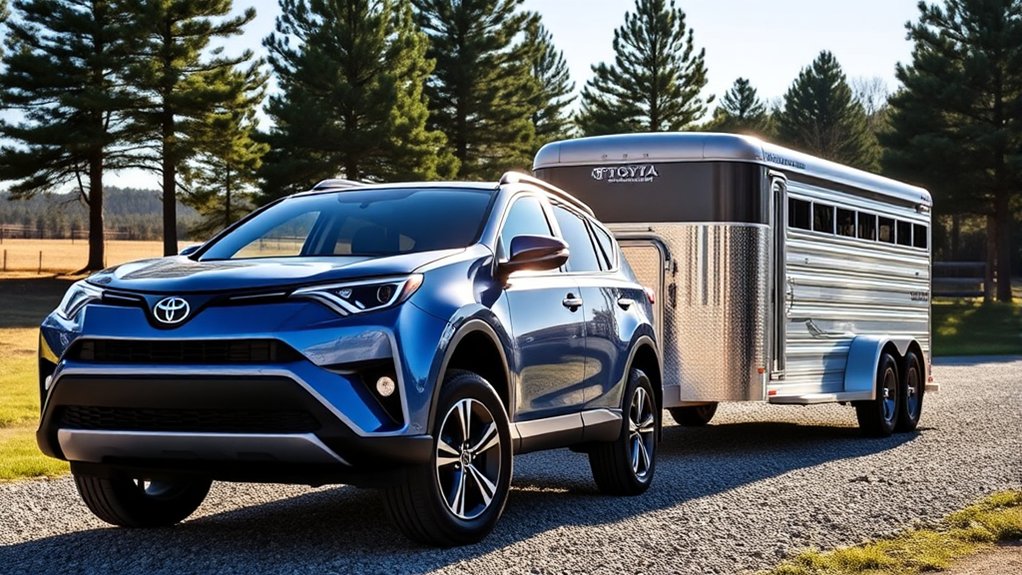
A Toyota RAV4 can tow a horse trailer only when the trailer’s actual loaded weight and the complete combination stay within every rating for that exact RAV4. For the 2026 U.S. RAV4, Toyota lists a 1,750-pound towing capacity for all front-wheel-drive models and the LE AWD, while selected AWD Hybrid and Plug-in Hybrid grades are rated up to 3,500 pounds. Most loaded horse trailers are a difficult match because the horse, tack, feed, water, passengers, cargo, and tongue weight can consume both trailer and vehicle capacity quickly.
Last updated: September 19, 2026. This update rechecked Toyota’s 2026 U.S. RAV4 towing ratings, towing-limit terminology, schema, and source links.
Scope: Current numerical ratings in this guide refer to U.S.-market RAV4 specifications. Towing ratings and legal equipment rules can differ by country, so owners outside the U.S. should use Toyota documentation and towing laws for their market.
Quick Answer
For 2026 U.S. models, Toyota lists 1,750 pounds for every front-wheel-drive RAV4 and the LE AWD. Selected AWD Hybrid grades—XLE, Woodland, SE, XSE, and Limited—and AWD Plug-in Hybrid grades—SE, XSE, and Woodland—are rated up to 3,500 pounds. Older RAV4 ratings vary by model year and equipment. A 3,500-pound tow rating alone does not make a loaded horse trailer a suitable match; payload, tongue weight, axle, hitch, tire, and combined-weight limits still apply.
Key Takeaways
- For 2026 U.S. models, 3,500 pounds applies only to selected AWD Hybrid and Plug-in Hybrid grades; all front-wheel-drive models and LE AWD are rated at 1,750 pounds.
- The horse, trailer, tack, feed, water, equipment, and other cargo must all be included in the loaded trailer weight.
- Tongue weight also uses the RAV4’s payload, along with passengers, luggage, and installed accessories.
- Aftermarket hitches, suspension aids, and cooling parts cannot raise Toyota’s certified towing, axle, or weight limits.
- A larger body-on-frame SUV or pickup usually provides better payload, braking, stability, and reserve capacity for regular horse transport.
At a Glance
| Time Required | About 30–60 minutes for the document and equipment checks, plus a trip to a certified public scale |
| Difficulty | Moderate to advanced; professional inspection is appropriate when the hitch, wiring, brakes, or ratings are unclear |
| Tools Needed | Owner’s manual, door labels, trailer data plate, scale ticket, tire-pressure gauge, hitch and ball specifications, and brake-controller instructions |
| Cost | Varies by public-scale fees and any required hitch, brake-controller, tire, wiring, or maintenance work |
Can a Toyota RAV4 Tow a Horse Trailer?
Some RAV4s have enough published towing capacity for an unusually light, fully loaded horse-trailer combination. However, the RAV4 name alone does not tell you the rating. Toyota has used different engines, hybrid systems, drivetrains, cooling packages, suspension setups, and towing specifications across generations.
Older V6 RAV4s can have materially different towing limits depending on model year and factory tow-prep equipment. Check the manual for the applicable older RAV4 and do not transfer a 3,500-pound figure from one model year or configuration to another unless the Toyota documentation and required equipment match your vehicle.
Toyota’s current U.S. 2026 RAV4 material gives a clear split: all front-wheel-drive models and the LE AWD are rated to tow 1,750 pounds, while selected AWD Hybrid grades—XLE, Woodland, SE, XSE, and Limited—and AWD Plug-in Hybrid grades—SE, XSE, and Woodland—are rated up to 3,500 pounds. Confirm the exact vehicle in Toyota’s 2026 RAV4 specifications before selecting a trailer.
For model-year-specific numbers beyond this horse-trailer decision guide, see our RAV4 towing capacity by year and trim. If you are still selecting hardware, use the RAV4 tow-hitch fitment guide after confirming the vehicle’s rating.
| RAV4 configuration | General towing guidance |
|---|---|
| Older V6 RAV4 models with factory tow-prep equipment | Do not assume one generation-wide rating. Confirm the exact model-year manual, required towing equipment, hitch limit, and vehicle labels before relying on any 3,500-pound figure. |
| 2013–2025 RAV4 models | Ratings vary by model year, powertrain, trim, and drivetrain. Use Toyota documentation for the exact vehicle rather than applying a number from another RAV4. |
| 2026 front-wheel drive and LE AWD | 1,750 pounds for U.S.-market models, according to Toyota’s current 2026 launch material. |
| 2026 selected AWD Hybrid and Plug-in Hybrid grades | Up to 3,500 pounds for AWD Hybrid XLE, Woodland, SE, XSE, and Limited, plus AWD Plug-in Hybrid SE, XSE, and Woodland. Confirm the exact vehicle documentation before towing. |
Warning: Never assume a RAV4 has a 3,500-pound rating because another RAV4 with the same body shape or trim badge has that rating. The exact model year, drivetrain, factory equipment, labels, and owner’s manual must agree.
Why a 3,500-Pound Rating May Not Be Enough
A published towing maximum is a ceiling under specified test conditions, not a recommended target for every trip. Horse trailers create an additional challenge because the animal can shift its weight during braking, cornering, climbing, or reacting to road conditions.
A common mistake is to add only the trailer’s empty weight and the horse. The actual loaded trailer can also include:
- The trailer’s actual empty weight, including permanently installed equipment
- The horse or horses
- Saddles, bridles, grooming supplies, blankets, and tack trunks
- Hay, feed, bedding, and water
- Rubber mats, partitions, ramps, batteries, and a spare tire
- Portable panels, tools, emergency supplies, and other cargo
For example, a trailer that actually weighs 2,400 pounds at a scale plus a 1,100-pound horse already totals 3,500 pounds before adding tack, feed, water, or supplies. That combination would exceed a 3,500-pound trailer rating as soon as any additional trailer cargo was added.
The lowest-rated part of the complete setup sets the limit. A high trailer-weight rating does not cancel a lower payload, axle, hitch, tongue-weight, or tire rating.
Ratings You Must Check Before Towing
Do not make the decision from the advertised towing capacity alone. Check each of the following limits for the exact vehicle and trailer:
| Rating | What it controls | Where to find it |
|---|---|---|
| Maximum trailer weight | The permitted loaded trailer weight for the specified vehicle configuration | Owner’s manual and official model specifications |
| Payload | Occupants, luggage, installed accessories, and the trailer’s actual tongue weight | Tire and Loading Information label on the vehicle |
| GVWR | Maximum permitted weight of the loaded RAV4 itself | Certification label and owner’s manual |
| GAWR | Maximum permitted weight on the front and rear axles | Vehicle certification label |
| GCWR | Maximum combined weight of the loaded vehicle and loaded trailer | Owner’s manual or manufacturer towing data, when published |
| Hitch and tongue-weight ratings | The load permitted on the receiver, drawbar, ball, coupler, and vehicle attachment points | Labels or instructions supplied with each component and the vehicle manual |
| Tire ratings | The load each vehicle and trailer tire can carry at the specified pressure | Tire sidewalls, vehicle label, and trailer documentation |
Decision rule: The usable limit is the lowest applicable rating in the complete setup. If the measured loaded trailer, loaded RAV4, combined rig, either axle, tongue load, hitch component, or tire load exceeds its own limit, the combination is not within ratings even when the trailer itself is below the advertised tow maximum.
Do not substitute a generic payload number from another RAV4 or an online example. Available payload is specific to the individual vehicle. Passengers, luggage, aftermarket accessories, and tongue weight must fit within the figure printed on that RAV4’s loading label.
Tongue weight is included in the loaded trailer weight, but it also presses down on the tow vehicle and uses payload. Conventional bumper-pull trailers often need approximately 10–15% of their loaded weight on the hitch for stable handling, but you must follow the limits and loading instructions supplied by Toyota and the trailer manufacturer.
Note: A weight-distribution hitch should not be installed merely because the trailer feels heavy. Use one only when Toyota, the receiver manufacturer, and the trailer manufacturer all approve it for that exact setup.
How to Check Your RAV4 and Horse Trailer
- Identify the exact RAV4. Record the model year, trim, drivetrain, engine or hybrid system, and vehicle identification number. Confirm whether the required factory towing equipment is installed.
- Read the model-specific towing section. Use Toyota’s official owner’s-manual library, not a rating copied from another trim or model year.
- Record the vehicle limits. Photograph the loading and certification labels. Write down payload, GVWR, front and rear GAWR, tire pressures, and any published tongue-weight or combined-weight limit.
- Inspect the trailer data plate. Record its GVWR, GAWR, tire specifications, and stated empty weight. Treat the listed empty weight as a starting point rather than the final loaded weight.
- Load the trailer as it will travel. Include the horse, tack, feed, water, bedding, mats, spare equipment, batteries, and emergency supplies.
- Use a certified public scale. Measure the loaded tow vehicle and trailer, ideally with separate axle weights. A second measurement can help determine the load transferred to the RAV4 by the trailer.
- Compare every result. Confirm that trailer weight, vehicle weight, axle weights, combined weight, tongue weight, hitch ratings, and tire loads all remain within their limits.
- Inspect the complete towing system. Verify the receiver, drawbar, ball, coupler, safety chains, wiring, trailer brakes, brake controller, breakaway system, tires, wheel fasteners, lights, and mirrors.
- Conduct a controlled test without the horse. Confirm predictable braking, steering, clearance, and temperature behavior before considering live-animal transport.
Horse-Trailer Equipment and Pre-Trip Checklist
A receiver marked for 3,500 pounds does not automatically make the complete combination suitable. The receiver, drawbar, hitch ball, coupler, fasteners, and vehicle attachment points must each be correctly sized, installed, and rated.
- Use the ball size and coupler type specified by the trailer manufacturer.
- Cross the safety chains beneath the coupler without allowing them to drag.
- Test the trailer’s brakes and compatible brake controller before loading the horse.
- Confirm that the breakaway switch and dedicated breakaway battery operate correctly.
- Check the running lights, turn signals, brake lights, and electrical connector.
- Inflate the RAV4 and trailer tires to their specified cold pressures.
- Inspect tires for damage, excessive age, uneven wear, and adequate load ratings.
- Check wheel-fastener torque according to the vehicle and trailer instructions.
- Inspect the horse-compartment floor, mats, ramp, partitions, latches, doors, and ventilation.
- Secure tack and equipment so nothing can shift, fall, or injure the horse.
- Adjust towing mirrors so you can see both sides of the trailer and surrounding traffic.
- Carry emergency equipment suitable for the vehicle, trailer, horse, route, and weather.
Pro Tip: Weigh the combination in its normal travel configuration at least once and repeat the measurement after changing horses, adding water or equipment, modifying the trailer, or changing the tow vehicle’s accessories.
How to Drive Safely With a Live Load
A horse can move during acceleration, braking, and cornering. Smooth control is therefore more important than simply having enough engine power.
- Accelerate, brake, and steer gradually.
- Reduce speed and leave substantially more following distance than you would without a trailer.
- Slow before curves rather than braking sharply while turning.
- Anticipate crosswinds and air movement from passing trucks.
- Use the transmission range or driving mode specified in the exact owner’s manual.
- Select a lower permitted gear before a long descent rather than relying only on the brakes.
- Stop periodically to check tires, hubs, the hitch, chains, doors, the horse, and the trailer interior.
If sway begins, keep the steering wheel steady, ease off the accelerator, and avoid abrupt steering or braking. A properly installed brake controller may let a trained driver apply the trailer brakes independently to help straighten the combination. Once stable, stop in a safe place and correct the cause before continuing.
Warning: Stop towing if the RAV4 sags excessively, steering becomes light, the trailer sways, braking feels weak, temperatures rise, warning lights appear, or you smell overheated brakes or transmission fluid. Do not continue until the cause has been identified and corrected.
What Owner Reports Can and Cannot Prove
Some RAV4 owners report towing lightweight trailers without an incident, while others describe poor stability, slow climbing, increased fuel use, or transmission concerns. These reports can reveal possible problems, but they cannot confirm that another combination is safe.
Two setups that appear similar may have different payload labels, hitches, tires, trailer brakes, tongue weights, road grades, temperatures, wind conditions, and loading patterns. A driver who completed one short trip without a problem may still have exceeded a vehicle or axle rating.
Use owner experiences to identify questions worth checking, not as a substitute for the manual, vehicle labels, professional inspection, and certified scale measurements.
Best Alternatives to the Toyota RAV4 for Towing Horse Trailers
If the loaded horse trailer approaches a RAV4’s maximum rating, a larger vehicle is usually the more suitable choice. Extra payload, a longer wheelbase, stronger brakes, greater axle capacity, and a heavier chassis can improve control and leave more room for people and equipment.
| Vehicle | 2026 U.S. maximum towing figure | Why it may be more suitable |
|---|---|---|
| Toyota Tacoma | Up to 6,500 pounds in applicable configurations | A midsize pickup with more towing headroom, although payload and rear-axle limits still require careful checking. |
| Toyota 4Runner | Up to 6,000 pounds | A body-on-frame SUV with more reserve capacity than most RAV4 configurations. |
| Toyota Tundra | Up to 12,000 pounds in applicable configurations | A full-size pickup with twin-turbo V6 or hybrid powertrains and substantially greater towing potential. |
| Toyota Sequoia | Up to 9,520 pounds in applicable configurations | A full-size SUV that can provide greater towing, passenger, and cargo capability. |
These are maximum figures for selected configurations, not ratings for every trim. Compare the exact vehicle’s payload, axle ratings, hitch rating, tires, passenger load, and intended trailer before buying.
A lightweight Brenderup or similar European-style trailer may reduce the required capacity, but weights and ratings vary by model, equipment, and condition. Inspect the trailer’s data plate and brakes, confirm that replacement parts remain available, and weigh it fully loaded. A lightweight brand name alone does not make the combination suitable for a RAV4.
Frequently Asked Questions
Can I tow a horse trailer with a RAV4 Hybrid?
Only when the exact model year and configuration are rated for the trailer’s measured loaded weight and the vehicle remains within its payload, GVWR, axle, hitch, tongue-weight, combined-weight, and tire limits. For 2026 U.S. RAV4 Hybrids, Toyota lists 1,750 pounds for front-wheel-drive models and LE AWD, while selected AWD Hybrid grades are rated up to 3,500 pounds.
Which 2026 RAV4 models can tow 3,500 pounds?
Toyota’s current U.S. 2026 material lists up to 3,500 pounds for AWD Hybrid XLE, Woodland, SE, XSE, and Limited grades, plus AWD Plug-in Hybrid SE, XSE, and Woodland grades. All front-wheel-drive models and the LE AWD are listed at 1,750 pounds. Confirm the exact vehicle’s documentation before towing.
What RAV4 features can improve towing stability?
All-wheel drive, stability control, traction control, properly functioning trailer brakes, correct tongue weight, suitable tires, and a correctly installed hitch can support control. These features cannot make an overloaded or poorly matched combination safe.
Can aftermarket accessories increase RAV4 towing capacity?
No. A receiver, brake controller, suspension aid, cooler, or upgraded tire may support a properly rated setup, but it cannot increase Toyota’s certified towing capacity, payload, GVWR, GAWR, GCWR, or attachment-point limits.
How does towing affect RAV4 fuel efficiency?
The additional weight and aerodynamic drag normally increase fuel or electricity consumption. Hills, speed, wind, temperature, trailer shape, and frequent acceleration can make the reduction more noticeable, so plan stops with a larger reserve than usual.
What are the legal towing limits for a RAV4?
The vehicle must remain within every manufacturer rating, while the driver must also follow the brake, lighting, safety-chain, breakaway-device, registration, licensing, speed, and equipment laws that apply in the relevant state, province, or country. Check the rules for every jurisdiction on the route.
What tongue weight should a horse trailer have?
Follow the vehicle and trailer manufacturers’ instructions. Conventional bumper-pull trailers commonly use approximately 10–15% of loaded trailer weight, but the actual tongue weight must be measured and remain within the RAV4’s payload, rear-axle, hitch, and attachment-point limits.
Do I need to weigh the loaded horse trailer?
Yes, especially when considering a RAV4 or any combination near a published limit. The trailer’s listed empty weight does not include the horse and may exclude optional equipment, water, feed, tack, batteries, mats, and supplies.
Conclusion
A Toyota RAV4 can tow a horse trailer only when the exact vehicle and fully loaded trailer remain within every applicable limit. For 2026 U.S. models, Toyota lists 1,750 pounds for all front-wheel-drive RAV4s and the LE AWD, while selected AWD Hybrid and Plug-in Hybrid grades reach 3,500 pounds. The complete setup must still satisfy trailer-weight, payload, GVWR, GAWR, GCWR, tongue-weight, hitch, and tire limits at the same time.
For regular horse transport, long trips, hills, highway speeds, or unpredictable weather, a larger body-on-frame SUV or pickup usually provides a better safety margin. Confirm all specifications, weigh the loaded rig, inspect the equipment, and choose the larger tow vehicle whenever the numbers or handling leave any doubt.
Sources
- Toyota 2012 RAV4 Manuals and Warranties — model-specific operating and towing instructions for the older RAV4 generation.
- Toyota 2026 RAV4 Specifications — current grade, drivetrain, equipment, and capacity information.
- Toyota USA Newsroom: 2026 RAV4 launch information — U.S. towing-capacity split for front-wheel drive, LE AWD, and selected AWD Hybrid and Plug-in Hybrid grades.
- National Highway Traffic Safety Administration: Trailer Safety — hitching, loading, equipment, and road-safety guidance.
- SAE International J2807 — standardized performance requirements used to determine trailer-weight ratings.
- Toyota Trucks — current Tacoma and Tundra model information.
- Toyota SUVs — current RAV4, 4Runner, and Sequoia model information.
