
For planning purposes, expect to fit two child restraints in a Toyota RAV4. A carefully chosen three-across setup may work in some vehicles, but it is not a dependable assumption: standardized Cars.com checks found room for two, not three, in the 2013/2014, 2025, and redesigned 2026 RAV4s they tested. Three across is acceptable only when every restraint installs independently, every required buckle remains usable, and both the RAV4 and child-restraint manuals allow the setup.
Last updated: September 19, 2026 — revised with current 2026 RAV4 LATCH information, IIHS anchor data, NHTSA installation guidance, and published car-seat fit testing.
Quick Answer
Plan for two car seats in a Toyota RAV4. Three across may be possible with a specific model year and carefully matched restraints, but recent standardized checks did not fit three in the 2025 or 2026 RAV4. Do not rely on advertised seat width alone; test the complete setup and confirm that each restraint stays independently secure.
Key Takeaways
- Two restraints are the dependable planning capacity; three-across compatibility must be proven with the exact vehicle and seats.
- The 2026 RAV4 has dedicated lower anchors on the two outboard rear seats and tether anchors for all three rear seating positions.
- IIHS lists two complete outboard LATCH positions for 2019–2025 RAV4s, with the center able to borrow inboard lower anchors; borrowed anchors cannot also serve the adjacent outboard seats.
- A narrow published width does not guarantee that three seats will fit, buckle correctly, or remain independently tight.
- Use either lower anchors or a locked seat belt unless both the vehicle and car-seat manufacturers permit combined use.
- Forward-facing harnessed seats should use the correct top tether, and difficult three-across setups should be checked by a certified Child Passenger Safety Technician.
How Many Car Seats Fit in a Toyota RAV4?

The RAV4 has three designated second-row seating positions, but that does not make it a dependable three-car-seat vehicle. Published fit checks are a better planning signal than seat count alone: Cars.com reported a two-seat fit in its 2013/2014 check and did not fit three across in its standardized 2025 or 2026 tests.
| RAV4 Model Year | Planning Guidance | Evidence to Use |
|---|---|---|
| 2013–2014 | Plan for two. | Cars.com’s standardized check reported two child seats in the second row. This generation also has overlapping center/outboard belt geometry that can limit side-by-side use. |
| 2015–2018 | Plan for two unless an exact three-across setup is confirmed. | IIHS shows two complete outboard LATCH positions and a center tether only. Overlapping belt geometry remains a known compatibility concern in this generation. |
| 2019–2024 | Two are straightforward to plan for; test any three-across combination in the exact vehicle. | IIHS confirms two complete outboard LATCH positions plus a center tether and permitted lower-anchor borrowing for the center, but anchor hardware alone does not prove three-across fit. |
| 2025 | Plan for two. | Cars.com reported that its three-seat test set did not fit across the second row. |
| 2026 | Plan for two. | Two separate Cars.com checks of the redesigned RAV4 did not fit three across. Toyota lists lower anchors on the outboard rear seats and tether anchors on all rear seats. |
Three-across arrangements usually become harder when you combine wide shells, fixed armrests, large cup holders, deeply reclined rear-facing seats, or boosters that cover adjacent buckles. A restraint can also appear to fit while being held tight only by pressure from the neighboring seat.
The correct answer is not simply “three.” The correct answer is the number of restraints you can install and use independently according to the RAV4 manual and each restraint’s instructions.
Warning: Never force three restraints into the row, route a belt through an unapproved path, share one lower anchor between two seats, or use borrowed center anchors unless the RAV4 manual and child-restraint manufacturer permit that exact arrangement.
Does the RAV4 Have Center-Seat LATCH by Model Year?
Do not assume the center seat has its own lower-anchor pair. Toyota and IIHS data show that the rear-seat hardware changes by generation, and a center tether is not the same thing as a complete center LATCH position. Check the manual for your exact model year before choosing an installation method.
| RAV4 Model Year | General Rear-Seat Hardware | What It Means for Three Across |
|---|---|---|
| 2026 | Toyota’s 2026 RAV4 specifications list lower anchors on the outboard rear seats and tether anchors on all rear seats. The official owner’s-manual identifier for the U.S./Canada 2026 RAV4 is OM0R160U. | Do not assume the center has dedicated lower anchors or that inboard anchors may be borrowed. Use the center seat belt unless the exact 2026 manual and child-restraint instructions expressly allow another method. |
| 2019–2025 | IIHS identifies two complete outboard LATCH positions, plus a center tether and the ability to borrow inboard lower anchors. | Borrowed anchors are unavailable to the adjacent outboard installations. Three seats cannot use overlapping anchor hardware. |
| 2015–2018 | IIHS evaluations show two complete outboard LATCH positions and a center tether anchor, but no center lower-anchor pair. | A center harnessed restraint normally requires a permitted seat-belt installation. Do not borrow outboard anchors unless your exact vehicle manual expressly allows it. |
| Earlier models | Anchor availability, center-seat shape, belts, head restraints, and tether locations vary. | Use the manual for the exact year and trim. Do not transfer instructions from a newer RAV4 to an older vehicle. |
Note: “LATCH position” means a seating position with lower anchors and a top tether. A center position with only a tether anchor does not have a complete LATCH system, although it may still accept a seat-belt-installed forward-facing restraint.
Which Three-Car-Seat Configurations Are Most Likely to Fit?
No single arrangement works for every family. Start with each child’s required restraint type, then test several orders across the row.
[Amazon Products Picked for You]

Fits 3 car seats across, saving space in your back seat without compromising on the safety you trust and the features you need

Advanced Safety and Belt Guidance:Meets FMVSS 213B standards for child restraints.Precision belt positioning prevents slipping & twisting; frontal-Impact protection meets latest U.S. safety standards.
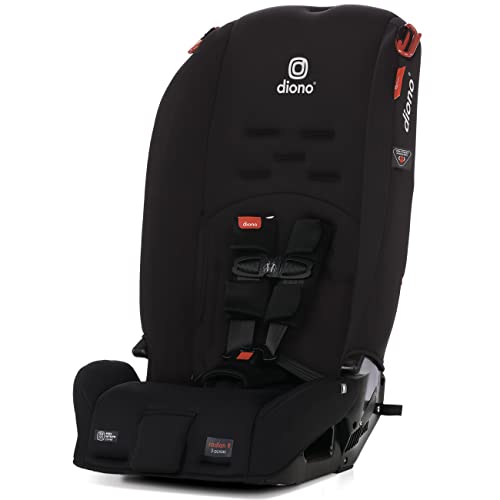
10 Years One Car Seat - from Birth to Booster (5 - 120 lb) it's all you will need. Grows with your child, ultimate protection on every road trip. 4 modes in 1 seat!
Rear-Facing, Forward-Facing, and Booster
A rear-facing seat beside a forward-facing seat sometimes fits because their shells widen at different heights. A booster may need the most hand space because the child must reach the buckle on every trip.
Do not automatically place the booster in the center. A narrow center cushion, an offset belt, a removable shoulder-belt connector, or covered buckle may make that position unsuitable. The lap and shoulder portions must lie correctly across the child without routing under an armrest or around another restraint unless the booster instructions require it.
Two Rear-Facing Seats and One Forward-Facing Seat
Check whether both rear-facing seats can maintain their required recline angles without forcing the driver or front passenger into an unsafe position. Contact between a rear-facing restraint and a front seat is allowed only when both vehicle and restraint instructions permit it.
Route the forward-facing seat’s top tether to the correct anchor. Do not connect it to a cargo tie-down or an adjacent tether anchor.
Three Harnessed Car Seats
This setup may offer easier buckle access because adults secure the harnesses rather than children reaching between boosters. However, each seat still needs an approved belt or lower-anchor path and enough room to tighten correctly.
Pro Tip: Test the widest or most difficult restraint first, usually the center seat or a rear-facing seat with a large base. Then add the other seats one at a time and recheck every installation.
How to Test a Three-Across Setup Safely
- Read both manuals. Confirm permitted seating positions, belt paths, lower-anchor spacing, tether routing, recline rules, and weight limits.
- Remove unapproved accessories. Do not place a cushion, thick mat, towel, buckle extender, or aftermarket padding under or behind a restraint unless the restraint manufacturer permits it.
- Install the center restraint first. Use either a permitted seat-belt installation or approved center lower-anchor method.
- Check movement at the belt path. The restraint should move less than one inch from side to side or front to back when tested with normal hand pressure.
- Add the two outboard restraints. Keep every belt, connector, buckle, and tether in its correct seating position.
- Check for interference. Confirm that one seat does not sit on another seat’s buckle, lower-anchor strap, belt, or connector.
- Test each installation independently. Remove the neighboring restraint and confirm that the remaining seat is still tight rather than being wedged in place.
- Verify daily usability. Make sure harness adjusters, infant-seat releases, booster buckles, and door-side access remain usable.
- Get the setup inspected. A certified Child Passenger Safety Technician can check the installation and teach you how to reproduce it.
Common RAV4 Car-Seat Installation Challenges
Families often focus on total bench width, but the difficult areas are usually the lower seat crease, buckle stalks, center-seat contours, and the space needed to tighten each installation. For 2013–2018 RAV4s, overlapping center/outboard belt geometry is an additional compatibility concern; for 2025 and 2026, published testing also found booster-buckle access or seat-shape issues that made three-across use harder.
Installation Challenges to Check
- Center belt geometry: A belt that begins from the roof or an offset point may affect routing and booster fit.
- Closely spaced buckles: An adjacent restraint may cover a booster buckle or press against a buckle release.
- Seat bolsters: Raised cushion edges may prevent a wide, flat base from sitting as intended.
- Anchor access: Lower anchors can be recessed between the seatback and cushion.
- Tether identification: Tether anchors on the seatback may sit near cargo hardware, so confirm the marked anchor in the manual.
- Front-seat clearance: A rear-facing restraint may limit driver or passenger positioning.
- Split-folding seatbacks: Confirm that each seatback is fully locked before installing a restraint.
When a Larger Vehicle May Work Better
A larger vehicle may be the better choice when your RAV4 cannot provide three independent installations, adults cannot access the children safely, or a booster rider cannot reach the buckle without moving the booster.
| Vehicle Type or Model | Why Families Consider It | What to Verify |
|---|---|---|
| Honda Odyssey | Sliding doors and movable second-row seating can improve access. | Anchor positions and whether removing or moving a seat affects the planned configuration. |
| Toyota Sienna | A minivan cabin can provide more room around installed restraints. | Second-row seating configuration, tether locations, and third-row access. |
| Chrysler Pacifica | Multiple rows and sliding-door access may simplify loading. | Whether floor-storage or folding-seat features affect restraint installation. |
| Kia Carnival | A wide cabin and minivan-style doors may offer easier access. | Trim-specific seat designs and lower-anchor locations. |
| Three-row SUVs | They can separate children across two rear rows. | Third-row tether availability, usable legroom, buckle access, and emergency exit paths. |
How Does the RAV4 LATCH System Work?
LATCH stands for Lower Anchors and Tethers for Children. Lower anchors can secure a compatible harnessed restraint instead of the vehicle seat belt. A top tether limits forward movement of a forward-facing restraint. NHTSA recommends using the tether with a forward-facing car seat when both the vehicle and restraint instructions permit it.
LATCH is not automatically safer than a correct seat-belt installation. Choose the method that is approved for the seating position and produces a tight, repeatable installation.
- Use one primary installation method: Use lower anchors or the seat belt, not both, unless both manufacturers explicitly permit combined use.
- Observe lower-anchor limits: Follow the limit printed on the car-seat label. If applicable, NHTSA’s general calculation subtracts the car seat’s weight from 65 pounds to determine the maximum child weight for lower-anchor use.
- Switch to a seat belt when required: A child may outgrow the lower-anchor limit before outgrowing the harness.
- Continue using the top tether: A forward-facing seat can normally use its tether with either a lower-anchor or seat-belt installation.
- Use the correct anchor: Do not confuse a tether anchor with a cargo hook or tie-down.
Which Car-Seat Measurements Matter in a RAV4?

Overall width is useful when comparing restraints, but it is only one measurement. Two seats with the same listed width can fit very differently because one is narrow at the base while the other is narrow only near the shoulders.
| Measurement or Feature | Why It Matters | What to Check |
|---|---|---|
| Base width | Determines how the restraint sits between buckles and cushion bolsters. | Measure the portion that contacts the vehicle seat. |
| Shell width and height | Adjacent shells may overlap at different heights. | Check shoulders, side wings, handles, and armrests. |
| Cup holders | Required cup holders can increase the installed width. | Remove them only if the restraint instructions say they are optional. |
| Rear-facing depth | A seat may fit across the bench but interfere with the front seat. | Test the required recline angle with the front seats in safe positions. |
| Belt-path location | The belt path determines where the restraint must be tight. | Confirm that the buckle does not enter a prohibited part of the belt path. |
| Booster buckle clearance | A child must buckle correctly without shifting the booster. | Have the child practice buckling and unbuckling before accepting the setup. |
Do not rely on a universal 17.5-inch or 18-inch cutoff. Compare current manufacturer dimensions, then test the actual restraints in your RAV4 before buying when the retailer permits it.
What to Watch for With Booster Seats in the RAV4
A booster does not simply need to fit on the cushion. It must position the vehicle’s lap-and-shoulder belt correctly while allowing the child to buckle without moving the booster out of place.
[Amazon Products Picked for You]

Rigorously Crash Tested: Graco ProtectPlus Engineered for maximum safety against frontal, rear, and rollover crashes.

2-in-1 Convertible Seat: From highback to backless booster to accommodate your growing child

3-in-1 harness booster helps protect your child, from toddler to youth
Seat Cushion and Head-Restraint Fit
- The booster should sit flat and contact the vehicle seat as required by its instructions.
- The vehicle seatback or head restraint must not push the booster forward unless that contact is permitted.
- Adjust or remove a vehicle head restraint only when the RAV4 manual and booster instructions permit it.
- Reinstall a removed head restraint before the position is used by an unrestrained passenger or as otherwise directed by Toyota.
- A backless booster requires adequate vehicle head support behind the child.
Buckle Access and Belt Routing
The child should be able to buckle the lap-and-shoulder belt without routing it around another restraint or accidentally releasing a neighboring seat belt. The lap belt should lie low across the upper thighs, while the shoulder belt should cross the chest and shoulder rather than the neck or face.
After buckling, confirm that the booster remains in its intended position and the belt moves freely through any belt guide. Teach the child not to lean, place the shoulder belt behind the back, or unbuckle another passenger’s restraint.
Pros and Cons of Using the RAV4 for Family Transport
| Advantages | Limitations |
|---|---|
| Three designated second-row seating positions | Three-across compatibility is not guaranteed |
| Outboard lower anchors on commonly owned model years | Center lower-anchor rules differ by year |
| Top-tether positions support forward-facing installations | Seatback anchors may require careful identification and access |
| Compact exterior size for daily driving | Less loading and buckle-access room than many minivans |
| Often practical for one or two restraints | A third restraint may require replacing otherwise usable seats |
Sources
- Toyota Manuals and Warranties — use the official Toyota lookup for the exact RAV4 model year and market before installing a restraint.
- 2026 Toyota RAV4 Brochure — lists lower anchors on the outboard rear seats and tether anchors on all rear seats.
- IIHS 2025 Toyota RAV4 evaluation — 2019–2025 LATCH positions, center borrowing, and anchor accessibility.
- IIHS 2018 Toyota RAV4 evaluation — two complete outboard LATCH positions and a center tether-only position for the evaluated 2015–2018 generation.
- Babylist vehicle/car-seat compatibility guidance — CPST-authored guidance on overlapping seat belts, including the 2013–2018 RAV4 as a compatibility example.
- Cars.com 2013 Toyota RAV4 Car Seat Check — standardized real-world fit check reporting room for two child seats.
- Cars.com 2025 Toyota RAV4 Hybrid Car Seat Check — standardized test in which three car seats did not fit across.
- Cars.com 2026 Toyota RAV4 Car Seat Check — follow-up test reporting ample room for two but not three across.
- NHTSA Car Seats and Booster Seats — installation methods, tether use, lower-anchor limits, and inspection help.
- NHTSA Right Seat guidance — restraint stages and proper belt fit.
- American Academy of Pediatrics car-seat guidance — restraint selection, rear-facing use, and transition guidance.
[Amazon Products Picked for You]

MADE TO BE WITH YOU FOR YEARS The Safety 1st Ellaris Convertible Car Seat is a 3 in 1 car seat that adapts to your growing little one with 3 modes of use, making Ellaris car seats a key piece of your family for years to come

🐕【Lifetime After-sale Service】 Worry-Free After-Sales Service. If you have any questions for our pet seat belts for car, please let us know!

【Quality Material】Molle panels for vehicles is made of rigid high-density polymer, including heavy-duty nylon straps and hoops as well as rough edges for added durability, strong load-bearing capacity, and durability
Related Guides
Frequently Asked Questions
Can I use an infant car seat in the RAV4’s back seat?
Yes. Install the infant seat rear-facing in a permitted second-row position using either an approved lower-anchor installation or the locked vehicle seat belt. Follow the infant-seat instructions for recline angle, handle position, front-seat clearance, and base installation.
Can three car seats fit in every Toyota RAV4?
No. Plan for two restraints unless you have test-fitted the exact three-seat combination. Cars.com did not fit three across in its standardized 2025 or 2026 RAV4 checks, and older generations have their own belt-geometry and anchor limitations.
Does the RAV4 have center-seat LATCH anchors?
It depends on the model year. IIHS shows center lower-anchor borrowing for 2019–2025 RAV4s, while 2015–2018 evaluations show a center tether but no center lower-anchor pair. Toyota’s 2026 specifications list lower anchors on the outboard rear seats and tether anchors on all rear seats, so verify the exact 2026 manual before using any center lower-anchor method.
What are the weight limits for car seats in a RAV4?
The restraint manufacturer sets the rear-facing, forward-facing, harness, and booster limits. Lower-anchor use has a separate limit shown on the restraint label or in its instructions. When required, subtract the car seat’s weight from 65 pounds to calculate the maximum child weight for lower-anchor installation.
Which car-seat brands are best for three across?
No brand is universally best. Compare the current model’s base width, shell shape, cup holders, belt path, rear-facing depth, and installation limits. Test the exact three-seat combination in your RAV4 rather than choosing from overall width alone.
Can I install a car seat with both LATCH and the seat belt?
Usually, no. Use either the lower anchors or the vehicle seat belt as the primary installation method unless both Toyota and the restraint manufacturer explicitly permit using both. A forward-facing top tether is separate and should normally be used with either approved method.
Is it safe to use a cushion or seat protector under a car seat?
Use only accessories permitted by the child-restraint manufacturer. Thick cushions, mats, towels, and aftermarket protectors can change the installation or hide movement. Toyota’s manual and the restraint instructions take priority.
Where can I get a RAV4 car-seat installation checked?
Use NHTSA’s car-seat inspection resources to locate a certified Child Passenger Safety Technician. A technician can check your exact seats and teach you how to install them correctly.
Conclusion
For most families, the practical planning answer is two child restraints in a Toyota RAV4. Three across should be treated as an exact-fit exception, not a promised capacity, especially because standardized checks did not fit three in the tested 2025 or redesigned 2026 RAV4.
If you need three children restrained across one row, bring the exact seats to the vehicle before buying or replacing restraints. Read both manuals, confirm the approved anchor and belt positions, test every seat independently, verify booster buckle access, and have a certified Child Passenger Safety Technician check any tight or complicated setup.
