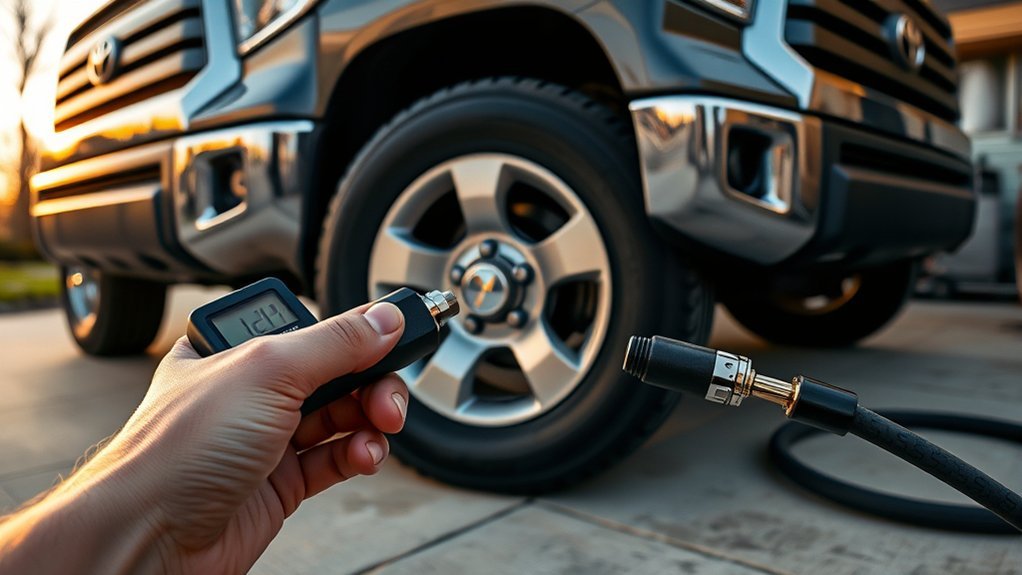
Your Toyota Tundra’s Tire Pressure Monitoring System can warn you about significant underinflation, but it does not replace a cold-tire check with an accurate gauge. The correct pressure is printed on the Tire and Loading Information label inside the driver’s door area. Use that value instead of a generic PSI range or the maximum pressure molded into the tire sidewall.
Quick Answer
Check your Toyota Tundra’s tire pressure when the tires are cold. Compare each reading with the driver-door placard, then add or release air as needed. Use the dashboard TPMS display if your truck shows individual readings, but confirm the pressure with a separate gauge.
Key Takeaways
- Use the cold-pressure values on your Tundra’s door-jamb label, not a generic 32, 34, or 36 PSI recommendation.
- Check every tire with an accurate gauge at least once a month and before long trips.
- A steady TPMS light usually means at least one tire is significantly underinflated.
- A TPMS light that flashes for about a minute and then stays on indicates a system malfunction.
- Check the spare and any trailer tires separately because they may not appear on the truck’s dashboard display.
At a Glance
| Time Required | About 10 to 15 minutes |
| Difficulty | Easy |
| Tools Needed | Accurate tire-pressure gauge and an air compressor or service-station air pump |
| Cost | Usually free if you already own a gauge and air source; public air-pump fees vary |
Understanding the Importance of Tire Pressure for Your Tundra
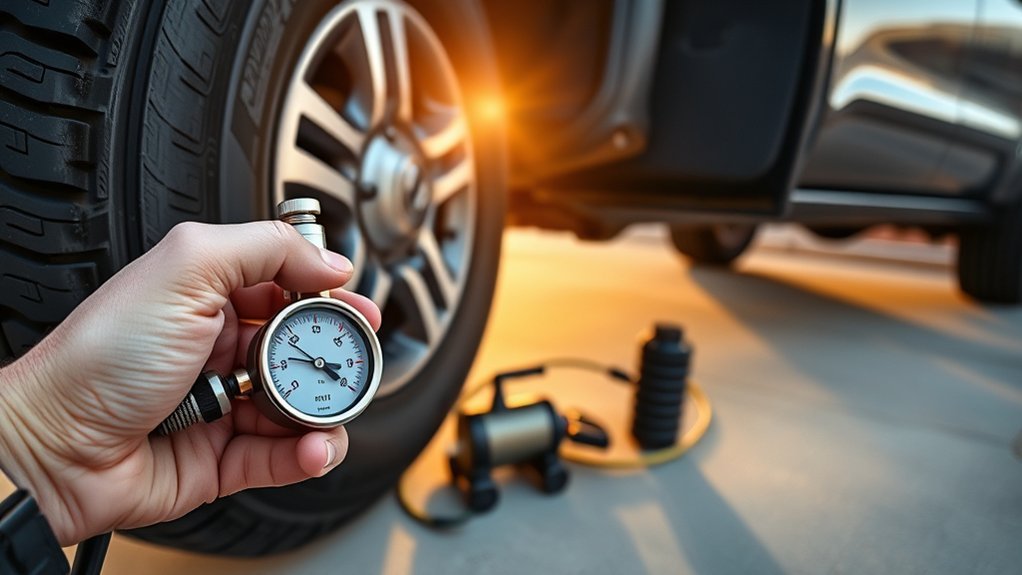
Correct tire pressure supports predictable steering, braking, ride quality, fuel economy, and even tread wear. A tire that is substantially underinflated flexes more than intended, which creates heat and increases the risk of tire damage or failure.
Excessive pressure can make the ride harsher, reduce the tire’s ability to absorb impacts, and contribute to center tread wear. The safest target is neither a guessed range nor the sidewall maximum. It is the vehicle manufacturer’s recommended cold pressure.
The National Highway Traffic Safety Administration recommends checking all tires at least once a month when they are cold. TPMS is useful, but its warning may not appear until a tire is already significantly underinflated.
Your Tundra’s TPMS is an early-warning system, not a substitute for a monthly check with an accurate pressure gauge.
Find the Correct Tire Pressure Before You Begin
Open the driver’s door and locate the Tire and Loading Information label on the door jamb or door edge. It lists the original tire size and the recommended cold inflation pressure for the front and rear tires.
The listed front and rear pressures may be the same, but you should not assume they are. Follow the values printed on your specific truck because tire size, configuration, and certification details can vary.
Warning: Do not use the maximum pressure molded into the tire sidewall as your normal target. That number is associated with the tire’s maximum rated load conditions, not the vehicle manufacturer’s recommended operating pressure.
If the label is missing, damaged, or unreadable, use the pressure specification in the correct Toyota owner’s manual. Toyota provides a 2020 Tundra manuals and warranties page for model-specific information.
Navigating Your Tundra’s Steering-Wheel Controls for Tire Pressure
Some Toyota Tundra gauge clusters can show individual tire-pressure readings in the multi-information display. If your truck has this feature, use the meter-control switches on the steering wheel to move through the available information screens.
The exact icons, switch layout, and available screens can differ by trim and equipment. Do not look for a button that physically sets the tire pressure. The steering-wheel controls only change the information shown on the dashboard.
| Action | What to Do |
|---|---|
| Start the truck | Park safely, start the engine, and keep your attention on the display while stationary. |
| Cycle the display | Use the steering-wheel meter controls to move through the multi-information screens. |
| Open the tire screen | Select the tire-pressure screen if it is available on your truck. |
| No numerical screen | Check all tires manually. A warning-only system may not identify the affected tire. |
If your display does not show individual numbers, that does not necessarily mean the system has failed. Your truck may provide only a low-pressure warning lamp, or the display may need updated sensor information.
Step-by-Step Guide to Checking and Setting Tundra Tire Pressure
The dashboard can help you spot a problem, but an accurate handheld gauge is the best tool for setting pressure. Perform the following procedure before driving or after the truck has been parked for at least three hours.
- Park on level ground. Set the parking brake and allow the tires to cool.
- Read the door-jamb label. Write down the specified cold pressure for the front and rear tires.
- Remove the first valve cap. Keep it in a clean place so dirt does not enter the valve.
- Press the gauge firmly onto the valve stem. A brief hiss is normal, but reseat the gauge if air continues escaping.
- Compare the reading with the placard. Do not compare it with the tire sidewall maximum.
- Add or release air. Add air in short bursts if the pressure is low. Press the valve core briefly if the pressure is high.
- Measure again. Continue adjusting until the cold reading matches the specified value.
- Reinstall the valve cap. Repeat the process for every road tire and check the spare separately.
Pro Tip: Keep a quality gauge in the glove box. Public air-pump gauges can receive heavy use, so checking with your own gauge helps you get consistent readings.
If a tire is visibly flat, has exposed cords, a bulge, a deep cut, or rapidly loses air, do not treat inflation as a complete repair. Install the spare when safe to do so or contact roadside assistance.
[Amazon Products Picked for You]
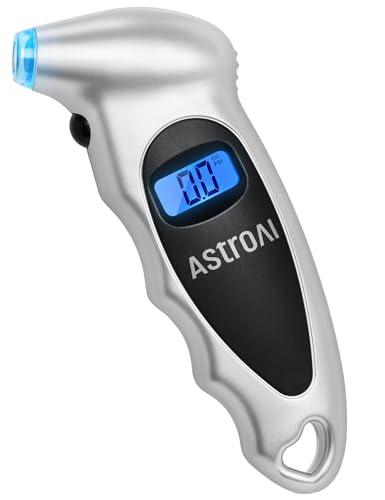
Accurate, Dependable Readings: Factory‑calibrated to ±1 PSI, so you can confidently match your vehicle’s recommended PSI (check the door jamb sticker). Ideal for monthly checks and road trips — consistent results every time, cold or warm.

EXPERT-GRADE CALIBRATION: Each AstroAI Tire Pressure Gauge is calibrated with professional-grade tools, ensuring quick and accurate measurement results within plus-minus 1PSI. Stay prepared for any roadside emergency and travel with peace of mind.

TRUSTED BY OVER 3 MILLION USERS: Based in Garden Grove, California, AstroAI serves customers in more than 15 countries worldwide. Known for professional-grade accuracy and durable construction, this digital tire inflator with gauge is a trusted choice for drivers, mechanics, and DIYers who rely on dependable tools.
Waiting for Tire-Pressure Readings to Appear
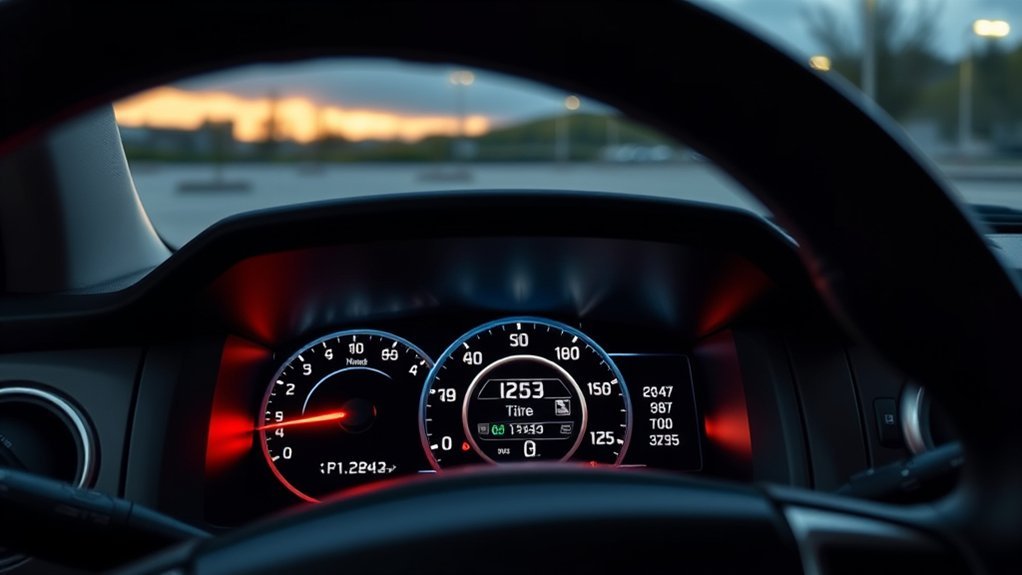
Your dashboard may not show fresh pressure readings immediately after startup, inflation, tire rotation, or sensor service. Direct TPMS sensors often conserve battery power while the vehicle is parked, so the system may need a short drive before it receives updated data.
Do not rely on a fixed two-minute rule. Update time can vary with sensor condition, vehicle movement, temperature, and whether the sensor IDs are correctly registered.
Note: Blank dashes or missing numbers are not permission to skip the manual check. Measure every tire with a gauge before driving if you suspect low pressure.
After adjusting the tires to the placard values, drive normally for a short distance in a safe area. If the display remains blank or the warning light stays on, stop and recheck the pressures manually.
Interpreting Tire-Pressure Readings
Dashboard numbers and handheld-gauge readings are measured in pounds per square inch, commonly written as PSI. Interpret each reading by comparing it with the cold-pressure value for that axle on your truck’s label.
| Reading | Meaning and Response |
|---|---|
| Below the placard value | Add air and check for damage or leakage. A repeated loss suggests a puncture, valve problem, bead leak, or wheel damage. |
| Matches the placard value when cold | The tire is set to the manufacturer’s specified cold pressure. |
| Above the placard value when cold | Release a small amount of air and recheck. Excess pressure can affect ride, grip, and wear. |
| Higher after driving | Some increase is normal as tires warm. Do not bleed a warm tire down to the cold specification. |
| One tire keeps dropping | Have the tire and wheel inspected for a leak instead of repeatedly adding air. |
Identifying Common Tire-Pressure Issues in Your Tundra
Most Tundra tire-pressure concerns fall into three groups: genuine underinflation, delayed or missing sensor information, and a TPMS malfunction. The warning lamp’s behavior provides an important clue.
[Amazon Products Picked for You]

[Accurate Real-time Monitoring & Multi-Alert System]: Tymate TM7 tpms sensor can be used to monitor your tires’ pressure and temperature data within robust accuracy of ±1.5 PSI or ±3°F (The units can be displayed as ℃ or ℉ & BAR or PSI). Designed with six distinct alarm modes: high/low pressure, fast leakage, high temperature, sensor low battery, and sensor signal lost. This system is a reliable tool for maintaining tire health, and it is especially beneficial for DIY enthusiasts and pre-owned vehicle markets, where constant vigilance on tire conditions is paramount for safety and vehicle longevity

Application: Marsflex tire sensors are compatible for Toyota Sequoia Sienna Tundra. 2008 2009 2010 2011 2012 2013 2014 2015 2016 2017 Toyota Sequoia| 2007 2008 2009 2010 2011 2012 2013 2014 2015 2016 2017 2018 2019 2020 Toyota Sienna| 2007 2008 2009 2010 2011 2012 2013 2014 2015 2016 2017 Toyota Tundra

HIGH ACCURACY: Every ETENWOLF's pencil tire gauge is calibrated to ANSI B40.1 Grade B, it is accurate to 2% of span in the middle 50% of range and 3% of span in the lower and upper 25% of range. Each ETENWOLF pencil tire pressure gauge is manually calibrated and has its unique calibration number printed on the pencil
Low Tire-Pressure Warning
A TPMS symbol that comes on and stays illuminated generally means at least one monitored tire is significantly underinflated. Reduce speed, avoid sharp maneuvers, and stop in a safe location to inspect the tires.
Check all tires with a gauge because a warning-only system may not tell you which tire is low. Inflate each tire to the applicable cold-pressure value. If one tire is much lower than the others, inspect it for a puncture or damage.
Cold weather can also cause a marginally low tire to cross the warning threshold. The light may turn off as the tire warms, but you should still correct the cold pressure rather than ignoring the warning.
TPMS Sensor Activation Delay
Individual readings may be delayed after the truck has been parked or after the tires have been serviced. A short drive may allow the sensors to transmit updated data.
| Symptom | Possible Cause | What to Do |
|---|---|---|
| Blank pressure display | Sensors have not sent fresh data, or the feature is not available | Check manually and consult the correct owner’s manual. |
| Old reading after inflation | Display has not updated | Drive briefly, then compare the display with a gauge. |
| One tire has no reading | Sensor, battery, registration, or communication issue | Have a qualified tire shop or Toyota dealer test the system. |
| Display differs slightly from a gauge | Timing, temperature, or normal gauge tolerance | Use one accurate gauge and check all tires under the same cold conditions. |
Incorrect Tire Pressure or a TPMS Malfunction
A steady warning and a flashing warning do not mean the same thing. Use the following distinction before deciding what to do:
- Steady TPMS light: Check all tire pressures promptly and inspect for damage.
- Flashes for roughly 60 to 90 seconds, then stays on: The monitoring system has detected a malfunction and needs inspection.
- Returns after proper inflation: Recheck the cold pressure and look for a slow leak.
- Appears after new wheels or sensors: The replacement sensors may need compatible parts, ID registration, or service.
The truck’s factory TPMS should not be assumed to monitor trailer tires. Check trailer pressure with a separate gauge or use a suitable trailer TPMS designed for the trailer.
Adjusting Tire Pressure for Safe Performance
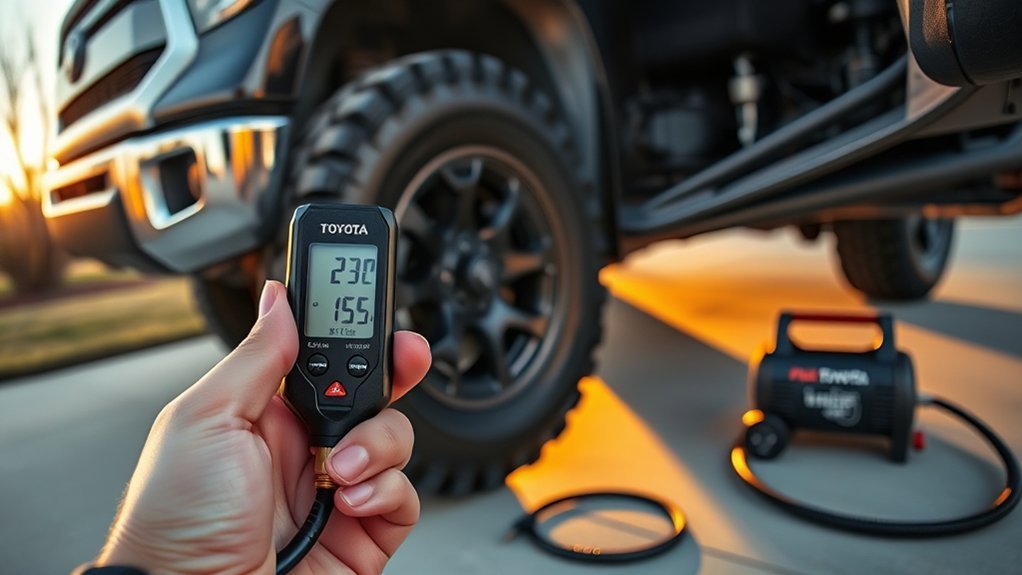
Adjust the tires to the manufacturer’s cold specification rather than creating your own light-load, standard-load, or heavy-load target. The placard pressure already reflects the vehicle manufacturer’s certified tire and loading requirements.
If you have changed tire size, wheel size, load rating, or suspension components, do not guess at a new pressure. Consult a qualified tire professional who can evaluate the replacement tire’s load capacity and the truck’s axle requirements.
[Amazon Products Picked for You]

INDUSTRIAL-GRADE DURABILITY: LUMITECO heavy-duty tire pressure gauge features a solid brass core, zinc alloy chucks for airtight seals. The stainless steel body resists rust and drops, while the built-in hanging ring ensures easy storage in toolboxes or glove compartments. Each 2-pack comes with 4 bonus valve cores and 4 bonus valve caps for quick replacements.

PROCESS LEVEL ACCURACY: This heavy duty tire pressure gauge is calibrated manually to ANSI B40.1 Grade A (±1% of span)

RUGGED DESIGN: The stainless steel components prevent rust and corrosion while the precision-crafted nozzle seamlessly seals onto the valve stems for highly accurate readings (±2% span). We also provide 4 valve stem caps for convenient replacement.
Ideal Tire-Pressure Levels
The ideal cold pressure is the pressure listed on your specific Tundra, not one universal number for every model. Use this decision table:
| Situation | Pressure Guidance |
|---|---|
| Factory-size tires | Use the cold front and rear values on the door-jamb placard. |
| Same-size replacement tires | Continue using the placard specification unless Toyota or a qualified professional provides different guidance. |
| Different tire or wheel size | Have the required pressure and load capacity evaluated professionally. |
| Towing or carrying cargo | Stay within payload, axle, tire, and towing limits. Do not invent a higher pressure unless supported by Toyota and the tire’s load data. |
Seasonal Pressure Adjustments
Air pressure changes as ambient temperature changes. A tire adjusted correctly during warm weather can read lower after a cold front, while a cold tire can read higher as the day becomes warmer.
Check the tires when seasons change and whenever temperatures move sharply. Always compare a cold reading with the placard instead of releasing air from a tire simply because its warm reading is higher.
Monitoring Tire Pressure Regularly
Check every road tire at least once a month and before long drives, towing trips, or heavy hauling. Include the spare in your routine even if it does not appear on the dashboard.
Look for nails, screws, cracking, cuts, bulges, valve-stem damage, and uneven tread wear while checking pressure. A tire that repeatedly loses air needs repair or replacement, not another temporary top-up.
When to Get Professional Help With Tire Pressure
Contact a qualified tire technician or Toyota dealer when the problem involves more than a normal pressure adjustment. Professional diagnosis is appropriate in these situations:
- The warning flashes before staying on. This pattern indicates a TPMS malfunction.
- A tire repeatedly loses pressure. The tire, valve, bead, or wheel may be leaking.
- One or more readings remain missing. A sensor battery, sensor ID, receiver, or compatible part may be involved.
- The warning stays on after a correct cold-pressure check. The system or a tire may require further inspection.
- New wheels or sensors were installed. The sensor IDs may need to be registered with the vehicle.
- A tire has a bulge, deep cut, exposed cords, or impact damage. Do not continue driving on a visibly unsafe tire.
- You changed tire size or load rating. A professional should confirm safe load capacity and inflation requirements.
Tips for Regular Tire-Pressure Monitoring
| Action | Frequency | Why It Helps |
|---|---|---|
| Check all road tires cold | At least monthly | Finds gradual pressure loss before the TPMS warning appears. |
| Check before a long trip | Before departure | Reduces the chance of starting a trip with an underinflated tire. |
| Check the spare | Monthly or with routine maintenance | Keeps the spare ready even when it is not monitored by TPMS. |
| Inspect for damage | Every pressure check | Finds punctures, cuts, bulges, and abnormal wear early. |
| Check after a major temperature change | As needed | Keeps the cold pressure aligned with the placard as seasons change. |
| Service a recurring leak | Immediately | Prevents repeated pressure loss from becoming a roadside failure. |
Why Proper Tire Pressure Matters for Safety and Efficiency
Inflation pressure affects how the tire supports the truck, contacts the road, handles heat, and wears over time. Keeping every tire at its specified cold pressure supports more consistent performance.
Enhanced Vehicle Handling
Underinflation changes the shape of the tire’s contact patch and increases sidewall flex. That can make steering feel less precise and can affect stability during braking, cornering, towing, or emergency maneuvers.
Correct pressure also helps the front and rear tires respond as Toyota intended. Pressure cannot compensate for worn tread, overloading, poor alignment, or unsuitable tires, but it is a basic requirement for predictable handling.
Improved Fuel Efficiency
Underinflated tires create additional rolling resistance. According to FuelEconomy.gov, gas mileage may fall by about 0.2% for each 1 PSI drop in the average pressure of all tires.
Keeping tires properly inflated improves fuel economy by about 0.6% on average and by up to 3% in some cases. The result depends on how underinflated the tires were and how the truck is driven.
| Pressure Condition | Likely Effect |
|---|---|
| Correct cold pressure | Supports intended rolling resistance, handling, and wear. |
| Underinflated | Increases rolling resistance and can reduce fuel economy. |
| Overinflated | Can produce a harsher ride and abnormal wear; it is not a safe fuel-saving strategy. |
Increased Tire Longevity
Underinflation commonly increases shoulder wear, while excessive pressure can contribute to wear near the center of the tread. Correct pressure helps distribute the load more evenly across the tire.
NHTSA reports that proper inflation can extend average tire life by about 4,700 miles. Actual results depend on alignment, rotation, road conditions, driving habits, load, and tire construction.
- Measure monthly. Do not wait for a warning light.
- Use the placard values. Avoid generic pressure charts.
- Inspect the tread. Look for uneven wear that may indicate inflation, alignment, or suspension problems.
- Rotate as specified. Follow the maintenance schedule and tire-manufacturer restrictions.
- Repair leaks promptly. Repeated inflation is not a permanent solution.
Related Guides
Frequently Asked Questions
How do I check my Toyota Tundra’s tire pressure on the dashboard?
Start the truck while safely parked and use the steering-wheel meter controls to cycle through the multi-information display. Select the tire-pressure screen if your gauge cluster provides one. If no numerical screen appears, check every tire with a handheld gauge.
Does every Toyota Tundra show individual tire pressures?
No. Display features can differ by model year, trim, gauge cluster, market, and equipment. Some trucks show individual readings, while others primarily provide a low-pressure warning lamp. Consult the correct Toyota owner’s manual for your truck.
Where can I find the correct Toyota Tundra tire pressure?
Use the Tire and Loading Information label inside the driver’s door area or the correct owner’s manual. Do not use the maximum PSI printed on the tire sidewall as the truck’s recommended operating pressure.
How do I know which tire is low?
An individual-pressure display may identify the affected tire. If your truck only shows a warning lamp, or if the screen is blank, measure all tires with a gauge. Do not judge pressure by appearance because a tire can be significantly low without looking flat.
Why is the TPMS light still on after I added air?
One or more tires may still be below the placard value, the system may not have updated, or a tire may have a slow leak. Check all tires cold with a gauge, adjust them correctly, and drive briefly. Seek service if the warning remains or returns.
What does a flashing Toyota TPMS light mean?
If the light flashes for roughly 60 to 90 seconds and then remains illuminated, the TPMS has detected a malfunction. The sensors, sensor batteries, registered IDs, receiver, or related components may require professional diagnosis.
Conclusion
Check your Toyota Tundra’s tire pressure with an accurate gauge when the tires are cold, then adjust each tire to the value on the driver-door placard. Use the TPMS display as a helpful warning and monitoring tool, but do not rely on it as your only pressure check.
Investigate repeated pressure loss, flashing warnings, missing sensor readings, or visible tire damage promptly. A consistent monthly routine helps protect handling, tire life, fuel economy, and roadside safety.
Sources
- Toyota 2020 Tundra Manuals and Warranties — model-specific owner documentation and feature guidance
- NHTSA TireWise — cold-pressure checks, placard guidance, TPMS warnings, tire safety, and maintenance frequency
- FuelEconomy.gov: Keeping Your Vehicle in Shape — government estimates for tire pressure and fuel economy
- Michelin Tire Pressure Guide — cold-pressure measurement, monthly checks, gauge use, and placard guidance