
Your Toyota Tacoma’s driver-side door opening contains the ratings you need before carrying passengers, loading the bed, or connecting a trailer. The certification label shows GVWR and front and rear GAWR, while the nearby Tire and Loading Information placard shows the combined occupant-and-cargo limit and recommended cold tire pressures. Read both labels because advertised maximums may not match your truck’s exact configuration.
Quick Answer
Open the driver’s door and find the certification label plus the Tire and Loading Information placard. Use the occupant-and-cargo limit as your starting payload figure, then subtract the driver, passengers, added accessories, cargo, hitch equipment, and trailer tongue weight. Stay under GVWR and both axle ratings.
Key Takeaways
- The certification label lists GVWR and front and rear GAWR.
- The Tire and Loading Information placard lists the maximum combined weight of occupants and cargo.
- The driver, passengers, permanent accessories, cargo, hitch equipment, and tongue weight all consume capacity.
- Your door labels do not provide the truck’s configuration-specific tow rating or GCWR.
- A public vehicle scale is the most reliable way to verify total and axle weights after modifications or loading.
At a Glance
| Time Required | 10 to 20 minutes for the labels and calculation; longer if you visit a scale |
| Difficulty | Easy |
| Tools Needed | Phone or notepad, calculator, tire-pressure gauge, and access to a vehicle scale when needed |
| Cost | Free for a label calculation; a public scale may charge a weighing fee |
Read Your Tacoma Door Labels First
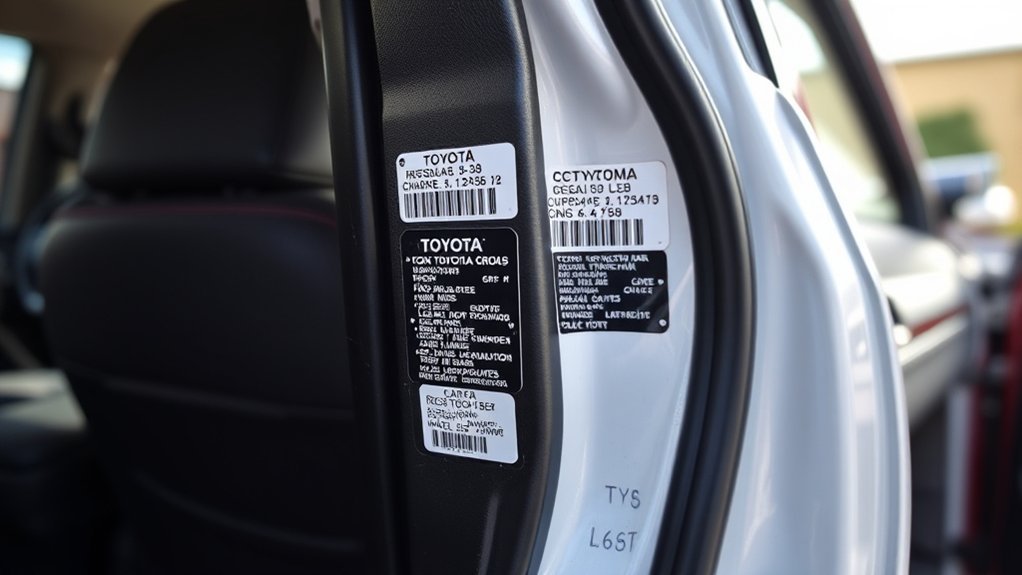
People often call everything in the driver’s door opening the “door-jamb sticker,” but you will normally find two types of information. The federal certification label identifies the truck and provides its certified weight ratings. A nearby Tire and Loading Information placard provides the occupant-and-cargo limit, original tire sizes, seating capacity, and recommended cold inflation pressures.
The labels apply to the truck as manufactured or certified. They are more useful than a general Tacoma advertisement because capacities vary with cab style, bed length, drivetrain, trim, suspension, powertrain, and equipment. Toyota’s launch information for the 2024 Tacoma, for example, announced a maximum payload of 1,709 pounds on a TRD Off-Road configuration and a maximum towing capacity of 6,500 pounds on specified SR5 i-FORCE and TRD PreRunner XtraCab grades. Those lineup maximums do not apply to every Tacoma.
Warning: Do not use a brochure’s maximum payload or towing figure unless it matches your Tacoma’s model year, cab, bed, drivetrain, powertrain, trim, equipment, and towing requirements.
Find GVWR, GAWR, Payload, and Tire Pressure
Locate the Two Labels
Open the driver’s door and inspect the B-pillar, door-latch post, and door edge. Federal certification rules require the manufacturer’s label to be placed near the driver’s seating position where it can be read after opening the door. That label includes the vehicle identification number, GVWR, and a GAWR for each axle.
The Tire and Loading Information placard is normally on the driver-side B-pillar or door edge. It includes wording that states the combined weight of occupants and cargo should never exceed a vehicle-specific number. It also shows the recommended cold inflation pressure and original tire-size information.
| Label or Placard | What It Shows | How You Use It |
|---|---|---|
| Certification label | GVWR, front GAWR, rear GAWR, VIN, manufacturer, and manufacture date | Check the truck’s total weight and the weight carried by each axle |
| Tire and Loading Information placard | Combined occupant-and-cargo limit, seating capacity, tire sizes, and cold tire pressures | Calculate how much capacity remains after people, accessories, cargo, and tongue weight |
| Owner’s manual | Tow rating, GCWR, towing equipment, trailer-loading guidance, and warnings | Confirm whether the truck and trailer combination is permitted |
Read Each Weight Rating Correctly
- GVWR: The maximum permitted weight of the loaded truck. It includes the truck, occupants, cargo, accessories, hitch equipment, and the trailer load carried by the truck.
- Front GAWR: The most weight the front axle is rated to support.
- Rear GAWR: The most weight the rear axle is rated to support.
- Occupant-and-cargo limit: The combined amount available for the driver, passengers, cargo, and equipment added after certification.
- Cold tire pressure: The vehicle manufacturer’s recommended pressure before driving has heated the tires.
GVWR and GAWR are separate limits. Staying below GVWR does not prove that the rear axle is within its rating. A heavy tongue load, bed load, or cargo placed behind the rear axle can overload the rear axle while the truck’s total weight remains below GVWR.
Note: The maximum pressure molded into a tire’s sidewall is not automatically the correct everyday pressure. Use the Tacoma’s placard pressure for the original tire setup unless Toyota or a qualified tire professional provides different instructions for an approved replacement setup.
Curb Weight, Payload, Tongue Weight, and GCWR
These terms describe different parts of the loading calculation. Mixing them together can produce an unsafe result.
| Term | Meaning | What Counts Toward It |
|---|---|---|
| Curb weight | The vehicle with standard equipment and required fluids, including fuel, but without occupants or cargo | The truck and equipment included in the applicable curb-weight definition |
| Payload or occupant-and-cargo capacity | The capacity available above the truck’s own weight | Driver, passengers, cargo, post-certification accessories, hitch equipment, and tongue weight |
| Tongue weight | The downward load the connected trailer applies to the truck | It consumes payload and commonly adds substantial load to the rear axle |
| Tow rating | The maximum trailer weight permitted for a specified vehicle configuration and equipment setup | Trailer, cargo in the trailer, fluids, batteries, propane, and installed trailer equipment |
| GCWR | The maximum combined weight of the loaded truck and loaded trailer | Everything in and on the truck and trailer |
The driver is not excluded from the occupant-and-cargo calculation. Every person in the cab consumes part of the placard limit. You must also count equipment such as a topper, bed rack, winch, skid plates, running boards, toolbox, larger spare tire, recovery gear, hitch receiver accessories, and weight-distributing-hitch components when they were added after the vehicle’s certified loading figure was established.
Calculate Your Remaining Payload Step by Step
The simplest method starts with the occupant-and-cargo limit printed on the Tire and Loading Information placard.
- Write down the placard’s maximum combined occupant-and-cargo figure.
- Subtract the driver and every passenger.
- Subtract accessories and permanent equipment added after certification.
- Subtract all cargo in the cab and bed.
- If towing, subtract the hitch equipment and actual trailer tongue weight.
- Confirm the result is positive, then verify GVWR and both GAWR values with scale weights when the load is substantial.
Formula: Remaining capacity = placard occupant-and-cargo limit − occupants − added equipment − cargo − hitch equipment − tongue weight.
Worked Payload Example
The numbers below are examples only. Your labels and scale ticket control your actual calculation.
| Item | Example Weight |
|---|---|
| Placard occupant-and-cargo limit | 1,350 lb |
| Driver and passengers | −390 lb |
| Topper, toolbox, and other added equipment | −140 lb |
| Cargo | −250 lb |
| Hitch equipment and measured tongue weight | −450 lb |
| Remaining capacity | 120 lb |
This example leaves only 120 pounds. Adding another passenger, a cooler, firewood, or more trailer tongue weight would exceed the placard limit unless other weight were removed.
Pro Tip: Keep a simple weight list for permanent accessories and commonly carried equipment. You can update the calculation quickly before each trip instead of rebuilding it from memory.
Use Scale Weights to Check GVWR and GAWR
A scale ticket is especially useful when the Tacoma has a topper, winch, rack, armor, larger spare tire, permanently stored tools, or other modifications. Weigh the truck in the condition you plan to drive it, including people, fuel, cargo, hitch equipment, and the connected trailer when applicable.
- Total GVWR margin: GVWR − actual total truck weight.
- Front axle margin: Front GAWR − actual front axle weight.
- Rear axle margin: Rear GAWR − actual rear axle weight.
Your usable margin is controlled by the first rating you reach, not by the largest number remaining in a different category.
For example, a scale ticket may show that the truck remains below GVWR but has very little rear-axle capacity left. In that situation, the rear GAWR limits additional bed cargo or tongue weight.
How Options and Add-Ons Reduce Available Capacity
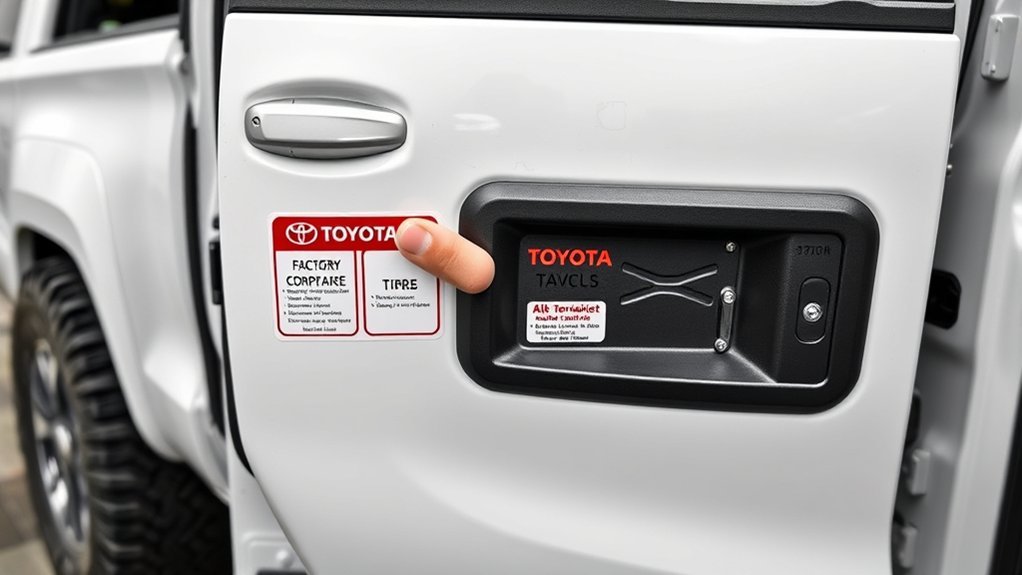
The door placard is intended to reflect the truck in its certified condition, not an imaginary base Tacoma. However, equipment added later reduces the capacity that remains for people, cargo, and trailer tongue weight.
Common additions include:
- Truck caps, camper shells, tonneau covers, bed slides, and drawer systems
- Bed racks, roof racks, rooftop tents, awnings, and recovery boards
- Winches, steel bumpers, skid plates, rock sliders, and additional recovery points
- Toolboxes, compressors, auxiliary batteries, fuel containers, and stored tools
- Larger wheels, tires, spare-tire carriers, and full-size spare tires
- Hitch receivers, ball mounts, weight-distributing-hitch components, and sway-control hardware
Each added pound generally removes a pound from the truck’s remaining capacity. Equipment mounted behind the rear axle can also place more than its own static weight on the rear axle by shifting weight away from the front axle.
Warning: Helper springs, airbags, shocks, suspension lifts, or higher-capacity replacement tires may improve a particular handling or tire characteristic, but you should not assume they increase Toyota’s certified GVWR or GAWR.
[Amazon Products Picked for You]

Classic Design: This overland bed cargo rack is compatible with mid-size trucks includes Ranger, Gladiator, Tacoma, it accommodates different bed lengths
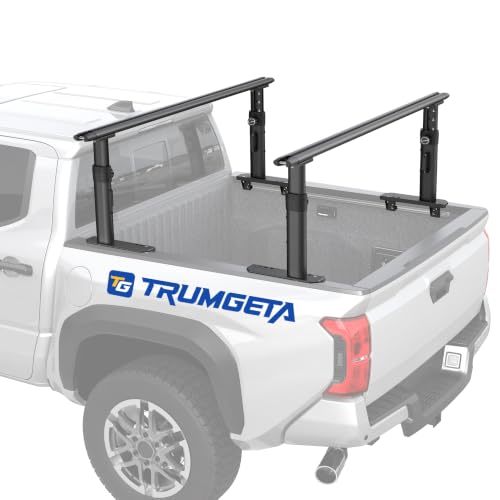
Durable & Heavy-Duty Construction: Crafted from rust-resistant aluminum, the rack’s overall structure is both lightweight and exceptionally sturdy. It resists corrosion, supports up to 800 lbs when stationary (and 600 lbs in motion), and features a weather-resistant coating for long-lasting performance in any environment

COMPATIBLE: OTHOWE ladder rack compatible with Chevy Colorado, GMC Canyon, Nissan Frontier, Toyota Tacoma, Ford F-150/F-250/F-350 Super Duty, Toyota Tundra, Dodge Ram 1500/Ram 2500/Ram 3500, Chevy Silverado, GMC Sierra 1500, Nissan Titan, 2016-2024 Titan XD, Jeep Gladiator JT.
Tacoma Towing: Tongue Weight, Tow Rating, and GCWR
You cannot determine your Tacoma’s towing capacity from the door labels alone. Use Toyota’s owner’s manual or official towing information for the exact model year and configuration. Then check every applicable limit rather than relying only on the advertised trailer rating.
[Amazon Products Picked for You]
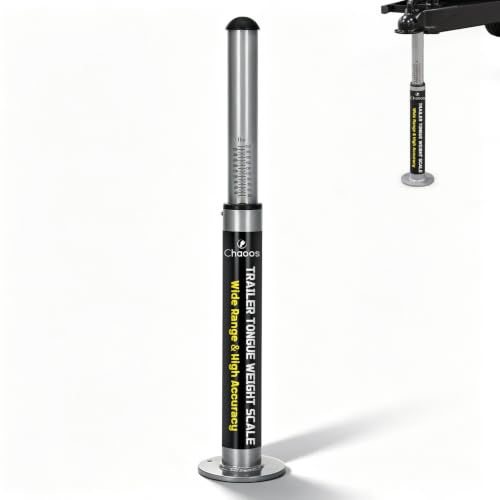
【Wide Range & High Accuracy】The Chaoos trailer tongue weight scale measures up to 2100 lbs with an accuracy within ±20 lbs, helping ensure proper tongue weight for safer towing and reduced trailer sway.

Digital battery-powered LED display offers fast, easy-to-read measurements.

【Professional-Grade Accuracy & Durability】Engineered for professionals and meticulous owners, this scale combines an industrial Q235 steel structure with a military-grade spring mechanism for lab-like precision up to 1800 lbs. Its finish undergoes a rigorous 300-hour salt spray test, offering exceptional corrosion and abrasion resistance for use in marinas, construction sites, farms, or frequent highway travel.
Check These Limits Before Towing
- Tow rating: The loaded trailer must stay within the rating for your exact Tacoma configuration.
- GCWR: The loaded truck and loaded trailer together must remain below the stated combined rating.
- Occupant-and-cargo capacity: People, truck cargo, hitch equipment, and tongue weight must remain within the placard limit.
- GVWR: The loaded truck, including the trailer load carried by the hitch, must remain below GVWR.
- Front and rear GAWR: Neither measured axle weight may exceed its rating.
- Trailer ratings: The trailer’s GVWR, axle ratings, tire ratings, coupler, hitch ball, and safety equipment must also be adequate.
Conventional trailers often use a tongue-weight target expressed as a percentage of loaded trailer weight, but the correct range depends on the trailer design and manufacturer instructions. Follow the Tacoma manual and trailer manufacturer instead of assuming one percentage fits every trailer. Measure tongue weight after the trailer is fully loaded because batteries, propane cylinders, water, tools, and cargo placement can change it significantly.
For illustration, a loaded trailer weighing 5,000 pounds with 600 pounds of measured tongue weight places that 600-pound load on the truck. The ball mount and other hitch components also consume capacity. You must then add the occupants, bed cargo, cab cargo, and accessories before checking the placard, GVWR, and rear GAWR.
How to Verify the Truck and Trailer at a Scale
- Load the truck and trailer exactly as they will travel.
- Weigh the connected combination with the truck’s front axle, rear axle, and trailer axles on separate scale platforms when available.
- Compare the truck’s axle weights with front and rear GAWR.
- Add the truck’s axle weights and compare the result with GVWR.
- Add all axle weights and compare the result with GCWR.
- When practical, obtain a second truck-only weight without changing passengers or truck cargo. The difference between the truck’s connected and disconnected weights helps verify how much trailer load is being carried by the truck.
A weight-distributing hitch can change how tongue load is shared among the truck’s front axle, rear axle, and trailer axles. It does not make the tongue load disappear or create additional payload. Follow Toyota’s and the hitch manufacturer’s setup instructions.
Weigh Your Tacoma, Check the Tires, and Load Safely
Complete these checks before a heavily loaded trip or towing journey:
- Photograph the certification label and Tire and Loading Information placard so you can read the numbers clearly.
- Confirm the exact towing and GCWR information in the correct Toyota manual.
- List the weight of every occupant, permanent accessory, cargo item, hitch component, and measured tongue load.
- Place heavy cargo low, centered, and as far forward in the bed as practical without overloading the front axle.
- Secure cargo so it cannot slide, become airborne, or change axle loading during braking and turns.
- Check the tires when cold and inflate them to the pressure shown on the placard unless Toyota provides different approved instructions.
- Inspect tire condition, load rating, lug-nut security, hitch hardware, safety chains, wiring, brakes, and trailer breakaway equipment.
- Use a scale to verify total and axle weights whenever the margins are close or the truck has substantial added equipment.
NHTSA describes cold tires as tires that have not been driven for at least three hours. Check pressure before travel rather than releasing air from warm tires simply because the warm reading exceeds the cold placard figure.
[Amazon Products Picked for You]

Enhanced Visibility in Low Light: Features a green backlit LCD screen and integrated flashlight, allowing for clear reading of tire pressure even in dark or dimly light conditions.

1. LONG ZINC ALLOY DUAL HEAD DESIGN : Straight foot air chuck are deisghed for inner wheels or difficult reached valve as well as the 30°reverse chuck are for outer wheels.A good choice for testing your tire pressure also a great father's day gift

PROCESS LEVEL ACCURACY: Each ETENWOLF’s digital tire pressure gauge is calibrated manually to ANSI B40.7 Grade 2A(plus-minus 1 PSI).Presta valve adapter not included, if used for bicycles, it must be purchased separately
Sources
- 49 CFR § 567.4, Vehicle Certification Labels — supports certification-label placement and GVWR and GAWR requirements.
- 49 CFR § 571.110, Tire and Loading Information — supports occupant-and-cargo, tire-size, seating, and cold-pressure placard requirements.
- NHTSA TireWise — supports cold tire-pressure checks and using the vehicle placard rather than the tire-sidewall maximum.
- Toyota Manuals and Warranties — provides access to model-year-specific owner’s manuals and towing instructions.
- Toyota 2024 Tacoma Launch Information — supports the configuration-specific 2024 lineup maximum payload and towing figures.
Related Guides
Frequently Asked Questions
Can you tell a Tacoma’s towing capacity from the door sticker?
No. The door labels provide GVWR, GAWR, occupant-and-cargo capacity, tire information, and other certification details. Use Toyota’s owner’s manual or official towing information to find the tow rating and GCWR for your exact Tacoma configuration.
Where is the payload figure on a Tacoma?
Look for the Tire and Loading Information placard in the driver’s door opening. The useful figure is the maximum combined weight of occupants and cargo. It may be on a separate placard next to the certification label that lists GVWR and GAWR.
Does the driver count against Tacoma payload?
Yes. The driver and every passenger are occupants, so their actual weight must be subtracted from the occupant-and-cargo limit along with cargo, added accessories, hitch equipment, and trailer tongue weight.
Does gear stored under the Tacoma’s rear seat count as payload?
Yes. Gear counts as cargo regardless of whether it is in the bed, on a rack, under a seat, or inside another storage compartment. Under-seat storage does not provide a separate weight allowance.
Do a topper, winch, or bed rack reduce available payload?
Yes, when the equipment was added after the truck’s loading figure was established. Count its actual weight as part of the truck load. A scale is the best way to verify the remaining capacity when several accessories are permanently installed.
Can airbags, stronger springs, or higher-rated tires increase Tacoma GVWR?
Do not assume they can. Such parts may change ride height, handling, or an individual component’s capability, but they do not automatically increase Toyota’s certified GVWR or GAWR. Continue following the ratings on the vehicle certification label.
Conclusion
Your Tacoma’s door labels provide the safest starting point for load planning. Use the certification label for GVWR and front and rear GAWR, and use the Tire and Loading Information placard for the combined occupant-and-cargo limit and cold tire pressures. Count every person, accessory, cargo item, hitch component, and pound of tongue weight.
When towing or carrying a substantial load, confirm the truck’s configuration-specific limits in the Toyota manual and verify total and axle weights on a scale. Staying below every applicable rating protects braking, steering, tires, suspension components, and vehicle stability.
