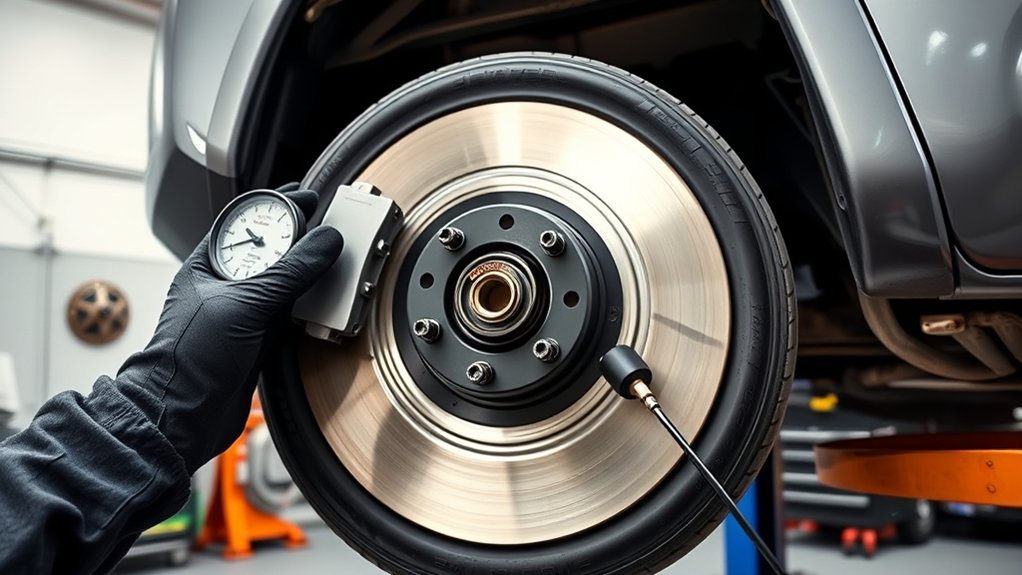
A humming, growling, or rumbling sound that rises with road speed can point to a worn Toyota Tacoma wheel bearing. However, cupped tires, dragging brakes, suspension play, and differential noise can sound similar. A reliable diagnosis combines a controlled road test, tire inspection, safely supported wheel checks, and model-specific repair information.
Quick Answer
A failing Tacoma wheel bearing usually causes a hum, growl, or rumble that rises with road speed. Confirm it by ruling out tire and brake noise, safely checking each wheel for roughness and play, and comparing both sides. Severe grinding, looseness, heat, or unstable handling requires immediate professional inspection.
Key Takeaways
- Wheel-bearing noise usually follows vehicle speed, but tires, brakes, CV joints, and driveline parts can mimic it.
- A change in noise during a gentle turn is only a clue because vibration can travel through the truck.
- Check tire wear, wheel play, rotational roughness, brake drag, and warning lights before ordering parts.
- Tacoma bearing designs and replacement methods vary by model year, drivetrain, axle, and wheel position.
- Never work beneath a Tacoma supported only by a jack, and do not drive with severe grinding or visible wheel movement.
At a Glance
| Time Required | About 20 to 45 minutes for basic checks; replacement time varies by bearing design and wheel position. |
| Difficulty | Beginner to intermediate for preliminary diagnosis; advanced for pressed-bearing, axle-shaft, or ABS-related replacement work. |
| Tools Needed | Wheel chocks, correctly rated floor jack and jack stands, flashlight, gloves, torque wrench, and optionally a dial indicator or mechanic’s stethoscope. |
| Cost | Basic inspection costs little if you own the tools. Repair cost varies widely by Tacoma year, drivetrain, axle position, parts required, and whether a press is needed. |
Warning: Perform checks on firm, level ground. Chock the wheels, use the jacking points listed in your Toyota owner’s manual, and support the truck with correctly rated jack stands. Never place any part of your body beneath a vehicle supported only by a hydraulic jack.
How to Identify and Fix Wheel Bearing Noise in Your Tacoma
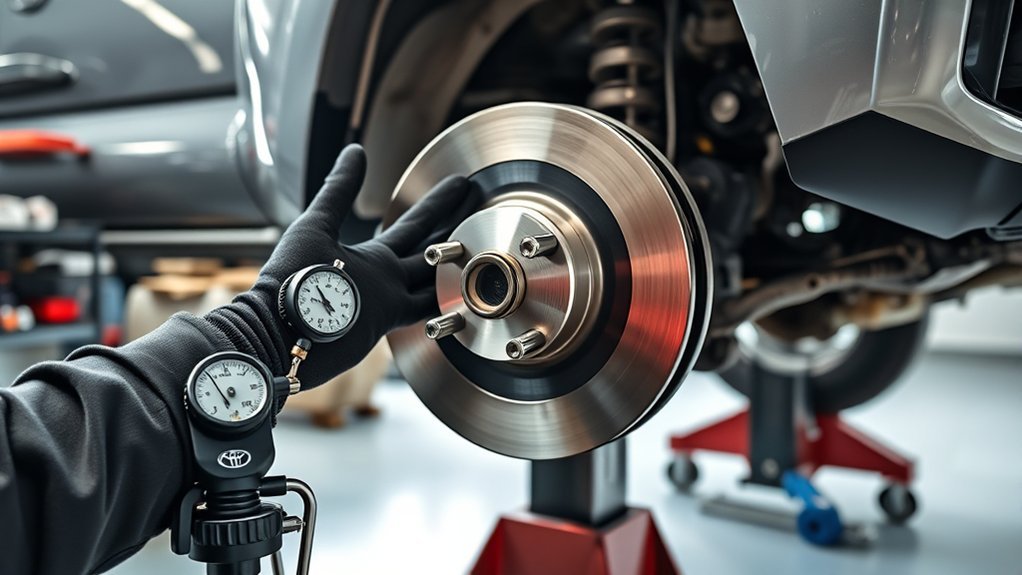
A worn wheel bearing often produces a low hum, growl, rumble, or grinding sound. The sound commonly becomes faster or louder as vehicle speed rises. It may remain present while you coast because wheel speed, rather than engine speed, controls the bearing’s rotation.
Do not diagnose a bearing from sound alone. Tire tread wear, brake contact, differential gears, CV joints, and loose suspension or shield components can create similar noises.
Common Wheel-Bearing Symptoms
- Hum or growl that follows road speed: The pitch or frequency changes as the Tacoma speeds up or slows down.
- Noise that changes during a gentle turn: Loading and unloading one side can alter the sound, but this does not prove which bearing has failed.
- Roughness while rotating the wheel or hub: A damaged race or rolling element may feel gritty, notchy, or uneven.
- Wheel movement: Excessive looseness can indicate bearing wear, although ball joints and other suspension parts may also cause movement.
- Steering or floor vibration: Advanced wear may create vibration, but tire imbalance and driveline problems can do the same.
- ABS or traction-control warning: Some bearing or hub problems can affect a nearby wheel-speed sensor, depending on the Tacoma’s design.
Sound can travel through the axle, suspension, and body. The corner that sounds loudest from the driver’s seat is not always the failed corner.
What Can Sound Like a Bad Wheel Bearing?
| Symptom | Possible Source | Useful Clue |
|---|---|---|
| Steady hum or roar | Bearing, cupped tire, or differential | Inspect tread wear and note whether the sound changes on different road surfaces. |
| Scraping at low speed | Brake shield, stone, rust ridge, or dragging brake | The sound may occur once per wheel revolution or change when the brake pedal is applied. |
| Clicking during tight turns | CV joint or driveline joint | Clicking under power is more typical of a joint than a wheel bearing. |
| Whine during acceleration or deceleration | Differential or gear-related problem | The sound may change more with throttle load than with steering input. |
| Clunk with wheel movement | Ball joint, tie rod, control arm, loose fastener, or bearing | Watch each joint while a helper rocks the wheel. |
Essential Tests for Diagnosing Wheel Bearing Issues
Use several tests before deciding that a wheel bearing has failed. One result may suggest a problem, but a combination of matching symptoms provides a stronger diagnosis.
1. Check the Tires and Visible Components
Inspect all four tires before lifting the truck. Look for cupping, scalloped tread blocks, feathered edges, bulges, embedded objects, and uneven wear. Run your hand across the tread in both directions while wearing gloves. A cupped tire can create a roar that closely resembles a bearing.
Check for a loose brake dust shield, trapped stone, damaged splash guard, or obvious contact near the rotor. Confirm that the wheel hardware appears secure. Use the exact lug-nut torque listed for your wheel and Tacoma configuration rather than a generic truck value.
2. Perform a Controlled Road Test
Choose a smooth, quiet road with little traffic. Keep the radio and climate-control fan off. Note the speed at which the sound begins and whether it follows vehicle speed.
When conditions are safe, make small, smooth steering inputs within your lane. Do not swerve or perform abrupt maneuvers. A bearing may become louder when its side carries more load, but sound transmission can make the result misleading.
Drive over more than one road surface when possible. Tire noise often changes noticeably between smooth asphalt and coarse pavement. Bearing noise usually remains more consistent.
Pro Tip: Record the speed range, road surface, steering direction, throttle position, and braking input that affect the noise. These details help a technician reproduce the problem and avoid replacing the wrong part.
3. Lift and Secure the Tacoma
Consult the Toyota owner’s manual portal for the correct jacking locations and wheel-service instructions for your model year.
- Park on firm, level ground.
- Place the transmission in Park, or in gear for a manual transmission.
- Apply the parking brake when it does not interfere with the wheel being tested.
- Chock the wheels that remain on the ground.
- Lift only at an approved jacking point.
- Place correctly rated jack stands beneath approved support points.
- Lower the Tacoma onto the stands and verify stability before touching the wheel.
OSHA’s jack standard states that a raised load must be cribbed, blocked, or otherwise secured promptly. A jack lifts the truck; it does not provide safe working support.
4. Spin the Wheel and Feel for Roughness
Rotate the wheel by hand and listen for grinding, scraping, or a dry rumble. Compare the sound and feel with the wheel on the opposite side.
Brake-pad contact may create a light brushing sound. Four-wheel-drive hardware, axle shafts, the differential, and parking-brake components may also add resistance. A wheel that does not spin freely is not automatically proof of a bad bearing.
Place your fingertips lightly on the coil spring, steering knuckle, or another solid nearby component while a helper rotates the wheel. A damaged bearing may transmit a rough vibration. Keep your hands clear of pinch points and rotating parts.
5. Check for Wheel Play
Hold the tire at the 12 and 6 o’clock positions. Push with one hand while pulling with the other, then reverse the pressure. Repeat at 3 and 9 o’clock.
- Movement at 12 and 6 o’clock: May come from a wheel bearing, ball joint, or another vertical-load component.
- Movement at 3 and 9 o’clock: May come from a tie rod, steering linkage, bearing, or hub attachment.
- Movement in several directions: Requires visual inspection of the bearing, hub, steering, and suspension parts.
Watch the brake rotor, hub, steering knuckle, ball joints, and tie-rod ends while a helper rocks the wheel. Movement between the hub and knuckle supports a bearing concern. Movement at a suspension joint points elsewhere.
A helper can press and hold the service brake while you repeat the test. A change in movement may help separate hub play from suspension play, but this test is not conclusive on every design.
Note: Some failing bearings make substantial noise without measurable looseness. Others develop play before producing a loud sound. Do not rule out a bearing from one negative test.
6. Check Warning Lights and Scan Data
An ABS, traction-control, or stability-control warning can accompany a hub or wheel-speed-sensor problem on some Tacoma configurations. The warning does not automatically prove that the bearing itself has failed.
Use a compatible scan tool to read stored fault codes and compare live wheel-speed data. A sensor circuit, damaged wiring, debris, tone-ring problem, or excessive bearing movement may produce similar symptoms.
7. Confirm the Diagnosis Before Ordering Parts
A professional shop may use chassis ears, a mechanic’s stethoscope, a dial indicator, or live wheel-speed data to confirm the faulty corner. A technician may also isolate brake drag or remove related components when the model-specific procedure permits it.
Do not remove a brake caliper or rotor unless you understand the repair procedure. Support a removed caliper so its weight never hangs from the brake hose.
When to Stop Driving
Do not continue a diagnostic road test when you find any of these conditions:
- Severe grinding or metal-on-metal noise
- Visible wheel wobble or substantial hub movement
- Unstable steering or unexpected vehicle movement
- A wheel or hub that becomes abnormally hot
- A burning smell or severe brake drag
- Brake-system warnings combined with abnormal braking
- Loose or damaged wheel hardware
Arrange a tow or professional inspection when the Tacoma cannot be driven safely. Continuing to drive can damage the hub, knuckle, axle, brake components, tire, or wheel-speed sensor.
How Wheel Bearings Work and Why They Matter
A wheel bearing supports the wheel and hub while allowing them to rotate with limited friction. The assembly uses hardened inner and outer races, rolling elements such as balls or rollers, lubricant, and seals.
The bearing carries radial loads from the Tacoma’s weight and road impacts. It also handles axial loads created during cornering. Surface damage, contamination, poor installation, incorrect fastener torque, impact damage, or seal failure can produce vibration and noise.
Timken’s technical discussion of bearing sound explains that surface imperfections can generate dynamic forces. Those forces travel into the surrounding structure, where they may become audible. The same structure can also transmit vibration from gears or other rotating parts through an otherwise functional bearing.
No dependable universal mileage tells you when a Tacoma wheel bearing will fail. Service life varies with operating load, pothole impacts, water and dirt exposure, wheel and tire changes, installation quality, towing, and off-road use.
Bearing vs. Hub Assembly Replacement: What You Need to Know
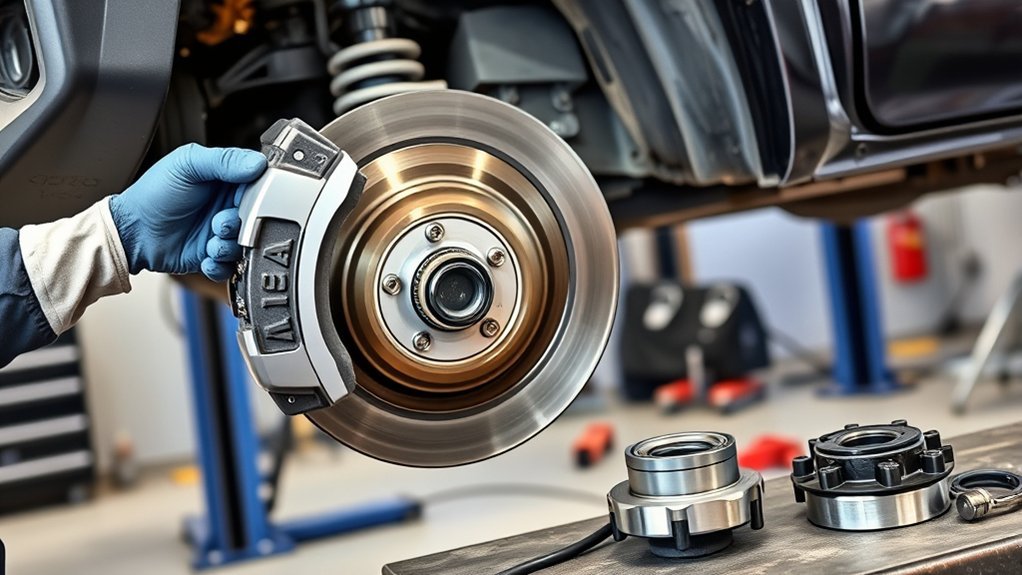
The correct repair depends on the Tacoma’s model year, drivetrain, axle design, and wheel position. Do not order a generic “Tacoma hub assembly” until you have confirmed fitment with the VIN.
Possible Repair Configurations
- Bearing-only replacement: The bearing may need to be pressed into or out of a knuckle, hub, or housing.
- Hub and bearing unit: Some applications use a replaceable unit that combines multiple components.
- Preassembled knuckle or hub package: An aftermarket package may reduce pressing work, but its fit and included parts must match the exact truck.
- Rear axle-shaft service: Some rear-bearing jobs require axle removal, pressing operations, seals, retainers, or other axle-specific work.
- ABS-related assembly: The bearing or hub may interact with a wheel-speed sensor, magnetic encoder, tone ring, or wiring harness.
Toyota’s Technical Information System provides factory repair manuals, service bulletins, wiring diagrams, and diagnostic information for Toyota vehicles sold in North America. Use the exact procedure and specifications for your VIN.
Replacement Details That Matter
A correct repair may require a hydraulic press, bearing separator, snap-ring pliers, seal drivers, axle tools, or model-specific fixtures. Press force must be applied through the correct race. Sending force through the rolling elements can damage a new bearing before the truck leaves the shop.
Follow the Toyota procedure for:
- Axle-nut, hub, knuckle, caliper, and wheel-fastener torque
- Fasteners or retaining nuts that must not be reused
- Seal, snap-ring, spacer, collar, or retainer replacement
- Bearing or magnetic-encoder orientation
- ABS sensor clearance and wiring routing
- Wheel alignment after knuckle or suspension removal
Finish critical fasteners with a calibrated torque wrench. Do not substitute a generic online torque value or rely only on an impact wrench.
Choosing Replacement Parts
Use the VIN to confirm part numbers through the official Toyota parts store, a Toyota dealer, or a reputable manufacturer’s catalog. A low price does not confirm correct fitment, included hardware, sensor compatibility, or bearing quality.
Genuine Toyota parts may simplify VIN-based fitment, while established bearing manufacturers can also supply suitable parts when the catalog application matches. No brand or part source can guarantee unlimited service life.
Maintenance Tips for Long-Lasting Tacoma Wheel Bearings
Most modern wheel-bearing assemblies are sealed and receive no routine grease service. Do not pry open seals or add grease unless the factory procedure identifies the bearing as serviceable.
- Respond to noise early: Investigate a new hum, growl, vibration, or wheel-play concern before it becomes severe.
- Inspect after hard impacts: A deep pothole, curb strike, or off-road impact can damage the bearing, wheel, tire, or suspension.
- Inspect after deep-water exposure: Water or debris entering a damaged seal can shorten bearing life.
- Maintain tires: Correct pressure, rotation, balance, and alignment reduce misleading tire noise and unnecessary wheel loads.
- Use correct wheel fitment: Large offsets, spacers, oversized tires, and heavy wheel packages can change bearing loads.
- Torque wheel hardware correctly: Use the value and sequence specified for the exact Tacoma and wheel.
- Protect sensor wiring: Secure ABS wiring and connectors during brake, suspension, and hub work.
- Avoid pressure-washing seals directly: High-pressure water aimed at sealing surfaces may force contamination past a damaged seal.
Toyota does not provide one universal wheel-bearing replacement mileage for every Tacoma. Follow the maintenance guide for your model and inspect the bearing whenever symptoms, related repair work, or severe operating conditions justify it.
Check your VIN in the NHTSA recall database and Toyota’s recall portal. A recall or service campaign may address an axle, hub, fastener, brake, or driveline concern that produces similar symptoms.
Frequently Asked Questions
How do I know if my Tacoma wheel bearings are bad?
Common clues include a hum, growl, or rumble that rises with road speed, roughness while rotating the wheel, excessive hub movement, or vibration near one corner. Confirm the result by inspecting the tires, brakes, suspension, and driveline because each can create similar symptoms.
How do you test for wheel-bearing noise?
Start with a controlled road test and note whether the sound follows vehicle speed. Inspect the tires, then safely support the Tacoma and check each wheel for roughness, vibration, and play. Compare both sides and use model-specific service information before removing brake or hub components.
What can mimic wheel-bearing noise on a Tacoma?
Cupped tires, brake-pad or shield contact, a CV joint, differential gears, driveshaft joints, loose wheel hardware, and worn suspension parts can mimic a bearing. Tire noise often changes with pavement, while gear noise may change more with throttle load.
What sounds are most common with a damaged wheel bearing?
A damaged bearing commonly produces humming, growling, rumbling, roaring, or grinding. Clanking or clicking more often suggests a loose component, CV joint, suspension joint, or driveline problem, although a complete inspection is still necessary.
Can I drive a Tacoma with a noisy wheel bearing?
A faint new hum still deserves prompt inspection because you cannot judge the remaining life from sound alone. Stop driving and arrange a tow if you notice severe grinding, wheel wobble, substantial looseness, abnormal heat, unstable steering, or braking problems.
Can a bad Tacoma wheel bearing turn on the ABS light?
It can on configurations where bearing movement, a damaged encoder, or a hub problem disrupts wheel-speed information. However, damaged wiring, sensor contamination, an incorrect air gap, or a failed sensor can create the same warning. Read the stored codes before replacing parts.
Conclusion
Diagnosing Toyota Tacoma wheel bearing noise requires more than listening for a hum. Start by ruling out tire and brake problems, then use a safe road test, supported wheel inspection, play check, and side-to-side comparison.
Treat turning behavior and wheel movement as clues rather than final proof. Tacoma bearing layouts and replacement procedures differ across model years, drivetrains, axles, and wheel positions. Confirm the repair through Toyota’s model-specific service information and VIN-based parts data.
Prompt inspection can prevent damage to nearby hub, brake, axle, suspension, and sensor components. Stop driving when the wheel is loose, unstable, abnormally hot, or producing severe grinding.
Sources
- Toyota Manuals and Warranties — model-specific owner’s manuals, maintenance guidance, jacking information, and wheel-service references.
- Toyota Technical Information System — factory repair manuals, service bulletins, wiring diagrams, and diagnostic procedures.
- Official Toyota Parts Store — VIN-based parts identification and fitment research.
- OSHA Standard 29 CFR 1910.244 — jack load ratings and the requirement to secure a raised load.
- NHTSA Recall Lookup — VIN-based safety recalls, manufacturer communications, and complaint information.
- Timken: Bearing Dynamics and Sound — bearing vibration, sound generation, structural transmission, and diagnostic limitations.
