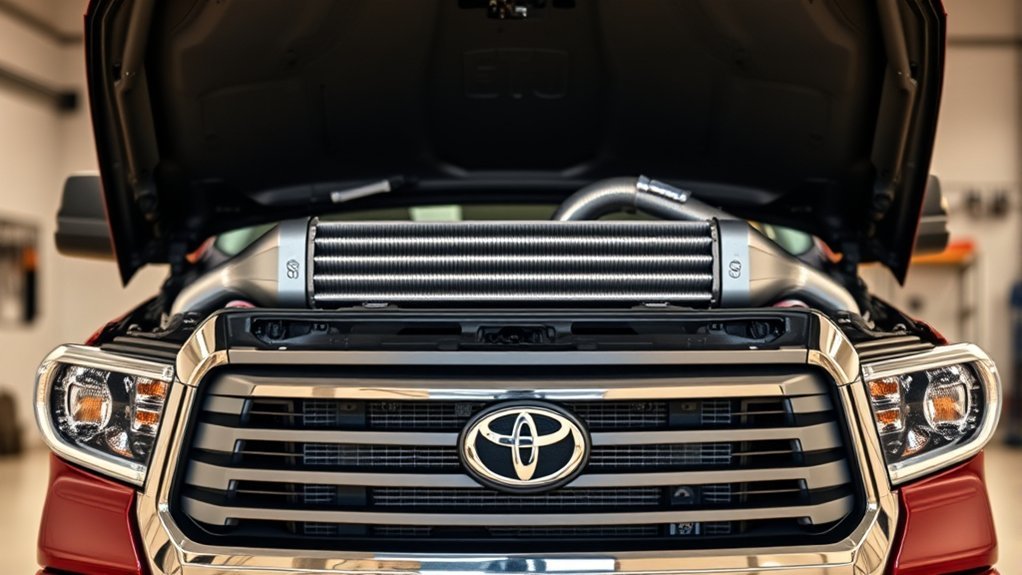
If you drive a 2022-or-newer Toyota Tundra with an i-FORCE or i-FORCE MAX twin-turbo V6, Toyota equips the engine with a water-cooled intercooler. The system removes heat from compressed intake air before that air reaches the cylinders, helping control charge temperature during towing, hot-weather driving, and repeated acceleration. Earlier naturally aspirated Tundras normally do not have a factory intercooler unless a forced-induction system was added.
Last updated: September 19, 2026
Quick Answer
The 2022-and-newer Toyota Tundra uses a water-cooled intercooler with its i-FORCE and i-FORCE MAX twin-turbo V6 powertrains. Compressed air from the turbochargers passes through the charge-air cooler, where heat transfers into an intercooler coolant circuit before the air enters the engine. Lower charge temperature helps the engine maintain its calibrated airflow, ignition, and boost targets under sustained load.
Key Takeaways
- Toyota identifies the factory 2022+ Tundra charge-air cooler as a water-cooled intercooler.
- The intercooler removes heat from compressed intake air; it does not create turbocharger boost.
- Low power, hissing, or an underboost code can indicate a charge-air leak. Repeatedly high charge temperatures can instead point to heat soak or a problem in the liquid-cooling circuit.
- For the 2026 Tundra, Toyota schedules radiator/condenser/intercooler inspection at 15,000-mile intervals and the first engine/intercooler coolant replacement at 100,000 miles or 120 months.
- An upgraded intercooler is most useful when measurements show excessive charge temperature or pressure loss under demanding conditions; core size alone does not prove an upgrade will help.
2022+ Toyota Tundra Intercooler at a Glance
| Question | Factory Tundra Answer |
|---|---|
| Which trucks use it? | 2022-and-newer Tundras with the i-FORCE or i-FORCE MAX twin-turbo V6. |
| What type is it? | A water-cooled, or air-to-liquid, charge-air cooling system. |
| What does it cool? | The compressed intake air leaving the turbochargers before combustion. |
| Common problem areas | Charge pipes, hose connections, seals, coolant level, circulation components, the liquid-side heat exchanger, sensors, and the intercooler assembly itself. |
| Does P0299 prove it is bad? | No. P0299 indicates underboost and requires diagnosis of the complete boost and control system. |
How Do Intercoolers Work?
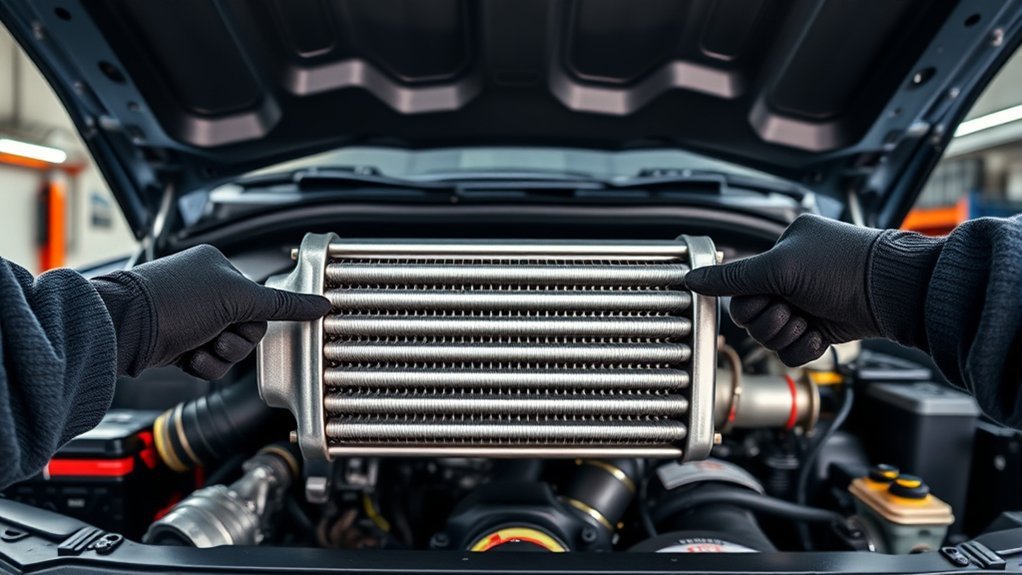
A turbocharger uses exhaust-gas energy to drive a compressor that forces more air into the engine. Compressing that air also raises its temperature. Before the compressed air reaches the cylinders, the Tundra’s intercooler removes part of that heat. For a deeper explanation of the boost side of the system, see how Toyota Tundra i-FORCE turbochargers work.
On the 2022+ Tundra, the factory intercooler is water-cooled. Heat transfers from the compressed air into the intercooler coolant circuit. That liquid circuit then carries heat away so it can be rejected through its heat-exchange system.
As the charge air cools, its density increases. The engine management system can then control fuel delivery, ignition timing, airflow, and boost according to its programmed operating targets. Lower charge temperature can also reduce knock tendency when the engine is working hard.
The intercooler cannot prevent every form of knock, fix an engine-cooling problem, or compensate for a boost leak. It manages charge-air temperature; the engine radiator and other cooling circuits have different jobs.
An intercooler does not create boost. It removes heat from the compressed charge so the engine can use the turbochargers’ airflow within its intended temperature range.
Which Toyota Tundras Have an Intercooler?
This topic mainly applies to the third-generation Tundra introduced for the 2022 model year. Toyota’s current 2026 lineup uses an i-FORCE twin-turbo V6 or an i-FORCE MAX twin-turbo V6 hybrid powertrain, depending on trim and configuration. Toyota’s technical material for the third-generation powertrain identifies the charge-air cooler as water-cooled.
Earlier Tundras were commonly equipped with naturally aspirated gasoline engines. A naturally aspirated engine does not use turbocharger-compressed intake air, so those trucks normally have no factory charge-air intercooler. An older Tundra may have one if a turbocharger or supercharger system was added.
Note: Parts, hose routing, coolant circuits, sensors, and service procedures can vary by model year and configuration. Confirm the VIN and exact powertrain before ordering an intercooler, hose, pump, sensor, or related component.
How Does the Tundra Intercooler Support Engine Performance?
The Toyota Tundra intercooler’s main job is charge-temperature control. When compressed intake air becomes hotter, the engine may have less knock margin and may need to adjust ignition, airflow, or boost-related operating targets. Removing heat from the charge helps reduce that temperature rise.
Charge-air cooling becomes most important during sustained high-load use. Towing, long grades, repeated acceleration, high ambient temperatures, and modified boost levels can add heat faster than short, light-throttle driving.
A properly functioning charge-air cooling system can provide several benefits:
- More consistent power: Lower charge temperature can reduce heat-related performance loss during repeated high-load operation.
- Lower knock tendency: Cooler intake air gives the combustion process more temperature margin.
- Stable operation under load: Effective heat transfer helps keep charge temperature within the range expected by the calibration.
- Support for modified engines: Higher airflow or boost can increase the amount of heat the system must reject.
These benefits do not guarantee better fuel economy or a fixed horsepower increase. Results depend on ambient temperature, boost demand, engine calibration, airflow, coolant circulation, heat-exchanger performance, and pressure loss through the charge path.
[Amazon Products Picked for You]
Compatibility - Compatible with 2007-2017 Tundra 5.7L V8 Multiple Color Selection - Multi-color silicone tubes Fit different colors of car/pickup hood accessories...
What Are the Signs of a Tundra Intercooler-System Problem?
A loss of power does not automatically mean the Toyota Tundra intercooler core needs replacement. A loose connection, split charge pipe, damaged seal, sensor problem, coolant-circulation fault, turbocharger issue, or control-system fault can produce similar symptoms.
Possible warning signs include:
- Reduced acceleration or inconsistent power: A boost leak or heat-related power reduction can prevent expected performance.
- Hissing or rushing-air sounds under boost: These noises can indicate a leaking hose, connection, seal, pipe, or charge-air component.
- An underboost fault such as P0299: The engine computer has detected boost below its expected target, but the code does not identify the failed component.
- Power reduction after repeated hard use: This can be consistent with excessive charge temperature or heat soak, but scan data is needed to separate temperature effects from other faults.
- Visible damage: Damage to charge-air plumbing can create a boost leak, while damage to the liquid-side heat exchanger can reduce cooling or cause coolant loss.
- Intercooler-circuit coolant loss: A falling coolant level can indicate leakage from a hose, fitting, heat exchanger, intercooler assembly, or another liquid-circuit component.
- A check-engine light: This is a general warning and does not prove that the intercooler has failed.
| Symptom | Possible Area | Useful Next Check |
|---|---|---|
| Hissing plus low boost or P0299 | Charge pipe, hose, seal, connection, intercooler, turbo or boost-control system | Inspect connections, retrieve freeze-frame data, and perform an appropriate charge-path leak test. |
| High charge temperature without obvious underboost | Heat soak, coolant circulation, liquid-side heat exchanger, pump or airflow | Compare intake/charge temperature with ambient conditions and verify intercooler-circuit coolant level and circulation. |
| Repeated intercooler-coolant loss | Liquid-circuit hose, fitting, heat exchanger, reservoir or intercooler assembly | Inspect the circuit cold and pressure-test it using the correct service procedure. |
| Power falls mainly after repeated towing pulls or acceleration | Charge-temperature rise, airflow restriction or another load-related control issue | Log temperature, boost request, measured pressure, speed, load and ambient conditions before replacing parts. |
| Light oil film in charge piping | Crankcase-vapor carryover can be one possible source | Look for abnormal pooling, smoke, rapid oil consumption or a sudden increase in residue before assuming component failure. |
Warning: Never open a pressurized coolant reservoir while the system is hot. Do not bypass the factory charge-air cooler or continue heavy towing when the truck has severe power loss, active overheating warnings, or a confirmed boost or coolant leak.
Why These Symptoms Can Be Misleading
A damaged intercooler is only one possible cause. A hissing noise can come from a hose or seal, while poor acceleration can result from fuel, ignition, exhaust, sensor, turbocharger, or boost-control problems. A light oil film inside charge piping can also come from crankcase-vapor circulation and does not, by itself, prove that the intercooler has failed.
Diagnose Before Replacing the Intercooler
- Retrieve diagnostic trouble codes. Record the codes and freeze-frame information instead of replacing parts based only on the warning light.
- Inspect accessible charge-air connections. Look for loose fittings, damaged seals, splits, rubbing damage, oil tracks around leaking joints, or disconnected pipes.
- Inspect the liquid-side heat exchanger. Check for road debris, crushed fins, corrosion, impact damage, or evidence of coolant leakage without bending the fins further.
- Test the charge-air path for leaks. A qualified technician can perform a pressure or smoke test using limits appropriate for the vehicle.
- Check the intercooler coolant circuit. Inspect the coolant level when cold and verify hoses, connections, circulation, and related components using the model-specific procedure.
- Review scan data. Charge/intake temperature, commanded boost, measured pressure, engine load, vehicle speed, and ambient conditions can help separate heat soak from a boost leak or control problem.
Why Does the Intercooler Matter When a Tundra Is Towing or Under Load?
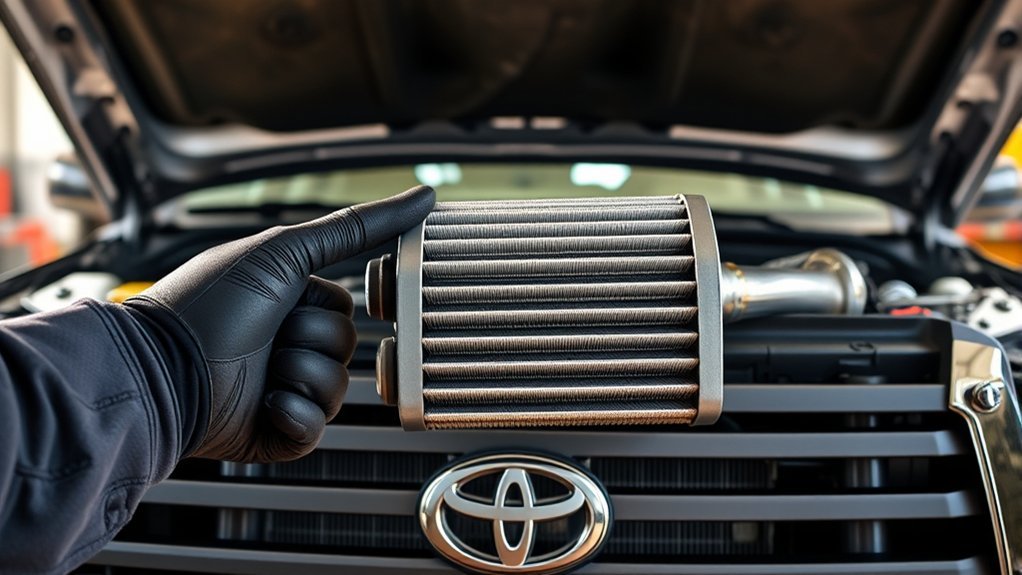
A turbocharged Tundra can spend long periods at high engine load while towing, climbing grades, driving off-road, or accelerating with a heavy vehicle. Higher compressor work adds heat to the intake charge, so the intercooler has more heat to remove than it does during light cruising.
The intercooler does not cool the entire engine in the same way as the radiator. The engine-cooling system manages engine temperature, while the charge-air system focuses on the temperature of turbocharger-compressed intake air.
If charge-air cooling becomes less effective during sustained operation, scan data may show charge temperature continuing to climb. The engine management system can respond by changing operating targets. That is why temperature, boost, load, and ambient conditions should be compared together rather than judging the intercooler from seat-of-the-pants power alone.
[Amazon Products Picked for You]

DIRECT OEM FIT - Radiator Compatible with 2007-2020 Tundra 2008-2014 Sequoia 4.6L 5.7L V8. Please confirm the fitment before ordering.

Increase Power & Performance: Free-flowing intake design delivers cooler, denser air to help increase horsepower, improve throttle response, and provide stronger acceleration.

Compatibility - Compatible with 2000 2001 2002 2003 2004 Toyota Tundra V6/V8 SR5
Does a 2022+ Toyota Tundra Use Air-to-Air or Air-to-Liquid Cooling?
The factory 2022-and-newer Toyota Tundra uses a water-cooled intercooler, commonly described as an air-to-liquid charge-air cooling system. The compressed intake air gives up heat to liquid coolant, and that coolant carries the heat to another heat exchanger.
Air-to-air systems are still common on other turbocharged vehicles and may appear on custom forced-induction builds, so understanding the distinction is useful when comparing aftermarket advice. It should not, however, replace the service information for the Tundra’s factory water-cooled system.
[Amazon Products Picked for You]

Compatible with 2006-2014 Toyota Tacoma -Hood -Matt Black

𝟵𝟮𝟳-𝟲𝟬𝟯𝟬 30 Amp Pink Fuse - exact fitment for the folllowing p/ns: 𝟵𝟬𝟵𝟴𝟮-𝟬𝟴𝟮𝟵𝟱 𝟲𝗘𝟱𝗧-𝟭𝟰𝗔𝟬𝟵𝟰-𝗕𝗔 𝟮𝟰𝟯𝟳𝟬-𝗖𝟵𝟵𝟯𝗕 𝟵𝟬𝟵𝟴𝟮-𝟬𝟴𝟯𝟬𝟲 𝟵𝟬𝟵𝟴𝟮𝟬𝟴𝟯𝟬𝟲. With the guide ribs to be the exact match for your Toyota Nissan or Ford vehicle. Other compatible part numbers 8980791910 89807-91910 SZ98058068 9666154780 96661-54780
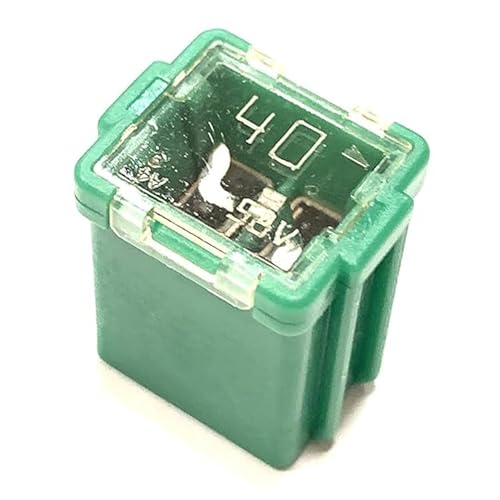
𝟗𝟐𝟕-𝟔𝟎𝟒𝟎 40 Amp Fuse - exact fitment for the folllowing p/ns: 𝟗𝟎𝟗𝟖𝟐-𝟎𝟖𝟐𝟗𝟒 𝟔𝐄𝟓𝐙-𝟏𝟒𝟓𝟐𝟔-𝐂𝐀 𝟐𝟒𝟑𝟕𝟎-𝐂𝟗𝟗𝟒𝐁 𝟔𝟖𝟏𝟑𝟕𝟎𝟒𝟒𝐀𝐀. With the guide ribs to be the exact match for your Toyota Nissan Chrysler or Ford vehicle
Air-to-Air Intercoolers
An air-to-air intercooler routes hot compressed intake air through internal passages while outside air crosses the fins and carries heat away. This design does not need an intercooler coolant pump or liquid circuit, but its performance depends on airflow, heat-exchanger position, ambient temperature, and core design.
Air-to-Liquid Intercoolers
An air-to-liquid system transfers heat from the compressed intake charge into circulating coolant. The liquid circuit then moves that heat to a heat exchanger where outside airflow helps reject it. Pumps, hoses, fittings, coolant condition, and heat-exchanger airflow therefore become part of the diagnostic picture.
Note: Generic front-mount intercooler advice does not automatically apply to the 2022+ Tundra’s original water-cooled system. Use parts and service information for the exact model year, engine, and configuration.
When Is a Toyota Tundra Intercooler Upgrade Worth Considering?
An upgraded charge-air cooler may help a modified truck or a Tundra that repeatedly reaches high charge temperatures under demanding conditions. A larger core does not automatically produce more horsepower, improve fuel economy, or reduce turbo response time.
Review these factors before choosing an upgrade:
- Baseline data: Confirm that charge temperature or pressure loss is actually limiting performance.
- Model-year compatibility: Verify mounting points, pipe connections, sensors, coolant fittings, pumps, and surrounding components.
- Cooling capacity: The unit should reject enough heat for the truck’s airflow, boost level, and operating conditions.
- Pressure drop: A restrictive charge path can reduce pressure between the compressor outlet and intake manifold.
- Internal volume: Major changes to core or piping volume can alter system response.
- Sealing and installation quality: Poor joints or seals can create leaks even when the cooler itself transfers heat effectively.
- Engine calibration: Modified airflow, boost, or fueling may require professional logging and calibration.
- Warranty implications: Confirm how the modification may affect coverage before installation.
- Emissions compliance: The installation must not disable, bypass, or interfere with required emissions controls.
Diagnostic Tip: Record charge/intake temperature, ambient temperature, requested and measured boost, engine load, and vehicle speed before buying an upgrade. Compare the same measurements afterward under similar conditions rather than relying only on advertised core size.
In the United States, review the EPA’s vehicle and engine alteration requirements. An intercooler installation should not include software or hardware intended to defeat emissions controls.
How Do You Maintain a Toyota Tundra Intercooler?
The intercooler assembly itself does not have a routine replacement interval, but the factory maintenance schedule does include inspections and intercooler-coolant service. For the 2026 U.S. Tundra, Toyota’s maintenance chart calls for radiator/condenser/intercooler inspection at 15,000-mile intervals. It lists the first engine/intercooler coolant replacement, when applicable, at 100,000 miles or 120 months, followed by replacement every 50,000 miles or 60 months.
Use the maintenance guide for your exact model year rather than automatically applying the 2026 interval to every Tundra. You can also see the site’s Toyota Tundra maintenance schedule by mileage and Toyota Tundra coolant type guide for the broader service context.
Basic intercooler-system maintenance includes:
- Inspecting the radiator/condenser/intercooler heat-exchange area at the model-year maintenance intervals.
- Removing insects, mud, leaves, and road debris gently without placing a high-pressure nozzle close enough to fold fins.
- Checking accessible charge-air hoses, pipes, seals, and connections for rubbing, splits, looseness, or oil tracks.
- Checking the intercooler-circuit coolant level only when the system is cold.
- Investigating repeated coolant loss rather than continually topping off the reservoir.
- Using the specified coolant and bleeding procedure when the liquid circuit is serviced.
You can locate the correct schedule and operating information through Toyota’s Manuals and Warranties portal. Select the correct year and model because coolant procedures, service intervals, and component locations can vary.
Frequently Asked Questions
What are the symptoms of a bad Toyota Tundra intercooler?
Possible symptoms include reduced power under boost, hissing, an underboost code, coolant loss, unusually high charge temperatures, or repeated heat-related power reduction. These signs can also come from hoses, seals, sensors, coolant-circulation components, turbochargers, or boost controls, so testing should come before replacement.
Does a 2022+ Toyota Tundra use an air-to-air or water-cooled intercooler?
Toyota identifies the 2022-and-newer Tundra’s factory charge-air cooler as a water-cooled intercooler. Heat moves from the compressed intake air into an intercooler coolant circuit rather than being rejected directly from the charge-air core to outside air.
How often should Toyota Tundra intercooler coolant be changed?
For the 2026 U.S. Tundra, Toyota lists the first engine/intercooler coolant replacement, when applicable, at 100,000 miles or 120 months, then every 50,000 miles or 60 months. Check the maintenance guide for your exact model year before servicing the system.
Does an upgraded intercooler make a difference?
It can improve charge-temperature consistency when measurements show that the original system is heat-soaking during towing, hot-weather use, repeated acceleration, or operation with a modified engine. A stock truck may show little peak-power change if the factory system already keeps charge temperature within its intended range.
Can I run a turbocharged Tundra without an intercooler?
Do not remove or bypass the factory charge-air cooler. The engine and its calibration are designed around the complete intake and charge-cooling system. Bypassing it can raise charge temperature, increase knock tendency, trigger faults, and reduce performance or reliability.
Does oil inside the intercooler mean it has failed?
Not always. A light oil film can enter charge piping through crankcase-vapor circulation. Heavy pooling, smoke, rapid oil loss, or a sudden increase in residue requires diagnosis because it may indicate a ventilation, turbocharger, or engine problem.
Should a Toyota Tundra intercooler be cleaned?
Remove external debris carefully when it blocks airflow through the liquid-side heat exchanger. Internal charge-path cleaning should be performed only when contamination has been confirmed and the correct component-specific procedure is available. Solvent left inside the intake path can damage components or create a safety risk.
Conclusion
The 2022-and-newer Toyota Tundra uses a water-cooled intercooler to remove heat from turbocharger-compressed intake air. If the truck develops underboost, hissing, coolant loss, or heat-related power reduction, diagnose the complete charge-air and intercooler-coolant systems before replacing the core. Check connections and coolant level when cold, retrieve fault codes and freeze-frame data, and use scan or leak-test results to separate a boost leak from a cooling-circuit problem. Follow the maintenance schedule for your exact model year, especially the intercooler inspection and coolant-service intervals.
Sources
- Toyota: 2026 Tundra — current i-FORCE and i-FORCE MAX twin-turbo powertrain information.
- Toyota USA Newsroom: Absolute Powerhouse — Next-Generation 2022 Toyota Tundra — Toyota’s description of the twin-turbo V6 and water-cooled intercooler.
- Toyota Manuals and Warranties — model-specific owner and maintenance guidance, including intercooler inspection and coolant service schedules.
- Garrett Motion: What Is a Turbo and How Does It Work? — turbocharger compression and charge-air cooling fundamentals.
- U.S. Environmental Protection Agency: Clean Air Act Vehicle and Engine Enforcement — emissions-control modification requirements.
