
Toyota Tacoma Engine Air Filter Replacement
By Natalie Rhodes · Last updated: September 22, 2026
You can replace a Toyota Tacoma engine air filter in about 5 to 15 minutes on many models: park safely, let the engine cool, open the airbox, remove the old filter, clear loose debris, seat the replacement filter evenly, and close the housing without forcing it.
Fitment matters before the procedure starts. K&N currently lists the 33-5017 for 2016–2023 Tacoma models with the 3.5L V6. It is not a universal Tacoma filter. Other Tacoma engines and model years use different filters, so confirm the year, engine, VIN, and part number before ordering.
Verification note: Filter fitment, K&N service guidance, Toyota part information, and Toyota maintenance guidance in this article were rechecked against current manufacturer and government sources on September 22, 2026.
Quick Answer
To replace a Tacoma engine air filter, open the hood, release the airbox fasteners, lift the cover, pull out the old filter, clear loose debris from the housing, seat the correct replacement filter flat against the sealing surface, and secure the airbox again. The K&N 33-5017 is listed for 2016–2023 Tacoma 3.5L V6 models; verify fitment before using it or any aftermarket filter.
Key Takeaways
- On 2016–2023 3.5L V6 Tacomas, the engine air filter sits inside the rectangular airbox on the passenger side of the engine bay. Other years and engines can use a different housing layout.
- Always confirm the replacement filter by VIN, model year, engine, and part number before installing it.
- A clogged filter can restrict airflow and hurt acceleration, but the U.S. Department of Energy says replacing a clogged filter on a modern computer-controlled fuel-injected gasoline engine does not improve fuel economy.
- K&N’s current 33-5017 product page lists cleaning every 75,000 miles under normal highway conditions, while K&N’s general FAQ gives up to 50,000 miles for factory-airbox High-Flow filters. Follow the instructions supplied for your specific filter and inspect it sooner in dirty conditions.
- A poor seal can allow unfiltered air to bypass the filter, so your final gasket, seam, and latch check matters as much as the filter swap.
At a Glance
| Time Required | 5 to 15 minutes |
| Difficulty | Beginner-friendly |
| Tools Needed | Usually none on the clip-style 2016–2023 3.5L V6 airbox; gloves, a microfiber towel, and a careful vacuum help keep the housing clean |
| Main Fitment Focus | 2016–2023 Tacoma 3.5L V6 when using K&N 33-5017 |
| Cost | Varies by filter brand, retailer, engine, and whether you choose a disposable OEM-style filter or a reusable filter |
Which Engine Air Filter Fits Your Tacoma?
Do not buy a replacement filter from the model name alone. Tacoma filter fitment changes by generation and engine. The table below summarizes current K&N catalog listings for common U.S.-market applications and makes clear why the 33-5017 should not be treated as a universal Tacoma filter.
| Tacoma Application | K&N Listing | What It Means for This Guide |
|---|---|---|
| 2005–2015 2.7L four-cylinder | 33-2306 | Do not use 33-5017 solely because the truck is a Tacoma. |
| 2005–2015 4.0L V6 | 33-2281 | The filter and airbox differ from the third-generation 3.5L application. |
| 2016–2023 2.7L four-cylinder | 33-2306 | Same generation does not mean the same filter as the 3.5L V6. |
| 2016–2023 3.5L V6 | 33-5017 | This is the application specifically covered by the K&N 33-5017 portions of this guide. |
| 2024–2026 2.4L gasoline | 33-2443 | The fourth-generation Tacoma uses a different K&N listing; verify hybrid and other configurations separately by VIN or K&N vehicle finder. |
K&N’s current Toyota Tacoma air-filter catalog lists these applications. If your year, engine, market, intake system, or VIN produces a different result, follow the vehicle-specific lookup rather than this table.
For 2016–2023 Tacoma 3.5L V6 applications, K&N lists the 33-5017 replacement air filter as a washable, reusable panel filter with oiled cotton media. Toyota’s Genuine engine air filter 17801-0P100 lists 17801-0S020 as a previous version. Always use Toyota’s VIN lookup or another trusted vehicle-specific catalog before ordering.
Warning: Do not run the engine with the airbox open or the filter removed. Unfiltered air can carry dust and debris into the intake.
[Amazon Products Picked for You]

【Fitment for Toyota Models 】fit for 2014-2022 Sequoia (flexible panel air filter only), 2016-2023 Tacoma 3.5L, 2014-2021 Tundra (flexible panel air filter only)

GENUINE OEM: Direct replacement Toyota air filter manufactured by Denso, ensuring perfect fitment and optimal engine performance

RUGGED CONSTRUCTION: K&N Advantage Plus Air Filters are manufactured with durable, premium materials to last for up to 18,000 miles of use.
How Often Should You Replace a Tacoma Engine Air Filter?

Use the maintenance guide for your exact Tacoma year as the controlling schedule. As one manufacturer-documented example, Toyota’s 2017 Tacoma Warranty & Maintenance Guide calls for engine air filter replacement at 30,000 miles or 36 months. The same guide calls for additional engine-air-filter inspections when the truck is driven primarily on dirt or dusty roads.
You can review the 2017 Tacoma Warranty & Maintenance Guide directly. Earlier and later Tacoma model years can have different maintenance documents, so do not automatically apply the 2017 schedule to every truck.
Inspect the filter during routine service and sooner after dusty roads, gravel, construction areas, trails, wildfire smoke, or heavy pollen. Look at the pleats and sealing edge. Replace a disposable filter if the media is damaged, heavily loaded, wet, or contaminated. A reusable filter should be serviced according to its manufacturer’s instructions.
Performance symptoms are not a reliable filter diagnosis by themselves. Restricted airflow can reduce acceleration, but rough running or unusual intake noise can also come from intake leaks, disturbed hoses, sensor problems, or other faults. The U.S. Department of Energy’s FuelEconomy.gov maintenance guidance says replacing a clogged filter on modern computer-controlled fuel-injected gasoline engines can improve acceleration but does not improve fuel economy.
Note: For a model-year-specific schedule beyond this 2017 example, see the site’s Toyota Tacoma engine air filter replacement interval guide and confirm the final interval in your truck’s Toyota maintenance documentation.
[Amazon Products Picked for You]

Provides high volumes of clean air for efficient operation and reduced engine wear

Bosch Workshop Engine Air Filters are constructed with a high number of pleats for robust particle holding capacity

[Compatible Models] - KAX GAF036 (CA11895) premium engine air filter replacement for Toyota Sequoia 2014-2022 V8 5.7L, Tacoma 2016-2023 V6 3.5L, Tundra 2013-2014 V6 4.0L (Only After 9/13), Tundra 2013-2019 V8 4.6L, 2013-2021 V8 5.7L
Parts & Tools: K&N 33-5017 and What to Have Ready
Most 2016–2023 Tacoma 3.5L V6 engine air filter swaps do not require special tools. The job goes faster when you stage everything first and keep dirt away from the open airbox. Other Tacoma generations or engines may use different fasteners, so inspect the housing before assuming the job is tool-free.
- Correct replacement engine air filter, verified by VIN, year, engine, and part number
- K&N 33-5017 reusable filter, only if confirmed for a 2016–2023 3.5L V6 application or another application explicitly listed by K&N
- OEM-style disposable filter, if you prefer Toyota Genuine or an equivalent service part
- Gloves to keep dirt and filter oil off your hands
- Microfiber towel for wiping the airbox sealing lip
- Small vacuum for loose leaves and dust around the housing
- K&N filter cleaner and oil kit for future cleaning of an applicable oiled-cotton reusable filter
If you use a K&N oiled-cotton filter, install it as supplied unless its instructions say otherwise. K&N says most of its cotton filters arrive pre-oiled and ready to install. Do not add extra oil before first use, and do not use a brush on the filter media.
Safety & Prep Before Replacing the Tacoma Engine Air Filter
Park on level ground, shift into Park, set the parking brake, switch the engine off, and let hot components cool. Remove loose jewelry, secure loose sleeves, and keep tools away from belts, fans, and hot engine parts. You do not normally need to disconnect the battery just to replace a factory-style engine air filter.
Before opening the airbox, remove loose leaves, sand, or dust from the top and sides of the housing. This reduces the chance that debris falls into the intake when you lift the cover. Keep the new filter clean and wrapped until you are ready to seat it.
Where Is the Tacoma Engine Air Filter?
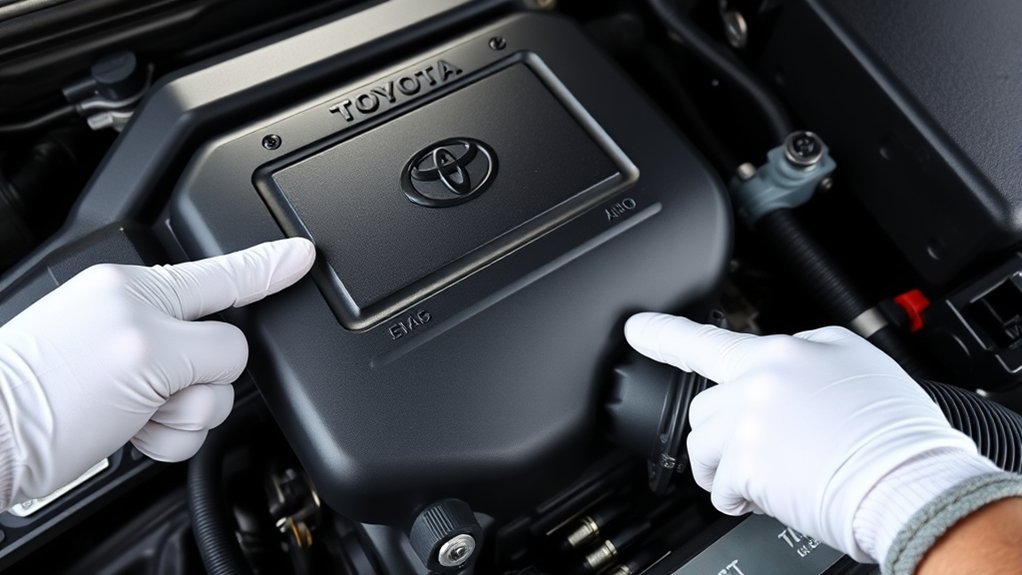
On a 2016–2023 Tacoma with the 3.5L V6, the engine air filter sits inside the rectangular black plastic airbox on the passenger side of the engine bay. The housing uses metal spring clips to secure the cover. Other Tacoma generations and engines can use a different airbox shape or fastener arrangement, so identify the housing connected to the engine’s intake tract before opening anything.
- Open the hood and locate the engine airbox connected to the intake tube.
- On the 2016–2023 3.5L V6, work from the passenger side.
- Identify the cover seam and spring clips or other fasteners used on your housing.
- Check that hoses and wiring near the airbox are not under tension.
- Clear loose debris before you open the cover.
How Do You Remove the Old Tacoma Engine Air Filter?
Release the airbox clips or fasteners, lift the cover only as far as necessary, and remove the old filter without shaking debris into the clean side of the housing. Before pulling it out, note its shape, sealing edge, and orientation so you can compare the replacement.
[Amazon Products Picked for You]
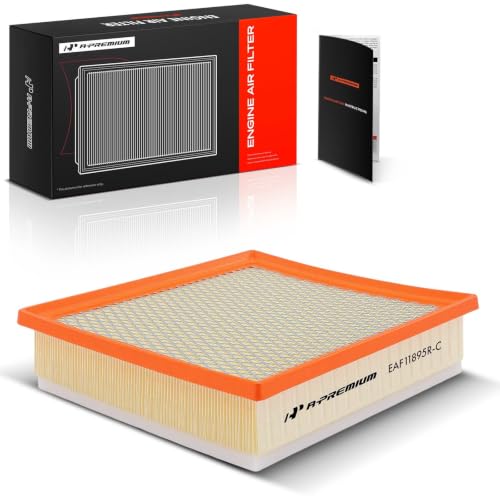
[Vehicle Fitment]: Compatible with Toyota Sequoia 2014-2022 V8 5.7L, Tacoma 2016-2023 V6 3.5L, Tundra 9/2013-2014 V6 4.0L, Tundra 9/2013-2019 V8 4.6L, 9/2013-2021 V8 5.7L

ENGINE PERFORMANCE: Helps maintain clean airflow to support consistent power, efficiency, and reliable engine operation. Designed for everyday driving, the filter helps your engine receive the air it needs for dependable performance mile after mile.

Compatible with Toyota V6 Engines – Fits Tacoma V6 (2005–2015), 4Runner V6 (2003–2009), Tundra V6 (2005–2010), and FJ Cruiser (2007–2009)
Open the Airbox
- Release each airbox clip or fastener.
- Lift the cover carefully without yanking nearby hoses or wiring.
- Hold the cover open only as far as needed to remove the filter.
- Look at how the old filter sits before removing it.
- Keep the new filter nearby but sealed or otherwise clean until the housing is ready.
Do not pry aggressively on the plastic cover. If it does not lift, recheck the fasteners, tabs, hoses, and housing edges instead of forcing it.
Remove the Old Filter
Grip the old filter by its frame or edge and lift it out. Avoid shaking it over the open airbox. Inspect the pleats and sealing surface for dust, leaves, insects, oil, water staining, damaged media, or a torn gasket. Replace a disposable filter if it is damaged or heavily contaminated.
Use a clean towel or careful vacuuming to remove loose debris from the dirty side of the housing. Do not push dirt into the intake tube. Inspect the airbox lip where the filter gasket seals; debris on that surface can prevent the new filter from sealing evenly.
How Do You Install a K&N 33-5017 in a Tacoma?
Install the K&N 33-5017 only after confirming that it matches your Tacoma’s year and engine. K&N currently lists it for 2016–2023 Tacoma 3.5L V6 models. Align the filter with the airbox seat and lower it into place without bending or forcing the frame.
A correct air filter replacement is not just about dropping in a new part. The filter must match the airbox, sit flat, seal evenly, and leave no debris on the sealing surface.
- Compare the replacement filter’s overall shape and sealing edge with the old filter.
- Seat the gasket evenly around the full perimeter.
- Do not trim, bend, add oil to, or otherwise modify a new filter to make it fit.
- Recheck the housing lip before closing the cover.
- Apply the reusable-filter reminder sticker only if it came with your filter and does not cover required service labels.
Pro Tip: Before removal, take a photo of the old filter and airbox. It gives you a quick reference for the original seating position and housing arrangement if anything looks unfamiliar during reassembly.
How Do You Check the Airbox Seal After Installation?
Lower the airbox cover carefully and secure every clip or fastener. The cover should sit evenly without requiring excessive force. If it will not close normally, stop and recheck the filter position, gasket, rear locating tabs, and part number.
Ensure Tight Latch
- Press the cover down evenly over the filter.
- Close each latch or fastener until the housing is secure.
- Look along the complete airbox seam for uneven gaps.
- Run a finger around accessible edges to check for a raised or pinched seal.
- Confirm nearby hoses, clamps, and wiring are still seated as they were before the job.
A poorly seated cover can allow unfiltered air to bypass the filter. If a hose or connector was disturbed, the truck may also develop abnormal intake noise or drivability symptoms.
Inspect the Rubber Gasket
Check the visible gasket edge and airbox seam. The gasket should not be pinched, folded, torn, or sitting outside the housing. Replace a filter with a damaged sealing edge rather than forcing the cover over it.
If you are reinstalling an oiled-cotton K&N filter after cleaning, let it dry naturally before applying filter oil. K&N specifically says not to apply oil until the filter is completely dry.
Run an Engine Leak Check
Start the engine and let it idle briefly. Listen near the airbox for new hissing, whistling, rattling, or other abnormal intake noise. If something sounds different, shut the engine off and recheck the housing, clips, hoses, and connectors before driving farther.
- Check that idle behavior is normal.
- Listen for new air-leak sounds around the airbox seam.
- Confirm no warning light appeared after the work.
- If a warning light appears and remains on, inspect anything you moved and scan the diagnostic code rather than guessing.
- Reinspect the airbox after especially dusty or off-road trips.
How Often Should You Clean a Reusable Tacoma Air Filter?
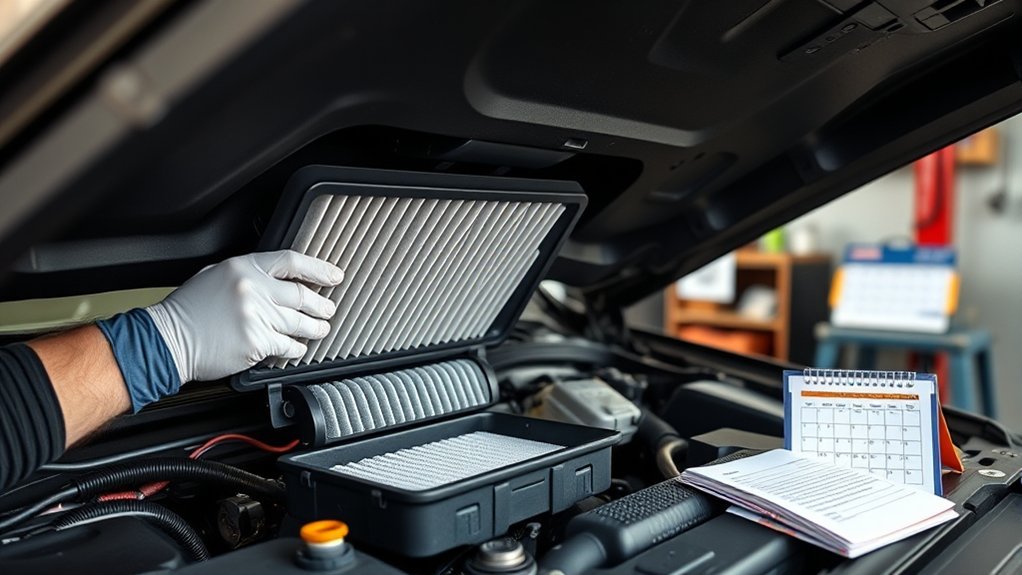
A reusable filter can reduce how many disposable filters you buy, but its service interval is not the same as Toyota’s replacement schedule for a disposable filter. K&N’s current 33-5017 product page says that particular filter needs cleaning every 75,000 miles under normal highway driving conditions. K&N’s general FAQ currently says factory-airbox High-Flow filters can go up to 50,000 miles under normal highway conditions.
Why the numbers differ: K&N’s part-specific 33-5017 page and its general replacement-filter FAQ currently publish different normal-use figures. Use the instructions supplied with your exact filter, inspect by condition, and service it sooner after heavy dust, sand, off-road travel, or other severe contamination.
| Task | When to Do It | Why It Matters |
|---|---|---|
| Visual inspection | At routine service or sooner after dusty/off-road driving | Finds contamination, damage, or poor seating before it becomes a larger problem |
| Disposable filter replacement | Follow the maintenance guide for your exact Tacoma year and driving conditions | Keeps the filter within Toyota’s scheduled-maintenance framework |
| K&N 33-5017 cleaning | Part-specific page currently says 75,000 miles under normal highway use; inspect/service sooner in dirty conditions and follow the instructions supplied with the filter | Allows the washable filter to be reused without treating it like a disposable element |
| Replace if damaged | Any time the media, frame, or sealing edge is torn or deformed | Helps prevent unfiltered air from bypassing the filter |
Reusable filters can reduce repeat purchases over long ownership, but only if you are willing to clean, dry, and re-oil them correctly. If you prefer a simpler maintenance routine, use the correct disposable Toyota Genuine or equivalent filter and replace it according to the maintenance guidance for your exact truck.
How Do You Clean a K&N Reusable Engine Air Filter?
When an applicable K&N oiled-cotton filter needs service, follow K&N’s official cleaning instructions. K&N specifies low-pressure rinsing, natural drying, and its filter oil for this filter type.
- Remove the filter from the airbox and lightly tap off loose dirt and debris.
- Spray K&N Power Kleen filter cleaner on both sides and let it sit for 10 minutes; do not let the cleaner dry on the filter.
- Rinse with cool, low-pressure water from the clean side out until the water runs clear.
- Shake off excess water gently and let the filter dry naturally.
- Do not apply filter oil until the media is completely dry.
- Apply K&N filter oil evenly along the pleats and let it wick for about 20 minutes.
- Touch up only light areas until the oil coverage is even.
- Reinstall the filter and verify the airbox seal again.
Warning: K&N recommends against using compressed air or brushes on its High-Flow cotton filter media and says not to substitute unapproved cleaners or oils. Follow the instructions for the exact filter type you own.
What If the Tacoma Runs Differently After the Filter Change?
If the Tacoma feels or sounds different immediately after the filter swap, recheck anything you touched before assuming the new filter itself is defective. Common installation issues include an incompletely closed airbox, a pinched sealing edge, a disturbed intake hose, or a disconnected electrical connector.
| Symptom | What to Check First | Next Step |
|---|---|---|
| Hissing or whistling | Airbox seam, filter seal, and nearby intake connections | Re-seat the filter and secure the housing without forcing it |
| Rough idle immediately after service | Any hose, clamp, or connector disturbed during the job | Restore anything moved to its original position and inspect for an intake leak |
| Airbox will not close normally | Wrong filter, raised gasket, debris on sealing lip, or misaligned housing tabs | Verify the part number and reinstall without forcing the cover |
| Check-engine light after service | Connector, intake hose, or another item disturbed during the work | Inspect your work and read the diagnostic trouble code if the light remains on |
Related Guides
Frequently Asked Questions
How do you replace a Tacoma engine air filter?
Turn the engine off, open the hood, release the airbox fasteners, lift the cover, remove the old filter, clear loose debris from the housing, seat the correct replacement filter flat, close the cover, and verify the full airbox seam is secure.
How often should you change the engine air filter on a Tacoma?
Use the Toyota maintenance guide for your exact model year. For example, Toyota’s 2017 Tacoma guide specifies replacement at 30,000 miles or 36 months and additional inspection during dusty-road operation. Other years may differ.
Does a dirty Tacoma air filter reduce fuel economy?
On modern computer-controlled fuel-injected gasoline vehicles, the U.S. Department of Energy says replacing a clogged air filter does not improve fuel economy, although it can improve acceleration when airflow was significantly restricted.
Does the Tacoma model year change which engine air filter you need?
Yes. Filter fitment changes by generation and engine. K&N, for example, lists different filters for 2005–2015 4.0L V6, 2016–2023 2.7L four-cylinder, 2016–2023 3.5L V6, and 2024–2026 2.4L gasoline applications. Verify by year, engine, VIN, and manufacturer fitment data.
Does K&N 33-5017 fit every Toyota Tacoma?
No. K&N currently lists 33-5017 for 2016–2023 Tacoma 3.5L V6 models. The 2016–2023 2.7L four-cylinder uses a different K&N listing, and K&N lists another filter for 2024–2026 2.4L gasoline Tacomas.
Can you clean a Tacoma engine air filter instead of replacing it?
Only if the filter is designed to be cleaned and reused. Replace a disposable paper-style filter when it reaches its service point or is damaged or heavily contaminated. A washable K&N oiled-cotton filter can be cleaned, dried, re-oiled, and reused according to K&N’s instructions.
Is it easy to replace an engine air filter yourself?
On many Tacomas, yes. It is a beginner-friendly maintenance job. The important parts are verifying fitment, keeping debris out of the open airbox, seating the filter evenly, and making sure the housing closes completely afterward.
Conclusion
Replacing a Tacoma engine air filter is usually a short DIY job, but the correct part matters more than the brand name on the box. Confirm the truck’s year and engine, keep debris away from the open intake, seat the filter evenly, and secure the full airbox seam before starting the engine.
If you have a 2016–2023 Tacoma 3.5L V6, K&N currently lists 33-5017 as a compatible reusable replacement. Other Tacoma engines use different filters. If you choose a reusable filter, follow its cleaning and oiling instructions; if you choose a disposable filter, use the service schedule for your exact Tacoma year and driving conditions.
Sources
- K&N Toyota Tacoma Air Filter Catalog — model-year, engine, and K&N filter fitment.
- K&N 33-5017 Replacement Air Filter — filter construction, pre-oiled installation, specifications, and part-specific normal-use cleaning guidance.
- K&N Air Filter Cleaning Instructions — cleaner application, low-pressure rinsing, drying, and re-oiling process.
- K&N Frequently Asked Questions — general replacement-filter service guidance and cleaning cautions.
- Toyota Genuine Engine Air Filter 17801-0P100 — Toyota part number and previous-version information.
- 2017 Toyota Tacoma Warranty & Maintenance Guide — Toyota’s 30,000-mile/36-month replacement point and dusty-road inspection guidance for that model year.
- FuelEconomy.gov: Keeping Your Vehicle in Shape — modern fuel-injected vehicle air-filter MPG and acceleration guidance.
