
Towing capacity and Gross Combined Weight Rating (GCWR) describe different limits, and checking only one of them can leave your vehicle overloaded. A safe towing setup must account for the loaded trailer, passengers, cargo, hitch equipment, tongue weight, vehicle axles, tires, and the exact configuration of the tow vehicle.
Quick Answer
Towing capacity is the manufacturer’s maximum loaded trailer weight for a specific vehicle configuration. GCWR is the maximum actual weight of the loaded tow vehicle and loaded trailer together. A safe setup must also stay within GVWR, axle, payload, hitch, tongue-weight, trailer, tire, and brake limits. Whichever applicable limit is reached first controls.
Key Takeaways
- Towing capacity applies mainly to the loaded trailer; GCWR applies to the loaded tow vehicle and trailer together.
- Passengers, cargo, accessories, hitch hardware, and tongue weight can reduce how much trailer weight your vehicle can handle.
- Do not rely on advertised maximum towing capacity without confirming the rating for your vehicle’s VIN, drivetrain, axle ratio, and equipment.
- The lowest applicable limit—including GVWR, GAWR, payload, hitch, trailer, and tire ratings—is your controlling limit.
- Actual scale weights are more reliable than dry-weight estimates.
At a Glance
| Time Required | 15–30 minutes for the calculation, plus time for a scale visit |
| Difficulty | Easy to moderate |
| Tools Needed | Owner’s manual, VIN-specific towing guide, door labels, trailer label, calculator, and a public scale |
| Cost | Free to calculate; public-scale fees vary by location |
Warning: Manufacturer ratings are maximum limits, not goals. Never exceed the vehicle, axle, hitch, tire, or trailer ratings. Follow the instructions for your exact vehicle and trailer, and check local requirements for trailer brakes, breakaway systems, licensing, speed, and safety equipment.
What Is Towing Capacity and Why Does It Matter?

Towing capacity, also called a trailer weight rating, is the maximum loaded trailer weight the manufacturer allows a particular vehicle configuration to tow. The rating may change with the model year, engine, transmission, drivetrain, axle ratio, cab and bed combination, wheelbase, cooling equipment, tow package, hitch type, and other options.
Advertised maximums usually apply only to a properly equipped configuration under defined loading assumptions. They may not represent the vehicle parked in your driveway. Passengers, cargo, aftermarket equipment, hitch hardware, and other added weight can reduce the practical trailer weight available to you.
For example, the 2026 Ford RV & Trailer Towing Guide explains that additional options, passengers, cargo, and hitch equipment must be deducted from the conditions used for its maximum loaded trailer figures. Chevrolet similarly warns that passengers, cargo, options, and accessories can reduce a vehicle’s trailering capacity.
Use the owner’s manual, manufacturer towing guide, trailering label, or VIN-specific lookup for your exact vehicle. Do not select a trailer from a general advertisement alone.
GCWR Explained: Why It Matters for Safe Towing
Gross Combined Weight Rating, or GCWR, is the maximum allowable combined weight of the loaded tow vehicle and loaded trailer. Some manufacturers use the phrase “Gross Combination Weight Rating,” but the meaning is the same.
Gross Combined Weight, or GCW, is different: it is the actual scale weight of the combination. It includes the tow vehicle, fuel, passengers, cargo, accessories, hitch equipment, and the loaded trailer.
The basic requirement is:
Actual GCW must not exceed GCWR.
Manufacturers establish GCWR through engineering and performance evaluation. The current SAE J2807 recommended practice provides performance criteria and calculation methodology for determining GCWR and trailer weight ratings for covered passenger vehicles and trucks.
GCWR is not permission to ignore the vehicle’s other ratings. A combination can remain below GCWR while exceeding the tow vehicle’s GVWR, rear GAWR, payload allowance, hitch rating, or tire capacity.
How Do Towing Capacity and GCWR Differ?
| Measurement | What It Covers | How to Use It |
|---|---|---|
| Towing capacity | The maximum loaded trailer weight allowed for a specific tow-vehicle configuration | Compare it with the trailer’s actual loaded weight, not just its advertised dry weight |
| GCWR | The maximum allowable weight of the loaded tow vehicle and loaded trailer together | Compare it with the actual combined scale weight |
| GVWR | The maximum allowable weight of the tow vehicle itself when loaded | Include passengers, cargo, accessories, hitch equipment, and trailer tongue or pin weight |
| GAWR | The maximum allowable load on an individual axle | Confirm front and rear axle weights separately on a scale |
Your safe trailer limit is not one advertised number. It is the lowest limit created by the vehicle, payload, axles, hitch, trailer, tires, and required braking equipment.
Towing Weight Terms You Need to Know
- Curb weight
- The manufacturer-defined weight of the vehicle with standard equipment and required fluids, but without passengers or cargo. Fuel assumptions can differ, so consult the manufacturer.
- Payload
- The weight the vehicle can carry in or on itself. Passengers, cargo, accessories, hitch hardware, and trailer tongue or pin weight consume payload.
- GVW
- Gross Vehicle Weight is the tow vehicle’s actual loaded weight. It is measured rather than assigned.
- GVWR
- Gross Vehicle Weight Rating is the maximum allowable loaded weight of the tow vehicle.
- GAWR
- Gross Axle Weight Rating is the maximum allowable weight on a specific axle. The rear axle frequently becomes important because trailer tongue weight pushes down near the rear of the tow vehicle.
- GTW
- Gross Trailer Weight is the trailer’s actual loaded weight, including cargo, water, batteries, propane, accessories, and installed equipment.
- Trailer GVWR or GTWR
- The maximum allowable loaded weight of the trailer. Do not confuse this rating with the trailer’s actual weight.
- Tongue weight or pin weight
- The downward load the trailer applies to the hitch. Conventional trailers use tongue weight; fifth-wheel and gooseneck trailers use pin weight.
- Hitch rating
- The maximum trailer and tongue or pin weight allowed by the receiver, ball mount, ball, coupler, weight-distribution equipment, or fifth-wheel hitch. The lowest-rated component controls.
Which Rating Actually Controls Your Towing Limit?
Your usable limit is the lowest result produced by all applicable ratings. Before towing, confirm each of the following:
- The loaded trailer does not exceed the manufacturer’s trailer weight rating.
- The actual combined weight does not exceed GCWR.
- The loaded tow vehicle, including tongue or pin weight, does not exceed GVWR.
- Neither tow-vehicle axle exceeds its GAWR.
- The remaining payload is sufficient for the tongue or pin weight.
- The receiver, ball mount, ball, coupler, and hitch equipment are rated for the load.
- The trailer does not exceed its own GVWR, axle ratings, or tire ratings.
- The setup meets the vehicle and trailer brake requirements and all applicable local laws.
Pro Tip: Payload and rear-axle capacity often become limiting factors before the advertised towing capacity does, especially with travel trailers, fifth-wheels, heavy passengers, bed cargo, or aftermarket equipment.
How to Calculate Your Vehicle’s Towing Capacity and GCWR

You do not normally calculate the manufacturer’s GCWR yourself. You locate the assigned GCWR for your exact vehicle and use it to check your actual combination. Follow these steps.
1. Find the Exact Vehicle Ratings
Record the following figures from your owner’s manual, VIN-specific towing guide, trailering label, and door-jamb labels:
- Maximum loaded trailer weight
- GCWR
- GVWR
- Front and rear GAWR
- Payload or occupant-and-cargo limit
- Maximum tongue or pin weight
- Receiver and hitch-equipment ratings
Some door labels list GVWR, GAWR, tire information, and payload but not GCWR or towing capacity. Use the manufacturer’s towing guide or owner’s manual for the missing ratings.
2. Load the Tow Vehicle as It Will Travel
Include the driver, passengers, pets, tools, luggage, bed cargo, roof cargo, aftermarket accessories, and installed hitch hardware. Weigh the vehicle without the trailer attached when possible.
3. Calculate GCWR Headroom
Use this formula:
GCWR headroom = GCWR − actual loaded tow-vehicle weight before hitching
This result shows the trailer weight permitted by the combined-weight calculation alone. It is not automatically your towing capacity and cannot override a lower manufacturer trailer rating, payload limit, axle rating, hitch rating, or trailer rating.
4. Determine the Trailer’s Loaded Weight
Use the trailer’s expected or measured loaded weight, including optional equipment, batteries, propane, water, food, tools, luggage, and other cargo. Dry or unloaded weight is not enough for a final towing decision.
If you are shopping and cannot know the final weight, the trailer’s GVWR can provide a conservative maximum-load figure. Your actual loaded trailer must remain within both the tow vehicle’s limits and the trailer’s own ratings.
5. Check Payload, GVWR, and Tongue Weight
Trailer tongue or pin weight becomes load carried by the tow vehicle. Add it to passengers, cargo, accessories, and hitch equipment, then confirm that the tow vehicle remains within its payload allowance, GVWR, and rear GAWR.
Many conventional-trailer instructions call for tongue weight near 10–15% of loaded trailer weight, but the exact requirement depends on the trailer, hitch, and tow vehicle. Follow the instructions for your equipment rather than forcing every trailer into one percentage.
6. Compare Every Limit
The trailer is suitable only if every applicable test passes. A lower payload, axle, hitch, tire, or manufacturer trailer rating overrides a higher GCWR-based result.
Worked Example
| Item | Example Value | Result |
|---|---|---|
| GCWR | 15,000 lb | Manufacturer’s combined-weight limit |
| Loaded tow vehicle before hitching | 5,800 lb | Includes passengers, cargo, and hitch hardware |
| GCWR headroom | 15,000 − 5,800 = 9,200 lb | Combined-weight math allows up to 9,200 lb |
| Published trailer weight rating | 9,000 lb | The lower 9,000-lb rating controls instead of 9,200 lb |
| Actual loaded trailer | 7,000 lb | Below both trailer-weight and GCWR limits |
| Remaining vehicle payload before tongue weight | 600 lb | Available after passengers, cargo, accessories, and hitch hardware |
| Measured tongue weight | 700 lb | Setup fails: tongue weight exceeds the remaining payload by 100 lb |
In this example, the trailer is below the advertised towing capacity and GCWR headroom, but the tow vehicle is still overloaded by tongue weight. The solution is not to ignore the payload limit. Cargo or passengers must be reduced, or a more suitable tow vehicle or lighter trailer must be used.
7. Verify the Combination on a Scale
Load the vehicle and trailer exactly as they will travel, including people, fuel, water, food, tools, and recreation equipment. Obtain axle weights for the tow vehicle and trailer.
- Add all axle readings to find actual GCW and compare it with GCWR.
- Add the tow vehicle’s front and rear axle readings and compare the total with GVWR.
- Compare each axle reading with its GAWR.
- Determine the trailer’s total loaded weight using scale measurements or the scale procedure recommended by the vehicle, trailer, or scale operator.
- Measure tongue or pin weight separately when required and compare it with payload, GVWR, rear GAWR, and hitch limits.
Keep the scale ticket with your towing records, especially after major cargo, equipment, battery, water-tank, hitch, or trailer changes.
How Tongue Weight Affects Payload and Axle Limits
Tongue weight is not weight that disappears from the calculation. When the trailer is connected, that downward force is carried by the tow vehicle and consumes part of its payload.
For example, suppose a payload label allows 1,500 pounds. If the occupants, luggage, accessories, and hitch hardware already total 900 pounds, only 600 pounds remain for tongue weight. A 750-pound tongue load would exceed the available payload even if the trailer remained below the vehicle’s advertised towing capacity.
Too little tongue weight can contribute to trailer instability. Too much can overload the hitch, rear axle, tires, or vehicle and may reduce steering and braking performance. Use the vehicle and trailer manufacturer’s target, then confirm the result by measurement.
Should You Use Dry Weight, Loaded Weight, or Trailer GVWR?
Dry weight is useful only as a starting point. It may exclude cargo and can also omit dealer-installed equipment, batteries, propane, water, and optional features.
Actual loaded trailer weight is the best figure for checking a trailer you already own. Weigh it as it will travel.
Trailer GVWR is the trailer’s maximum allowable loaded weight. It can be a conservative planning figure when shopping or when the final cargo load is unknown, but the trailer does not necessarily weigh its full GVWR on every trip.
Never allow the actual trailer weight to exceed the trailer’s GVWR, axle ratings, or tire capacities.
[Amazon Products Picked for You]
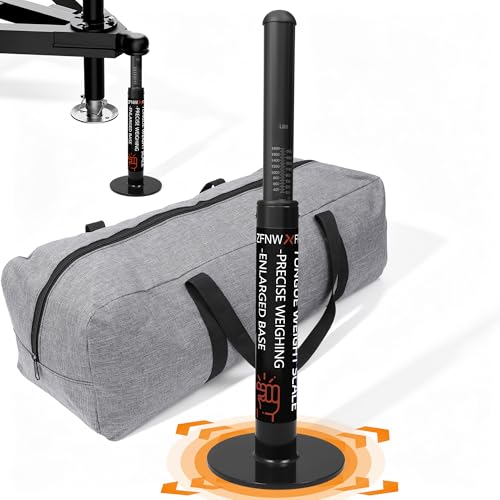
【Stable 6.3" Large Base】Our trailer tongue weight scale features an upgraded large base - 6.3" to prevent tipping, wobbling, or sinking in mud—safe and reliable for every towing trip, no messy mishaps.

【Accurate Trailer Tongue Weight Scale】 Know your tongue weight before you tow. This trailer tongue weight scale helps you check hitch load, support proper weight distribution, reduce trailer sway, and improve towing stability for travel trailers, RVs, boats, campers, cargo trailers, and utility trailers.
Top Mistakes to Avoid When Evaluating Towing Capacity and GCWR
- Using a brochure maximum: Confirm the rating for your exact model, drivetrain, axle ratio, equipment, and VIN.
- Checking GCWR alone: A rig can remain below GCWR while exceeding payload, GVWR, rear GAWR, or hitch limits.
- Using dry trailer weight: Include all cargo, water, batteries, propane, accessories, and installed options.
- Forgetting tongue or pin weight: It consumes tow-vehicle payload and affects GVWR and axle loads.
- Assuming the hitch can handle the vehicle maximum: Check the receiver, ball mount, ball, coupler, and weight-distribution or fifth-wheel equipment separately.
- Relying on an arbitrary 1,000-pound buffer: A fixed margin cannot prove that payload, axle, hitch, or tire limits are satisfied.
- Skipping the scale: Estimates can miss hundreds of pounds of passengers, equipment, water, and cargo.
- Ignoring trailer brakes and tires: Weight compliance does not make a setup safe if its braking, tire, lighting, or breakaway equipment is unsuitable.
Note: The “80% rule” is an informal suggestion to use less than the advertised towing maximum. It is not a universal SAE or manufacturer rating. A personal buffer may be useful for comfort or changing conditions, but it does not replace checking GCWR, GVWR, GAWR, payload, hitch, tongue-weight, trailer, tire, and brake limits.
[Amazon Products Picked for You]

【Upgraded 2000 LBS Heavy‑Duty Capacity】This upgraded trailer tongue weight scale supports up to 2000 lbs tongue load. Built with high‑strength steel and heavy‑duty internal spring assembly, it delivers stable performance for heavy‑load towing, ideal for RVs, travel trailers, boat trailers and utility trailers
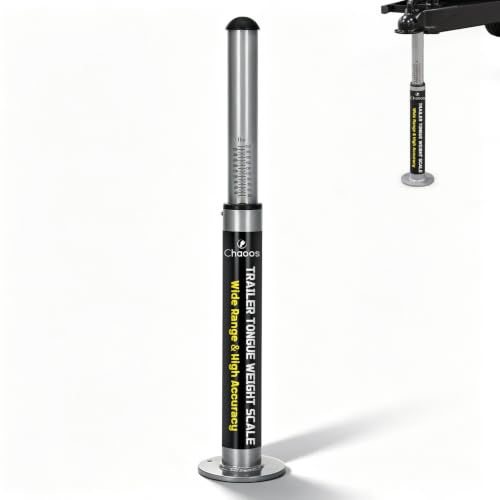
【Wide Range & High Accuracy】The Chaoos trailer tongue weight scale measures up to 2100 lbs with an accuracy within ±20 lbs, helping ensure proper tongue weight for safer towing and reduced trailer sway.
Final Pre-Tow Safety Checklist
- Confirm the loaded vehicle, trailer, and axle weights.
- Verify the receiver, hitch, ball, ball mount, and coupler ratings.
- Secure the coupler and install the hitch pin or locking device correctly.
- Cross and attach safety chains as instructed, with enough slack for turns.
- Connect the breakaway cable to the tow vehicle independently of the safety chains when the trailer uses one.
- Test running lights, brake lights, turn signals, and trailer brakes.
- Inflate tow-vehicle and trailer tires to the specified cold pressures and inspect their load and speed ratings.
- Secure cargo so it cannot move forward, rearward, or side to side.
- Adjust mirrors for a clear view along both sides of the trailer.
- Allow more distance for braking, turning, merging, and lane changes.
[Amazon Products Picked for You]

☆ Upgraded Trailer Alignment Kit With Magnet Hitch Line Up is towing facility for aligning hitch with the trailers.

One-person hook-up on the first try every time

[VEHICLE FITMENT] - This Direct Replacement 7-Way Harness Kit is Designed to fit for 2005 - 2024 Nissan Frontier; 2005 - 2012 Nissan Pathfinder; 2005 - 2015 Nissan Xterra and 2009 - 2012 Suzuki Equator without Factory Trailer Connector. Please Double-check the Compatibility to Avoid Mistakes!!!
Frequently Asked Questions
What is the difference between GCWR and towing capacity?
Towing capacity is the maximum loaded trailer weight allowed for a specific vehicle configuration. GCWR is the maximum allowable actual weight of the loaded tow vehicle and loaded trailer together. Both limits apply, along with payload, GVWR, GAWR, hitch, tire, tongue-weight, and trailer ratings.
What is the 80/20 rule for towing?
It is an informal suggestion to keep loaded trailer weight at or below about 80% of the advertised towing capacity. It is not a universal manufacturer or SAE requirement. Staying below 80% also does not prove that payload, GVWR, axle, hitch, tongue-weight, tire, or trailer limits are satisfied.
When towing, should you use dry weight or trailer GVWR?
Use the trailer’s actual loaded weight whenever possible. Dry weight is normally too low for a final calculation because it excludes cargo and may exclude equipment or fluids. Trailer GVWR is useful as a conservative maximum when shopping or when the final loaded weight is unknown.
What is the 60/40 rule for loading a trailer?
The common guidance is to place roughly 60% of the cargo weight in the front half of the trailer and 40% in the rear half, while keeping heavy items low and near the trailer axles. It does not mean placing 60% of total trailer weight on a front axle. Always verify the manufacturer’s required tongue weight after loading.
Does tongue weight count against payload?
Yes. Tongue or pin weight is carried by the tow vehicle and consumes part of its payload allowance. It must also fit within the vehicle’s GVWR, rear GAWR, tire ratings, receiver rating, and hitch limits.
Can you calculate towing capacity from GCWR alone?
No. Subtracting the loaded tow-vehicle weight from GCWR shows combined-weight headroom, but the result may be higher than the manufacturer’s trailer rating or the limits created by payload, GVWR, GAWR, hitch equipment, tires, tongue weight, or the trailer itself.
Conclusion
Towing capacity and GCWR answer different questions. Towing capacity limits the loaded trailer for a specific vehicle configuration, while GCWR limits the actual weight of the loaded tow vehicle and trailer together. Neither number can be checked in isolation.
Confirm the exact manufacturer ratings, include every passenger and item of cargo, account for tongue or pin weight, and verify the finished setup on a scale. The lowest applicable vehicle, axle, payload, hitch, trailer, tire, or brake limit is the one that controls.
Sources
- SAE International — J2807_202411 — performance criteria and methodology for tow-vehicle GCWR and trailer weight ratings.
- Ford — 2026 RV & Trailer Towing Guide — definitions of payload, GVWR, GAWR, GCW, GCWR, trailer weight, and tongue or pin weight.
- Chevrolet — 2026 Trailering Guide — trailering classifications, rating definitions, loading assumptions, and scale guidance.
- NHTSA-hosted owner-manual filing — trailer cargo distribution, tongue-weight guidance, and towing-safety checks.