Toyota Tacoma towing capacity is not one universal number. For 2026, Toyota advertises a maximum of 6,500 pounds, but the rating for your truck depends on its model year, configuration, equipment, and loaded condition. Before hitching a trailer, verify TWR, payload, GVWR, front and rear GAWR, GCWR, tongue weight, and every hitch and trailer component rating. Loaded scale weights are the best way to confirm that the exact truck-and-trailer combination remains within every limit.
By Natalie Rhodes, GoMyReview writer covering automotive troubleshooting and vehicle maintenance · Originally published February 20, 2026 · Last reviewed for accuracy September 19, 2026
Quick Answer
Your Tacoma can tow a trailer only when every applicable limit is satisfied: the model-specific TWR in the owner’s manual, the truck’s payload and axle ratings, GCWR, tongue weight, and every hitch and trailer component rating. The 2026 lineup maximum is 6,500 pounds, not a universal rating for every Tacoma. Use loaded scale weights, not brochure maximums, and follow the lowest verified limit.

Key Takeaways
- For 2026, Toyota advertises up to 6,500 pounds of towing capacity, but the exact rating still depends on configuration and equipment.
- The driver-door labels normally show GVWR, axle ratings, tire information, and occupant-and-cargo capacity, not the truck’s trailer tow rating.
- Find TWR, GCWR, required equipment, and tongue-weight instructions in the owner’s manual for your exact model year and configuration.
- Tongue weight is already part of loaded trailer weight. Do not add it to the trailer weight a second time.
- Passengers, bed cargo, accessories, hitch hardware, and trailer tongue load all use the truck’s available payload.
- Your safe planning limit is the lowest limit produced by payload, TWR, GCWR, axle, hitch, tire, and trailer checks.
At a Glance
| Time Required | About 30–60 minutes, plus travel to a public scale |
| Difficulty | Moderate; you need to identify several ratings and compare actual weights |
| Tools Needed | Owner’s manual, door labels, trailer label, calculator, public scale, and tongue-weight scale when available |
| Cost | Usually free to low cost; public-scale fees vary by location |
Warning: Never assume a lineup’s advertised maximum applies to your Tacoma. Cab style, bed length, drivetrain, transmission, trim, factory equipment, accessories, and model year can change the rating. Your exact owner’s manual and vehicle labels control.
Know Which Tacoma Towing Number Comes From Which Source
Several different ratings control a Tacoma and trailer combination. They are not interchangeable, and passing one limit does not mean you pass the others.
| Rating | What It Means | Where to Find It |
|---|---|---|
| TWR | The maximum loaded trailer weight approved for a specific truck configuration | Owner’s manual or official towing specifications |
| GVWR | The maximum allowed weight of the loaded truck, including occupants, cargo, accessories, hitch equipment, and tongue load | Certification label near the driver’s door |
| GAWR | The maximum weight allowed on the front or rear axle | Certification label near the driver’s door |
| Payload | The available capacity for occupants, cargo, accessories, hitch hardware, and trailer tongue load | Tire-and-loading placard near the driver’s door |
| GCWR | The maximum combined weight of the loaded truck and loaded trailer | Owner’s manual or official towing guide |
| Trailer GVWR | The maximum loaded weight allowed for the trailer itself | Trailer certification label |
| Tongue weight | The portion of the loaded trailer’s weight pressing down on the hitch | Tongue-weight scale or verified scale procedure |
Your advertised tow rating is a ceiling for a qualifying configuration, not a promise that payload, axle capacity, hitch hardware, or GCWR will support that much trailer in your loaded truck.
What Your Tacoma’s Door Stickers Actually Mean
Your Tacoma may have two important labels near the driver’s door. The certification label lists the truck’s GVWR and front and rear GAWR. Federal certification-label rules require these ratings, along with the VIN and other vehicle information. You can review the requirements in 49 CFR § 567.4.
The tire-and-loading placard states that the combined weight of occupants and cargo should never exceed a vehicle-specific amount. It also lists original tire sizes and recommended cold inflation pressures. These placard requirements appear in Federal Motor Vehicle Safety Standard No. 110.
Neither label should be treated as a universal trailer tow-rating label. Use the payload figure to determine how much capacity remains for people, bed cargo, accessories, hitch hardware, and tongue load. Use GVWR and GAWR to confirm the loaded truck and each axle stay within their ratings.
For a label-by-label walkthrough, see Toyota Tacoma door-jamb stickers explained.
Note: Aftermarket bumpers, skid plates, bed racks, camper shells, larger spare tires, recovery gear, toolboxes, and similar additions use payload. Suspension upgrades may change how the truck sits or handles, but they do not raise Toyota’s GVWR, GAWR, GCWR, or TWR.
Find the Exact Tow Rating in Your Tacoma Owner’s Manual
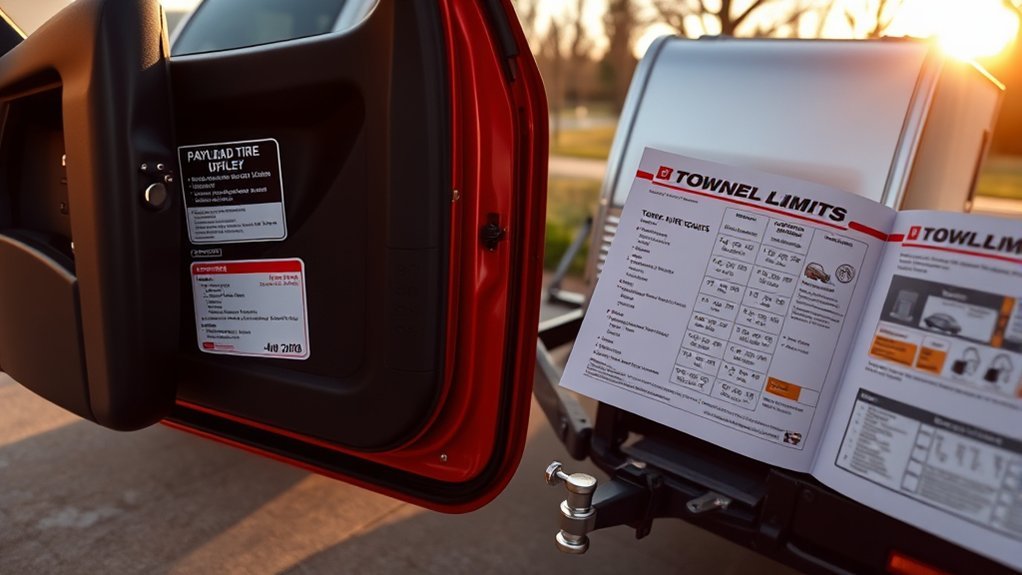
Use Toyota’s Manuals and Warranties portal to select your exact Tacoma. Confirm the model year, cab, bed length, drivetrain, transmission, trim, engine, and required towing equipment before using any published rating. When the manual uses a model-code table for TWR and GCWR, match the code shown on the truck’s certification label to the correct row instead of choosing a rating by engine or trim name alone.
Do not combine lineup maximums as though they describe one truck. Toyota’s 2026 Tacoma information advertises a maximum towing capacity of 6,500 pounds and a maximum payload of 1,705 pounds. Those are separate lineup maximums; your exact Tacoma may have lower limits. Match the exact manual row to your truck, then verify payload, axle, hitch, and combined-weight limits with the truck loaded for travel.
Older Tacoma generations used different engines and ratings. A 4.0-liter V6, 3.5-liter V6, 2.7-liter four-cylinder, turbocharged four-cylinder, and hybrid Tacoma can each have several ratings depending on configuration. Avoid engine-only charts unless they identify the exact year and vehicle setup.
How to Verify Factory Towing Equipment
A receiver hitch, four-pin or seven-pin connector, brake controller, transmission cooler, or towing software can help identify installed equipment. However, visible hardware alone does not prove that the truck left the factory with a particular towing package.
Check the original window sticker, build record, purchase documents, or dealer-accessible VIN information. Compare the installed equipment with the towing section of the exact owner’s manual. An aftermarket receiver or wiring connector cannot increase the manufacturer’s ratings.
Calculate Your Real-World Tacoma Towing Limit
Run each calculation separately. Your final planning limit is the lowest result, and actual scale weights must still confirm that the truck, axles, combination, hitch, and trailer remain within their ratings.
[Amazon Products Picked for You]
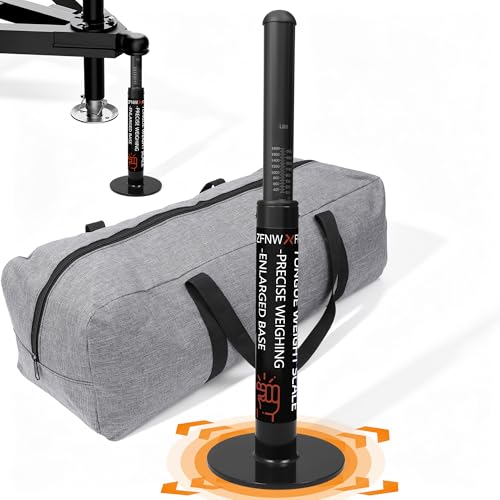
【Stable 6.3" Large Base】Our trailer tongue weight scale features an upgraded large base - 6.3" to prevent tipping, wobbling, or sinking in mud—safe and reliable for every towing trip, no messy mishaps.

【Upgraded 2000 LBS Heavy‑Duty Capacity】This upgraded trailer tongue weight scale supports up to 2000 lbs tongue load. Built with high‑strength steel and heavy‑duty internal spring assembly, it delivers stable performance for heavy‑load towing, ideal for RVs, travel trailers, boat trailers and utility trailers
1. Gather Every Required Rating
- Your Tacoma’s TWR and GCWR from the exact owner’s manual or towing guide
- GVWR and front/rear GAWR from the certification label
- Occupant-and-cargo capacity from the tire-and-loading placard
- Receiver, ball mount, hitch ball, and coupler ratings
- Trailer GVWR and axle ratings from the trailer label
- Required tongue-weight range from the Tacoma and trailer instructions
2. Load the Truck and Trailer for Travel
Include every passenger, pet, cooler, tool, bed item, water tank, propane cylinder, battery, accessory, and piece of camping or work equipment. Use the trailer’s loaded weight, not its advertised dry weight.
3. Calculate Remaining Payload
Remaining payload = door-placard occupant-and-cargo limit − occupants − truck cargo − added accessories − hitch hardware
The remaining amount must be enough for the trailer’s tongue load. If your Tacoma has 500 pounds of remaining payload, a 650-pound tongue load is too heavy even when the trailer itself is below the published tow rating.
For a focused worksheet-style explanation of this step, see the Tacoma payload calculator and door-sticker guide.
4. Estimate the Payload-Limited Trailer Weight
For preliminary planning only, divide the remaining payload by the expected tongue-weight fraction:
Payload-limited trailer estimate = remaining payload ÷ tongue-weight fraction
For example, if the applicable Tacoma manual specifies a 9%–11% conventional tongue-weight range, using 11% as a conservative payload-screening fraction gives 600 ÷ 0.11 = about 5,455 pounds. This is only a preliminary estimate. Use the exact range required by your model-year Tacoma manual and trailer manufacturer, then verify the actual tongue load. Do not deliberately reduce tongue weight below their instructions just to make a heavier trailer appear acceptable.
5. Check the GCWR Limit
Weigh the loaded Tacoma without the trailer attached, while keeping the same passengers, cargo, fuel, and hitch hardware aboard.
GCWR-limited trailer weight = GCWR − actual loaded truck weight
If the GCWR is 11,000 pounds and the loaded truck weighs 5,600 pounds, no more than 5,400 pounds remains for the loaded trailer. The exact TWR or another limit may produce an even lower result. For a deeper explanation of this constraint, see towing capacity vs. GCWR.
6. Weigh the Complete Combination
Use a public vehicle scale with the trailer loaded for travel. Record the steer-axle, drive-axle, trailer-axle, and total combination weights when the scale provides them.
- Truck weight with the trailer coupled must remain at or below GVWR.
- Front and rear axle weights must remain at or below their respective GAWR figures.
- Total truck-and-trailer weight must remain at or below GCWR.
- Actual loaded trailer weight must remain at or below TWR and trailer GVWR.
- Tongue load must fit within remaining payload and all hitch-component limits.
One practical method uses two scale passes. First, weigh the loaded truck and trailer together. Then disconnect the trailer in an approved location and weigh the loaded truck alone. Subtract the truck-only total from the combined total to find the trailer’s actual loaded weight.
Measure tongue weight with a suitable tongue-weight scale when possible. The increase in the truck’s axle total after coupling can also provide useful information, but a weight-distributing hitch can transfer some load to the trailer and front axle. Follow the scale and hitch manufacturers’ procedures for an accurate measurement.
Pro Tip: Keep the scale tickets with your towing records. Reweigh after adding a camper shell, rack, larger spare tire, toolbox, new batteries, water, or other heavy equipment.
Worked Example
Assume a hypothetical Tacoma has a 1,300-pound occupant-and-cargo limit. The passengers weigh 450 pounds, bed cargo weighs 250 pounds, and accessories plus hitch hardware weigh 80 pounds.
- Used payload: 450 + 250 + 80 = 780 pounds
- Remaining payload: 1,300 − 780 = 520 pounds
- At an 11% tongue-weight screening fraction: 520 ÷ 0.11 = about 4,727 pounds
Assume the exact manual lists a 6,400-pound TWR, the GCWR calculation leaves room for 5,200 pounds of trailer, and the lowest hitch-component rating is 5,000 pounds. The preliminary planning limit would be about 4,727 pounds because the payload-and-tongue-weight calculation produces the lowest result. Scale measurements must still verify GVWR, GAWR, GCWR, tongue load, and trailer weight.
Tongue Weight and Load Distribution
Tongue weight is part of the trailer’s loaded weight. It should not be added to that weight again when calculating total combination weight. Instead, treat it as the portion transferred onto the Tacoma’s hitch and rear structure.
Recent Tacoma owner’s manuals specify a 9%–11% tongue-weight range for conventional towing. Treat that as model-year guidance, not a universal rule for every Tacoma or every trailer. Follow the exact range in your Tacoma owner’s manual and the trailer manufacturer’s instructions.
Too little tongue weight can encourage sway. Too much can consume payload, overload the receiver or rear axle, reduce front-axle loading, and affect steering or braking. Load heavy items low, secure them against movement, and position them according to the trailer manufacturer’s instructions.
Warning: Do not move cargo behind the trailer axle merely to reduce tongue weight enough to fit the Tacoma’s payload. Rear-heavy loading can make a trailer unstable.
Towing Equipment, Tow Packages, and Component Limits
Every towing component has its own rating. Check the labels or markings on the receiver, ball mount, hitch ball, coupler, safety chains, tires, wheels, and trailer axles. The lowest component rating controls, even when the Tacoma’s TWR is higher.
A Class-IV receiver is not a universal requirement for every Tacoma and trailer. Use the hitch type and rating required by your exact manual and trailer setup. The receiver’s maximum rating does not raise the truck’s factory towing capacity.
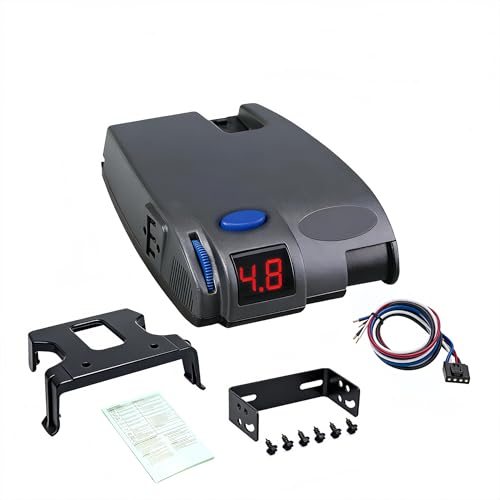
Use a trailer brake controller when the trailer has compatible electric brakes and when the manual or applicable law requires it. Test brake operation at low speed before entering traffic. Check the rules for every state or province on your route because brake, breakaway, lighting, and registration requirements vary.
As one current-model example, Toyota’s 2026 Tacoma owner’s manual requires trailer service brakes when gross trailer weight exceeds the unbraked TWR, a sway-control device with sufficient capacity above 2,000 pounds, and a weight-distributing hitch with sufficient capacity above 5,000 pounds. Do not apply those thresholds to another model year without checking that year’s manual.
When a weight-distributing hitch is required or permitted by the Tacoma manual, also confirm that the receiver and trailer manufacturer approve it for the exact combination. Correct setup may improve axle-load distribution, but it cannot increase GVWR, GAWR, GCWR, TWR, payload, or component ratings.
[Amazon Products Picked for You]
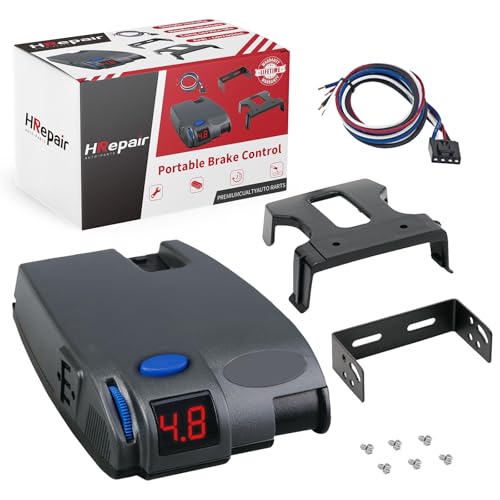
✨ Proportional Braking System: Ensures smooth, consistent stops by applying trailer brakes in proportion to your vehicle's braking intensity. Ideal for all trailer types, from light utility to heavy-duty.
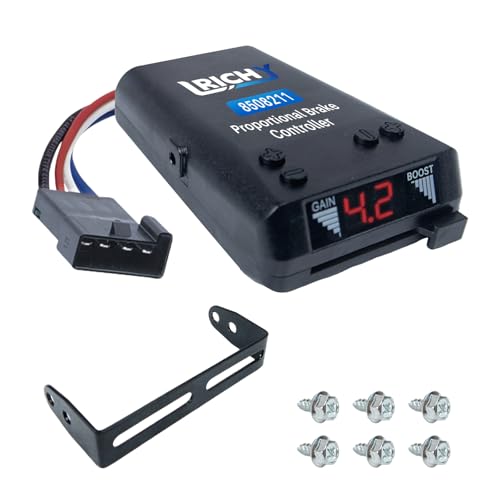
🏆【PROPORTIONAL ELECTRIC BRAKE CONTROLLER】Lrichy brake controller uses internal sensors to automatically apply trailer brakes based on your tow vehicle's braking intensity and speed. It intelligently sets the correct braking level and adjusts for hills, delivering reliable stopping power in any situation
【WIDE COMPATIBILITY】Proportional Brake Controller Designed as a direct replacement for Tekonsha 90160 Primus IQ | Compatible with Ford, Chevy, Dodge, RAM, Toyota, Jeep, GM,etc supporting 2, 4, or 6 brake electric brake trailers. (NOTE: Vehicle-specific plug-and-play harness is not included)
Towing Checklist: Gear, Load Distribution, and When to Downsize
Complete this check before each trip and whenever the trailer’s cargo changes.
| Item | Purpose | Quick Check |
|---|---|---|
| Manual and ratings | Confirm the exact vehicle and trailer limits | TWR, GCWR, GVWR, GAWR, and tongue instructions verified |
| Receiver, ball mount, and ball | Connect the trailer with rated components | Correct size, rating, rise or drop, and secure pin |
| Coupler and latch | Keep the trailer attached to the hitch ball | Fully seated, latched, locked, and matched to ball size |
| Safety chains | Retain the trailer if the coupler separates | Properly attached with enough turning clearance |
| Wiring and lights | Operate brake, turn, marker, and running lights | Connector secure; every light works |
| Brake controller | Control compatible electric trailer brakes | Connected, tested, and adjusted for the loaded trailer |
| Breakaway system | Apply trailer brakes after a separation | Battery charged and cable attached independently |
| Tires and wheels | Carry the load safely | Cold pressure, condition, load rating, and lug torque checked |
| Cargo and tongue load | Reduce sway and prevent load movement | Weight measured and cargo secured |
| Mirrors and cameras | Maintain adequate rear and side visibility | Clear view along both sides of the trailer |
[Amazon Products Picked for You]

【Professional-Grade Accuracy & Durability】Engineered for professionals and meticulous owners, this scale combines an industrial Q235 steel structure with a military-grade spring mechanism for lab-like precision up to 1800 lbs. Its finish undergoes a rigorous 300-hour salt spray test, offering exceptional corrosion and abrasion resistance for use in marinas, construction sites, farms, or frequent highway travel.

Digital battery-powered LED display offers fast, easy-to-read measurements.
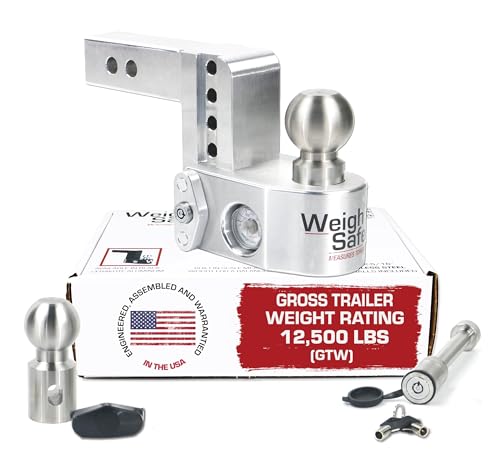
Adjustable Trailer Hitch: This truck hitch has a 4" drop and a 5" rise in 1" increments and comes with a Keyed Alike Dual Pin Lock and Receiver Pin Lock
When to Downsize the Trailer
Choose a lighter trailer or remove cargo when any required limit is exceeded. Downsizing is also the safer choice when:
- The expected tongue load is greater than your remaining payload.
- The rear axle approaches its GAWR even though total truck weight remains below GVWR.
- The GCWR calculation produces a lower limit than the advertised tow rating.
- You must place cargo too far behind the trailer axle to make the numbers fit.
- The trailer sways, pushes the truck, or feels unstable despite correct loading and equipment.
- Strong crosswinds, steep grades, extreme heat, or long mountain descents make the combination difficult to control.
- Your loaded trailer weight changes significantly between trips.
Maximum ratings are limits, not targets. A personal operating buffer can provide more room for changing weather, cargo, and driving conditions, but no universal percentage replaces the manual, component ratings, and actual scale measurements.
Frequently Asked Questions
How do I tell my Tacoma’s towing capacity from the door sticker?
You generally cannot determine the complete trailer tow rating from the door sticker alone. The certification label supplies GVWR and GAWR, while the tire-and-loading placard supplies occupant-and-cargo capacity. Find TWR, GCWR, required equipment, and tongue-weight instructions in the owner’s manual for your exact Tacoma.
How can I verify whether my Toyota Tacoma has a factory tow package?
Check the original window sticker, build record, purchase documents, or dealer-accessible VIN information. Then compare the listed equipment with your model-year manual. A receiver hitch, wiring connector, or brake controller can be aftermarket and does not by itself prove a factory package.
What is the towing capacity of a manual-transmission Tacoma?
No single capacity applies to every manual-transmission Tacoma. The rating depends on model year, cab, bed, drivetrain, engine, trim, transmission, and required equipment. Use the TWR and GCWR table in the manual for the exact truck rather than applying a broad manual-transmission range.
Does a Class-IV hitch and seven-pin connector prove I have a tow package?
No. Both parts can be installed after the truck leaves the factory. Inspecting them confirms that hardware is present, but only the VIN/build record and model-year documentation can verify the original package and the rating that applies to the truck.
Does installing a heavier hitch increase Tacoma towing capacity?
No. A higher-rated receiver may prevent that component from becoming the lowest limit, but it cannot raise Toyota’s TWR, GCWR, GVWR, GAWR, or payload rating. Follow the lowest rating in the complete truck, hitch, and trailer system.
Can I combine the maximum payload and maximum tow rating?
Do not assume you can. Lineup maximum payload and maximum towing figures often belong to different configurations. Even on one truck, carrying more passengers and cargo leaves less payload for tongue weight and can reduce the trailer weight permitted by GCWR.
How much can a 2026 Toyota Tacoma tow?
Toyota advertises a maximum 2026 Tacoma towing capacity of 6,500 pounds. That is a lineup maximum, not the rating for every truck. Use the TWR and GCWR row for your exact model code and equipment, then verify payload, axle, hitch, and loaded-scale limits.
What tongue weight should a Toyota Tacoma trailer have?
Recent Tacoma owner’s manuals specify 9%–11% tongue weight for conventional towing. Check the exact model-year manual and trailer instructions because the required range is configuration- and trailer-dependent.
Does trailer tongue weight count against Tacoma payload?
Yes. Tongue load presses on the truck through the hitch and uses available payload along with passengers, bed cargo, accessories, and hitch hardware. It must also stay within rear-axle and hitch-component limits.
Conclusion
Your Tacoma’s real towing limit cannot be found from one sticker or one advertised number. Start with the exact owner’s manual, then check payload, GVWR, GAWR, GCWR, TWR, trailer GVWR, tongue load, and every hitch component. Load the truck and trailer as you will travel, weigh the combination, and follow the lowest verified limit.
Downsize whenever the numbers are close, a required rating is unknown, or the combination does not feel stable. Record the model code, door-placard capacity, axle ratings, selected TWR/GCWR row, and scale tickets so you can repeat the check after cargo or equipment changes. Careful weighing and correct equipment provide far more useful safety information than an engine-only towing chart.
Sources
- Toyota Manuals and Warranties — model-year owner’s manuals and vehicle-specific towing instructions
- Toyota USA Newsroom: 2026 Tacoma — current lineup maximum towing and payload figures
- 49 CFR § 567.4 — required certification-label information, including GVWR and GAWR
- 49 CFR § 571.110 — tire-and-loading placard and occupant-and-cargo capacity requirements
- SAE J2807_202411 — current SAE standard page for determining tow-vehicle GCWR and trailer weight rating
