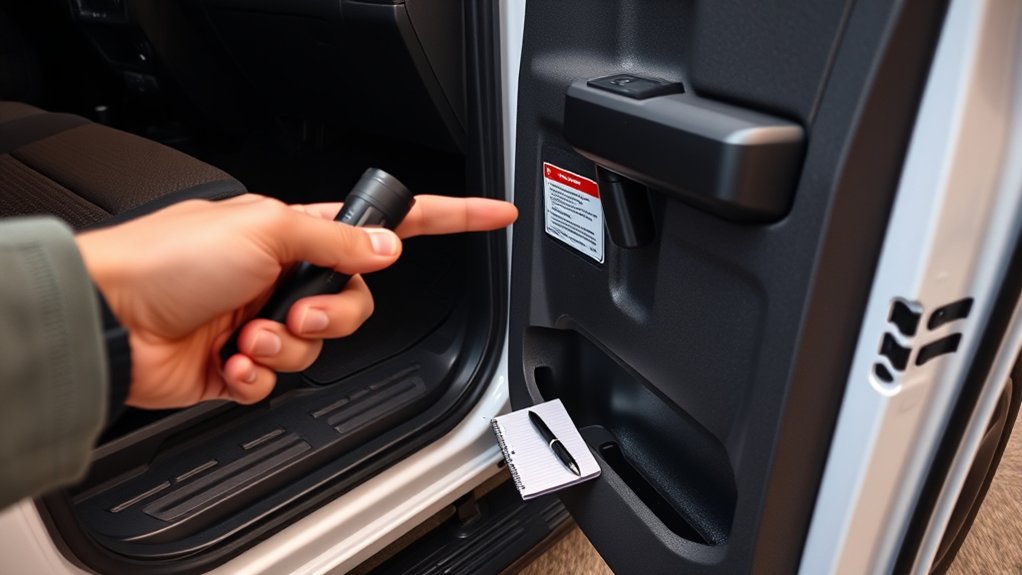
Your Toyota Tacoma’s real payload limit is vehicle-specific, so a brochure maximum or a number from another trim can mislead you. Start with the Tire and Loading Information placard on the driver-side door opening. Then subtract every passenger, cargo item, added accessory, and trailer tongue load from the placard’s occupants-and-cargo limit.
Quick Answer
Find the placard that says, “The combined weight of occupants and cargo should never exceed…” Use that number as your Tacoma’s as-built payload limit. Subtract passengers, cargo, post-production accessories, hitch equipment, and trailer tongue weight. For the most accurate check, weigh the loaded truck and compare total and axle weights with GVWR and GAWR.
Key Takeaways
- Use your Tacoma’s vehicle-specific occupants-and-cargo placard, not a generic advertised maximum.
- Passengers, bed cargo, cab cargo, added accessories, hitch hardware, and trailer tongue load all use payload.
- The certification label lists GVWR and GAWR, but it normally does not list curb weight.
- A suspension upgrade may reduce sag, but it does not automatically increase the manufacturer’s weight ratings.
- Check gross weight, both axle weights, tire ratings, and towing limits because the lowest limit controls.
At a Glance
| Time Required | 10–20 minutes for a label calculation; longer if you visit a scale |
| Difficulty | Easy |
| Tools Needed | Phone or calculator, item weights, owner’s manual, and an axle scale for verification |
| Cost | Free for the label method; commercial scale fees vary |
Understanding Tacoma’s Payload Capacity
Payload is the weight your truck carries in or on the vehicle. It includes the driver, passengers, cargo in the cab and bed, removable gear, and the downward load a trailer places on the hitch.
Payload is not the same as towing capacity. A Tacoma can remain below its trailer-weight limit while exceeding its payload, rear-axle, tire, hitch, or gross-combination limit.
Federal rules define curb weight as a vehicle with standard equipment and full fuel, oil, and coolant. They also require a separate vehicle-capacity statement for occupants and cargo. You can review those definitions in Federal Motor Vehicle Safety Standard 110.
Factory-installed equipment is reflected in the truck’s as-built labeling. Accessories installed later, such as a topper, steel bumper, winch, drawer system, running boards, or bed rack, reduce the payload you have left.
Finding the Door Sticker: Key Information
Open the driver’s door and inspect the B-pillar, door-latch post, and door edge. You will usually see two labels that serve different purposes.
| Label | What It Tells You | How to Use It |
|---|---|---|
| Tire and Loading Information | Maximum combined weight of occupants and cargo, original tire sizes, and recommended cold tire pressures | Use the occupants-and-cargo number as the simplest vehicle-specific payload starting point |
| Certification label | GVWR, front and rear GAWR, VIN, manufacture date, and certification information | Compare scale weights with the total and axle ratings |
“The combined weight of occupants and cargo should never exceed…” is the key payload statement on the Tire and Loading Information placard.
Federal labeling rules require the occupants-and-cargo statement on the vehicle placard and require GVWR and GAWR on the certification label. The required label locations and contents appear in 49 CFR 571.110 and 49 CFR 567.4.
Note: The certification label generally does not list curb weight. An online curb-weight figure may also differ from your truck because of trim, drivetrain, cab, bed, options, fuel, and added equipment.
How to Calculate Your Tacoma’s Payload Capacity
You can calculate payload in two useful ways. The placard method tells you how much occupants-and-cargo capacity the truck had as built. The scale method shows how much gross and axle-weight margin remains in its current condition.
Method 1: Use the Occupants-and-Cargo Placard
- Record the placard limit. Find the number after “The combined weight of occupants and cargo should never exceed.”
- Add every occupant. Include the driver and all passengers at their actual travel weights.
- Add all cargo. Count items in the bed, cab, roof rack, hitch carrier, and storage compartments.
- Add post-production equipment. Include accessories installed after the truck received its original placard unless a qualified alterer supplied updated labeling.
- Add trailer load on the truck. Include actual tongue or pin weight plus hitch and weight-distribution hardware carried by the Tacoma.
- Subtract the total from the placard limit. A positive result is your estimated remaining payload. A negative result means you are overloaded.
Formula: Remaining payload = placard occupants-and-cargo limit − occupants − cargo − added accessories − hitch hardware − trailer tongue or pin load.
Example: Suppose the placard says 1,250 pounds. You add 420 pounds of occupants, 300 pounds of cargo, a 70-pound bed cover, and 350 pounds of measured tongue load. The total added load is 1,140 pounds, leaving an estimated 110 pounds. This example is illustrative, not a Tacoma specification.
Method 2: Use a Vehicle Scale
- Photograph the certification label so you have the GVWR and front and rear GAWR values.
- Load the Tacoma as it will travel, including people, fuel, cargo, accessories, hitch equipment, and the connected trailer when applicable.
- Position the truck so the scale reports front-axle, rear-axle, and total truck weight separately.
- Compare total truck weight with GVWR and each axle weight with its GAWR.
- Calculate gross-weight margin: GVWR − actual truck weight. Do not treat that result as permission to exceed an axle, tire, hitch, trailer, or combination rating.
Pro Tip: Save a photo of both labels and keep the scale ticket with your towing notes. Reweigh after major accessory changes or when your trailer loading changes.
Common Mistakes in Calculating Payload Capacity
Payload mistakes usually happen because drivers count only what is in the bed. Your Tacoma also carries the people and equipment inside the cab, accessories bolted to the truck, cargo on racks or carriers, and trailer load transferred through the hitch.
- Using a brochure maximum: A published maximum normally applies to a particular configuration, not every Tacoma.
- Confusing the two labels: The occupants-and-cargo placard gives the easiest payload number, while the certification label gives GVWR and GAWR.
- Using an online curb weight as exact: Generic specifications may not match your truck’s installed options or modifications.
- Ignoring permanent accessories: A topper, bumper, winch, rack, or drawer system uses capacity even when the bed appears empty.
- Ignoring tongue load: The trailer’s downward load and hitch hardware count against the truck’s payload.
- Checking only total weight: You can stay below GVWR and still overload the rear axle or rear tires.
- Assuming helper springs raise the rating: Reduced sag does not automatically change GVWR, GAWR, tire ratings, or the original placard.
- Using tire-sidewall pressure: Use the vehicle manufacturer’s recommended cold pressure on the placard unless Toyota provides different instructions for your setup.
Warning: Do not rely on ride height as proof that a load is safe. Air springs, helper springs, and stiffer shocks can make the truck look level while the axle, tires, frame, hitch, or brakes remain overloaded.
Understanding the Safety Risks of Inaccurate Payload Measurements
Excess weight can reduce steering response, increase stopping distance, raise tire heat, accelerate suspension and brake wear, and make the truck less stable during emergency maneuvers. Poor placement can overload one axle even when total truck weight remains below GVWR.
Use the following checks before a heavy trip:
| Check | Why It Matters |
|---|---|
| GVWR | Limits the total loaded weight carried by the truck’s tires. |
| Front and rear GAWR | Prevents one axle from carrying more than its rated load. |
| Tire load ratings and pressure | Helps prevent tire overloading and heat buildup. |
| Load placement | Affects axle balance, steering, braking, and stability. |
| Hitch and trailer limits | Ensures the receiver, ball mount, trailer, and truck remain within their separate ratings. |
The National Highway Traffic Safety Administration’s tire guidance explains where to find the Tire and Loading Information label and why the vehicle placard, rather than the tire sidewall, provides the correct recommended cold pressure.
Discrepancies Between Advertised and Actual Payload
Advertised payload figures often describe the highest-capacity configuration in a model range. Cab style, drivetrain, bed length, trim, powertrain, factory options, and installed equipment can all change the number printed on a specific truck’s placard.
A scale ticket may also appear to disagree with the placard because it answers a different question. The placard states the as-built occupants-and-cargo allowance. A scale measures the truck’s weight at that moment, including whatever fuel, people, cargo, accessories, and hitch load are present.
For normal loading decisions, start with the placard and subtract everything added to the truck. Use the scale to confirm total and axle weights. Do not replace a vehicle-specific label with a generic internet specification.
How Modifications Impact Your Tacoma’s Payload Capacity
Most owner-added equipment reduces remaining payload pound for pound. A 180-pound topper and a 120-pound drawer system use about 300 pounds of the placard allowance before you add people or trip cargo.
Suspension helpers can improve ride height or control, but they do not automatically raise the limits established for the frame, axles, tires, wheels, brakes, and other components. Use them only within the truck and component manufacturers’ instructions.
Federal rules require qualified alterers to provide additional labeling when certified vehicles are altered before first retail sale and the ratings change. That process is different from an owner installing aftermarket parts later. See 49 CFR 567.7 for the alterer-label requirements.
After a major build, weigh the truck with its permanent equipment installed. Compare the measured total and axle weights with the original labels, and reduce trip cargo until every applicable limit is satisfied.
Tips for Accurately Weighing Your Tacoma
A commercial platform scale can show whether your loaded Tacoma is within its gross and axle ratings. For a towing check, load the truck and trailer exactly as you plan to travel, including passengers, food, water, tools, batteries, fuel, and recreational gear.
- Bring the ratings. Photograph GVWR, front GAWR, rear GAWR, tire sizes, and placard pressure.
- Use travel-ready loading. Small items add up, so include everything that will be aboard.
- Separate the axles. Place the front axle, rear axle, and trailer axle group on separate scale platforms when the facility allows it.
- Read every number. Compare the truck total with GVWR and each axle with its GAWR.
- Check the trailer separately. Confirm trailer axle, trailer GVWR, hitch, and gross-combination limits using the applicable manuals and labels.
- Reweigh after adjustments. Moving cargo can solve an axle imbalance but does not reduce total weight unless you remove something.
CAT Scale’s positioning guide shows a truck’s front axle on the first platform, rear axle on the second, and trailer axle group on the third. Other scale facilities may use different procedures, so follow the attendant’s directions.
Using Your Payload Capacity Effectively for Towing
Payload is often the limiting number when towing with a midsize pickup. The trailer may be below the advertised tow rating, yet the truck can exceed its occupants-and-cargo limit after you add passengers, camping gear, hitch hardware, and tongue load.
Check the owner’s manual for your Tacoma’s model year, powertrain, drivetrain, and towing equipment. Toyota provides model-specific manuals through its Manuals and Warranties portal.
Understanding Tongue Weight
Tongue weight is the downward force the trailer applies to the hitch. It becomes part of the load carried by the Tacoma, so it must fit within the truck’s payload, rear GAWR, tire ratings, receiver rating, and any limits for the ball mount or weight-distribution equipment.
Do not assume one percentage works for every trailer. Use the trailer manufacturer’s loading instructions and the Tacoma owner’s manual, then measure the loaded trailer’s actual tongue weight. Too little or poorly distributed tongue load can contribute to sway, while too much can overload the truck’s rear axle and reduce front-axle load.
Calculating Total Weight Capacity
Safe towing requires several calculations, and the lowest applicable rating controls:
- Truck payload: Placard occupants-and-cargo limit minus people, cargo, accessories, hitch hardware, and tongue load.
- Truck gross weight: Actual loaded truck weight must not exceed GVWR.
- Axle weight: Actual front and rear axle weights must not exceed their GAWR values.
- Tire capacity: Each tire and axle set must support the measured load at the specified pressure and within the manufacturer’s limits.
- Trailer and hitch ratings: The loaded trailer, receiver, ball mount, coupler, and related components must stay within their ratings.
- Combination weight: The loaded truck-and-trailer combination must stay within the vehicle manufacturer’s stated gross-combination limit when one applies.
Setting Up for Safe Towing
A correct hitch, balanced trailer, working brakes, properly rated tires, and verified weights matter more than how level the truck looks. Follow the Tacoma manual, hitch instructions, trailer manual, and applicable state requirements.
Proper Hitch Setup
Use a receiver, ball mount, hitch ball, and coupler that are compatible and rated for the loaded trailer. Set the hitch height so the trailer rides as specified by its manufacturer. Secure the coupler, pin, safety chains, breakaway cable, and electrical connector before moving.
A weight-distribution hitch can change how load is shared across the truck and trailer axles, but it does not create extra payload or raise GVWR, GAWR, tire, or receiver limits. Use one only when Toyota, the hitch maker, and the trailer maker permit it.
Load Weight Distribution
Place heavy cargo low and secure it against movement. Keep truck-bed weight balanced side to side and positioned so neither axle is overloaded. Load the trailer according to its manufacturer’s instructions, and verify tongue weight after the trailer is fully packed.
Do not move cargo rearward merely to reduce truck tongue load unless the trailer maker’s balance requirements still remain satisfied. An improperly balanced trailer may become unstable even when scale totals appear legal.
Brake System Considerations
Extra weight increases the energy the brakes must manage. Inspect the Tacoma’s brakes, tires, wheel bearings, and suspension before a heavy trip. Allow more following distance and avoid abrupt speed changes.
Use trailer brakes and a compatible brake controller when required by the vehicle, trailer, or law. Do not assume aftermarket truck brakes increase payload or towing ratings. Any brake modification must remain compatible with the Tacoma’s electronic safety systems and component instructions.
Frequently Asked Questions
Where is the payload on a Tacoma door sticker?
Look for the Tire and Loading Information placard on the driver-side B-pillar, door-latch post, or door edge. The payload starting point is the statement showing the maximum combined weight of occupants and cargo.
How do I calculate my remaining Tacoma payload?
Subtract the actual weight of passengers, cargo, added accessories, hitch equipment, and trailer tongue load from the occupants-and-cargo limit on the placard. Then verify the loaded truck’s total and axle weights on a scale.
What year was the worst year for Toyota Tacoma?
No authoritative source establishes one Tacoma model year as the single “worst.” Complaint totals can reflect sales volume, vehicle age, maintenance, and reporting behavior. A model-year reliability label also does not change how you calculate payload for a specific truck.
What is the formula for finding payload?
The design-level relationship is GVWR minus the truck’s as-built weight. For daily loading, the more useful formula is placard occupants-and-cargo limit minus all people, cargo, added accessories, hitch equipment, and tongue load.
Does a suspension upgrade increase Tacoma payload?
Not automatically. Springs, air bags, and shocks may improve ride height or control, but they do not by themselves change the original GVWR, GAWR, tire ratings, or occupants-and-cargo placard.
Can my Tacoma be under GVWR but still overloaded?
Yes. The rear axle, front axle, an individual tire, the receiver, or another component can exceed its rating while total truck weight remains below GVWR. That is why an axle-by-axle scale ticket matters.
Does trailer tongue weight count as payload?
Yes. The trailer’s downward load on the hitch, plus hitch hardware carried by the truck, uses the Tacoma’s payload and affects rear-axle loading.
Should I use an online curb weight to calculate payload?
Use it only as a rough reference. The occupants-and-cargo placard is specific to the truck as built, while a scale captures its current configuration. Online curb weights may describe a different trim, cab, drivetrain, bed, or option package.
Conclusion
Your Tacoma’s safest payload number comes from its own labels, not from another owner’s truck or the highest figure in a brochure. Start with the occupants-and-cargo placard, subtract every load the truck carries, and use a scale to verify GVWR and both axle ratings. When towing, include measured tongue load and follow the lowest rating in the complete truck, hitch, tire, and trailer system.
Sources
- 49 CFR 571.110, Tire Selection and Vehicle Load Information — defines curb weight and vehicle capacity weight and specifies the Tire and Loading Information placard.
- 49 CFR 567.4, Vehicle Certification Labels — specifies certification-label location and required GVWR and GAWR information.
- 49 CFR 567.7, Altered Certified Vehicles — explains additional certification duties and rating labels for qualified alterers.
- NHTSA TireWise — explains placard location, tire sizing, and manufacturer-recommended cold tire pressure.
- Toyota Manuals and Warranties — provides model- and year-specific owner’s manuals and towing instructions.
- CAT Scale: How to Weigh — shows platform positioning for truck and trailer axle weights.

