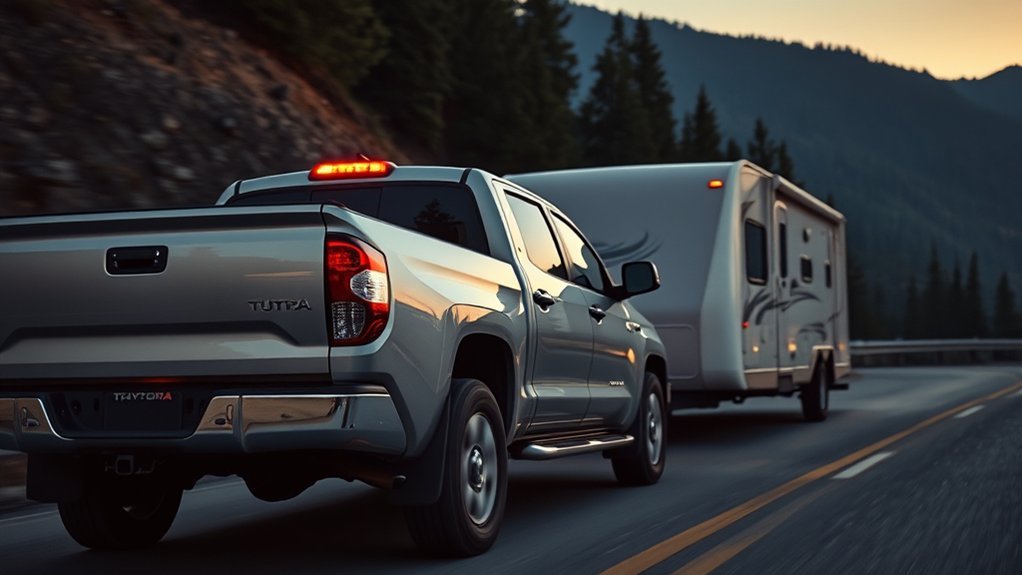
Use Toyota Tundra engine braking when towing on a long or steep descent to help hold a controlled speed and reduce continuous heat in the service brakes. Slow before the grade, select the towing mode and transmission range specified for your model year, and use the truck and trailer brakes whenever additional slowing is needed. Do not use one fixed gear rule for every Tundra: Toyota’s 2020 trailer-towing guidance specifies S4 for engine-braking efficiency, while the 2023 10-speed Tundra provides S1 through S10 and increases engine braking as lower ranges are selected.
Last updated: September 11, 2026 — model-year transmission guidance, TOW/HAUL and TOW+ operation, trailer-brake-controller setup, and downhill towing safety references rechecked.
Quick Answer
Before descending a hill, slow to a safe speed and select the towing mode your exact Tundra provides. Use TOW/HAUL or TOW+ when the model-year manual calls for it, then choose an appropriate S-mode or lower transmission range if more engine braking is needed. If you intend to rely on manual S-mode engine braking, cancel cruise control unless your exact manual says otherwise. Use controlled service-brake applications as needed, keep the trailer brakes correctly adjusted, and never rely on engine braking alone.
Key Takeaways
- Reduce your speed before the descent instead of allowing the truck and trailer to accelerate first.
- Do not copy one S-range number across every Tundra generation; transmission controls and Toyota’s towing instructions changed over time.
- Use the TOW/HAUL, TOW+, manual-range, or selectable-gear controls specified for your exact Tundra model year.
- Choose a gear or range that provides useful deceleration without entering the tachometer’s prohibited range.
- Set trailer-brake gain through Toyota’s or the controller manufacturer’s controlled test, not by simply making the brakes “tighter.”
- Stop safely if you notice brake fade, smoke, a strong burning smell, warning lights, abnormal pedal feel, or transmission slipping.
At a Glance
| Time Required | Varies by trailer and controller; complete the full inspection and brake test before entering traffic or beginning a major descent |
| Difficulty | Moderate; practice with a light load before attempting long or steep mountain descents |
| Tools Needed | The correct Toyota owner’s manual, tire-pressure gauge, functioning trailer brakes, breakaway system, safety chains, and a compatible brake controller when required |
| Cost | No added cost when the equipment is already installed and maintained; inspection or repair costs vary |
The Importance of Engine Braking When Towing
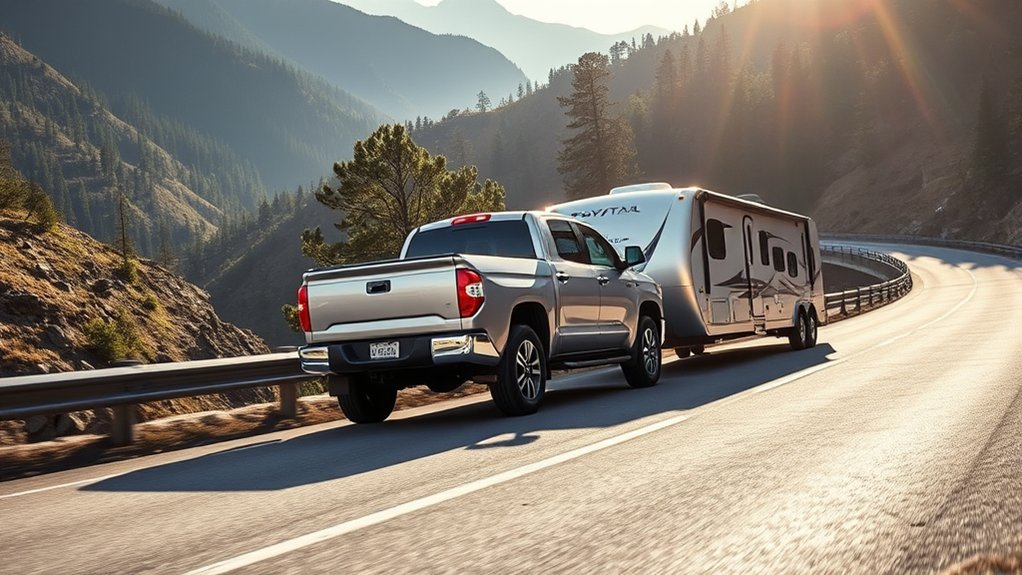
Engine braking is the deceleration produced when you release the accelerator while the drivetrain remains engaged. Selecting a lower gear or transmission range can increase that effect by keeping the engine at a higher speed.
While towing, this can reduce the amount of heat generated by the truck’s friction brakes on a long descent. It can also help maintain a steadier speed and leave more braking capacity available when you need to slow further or stop.
Warning: Engine braking is an aid, not a replacement for the Tundra’s service brakes or the trailer’s brakes. Do not tow a brake-equipped trailer with inoperative brakes, an untested controller, damaged wiring, or a faulty breakaway system.
Engine braking strength varies with the selected gear, engine and transmission design, vehicle speed, road grade, trailer weight, and traction. A gasoline or hybrid Tundra may also feel different from a diesel tow vehicle, so do not copy a technique based solely on another truck’s behavior.
Know Your Tundra’s Model-Year Controls
Toyota Tundra controls are not identical across generations. Older six-speed trucks and newer 10-speed trucks use different S-mode ranges and towing-mode logic, so a gear recommendation copied from another model year can be wrong for your truck.
Use the Toyota Manuals and Warranties portal to select your exact year and model before relying on any shift procedure. Toyota’s current Tundra information lists selectable TOW/HAUL modes and an Integrated Trailer Brake Controller on applicable configurations, but that does not mean every Tundra has the same equipment.
Note: “S” is a selectable shift-range mode, not necessarily one permanently locked physical gear. The selected number normally limits the highest transmission range available while still allowing lower gears as operating conditions require.
| Model-Year Example | Transmission / Controls | Verified Downhill-Towing Guidance |
|---|---|---|
| 2020 Tundra example | Six-speed automatic with S-mode ranges and available TOW/HAUL | Toyota’s trailer-towing instructions specify S4 rather than D when using engine braking to maintain engine-braking efficiency. Do not automatically substitute S3 or another range. |
| 2023 Tundra example | Ten-speed automatic with S1 through S10 and available TOW HAUL / TOW+ | Lower S ranges provide greater engine braking. Toyota’s manual uses TOW HAUL below 5,000 lb of trailer weight and TOW+ above 5,000 lb; its wording does not expressly assign exactly 5,000 lb. |
| Other Tundra years | Controls, number of ranges, towing modes, and software logic vary | Use the Toyota owner’s manual for the exact year, powertrain, market, and equipment instead of carrying one example across generations. |
For a separate explanation of the towing-mode controls, see the Toyota Tundra Tow/Haul mode guide.
Understanding the Benefits of Lower Gears
A suitable lower gear or transmission range keeps the engine connected to the wheels at a higher RPM, increasing resistance when you release the accelerator. The goal is not to select the lowest possible gear. The goal is to choose a range that helps hold a safe speed without harsh shifting or excessive engine speed.
| Benefit | How It Helps |
|---|---|
| Speed control | Reduces the rate at which the truck and trailer accelerate downhill. |
| Reduced brake heat | Decreases continuous demand on the truck’s friction brakes. |
| Improved consistency | Helps avoid repeated upshifts and downshifts on rolling or mountainous roads. |
| More reserve braking | Preserves more service-brake capacity for curves, traffic, hazards, and stops. |
Higher engine RPM after a downshift is often normal. Watch the tachometer and dashboard, but do not treat one fixed RPM number as a universal fault threshold. Avoid the prohibited or red zone and follow any transmission, engine-temperature, or hybrid-system warnings.
Complete a Pre-Descent Towing Checklist
Safe downhill control starts before the road drops. Pull over at a safe location before a major descent and verify the following:
- The truck, passengers, cargo, hitch load, and trailer remain within the exact vehicle’s GVWR, GAWR, GCWR, payload, hitch, and trailer limits.
- The coupler or fifth-wheel connection is locked, safety chains are crossed and secured, and the breakaway cable is attached correctly.
- The trailer connector, brake lights, turn signals, and running lights operate.
- The truck and trailer tires are cold-inflated to the applicable specifications and show no damage.
- The trailer brakes respond smoothly and evenly.
- The brake-controller gain is appropriate for the current trailer and load.
- The route, grade, curves, weather, traffic, and escape areas are understood.
- No brake, transmission, engine, hybrid-system, stability-control, or trailer-connection warning is active.
[Amazon Products Picked for You]
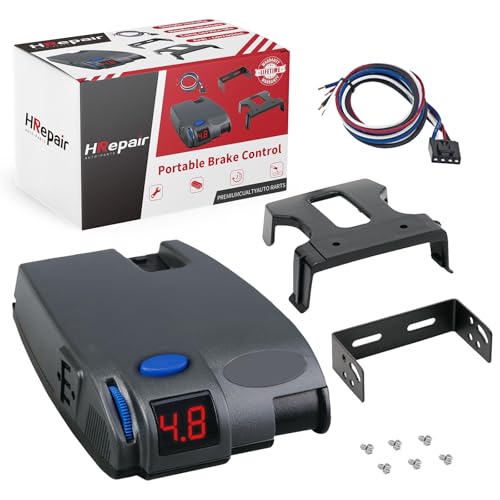
✨ Proportional Braking System: Ensures smooth, consistent stops by applying trailer brakes in proportion to your vehicle's braking intensity. Ideal for all trailer types, from light utility to heavy-duty.
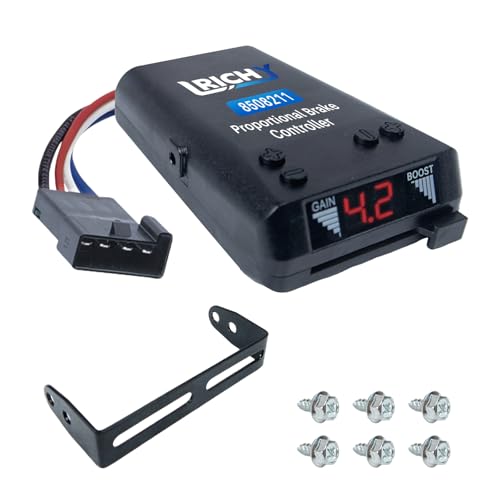
🏆【PROPORTIONAL ELECTRIC BRAKE CONTROLLER】Lrichy brake controller uses internal sensors to automatically apply trailer brakes based on your tow vehicle's braking intensity and speed. It intelligently sets the correct braking level and adjusts for hills, delivering reliable stopping power in any situation
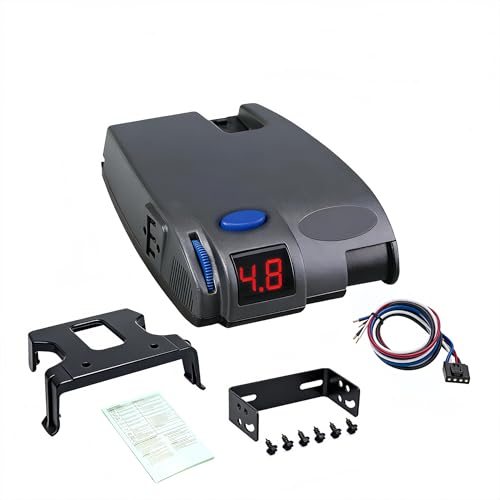
【WIDE COMPATIBILITY】Proportional Brake Controller Designed as a direct replacement for Tekonsha 90160 Primus IQ | Compatible with Ford, Chevy, Dodge, RAM, Toyota, Jeep, GM,etc supporting 2, 4, or 6 brake electric brake trailers. (NOTE: Vehicle-specific plug-and-play harness is not included)
Set Trailer-Brake Gain Correctly
Do not increase trailer-brake gain simply because the road is steep. Set it through the controller manufacturer’s and Toyota’s prescribed procedure for the exact truck and controller.
For recent Tundras equipped with Toyota’s factory trailer brake controller, Toyota’s documented procedure starts at gain 5.0, then tests the loaded trailer at approximately 20–25 mph (35–40 km/h) on a level, traffic-free surface. Fully apply the manual trailer-brake slider and adjust the gain until braking is strong but just below trailer-wheel lockup. Recheck the setting when the truck load, trailer load, road conditions, or weather changes. If your model-year manual gives a different procedure, follow that manual.
The trailer should contribute meaningful braking without uncontrolled wheel lock, jerking the hitch, or pushing the truck. Do not use a high gain setting to hide worn brakes, poor adjustment, damaged wiring, or an incompatible brake system.
Pro Tip: Test the combination before reaching the mountain. A controller setting that felt acceptable with an empty trailer may be inadequate or too aggressive after cargo, water, equipment, or passengers are added.
How to Engage Engine Braking in Your Tundra
- Slow before the descent. Reduce speed while the road is still level or only beginning to slope downward. If you plan to use manual S-mode engine braking, cancel cruise control unless your exact owner’s manual says otherwise.
- Engage the appropriate towing mode. Use TOW/HAUL or TOW+ if equipped and specified for your truck, trailer weight, and conditions. Do not assume the mode-selection rules from another generation apply to yours.
- Select a lower range or gear when needed. Use the transmission control described in your model’s manual. Do not force a downshift that would cause excessive RPM or abrupt deceleration.
- Release the accelerator. Evaluate how well the selected range holds speed.
- Use smooth service-brake applications as needed. Reduce speed early enough that you do not need panic braking before a curve or slower vehicle, and avoid holding continuous brake pressure long enough to build excessive heat.
- Reassess continuously. If the truck keeps gaining speed, slow further and select a more suitable range only when vehicle speed and the owner’s manual permit it.
Enter the hill slowly enough that engine braking and controlled brake applications can maintain speed without forcing the truck, trailer, or braking system beyond its limits.
Do not deliberately allow the combination to accelerate by a fixed number of miles per hour before braking. A safe speed depends on the posted limit, grade, curve radius, visibility, traffic, traction, stopping distance, and trailer condition.
Best Techniques for Effective Engine Braking
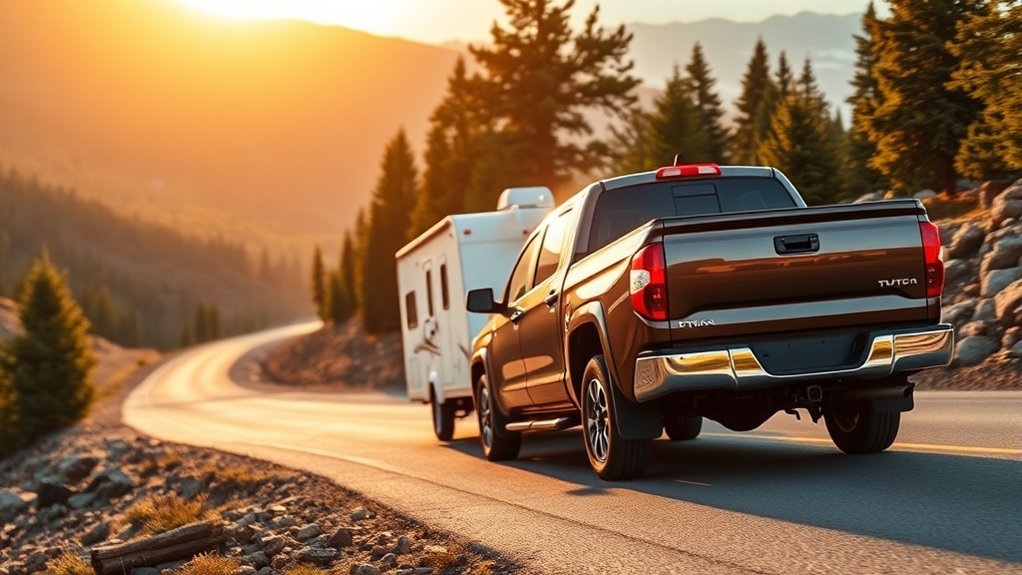
Effective engine braking is smooth and planned. The truck should remain stable, the engine should stay within its permitted operating range, and the trailer should continue tracking behind the truck without wheel lockup or sway.
Downshifting Techniques Explained
- Reduce speed before requesting a substantially lower gear or range.
- Make one range change at a time and evaluate the result.
- Do not shift into Park, Reverse, or Neutral while descending.
- Do not force the transmission to hold a range that triggers a warning or places the engine in the prohibited RPM zone.
- Expect the transmission to reject, delay, or automatically override an unsafe range on models designed to protect against over-revving or excessive transmission temperature.
- Return to a higher range when the grade ends and conditions permit.
A sudden increase in RPM after a valid downshift can be normal. Unexpected flaring without corresponding deceleration, repeated gear hunting, slipping, harsh engagement, or a warning message deserves inspection.
Utilizing Gear Selection
Choose the setting that provides enough resistance to control speed while leaving flexibility for curves and traffic. A lightly loaded trailer on a gentle hill may need little manual intervention, while a heavier trailer on a long descent may require the towing mode and a lower selectable range specified for the exact truck.
There is no universal instruction to use second gear, S3, S4, or any other single range on every descent. Toyota’s own instructions differ between model years, and the correct choice also depends on speed, load, road grade, and traction.
Maintaining Control on Grades
- Increase following distance before the descent.
- Stay in a gear or range that keeps the drivetrain engaged.
- Brake before curves rather than while cornering hard.
- Keep steering, throttle, shifting, and braking inputs smooth.
- Avoid relying on cruise control on steep, winding, congested, or slippery descents. Cancel it before depending on manual S-mode engine braking when your model’s instructions require that.
- Use designated pullouts to let overheated brakes cool or allow faster traffic to pass.
Engine Braking on Wet, Icy, or Loose Surfaces
Use extra caution when traction is limited. An abrupt downshift can increase deceleration at the drive wheels and contribute to a skid. Select a conservative speed before the hill, use gradual control inputs, and avoid sudden changes in gear, steering, throttle, or brake pressure.
If the trailer begins to sway, remain calm, keep the steering wheel steady, ease off the accelerator, and avoid abrupt truck braking or steering. Follow the trailer and brake-controller manufacturer’s approved sway-recovery procedure.
Top Mistakes to Avoid When Using Engine Braking
- Starting the descent too fast: Engine braking cannot reliably correct an unsafe entry speed.
- Using one gear rule for every truck: Transmission controls and safe ranges vary by model year and operating conditions.
- Leaving cruise control engaged when manual engine braking is needed: On some Tundra models, cruise operation can prevent the S-mode engine-braking response the driver expects.
- Forcing an abrupt downshift: This can cause harsh deceleration, excessive RPM, or reduced traction.
- Riding the brake pedal continuously: Constant braking can build heat and contribute to fade.
- Relying only on engine braking: The truck and trailer brakes must remain functional and available.
- Increasing trailer gain without testing: Excessive gain may lock the trailer wheels, especially on wet or loose surfaces.
- Using Neutral downhill: Neutral removes useful drivetrain resistance and reduces immediate control.
- Ignoring weight limits: Excess payload, axle load, hitch load, or trailer weight increases braking demand.
- Continuing after brake fade: A longer stopping distance, changing pedal feel, smoke, or a burning smell requires immediate attention.
Warning: If braking effectiveness drops, activate the hazard lights when appropriate, use the available braking systems to reduce speed smoothly, and move to a safe stopping area. Do not continue down the grade with fading, smoking, or visibly overheated brakes. See the Toyota Tundra brake-fade guide for the related warning signs and prevention steps.
Does Engine Braking Need a Tune-Up?
Engine braking does not normally have a separate tune-up procedure. It results from the engine, transmission, drivetrain, and control systems operating together. If the truck does not decelerate as expected, the cause may be the selected range, excessive speed or load, cruise-control operation on some models, transmission operation, engine management, service brakes, trailer brakes, controller settings, or road conditions.
[Amazon Products Picked for You]
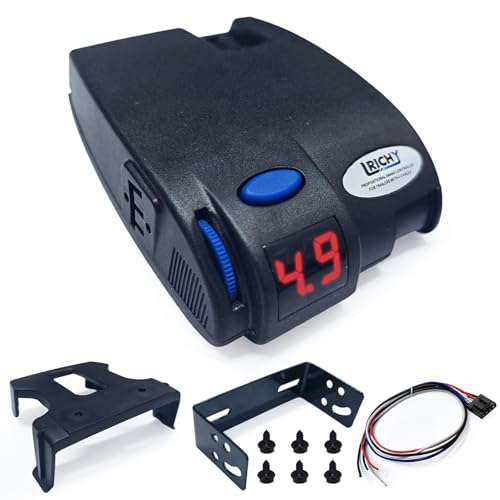
🏆【PROPORTIONAL ELECTRIC BRAKE CONTROLLER】Lrichy trailer brake controller utilizes internal inertia sensors to automatically apply trailer brakes based on your tow vehicle's braking intensity and speed, ensuring smooth and reliable stopping power in various conditions, including general and heavy-duty emergency braking.

Time-Delay Braking: Time-delay braking system gradually applies trailer brake power after vehicle braking, helping reduce sudden jerks and providing smoother, more predictable stopping for safer towing in daily and highway driving.

Slim, low-profile design for a functional, modern aesthetic
Signs That Require Inspection
- A transmission, check-engine, brake, hybrid-system, stability-control, or trailer-connection warning
- Transmission slipping, delayed engagement, repeated hunting, or harsh shifts
- Unexpected loss of deceleration in a range that previously worked normally
- Brake fade, smoke, a strong burning odor, or fluid leakage
- A soft, sinking, unusually hard, pulsating, or changed brake pedal
- Trailer brakes that grab, lock, pull to one side, or fail to respond
- Frequent fuse, wiring, connector, or controller faults
- Engine or transmission temperatures outside the normal range
Higher RPM alone does not prove a fault. Compare the behavior with the applicable owner’s manual and the tachometer’s permitted range.
Unusual Sounds While Braking
Grinding, scraping, squealing, or knocking during pedal braking usually calls for inspection of the truck or trailer friction brakes, wheel hardware, suspension, hitch, or related components. A sound that occurs only after selecting a lower range may instead involve the engine, exhaust, transmission, or driveline.
Stop towing and arrange an inspection when the noise is accompanied by reduced braking, pulling, vibration, smoke, warning lights, fluid leakage, or abnormal wheel heat.
Ineffective Speed Control
If the combination repeatedly gains speed despite an appropriate range and controlled braking, do not keep increasing speed or making increasingly harsh downshifts. Reduce speed, use a safe pullout, and determine whether the issue is excessive load, an unsuitable range, brake fade, poor trailer-brake contribution, a controller fault, cruise-control operation, or a mechanical problem.
For an unexplained or recurring problem, have the truck and trailer inspected before continuing through mountainous terrain.
Engine Braking vs. Service Braking: Key Differences
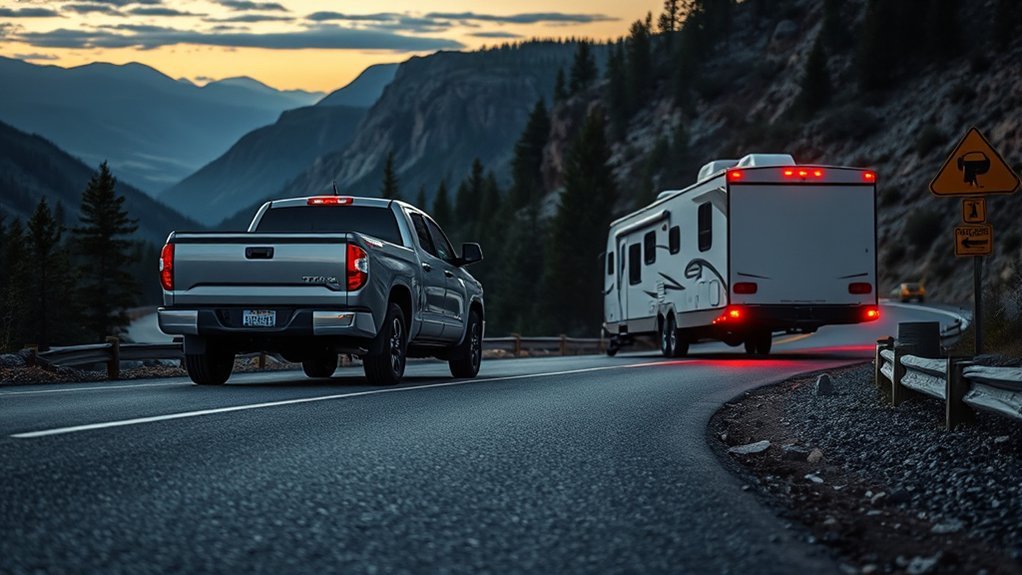
Engine braking and friction braking complement each other. Neither should be treated as the only method of controlling a loaded truck and trailer.
| Feature | Engine Braking | Truck and Trailer Brakes |
|---|---|---|
| How it slows the combination | Uses drivetrain and engine resistance while a gear remains engaged. | Uses friction at the truck and trailer wheels. |
| Best use | Maintaining or moderating speed on a descent. | Reducing speed further, stopping, responding to traffic, and handling emergencies. |
| Heat generation | Reduces the amount of heat demanded from the friction brakes. | Generates heat that can lead to fade if braking demand exceeds cooling capacity. |
| Main limitation | May not provide enough deceleration by itself and can affect traction if used abruptly. | Can overheat, fade, wear, or become unstable if trailer gain is incorrect. |
How to Enhance Towing Safety With Proper Braking Techniques
- Verify the ratings. Use the exact truck’s certification labels, owner’s manual, hitch rating, and trailer specifications.
- Distribute and secure the load. Poor loading can reduce steering authority, overload an axle, or increase trailer sway.
- Test the trailer brakes. Confirm smooth operation and calibrate gain before entering traffic or reaching a grade.
- Use the correct towing mode. Follow the model-specific TOW/HAUL or TOW+ instructions instead of carrying a rule from one Tundra generation to another.
- Slow before descending. Do not depend on the brakes to remove excessive speed after the combination is already on the steepest section.
- Select a suitable lower range. Keep the engine within its allowed operating range and allow the transmission’s protective logic to reject an unsuitable downshift.
- Leave extra space. A loaded trailer increases stopping distance and limits evasive options.
- Monitor the truck and trailer. Watch for sway, warning messages, odors, smoke, temperature changes, or altered braking response.
Driver-assistance systems can support awareness, but they do not change the tow rating, compensate for an overloaded combination, or replace attentive speed and brake management.
Maintenance Tips for Your Tundra’s Braking System While Towing
- Inspect the truck’s brake pads, rotors, calipers, hoses, fluid, parking brake, and warning systems at the specified intervals.
- Service the trailer’s electric, electric-over-hydraulic, hydraulic, disc, or drum brakes according to the trailer and axle manufacturers’ schedules.
- Check trailer-brake wiring, grounds, connectors, magnets or actuators, battery, and breakaway switch.
- Verify that the integrated or aftermarket controller is compatible with the trailer’s brake system.
- Recheck wheel fasteners, bearings, seals, tire condition, and inflation before long towing trips.
- Keep the truck’s cooling and transmission systems maintained, especially when towing near the vehicle’s limits.
- Do not lubricate friction surfaces. Brake-pad and rotor cleaning or lubrication must follow the component manufacturer’s service procedure.
- Check the truck for VIN-specific recalls and service campaigns through the Toyota recall lookup and NHTSA recall database.
[Amazon Products Picked for You]

Proportional Mode Brake for Everyday Towing: The Tow-Pro Liberty delivers Proportional Mode braking for smooth on-road control. Easy to install and use, the system reduces push and pull for ultimate towing confidence on roads and highways

Ensure Fit - Compatible with 2008-2014 Cadillac Escalade & Escalade ESV, 2008-2013 Cadillac Escalade EXT, 2008-2013 Chevy Avalanche & Silverado 1500, 2007-2014 Chevy Silverado 2500HD & 3500HD, 2008-2014 Chevy Suburban 1500, 2007-2013 Chevy Suburban 2500, 2008-2014 Chevy Tahoe, 2008-2013 GMC Sierra 1500, 2007-2014 GMC Sierra 2500HD & 3500HD, 2008-2014 GMC Yukon & Yukon XL 1500, 2007-2013 GMC Yukon XL 2500.

【Intelligent braking】Proportional controllers are the safest and most responsive braking system you can install.Proportional trailer brake controllers automatically sense when your tow vehicle slows down or stops. This type of brake controller will replicate your own braking intensity for your trailer's brakes, whether you slow to a gradual stop or have to slam on your brakes
Frequently Asked Questions
Which S range should you use for engine braking on a Toyota Tundra?
There is no universal S range for every Tundra. Toyota’s 2020 trailer-towing instructions specify S4 for engine-braking efficiency, while the 2023 10-speed provides S1 through S10 and states that lower ranges increase engine braking. Use the exact model-year manual and reduce vehicle speed before requesting a lower range.
Should you use cruise control while engine braking downhill?
Do not depend on cruise control for a steep towing descent. On a 2020 Tundra, Toyota specifically notes that expected S-mode engine braking from downshifting to ranges 5 or 4 will not activate while cruise control remains engaged. Cancel cruise control before relying on manual S-mode engine braking unless the exact manual for your truck instructs otherwise.
How do you turn off automatic braking on a Toyota Tundra while towing?
Do not routinely disable pre-collision braking simply because you are towing. A trailer or hitch may sometimes interfere with parking sonar or parking-support braking while reversing, but those are separate features. Controls vary by model year and equipment, so use the feature-specific procedure in the exact Toyota owner’s manual. Re-enable any temporarily disabled parking feature when the obstruction is removed.
Is there a bad year for the Toyota Tundra?
There is no single model year that is automatically unsuitable for every buyer or towing job. Condition, configuration, maintenance, modifications, accident history, corrosion, previous towing use, and unresolved recalls matter more than a blanket year label. Check the VIN through Toyota and NHTSA, review service records, and obtain a qualified pre-purchase inspection.
When should you use TOW/HAUL mode on a Toyota Tundra?
Use the towing mode specified by the applicable owner’s manual. Earlier equipped Tundras commonly use a single TOW/HAUL setting. In the 2023 Tundra manual, TOW HAUL is specified below 5,000 lb of trailer weight and TOW+ above 5,000 lb; the manual’s wording does not expressly assign exactly 5,000 lb. The modes change powertrain and related control behavior but do not replace trailer brakes, weight compliance, or safe downhill speed management.
What is engine braking on a Toyota Tundra?
Engine braking is the slowing force produced when the accelerator is released while the drivetrain remains engaged. Selecting an appropriate lower transmission range can increase the effect, helping control downhill speed and reduce continuous demand on the friction brakes.
Is high RPM normal when engine braking?
A noticeable RPM increase can be normal after the transmission selects a lower gear or range. The important limits are the tachometer’s prohibited range, warning messages, abnormal noise, slipping, overheating, and the procedures in the exact owner’s manual. Do not diagnose a problem from one universal RPM number.
Can engine braking overheat the engine or transmission?
Normal engine braking within the permitted gear, RPM, temperature, and load limits is an intended vehicle function. Excessive speed, an unsuitable forced range, overloading, inadequate maintenance, or an existing mechanical fault can still create excessive heat. Watch the gauges and warnings and stop safely if temperatures become abnormal.
What should you do if the brakes smell hot while towing downhill?
Move to a safe stopping area as soon as conditions allow. Do not touch the wheels or brake components, and do not continue until the cause has been assessed and braking performance is normal. Smoke, fluid leakage, reduced braking, or an abnormal pedal requires professional inspection or roadside assistance.
Conclusion
Engine braking can make downhill towing safer and more controlled when it is used as one part of a complete braking strategy. Slow before the descent, choose the towing mode and transmission range specified for the exact Tundra model year, keep the engine within its permitted operating range, and combine drivetrain resistance with correctly functioning truck and trailer brakes.
Do not rely on a universal S3, S4, grade-percentage, RPM, or trailer-gain rule. Toyota’s own guidance changes between generations. Confirm the manual for your truck, test the trailer brakes before the grade, cancel cruise control when the model’s engine-braking procedure requires it, and stop if braking performance, temperature, or transmission behavior becomes abnormal.
Sources
- Toyota Manuals and Warranties — model-year-specific operating, towing, transmission, trailer-brake-controller, warning, and safety instructions
- Toyota Tundra Official Model Page — current Tundra powertrain, towing, TOW/HAUL, and available trailer-equipment information
- Toyota Safety Recall and Service Campaign Lookup — VIN-specific Toyota recall and campaign information
- National Highway Traffic Safety Administration Recall Lookup — VIN, vehicle, complaint, investigation, and safety-recall information
