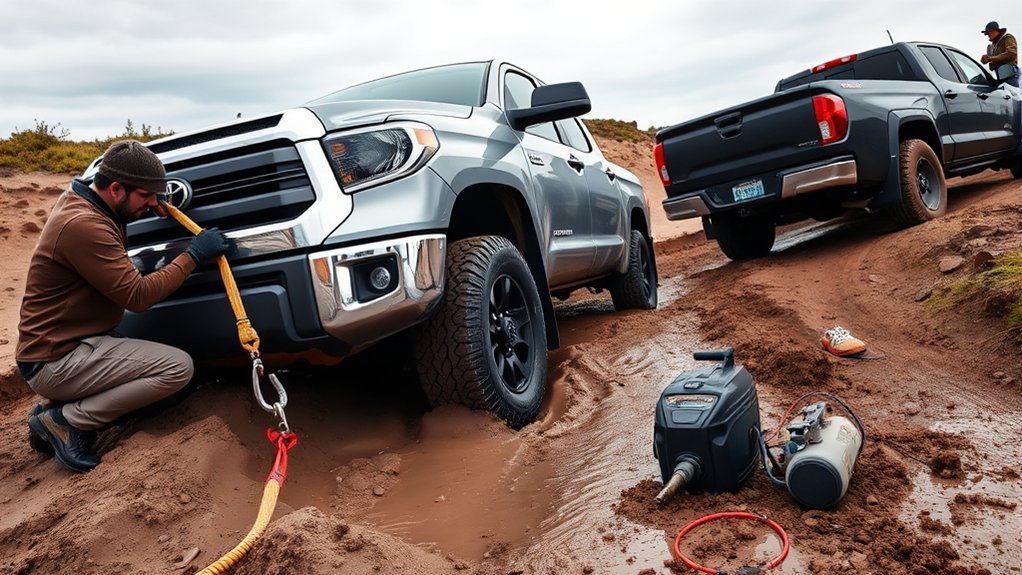
Toyota Tundra sand and mud recovery starts with three priorities: reduce wheelspin, reduce resistance, and use the correct four-wheel-drive range. On soft beach sand, airing down can improve flotation; in mud, the surface underneath matters just as much as tire pressure. Prepare before leaving pavement, use smooth inputs, and stop early when forward progress disappears.
Last updated: September 11, 2026 — tire-pressure guidance, Toyota 4WD/Multi-Terrain Select information, tide guidance, recovery safety, FAQ focus, and source links were rechecked.
Quick Answer
For soft beach sand, some public-land authorities recommend starting near 15–20 PSI, but that is location-specific guidance—not a universal Toyota Tundra specification. Use 4H for normal loose-terrain travel, reserve 4L for slow hard pulling or controlled recovery, stop wheelspin as soon as movement ends, and use only rated recovery gear and approved attachment points. Reinflate to the door-placard pressure before normal pavement driving.
Key Takeaways
- Treat 15–20 PSI as common soft-sand guidance from some beach authorities, not a universal Toyota Tundra setting.
- Use 4H for loose or slippery terrain and reserve 4L for slow, steep, deeply rutted, or hard-pulling situations.
- Stop spinning the tires as soon as forward motion fades; digging and reducing resistance are safer than adding throttle.
- Use only rated ropes, shackles, winches, anchors, and manufacturer-approved recovery points—never a trailer ball.
- Check permits, closures, weather, tides, and a safe return route before driving onto a beach.
At a Glance
| Preparation Time | Varies; allow enough time to inspect the route, adjust all four tires, verify recovery equipment, and check conditions before entering soft terrain |
| Difficulty | Intermediate; assisted kinetic-rope and winch recoveries require training |
| Tools Needed | Low-pressure gauge, compressor, shovel, traction boards, suitable spare tire, jack base, gloves, and rated recovery equipment |
| Cost | Varies with equipment already owned, permit requirements, and whether professional recovery is needed |
Warning: This guide provides general off-road information. Your Tundra owner’s manual, tire manufacturer limits, local regulations, posted closures, and trained recovery instructions take priority. Low tire pressure and improperly rigged recovery equipment can cause tire failure, vehicle damage, serious injury, or death.
Evidence basis: This guide synthesizes Toyota owner guidance, National Park Service beach rules, Michelin tire guidance, NOAA tide information, and recovery-equipment safety guidance. It does not claim hands-on testing of a specific Tundra, tire, wheel, or recovery setup.
Toyota Tundra Sand vs. Mud Setup: Quick Decision Table
| Decision | Soft Sand | Mud |
| Pressure approach | Airing down often improves flotation. Some beach authorities use 15–20 PSI as local guidance. | Use a conservative reduction only when tire, wheel, load, terrain, and bead risk permit it. |
| Normal 4WD range | 4H for normal loose-sand travel. | 4H for normal slippery travel. |
| When 4L fits | Slow hard pulling, steep exits, deeply churned sand, or controlled self-recovery. | Deep ruts, steep grades, crawling, or controlled recovery where low-speed torque is needed. |
| Main driving goal | Maintain smooth momentum and flotation without wheelspin. | Preserve traction while avoiding hidden ruts, side slopes, rocks, roots, and a bottomless section. |
| Do not enter when | The legal route, exit, or safe tide window cannot be confirmed. | You cannot verify depth, bottom condition, or a safe exit. |
Tire Pressure Tips for Beach Driving in Sand and Mud

Lower tire pressure can lengthen the tire’s contact patch and help a heavy truck float over loose sand instead of cutting through it. However, there is no single pressure that works for every Tundra, tire, wheel, load, or beach.
The National Park Service’s Cape Lookout guidance, for example, strongly recommends 15–20 PSI before entering its designated soft-sand routes. That is local beach guidance, not a Toyota specification. Other locations may post different requirements, so follow the managing authority for the route you are visiting.
How to Air Down Safely
- Check the normal cold pressure first. Record the pressure listed on the driver-door placard and measure all four tires before leaving pavement.
- Reduce pressure evenly. Air down all four tires in small steps, checking each one with a low-pressure gauge.
- Start conservatively. On firmer sand, you may not need to reduce pressure as much as you would in deep, dry, powdery sand.
- Test at low speed. Make a gentle turn and confirm that the sidewalls are not folding excessively or allowing the tire to move on the wheel.
- Recheck when conditions change. Heat, load, and continued travel can change the measured pressure.
- Reinflate before pavement. Return every tire to the vehicle placard’s recommended cold pressure as soon as practical.
Warning: Do not treat 10–15 PSI as a routine setting. Very low pressure can reduce load capacity, over-flex the sidewall, damage the tire, or unseat the bead during a sharp turn. Michelin states that pressures below 20 PSI may be used only off-road at speeds below 15 mph and only when the tire still has adequate load-carrying capacity at that pressure.
Do Sand and Mud Need the Same Tire Pressure?
No. Sand usually rewards a wider footprint and smooth flotation. Mud is less predictable. A modest pressure reduction may help a tire conform to uneven ground, but excessive deflation can expose the sidewall to roots, rocks, deep ruts, and bead damage.
For mud, consider the tire’s tread, rut depth, vehicle load, and what lies below the surface. If the mud has a firm base, steady progress may be possible without a major pressure reduction. If there is no firm base, airing down further may simply let the truck sink deeper.
Note: The pressure printed on a tire sidewall is normally its maximum cold pressure for a specified load—not the correct everyday pressure for your Tundra. Use the vehicle placard when returning to the road.
Using 4H, 4L, and Multi-Terrain Select
Tundra controls vary by model year, drivetrain, powertrain, and trim, so review the manual for your specific truck. Toyota’s Tundra guidance describes 2H for normal dry-road driving, 4H for off-road or other surfaces that permit tire slip, and 4L for maximum low-speed power and traction during steep travel or hard pulling in sand, mud, or deep snow.
When Should You Use 2H, 4H, or 4L?
- 2H: Normal travel on dry, hard-surfaced roads.
- 4H: Routine sand, dirt, snow, mud, and other loose or slippery off-road surfaces.
- 4L: Slow recovery attempts, deep ruts, steep grades, controlled crawling, or hard pulling where 4H does not provide enough control.
On equipped 2024 Tundras, Toyota lists terrain-specific Multi-Terrain Select indicators including DIRT, SAND, MUD, DEEP SNOW, ROCK, and MOGUL, while its 2024 Tundra brochure states that MTS is available in 4×4 high or low range. Exact selectable modes vary by configuration. Use only the modes shown for your truck in its owner’s manual.
Warning: Do not leave a part-time 4WD system in 4H or 4L on dry, high-traction pavement. Driveline binding can occur because the tires cannot slip enough to release the difference in axle speed.
Follow Toyota’s exact shift procedure. On recent Tundras, changing between 4H and 4L requires stopping completely, holding the brake, placing the transmission in neutral, and then selecting the new range. Older models may use a different procedure. If the 4H or 4L indicator continues flashing, do not repeatedly force the change; see the Toyota Tundra 4WD troubleshooting guide for the separate diagnostic process.
Must-Have Recovery Gear for Your Tundra Adventures
Equipping your Toyota Tundra with appropriate recovery gear can prevent a minor loss of traction from becoming an expensive emergency. Carry equipment suited to a full-size truck, and inspect it before every trip.
- Low-pressure tire gauge: Choose one that reads accurately at off-road pressures.
- Portable air compressor: Confirm that it can reinflate four large truck tires without overheating.
- Full-size shovel: Use it to remove sand or mud from the tires, axles, differential, and frame.
- Traction boards: Select boards rated for the vehicle and use them in the intended direction.
- Suitable spare tire: Confirm that the spare is appropriate for remote off-road use.
- Jack and wide support base: A normal jack can sink into sand or mud without a stable base.
- Rated kinetic rope or recovery strap: It must be suitable for the loaded vehicle and the intended recovery method.
- Rated shackles and receiver recovery mount: Capacity markings must be legible and compatible with the rest of the system.
- Winching gloves: Wear them when handling either synthetic or steel line.
- First-aid kit, drinking water, flashlight, and fire extinguisher: These are especially important in remote areas.
Recovery gear is only as safe as its weakest component—and the attachment point is part of the system.
Kinetic Ropes and Recovery Points
A kinetic recovery rope stretches under load and can apply force more progressively than a non-stretch tow strap. That does not make every kinetic recovery safe. Both vehicles need suitable recovery points, correctly rated equipment, a clear plan, and drivers who understand the rope manufacturer’s procedure.
Warning: Never attach a kinetic rope, recovery strap, or winch line to a trailer ball, axle, suspension arm, steering component, bumper skin, or unapproved tie-down point. WARN specifically warns that trailer balls, axles, control arms, and unsuitable tie-down points are not designed for vehicle-recovery forces. Use only a recovery point approved for the truck and the type of pull.
Earth Anchors and Winches
A purpose-built land anchor may provide an option where no suitable vehicle or fixed anchor exists. Holding capacity depends on the anchor design, ground conditions, installation, pull direction, and equipment rating. Use one only according to its manufacturer’s instructions and after receiving appropriate recovery training.
Keep all spectators well away from a loaded rope or winch line. Establish one recovery leader, agree on hand signals or radio commands, and stop immediately if communication is lost.
Driving Techniques to Prevent Getting Stuck in Sand
Good sand driving is based on controlled momentum rather than speed. The goal is to keep the tires rolling on top of the surface without spinning, plowing, or making abrupt changes that force them deeper.
- Select 4H before entering soft sand. Choose a suitable SAND or Multi-Terrain Select setting only if your Tundra is equipped with it and your manual permits it.
- Use smooth throttle. Apply only enough power to maintain progress.
- Make wide, gentle steering inputs. Sharp turns increase rolling resistance and can increase bead risk at very low pressure.
- Avoid sudden braking. Coast to a stop when practical so the tires do not build a ridge of sand in front of them.
- Use established legal tracks when they are safe. Compacted tracks may provide a firmer route, but deep ruts can also catch the differential or frame.
- Watch the surface ahead. Dry powder, churned access ramps, steep exits, and areas close to dunes are often softer.
- Stop early when speed falls. Continuing to apply throttle after the truck stops moving will dig the tires deeper.
Pro Tip: Before parking on soft sand, choose a level area and roll to a gentle stop. When leaving, start with the wheels straight to reduce rolling resistance.
Driving Through Mud
Mud requires a different approach because its depth, consistency, and the surface underneath may be impossible to judge from the cab.
- Stop and inspect a questionable section before entering it.
- Do not enter standing water when you cannot verify its depth, current, bottom condition, and safe exit.
- Choose a line that avoids the deepest ruts and hidden side slopes.
- Use 4H and a suitable terrain mode for normal slippery travel when equipped.
- Use 4L when very low speed and controlled torque are needed.
- Keep steering and throttle inputs smooth.
- Back out while you still can if the surface is becoming progressively deeper.
- Stop spinning the tires once forward progress ends.
Some wheelspin may be managed by the truck’s traction systems, but uncontrolled spinning can fill the tread with mud, cut deeper ruts, overheat components, and make recovery harder. Do not disable stability or traction systems unless the owner’s manual for your exact model describes that action for a stuck-vehicle situation and the system is preventing the recovery attempt.
Beach Conditions and Tide Awareness

Beach driving conditions can change within a short distance. Damp, compacted sand may feel firm, while dry powder, churned access points, washouts, and sand near dunes can stop a heavy truck quickly.
Check official tide predictions through NOAA Tides and Currents where available, but do not plan around the low-tide time alone. NOAA explains that astronomical tide predictions do not capture every short-term water-level effect from weather, wind, atmospheric pressure, or runoff. Leave enough time to enter, travel, stop, and return before the route narrows or conditions change.
Pre-Trip Beach Checklist
- Confirm that public vehicle access is open.
- Obtain any required permit or education certificate.
- Check tide predictions, weather, surf conditions, and local alerts.
- Identify the legal access and exit ramps.
- Learn the posted speed limits.
- Review wildlife and resource-protection closures.
- Confirm that your return route will remain passable.
- Tell someone where you are going and when you expect to return.
Note: Do not drive on dunes, vegetation, wildlife closures, or unmarked routes. Slow down around pedestrians, children, pets, parked vehicles, anglers, and fishing lines. Local rules always override general driving advice.
How to Recover a Stuck Tundra in Sand or Mud
When the truck stops moving, stop applying throttle. A calm, low-force recovery is usually safer than immediately connecting another vehicle or a winch.
- Secure the scene. Set the brake as appropriate, assess the tide or water level, and move spectators away from the recovery area.
- Determine why the truck stopped. Check whether the tires are buried, the frame or differential is resting on the surface, or the route ahead is impassable.
- Reduce the load if practical. Remove unnecessary cargo only when it can be done safely and without blocking the route.
- Dig before pulling. Clear material from in front of the tires and from any frame, axle, skid plate, or differential contact point.
- Straighten the wheels. A straight tire requires less force to roll than a sharply turned tire.
- Consider a small additional pressure reduction. Do this only when the tires, wheels, load, speed, tire-manufacturer guidance, and bead risk permit it.
- Place traction boards. Seat them firmly against the tires in the intended direction of travel.
- Select the appropriate range. Use 4L for a slow, controlled self-recovery when the manual permits it.
- Apply light, steady throttle. Stop if the tires begin spinning without moving the truck.
- Escalate carefully. Use a rated rope or winch only after identifying approved recovery points and clearing the danger zone.
Pro Tip: After placing traction boards, begin with the wheels straight and the lowest practical throttle. Once the truck starts moving, continue to firm ground before stopping to retrieve equipment.
Common Recovery Mistakes to Avoid
- Continuing to spin the tires after the vehicle stops moving
- Using speed as a substitute for controlled momentum
- Connecting recovery gear to a trailer ball or unapproved point
- Using a tow strap where a kinetic rope is required—or a kinetic rope where a static strap is required
- Mixing components with unknown or mismatched ratings
- Allowing bystanders near a tensioned rope, strap, shackle, or winch line
- Standing over or straddling a loaded line
- Winching from a weak tree, loose boulder, rotten stump, or poorly installed anchor
- Using damaged, sun-faded, cut, or contaminated recovery gear
- Crawling beneath a vehicle supported only by a jack
- Driving at normal road speed while the tires remain aired down
- Waiting until the tide is rising around the vehicle before calling for professional help
Post-Trip Inspection and Cleaning
Sand, salt, and mud can remain packed around components after the trip. Complete these checks before returning to normal driving:
- Reinflate every tire to the driver-door placard pressure.
- Inspect the tread, sidewalls, valve stems, and bead area for cuts, bulges, leaks, or trapped debris.
- Check the wheels for impact damage and confirm that no tire has shifted on its rim.
- Check brake effectiveness before entering normal traffic.
- Remove mud from the wheels, brakes, skid plates, suspension, steps, and underbody.
- Rinse salt and beach sand from the frame and underbody as soon as practical.
- Clear packed material from the radiator and cooling-air openings without damaging the fins.
- Inspect recovery equipment, clean it according to its manufacturer’s directions, dry it, and replace damaged items.
- Return the 4WD selector and drive modes to their normal road settings.
How to Use Community Off-Road Advice Safely
Tundra forums and local off-road groups can help you learn about access ramps, seasonal conditions, compressor performance, tire behavior, and recovery services. Local drivers may also know where sand changed after a storm or where a mud hole developed a deep rut.
Use community experience as additional context, not as a replacement for the owner’s manual or local regulations. A setup that worked for an unloaded truck with wide tires may be unsafe for a heavily loaded Tundra with larger wheels and shorter sidewalls.
- Ask contributors to identify their tire size, wheel size, load, pressure, and terrain.
- Confirm that recovery advice uses rated points and equipment.
- Be cautious with pressure recommendations that do not mention speed or load.
- Verify permits, closures, and tide information through the managing authority.
Some Tundra owners cross firm sand without airing down. That does not prove that full road pressure is best for soft sand. Surface firmness, vehicle weight, tire construction, temperature, and driver technique can produce very different results.
Related Guides
Frequently Asked Questions
What tire pressure should I use for a Toyota Tundra on beach sand?
There is no universal Toyota Tundra beach-sand PSI. Cape Lookout National Seashore strongly recommends 15–20 PSI for its designated soft-sand routes, but your safe pressure also depends on tire construction, wheel size, vehicle load, speed, and local rules.
Should I use 4H or 4L in sand?
Use 4H for normal travel over loose sand. Select 4L for slow, steep, deeply churned, or hard-pulling conditions and controlled recovery attempts. Follow the shift procedure in the manual for your model year.
How do I get a Toyota Tundra unstuck from sand or mud?
Stop wheelspin, secure the area, determine whether the tires or underbody are buried, dig away resistance, straighten the wheels, place traction boards, select the appropriate 4WD range, and use light steady throttle. Escalate to a rope or winch only with rated equipment, approved recovery points, and a clear danger zone.
Can I drive on sand at the normal road pressure?
A Tundra may cross firm sand at normal pressure, but soft sand usually benefits from more flotation. Local authorities may also require or strongly recommend airing down. Use the pressure appropriate for your tires, wheels, load, speed, terrain, and local rules.
Can I use the Tundra’s trailer ball for recovery?
No. A trailer ball is not a kinetic-recovery attachment point and can break away as a dangerous projectile. Use a properly rated receiver recovery mount or another manufacturer-approved recovery point suitable for the pull.
How fast should I drive after airing down below 20 PSI?
Michelin states that pressures below 20 PSI may be used off-road only at speeds below 15 mph and when adequate tire load capacity remains. Your tire manufacturer, vehicle limits, terrain, and any lower posted speed limit still take priority.
Should I turn off traction control when my Tundra is stuck?
Only if your model-year owner’s manual describes doing so for a stuck-vehicle situation and the system is preventing the wheel movement needed for recovery. Re-enable the system after the recovery and return the truck to its normal road settings.
Conclusion
Successful Toyota Tundra sand and mud driving comes from preparation and restraint. Air down only as far as your tires, wheels, load, speed, and terrain safely permit. Use 4H or 4L for the conditions, keep steering and throttle smooth, and stop spinning before the truck buries itself. If you do get stuck, reduce resistance before increasing recovery force. Before returning to normal road travel, reinflate the tires, confirm normal brake operation, inspect the tires and underbody, clean away salt or mud, and return the 4WD controls to their normal road settings.
Sources
- Toyota 2024 Tundra Quick Reference Guide — 2H, 4H, 4L, and model-control guidance
- Toyota 2024 Tundra eBrochure — Multi-Terrain Select availability and 4×4 high/low-range guidance
- Toyota 2024 Tundra Owner’s Manual — 4H, 4L, and Multi-Terrain Select indicators
- National Park Service: Cape Lookout Beach Driving — beach tire pressure, equipment, permits, closures, and safety guidance
- Michelin Tire FAQ — load-capacity conditions and slow off-road operation below 20 PSI
- NOAA Tides and Currents — official tide predictions, water levels, and coastal-condition information
- WARN: Top Vehicle Recovery Mistakes — recovery points, anchors, rigging, communication, and equipment safety
