
The Toyota Camry Hybrid powertrain automatically blends gasoline and electric power to improve efficiency without requiring the driver to plug in the vehicle. For the current 2026 U.S. Camry, Toyota pairs a 2.5-liter four-cylinder engine with its fifth-generation hybrid system, an electronically controlled continuously variable transmission, and either front-wheel drive or Electronic On-Demand All-Wheel Drive. Because specifications changed substantially after 2024, checking the model year is essential before comparing horsepower, drive modes, or fuel economy.
Quick Answer
The current Toyota Camry uses a fifth-generation hybrid system combining a 2.5-liter engine, electric motor-generators, a lithium-ion traction battery, and an eCVT. Front-wheel-drive versions produce 225 net combined horsepower; AWD versions add a rear motor and produce 232 horsepower, while the most efficient configuration reaches an EPA-estimated 51 mpg combined.
Key Takeaways
- The current Camry is an all-hybrid model in the United States and does not require plug-in charging.
- Current output is 225 net combined horsepower with front-wheel drive or 232 horsepower with Electronic On-Demand AWD.
- The gasoline engine does not start at one fixed road speed; the control system responds to power demand, battery charge, temperature, and other conditions.
- Regenerative braking recovers some energy during deceleration, but the vehicle still uses conventional friction brakes when needed.
- The advertised 51-mpg combined figure is an “up to” rating for the most efficient configuration, not a guarantee for every trim or driving situation.
What Is the Toyota Camry Hybrid Powertrain?
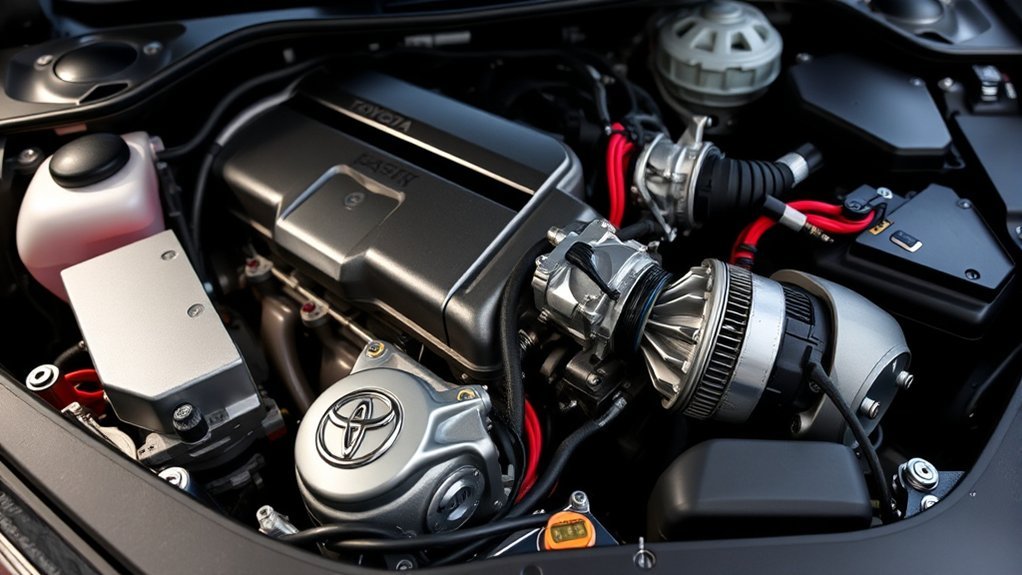
The current Toyota Camry Hybrid powertrain combines a 2.5-liter four-cylinder gasoline engine, electric motor-generators, a lithium-ion traction battery, a power control unit, and an electronically controlled continuously variable transmission, commonly called an eCVT.
These components are managed as one system. Depending on the situation, the gasoline engine can propel the vehicle, an electric motor can assist or move the car, or both power sources can work together. The system can also shut off the engine when its power is unnecessary and recover energy while the vehicle slows.
| Specification | Current U.S. Camry |
|---|---|
| Gasoline engine | 2.5-liter four-cylinder engine |
| Front-wheel-drive output | 225 net combined horsepower |
| All-wheel-drive output | 232 net combined horsepower |
| Transmission | Electronically controlled continuously variable transmission |
| Drivetrain choices | Front-wheel drive or Electronic On-Demand All-Wheel Drive |
| Maximum fuel-economy rating | Up to an EPA-estimated 51 mpg combined |
| External charging | Not required; the traction battery is charged by the engine and regenerative braking |
Note: The 208-horsepower specification belongs to the previous-generation 2024 Camry Hybrid, which used Toyota Hybrid System II. Toyota listed that model at up to 52 mpg combined in its most efficient configuration. The fifth-generation system used in the current Camry produces 225 horsepower with FWD or 232 horsepower with AWD. Compare specifications only after confirming the model year and drivetrain.
How Does the Toyota Hybrid System Work?
A hybrid control computer continuously decides how to use the engine, motor-generators, and traction battery. The driver does not need to choose between gasoline and electric power manually. Instead, the system responds to accelerator input, vehicle speed, road grade, battery charge, engine temperature, cabin-climate demand, and traction conditions.
Starting and Low-Load Driving
When the car is ready to drive, the gasoline engine may remain off. If battery charge, temperature, and power demand permit, an electric motor can move the vehicle at low speed or under light load. This can reduce fuel use and produces no tailpipe exhaust while the gasoline engine is off.
Electric-only operation in a conventional Camry Hybrid is normally brief. It is not comparable to the extended battery-powered range of a plug-in hybrid or fully electric vehicle.
Acceleration and Hill Climbing
During stronger acceleration or when climbing a hill, the gasoline engine and electric motor can work together. The electric motor supplies immediate assistance while the engine provides sustained power. The traction battery acts as an energy buffer, supplying electricity when extra assistance is useful.
Steady-Speed Cruising
At a steady road speed, the system selects an efficient combination of engine power, electric assistance, and battery charging. The engine may run even at a relatively low vehicle speed, or it may shut off briefly at a higher speed when conditions permit. There is no single road speed at which every Camry Hybrid must switch from electric power to gasoline.
Deceleration and Stopping
When the driver releases the accelerator or presses the brake pedal, a motor-generator can convert some of the vehicle’s motion into electricity. That electricity is sent to the traction battery for later use. At a stop, the gasoline engine can shut down instead of idling when operating conditions allow.
How the eCVT Manages Engine and Motor Power
The Camry Hybrid’s eCVT does not operate like a conventional automatic transmission with a fixed sequence of gears. It also should not be confused with a typical belt-and-pulley CVT. The hybrid transaxle coordinates the gasoline engine and motor-generators so the system can change the relationship between engine speed and wheel speed continuously.
This design lets the engine operate in an efficient range while electric power fills in torque as needed. During hard acceleration, engine speed may rise and remain relatively steady while vehicle speed continues to increase. That behavior is normal for an eCVT and does not necessarily indicate transmission slip.
Pro Tip: Before comparing two Camrys, confirm the model year, trim, wheel size, and drivetrain. A 2024 LE Hybrid, a 2026 LE FWD, and a 2026 XSE AWD can have different power, equipment, and fuel-economy ratings even though all carry the Camry name.
Toyota Camry Hybrid Drive Modes
Toyota lists Normal, Eco, and Sport as the selectable driving modes for the current Camry. These settings change response characteristics, but they do not replace the hybrid computer’s automatic control of the engine and electric motors.
| Drive Mode | What It Changes | Best Used For |
|---|---|---|
| Normal | Provides the standard balance of accelerator response, comfort, and efficiency. | Most everyday driving |
| Eco | Softens accelerator response and can moderate climate-control demand to support efficient driving. | Urban traffic and drivers seeking gentler response |
| Sport | Sharpens accelerator response for a more immediate feel. | Merging, winding roads, or more responsive driving |
The hybrid system can still use electric power in any of these modes when conditions allow. Some earlier model years may also provide a separate EV Drive Mode control. Its availability and limitations should be confirmed in the owner’s manual for the exact vehicle.
[Amazon Products Picked for You]

【Compatibility】 This master power window switch compatible with 2010-2015 Toyota Prius, 2009-2011 Toyota Camry, 2008-2013 Toyota Land Cruiser, 2012-2015 Toyota Prius...
Performance and Efficiency Balance
Drive modes do not create extra rated horsepower. They primarily alter how quickly the vehicle responds to driver input. Eco mode cannot guarantee better mileage if the vehicle is driven aggressively, while Sport mode does not force the gasoline engine to run continuously. Actual operation remains under computer control.
How the Powertrain Affects Performance
The current front-wheel-drive Camry produces 225 net combined horsepower. Models equipped with Electronic On-Demand AWD add a motor-generator at the rear axle and produce 232 net combined horsepower.
Electric-motor assistance is especially noticeable when pulling away from a stop because an electric motor can respond without waiting for the gasoline engine to build speed. The eCVT then blends engine and motor output without conventional gear changes.
The current Camry Hybrid produces 225 net combined horsepower with front-wheel drive or 232 horsepower with Electronic On-Demand AWD, while the most efficient configuration is rated at up to 51 mpg combined.
How Electronic On-Demand AWD Works
The AWD system uses a separate electric motor at the rear axle. When additional traction is useful, the system can send power to the rear wheels without relying on a conventional mechanical driveshaft connecting the front and rear axles.
This arrangement can improve traction when starting on a slippery surface or accelerating through changing road conditions. AWD does not shorten stopping distances on ice and is not a substitute for suitable tires, cautious speeds, or adequate following distance.
Key Components of the Toyota Hybrid System

Each component has a distinct role, but the system is designed to function as an integrated powertrain rather than as a gasoline engine with a separate electric add-on.
2.5-Liter Gasoline Engine
The four-cylinder engine supplies sustained power and can also contribute energy used to maintain the traction battery’s operating charge. Toyota’s hybrid engine is tuned for efficiency and works with the electric motors instead of handling every driving condition by itself.
The engine can stop when it is unnecessary and restart automatically when the vehicle needs more power, heat, battery charging, or other support. Drivers may hear it start while the vehicle is stationary, especially during cold weather or when the climate-control system is working hard.
Electric Motor-Generators
The motor-generators can perform several jobs. Depending on operating conditions, they can propel the car, assist the gasoline engine, start the engine, generate electricity, or recover energy while the vehicle slows.
Because an electric motor can respond quickly, it helps provide smooth initial acceleration. Its role changes continuously rather than remaining limited to one fixed speed range.
Lithium-Ion Traction Battery
The high-voltage lithium-ion traction battery stores energy for the electric motors. The hybrid control system keeps the battery within a managed operating range instead of routinely charging it to 100% or allowing it to become fully depleted.
The driver does not plug in a conventional Camry Hybrid. Battery energy comes mainly from regenerative braking and, when necessary, operation of the gasoline engine.
Power Control Unit, Inverter, and DC/DC Converter
The power control unit manages electrical energy moving between the traction battery and motor-generators. Its inverter changes direct current from the battery into the alternating current used by the drive motors and converts generated electricity back into a form the battery can store.
A DC/DC converter reduces high-voltage battery power to the lower voltage used by vehicle accessories and the 12-volt electrical system.
| Component | Primary Role |
|---|---|
| Gasoline engine | Supplies sustained propulsion and can support battery charging |
| Motor-generators | Provide propulsion, engine assistance, generation, and regenerative braking |
| Traction battery | Stores high-voltage electrical energy |
| Power control unit | Controls electrical power flow |
| Inverter | Converts electricity between DC and AC |
| DC/DC converter | Supplies lower-voltage power for accessories and the 12-volt system |
| Rear motor on AWD models | Provides electronically controlled rear-wheel assistance |
Warning: Hybrid components can retain dangerous high voltage even when the vehicle appears to be off. Do not open the traction-battery case, inverter, or other high-voltage assemblies, and do not touch damaged orange high-voltage cables. Diagnosis and repair should be performed by properly trained personnel following Toyota service procedures.
How Regenerative Braking Enhances Efficiency
In an ordinary friction-braking system, much of the vehicle’s motion is converted into heat at the brake pads and rotors. Regenerative braking allows a motor-generator to recover part of that motion as electrical energy.
When the driver slows the Camry Hybrid, the brake-control system blends regeneration with the conventional hydraulic brakes. Light or moderate deceleration may allow substantial energy recovery. The friction brakes provide additional stopping force during harder braking, at very low speeds, when traction is limited, or when the battery cannot accept as much regenerated energy.
Regeneration is particularly useful in stop-and-go driving because frequent deceleration creates repeated opportunities to recover energy. It may also reduce friction-brake use, but it does not eliminate normal brake inspection or maintenance.
Toyota Camry Hybrid Fuel Economy
The current Camry is advertised at up to an EPA-estimated 51 mpg combined. That figure applies to the most efficient configuration rather than every trim and drivetrain. Larger wheels, AWD equipment, vehicle load, temperature, speed, traffic, tire pressure, short trips, and heating or air-conditioning use can all affect actual fuel consumption.
EPA ratings are produced through standardized test procedures so shoppers can compare vehicles under consistent conditions. They are not a promise that every driver will reproduce the label value.
Note: Cold weather can reduce hybrid fuel economy because the gasoline engine may run longer to warm itself and provide cabin heat. Short trips can also return lower mileage because the powertrain spends a larger share of each trip warming up.
Maintenance Tips for Your Camry Hybrid
A Camry Hybrid still requires scheduled maintenance even though its electric motors and regenerative braking can reduce some mechanical loads. Follow the schedule for the exact model year, mileage, operating conditions, and market.
- Change the engine oil and filter as specified. The gasoline engine still depends on correct oil quality and level.
- Rotate and inspect the tires. Correct inflation and even wear support handling, efficiency, and tire life.
- Inspect the brakes. Regeneration can reduce pad use, but corrosion, sticking components, fluid condition, and normal wear still require attention.
- Keep battery-cooling air paths unobstructed. Do not cover any traction-battery cooling intake identified in the owner’s manual.
- Service the cooling systems on schedule. The gasoline engine and hybrid electronics depend on proper temperature control.
- Use qualified service for warning lights. A hybrid-system warning should be diagnosed rather than cleared without identifying its cause.
- Review the correct maintenance guide. Requirements can differ by model year and by severe-use conditions.
For new U.S. Toyota vehicles, ToyotaCare covers normal factory-scheduled maintenance for two years or 25,000 miles, whichever comes first, subject to program terms.
For Toyota hybrids from model year 2020 onward in the United States, Toyota states that the hybrid battery is covered for 10 years or 150,000 miles from first use, whichever comes first. Other specified hybrid-related components generally receive 8-year/100,000-mile coverage. Always consult the warranty guide for the exact vehicle, because terms can vary by component, model year, market, and applicable emissions coverage.
[Amazon Products Picked for You]

Vehicle Application: KAX cabin & engine air filter kit replacement for Ford Fusion FHEV/PHEV 2013-2020, Ford SSV Plug-In Hybrid 2019-2020, Lincoln MKZ FHEV 2013-2020


Practical Function: The stretch belt mate kit is used for the quick and safe removal or installation of serpentine belts. The tools of the kit are precisely machined and polished to ensure smooth surfaces, reducing the possibility of belt damage or hand injury
Frequently Asked Questions
How does a Toyota Camry Hybrid powertrain work?
It uses a gasoline engine, electric motor-generators, a traction battery, an eCVT, and electronic controls. The system automatically selects gasoline power, electric assistance, or a combination of both. It also recovers some energy during deceleration and stores it in the traction battery.
At what speed does a Toyota Camry Hybrid switch to gas?
There is no fixed switching speed. The gasoline engine may start at low speed when more power, cabin heat, battery charging, or engine warm-up is needed. It may also shut off temporarily at a higher speed under light-load conditions. Battery charge, temperature, road grade, accelerator input, and climate-control demand all influence the decision.
Is every 2026 Toyota Camry a hybrid?
Yes. The 2026 U.S. Camry lineup uses an all-hybrid powertrain and is available with front-wheel drive or Electronic On-Demand All-Wheel Drive. Previous model years, including 2024, were also offered with non-hybrid gasoline engines, so used-vehicle shoppers should verify the year and powertrain.
Does a Toyota Camry Hybrid need to be plugged in?
No. A conventional Camry Hybrid is not a plug-in vehicle. Its traction battery is charged through regenerative braking and energy supplied by the gasoline engine. You refuel it with gasoline in the same general way as a non-hybrid car.
Will a Camry Hybrid keep driving after it runs out of gas?
No. The traction battery is not designed to provide a useful emergency driving range after the fuel tank is empty. Continuing to attempt operation can discharge the battery and complicate restarting. Stop safely and add fuel rather than relying on battery power.
How long is the Toyota hybrid battery warranty?
For Toyota hybrids from model year 2020 onward in the United States, Toyota states that the hybrid battery warranty lasts 10 years or 150,000 miles from the vehicle’s first use, whichever occurs first. Check the applicable warranty guide for complete terms, exclusions, and regional differences.
Conclusion
The Toyota Camry Hybrid powertrain improves efficiency by coordinating a gasoline engine, electric motor-generators, a lithium-ion traction battery, an eCVT, and regenerative braking. In the current Camry, front-wheel-drive models produce 225 net combined horsepower, while AWD models add a rear electric motor and produce 232 horsepower.
The most important ownership detail is that the system operates automatically. There is no fixed speed at which it must switch to gasoline, no need for external charging, and no single fuel-economy result that applies to every trim or driving condition. Confirming the model year and following the correct maintenance and warranty guides will provide the most accurate information for a specific Camry.
Sources
- Toyota: Current Camry specifications — current horsepower, drivetrain, all-hybrid configuration, and maximum EPA-estimated fuel economy.
- Toyota USA Newsroom: 2026 Camry announcement — fifth-generation hybrid system, FWD and AWD output, drive modes, battery type, and drivetrain details.
- U.S. Department of Energy Alternative Fuels Data Center — hybrid charging, motor, battery, regenerative-braking, inverter, and DC/DC-converter operation.
- U.S. Environmental Protection Agency: Fuel Economy Testing — how official fuel-economy estimates are produced.
- Toyota Manuals and Warranties — U.S. hybrid battery, hybrid-component, and powertrain warranty information.
- Toyota Maintenance Plans — ToyotaCare coverage and scheduled-maintenance program information.
