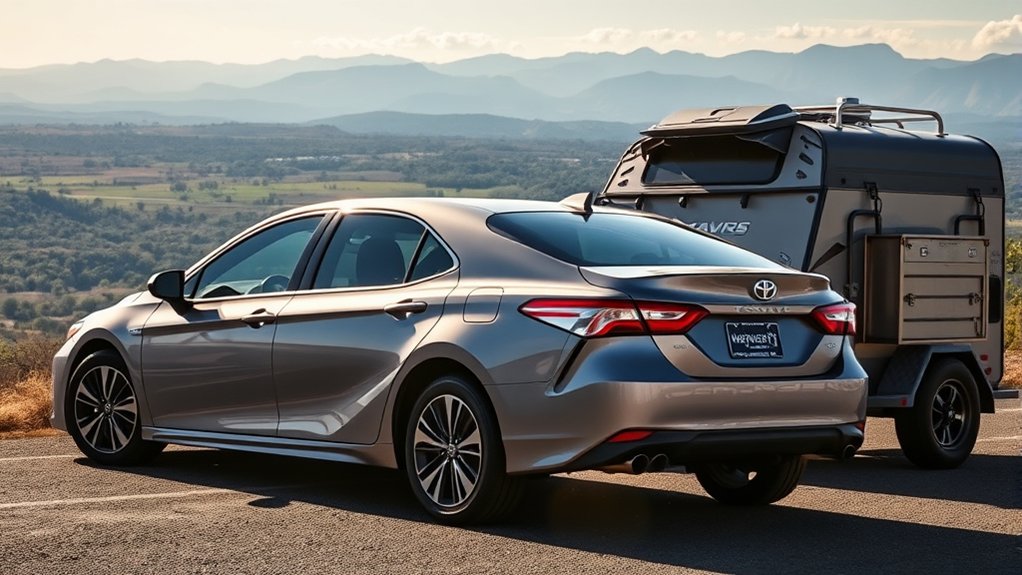
A Toyota Camry does not have one universal towing capacity. The permitted limit—or whether trailer towing is allowed at all—can change by model year, powertrain, trim, country, and installed equipment. Before connecting a trailer, check the owner’s manual issued for your exact vehicle and market. If Toyota does not authorize trailer towing or publish the necessary limits, do not tow a road trailer with that Camry.
Quick Answer
Toyota Camry towing capacity is model- and market-specific. The 2026 U.S. Camry owner’s manual states that the vehicle is not designed for trailer towing. Other markets or older configurations may use different rules. Check the exact manual for your VIN; if Toyota does not publish permission and limits, do not tow a road trailer.
Key Takeaways
- Camry towing rules are not the same across every year, powertrain, trim, and country.
- The 2026 U.S. Camry is not designed for trailer towing, according to its official owner’s manual.
- Use the trailer’s fully loaded, trip-ready weight—not its advertised dry or empty weight.
- The vehicle, trailer, hitch, tongue load, tires, axles, payload, and combined-weight limits must all be satisfied.
- A hitch, transmission cooler, stronger spring, or other accessory cannot create or increase a manufacturer tow rating.
At a Glance
| Time Required | About 10–20 minutes to verify the manual and labels; longer if dealer confirmation or scale measurements are needed. |
| Difficulty | Easy to verify documentation; moderate when calculating payload, tongue load, axle loads, and combined weight. |
| Tools Needed | VIN, exact owner’s manual, certification and tire labels, trailer data plate, calculator, pressure gauge, and a public scale when weights are close. |
| Cost | Manual and label checks are free. Dealer consultation, public-scale tickets, inspections, and approved equipment may cost extra. |
How Much Can Your Toyota Camry Tow?
The controlling answer comes from Toyota’s documentation for your exact Camry. Toyota publishes different manuals and specifications for different countries and model years, and information for one market should not be transferred to a vehicle built and certified for another.
An Australian specification, for example, may use braked and unbraked trailer limits that do not apply to a U.S.-market Camry. Differences may also exist among gasoline, hybrid, front-wheel-drive, and all-wheel-drive versions.
The safe limit is not the largest Camry number you can find online. It is the lowest applicable restriction for your exact vehicle, trailer, hitch, tires, axles, payload, and route.
Current U.S. Example: 2026 Toyota Camry
The official 2026 U.S. Toyota Camry owner’s manual states that the vehicle is not designed for trailer towing. Therefore, a generic 1,000-pound figure from a hitch seller, dealership blog, forum, or towing chart should not be applied to that vehicle.
This example does not prove that every Camry sold in every country and every year has the same restriction. It shows why market- and model-year-specific documentation is essential.
Warning: “No towing rating listed” is not permission to choose a number yourself. It may not be a formal zero-pound specification, but the safe operating decision is the same: do not tow unless Toyota authorizes it and supplies the applicable limits for your exact vehicle.
How to Verify Your Exact Camry Towing Limit
- Identify the model year, market, and powertrain. Check the registration, VIN information, certification label, and Toyota documentation rather than relying only on the purchase date or trim badge.
- Open the correct owner’s manual. U.S. owners can use the Toyota Manuals and Warranties portal. Australian owners can use the Toyota Australia manuals portal.
- Search the manual for the right terms. Look for “trailer towing,” “towing capacity,” “trailer weight,” “vehicle load limits,” “tow hitch,” “tow bar,” “GCM,” or “GCWR.”
- Record every relevant number. Depending on the market, these may include braked capacity, unbraked capacity, tongue or tow-ball load, vehicle payload, axle ratings, and gross combined mass or weight.
- Read every condition attached to the rating. Conditions may address trailer brakes, approved equipment, speed, cooling, tire pressure, passenger load, cargo, road type, or maintenance.
- Check the vehicle labels. Confirm the permitted occupant-and-cargo load, vehicle mass, axle ratings, tire load limits, and recommended cold tire pressures.
- Read the trailer’s data plate. Record its empty or tare weight, GVWR or ATM, axle rating, tire ratings, and coupling requirements.
- Ask Toyota when the documentation is unclear. Give the dealer or Toyota customer service your VIN and request configuration-specific guidance. Written confirmation is preferable when the answer affects safety, insurance, or warranty coverage.
Why There Is No Reliable Universal Camry Towing Chart
A year-by-year chart can be misleading if it combines vehicles from different countries or assumes that every trim shares one specification. A complete chart would need to separate model year, production series, market, powertrain, drivetrain, certification class, and any required factory equipment.
A single number without those qualifiers may look convenient, but it can be less useful than the exact manual. Even two Camrys with similar exterior styling may have different towing instructions because of certification, cooling, braking, structural, software, or warranty differences.
Why Different Camrys Have Different Limits
| Factor | Why It Matters |
| Country or market | Vehicles are tested, certified, equipped, and documented under different national requirements. |
| Model year | The chassis, cooling system, brakes, powertrain, software, and approved accessories can change between generations. |
| Powertrain and drivetrain | Gasoline, hybrid, front-wheel-drive, and all-wheel-drive versions may have different thermal, structural, and weight restrictions. |
| Passengers and cargo | Occupants, luggage, accessories, and trailer tongue load all consume the vehicle’s available payload. |
| Trailer brakes and equipment | A braked rating does not authorize towing the same weight with an unbraked trailer. |
| Approved hitch or tow bar | Attachment points, tongue position, fasteners, electrical integration, and permitted hitch load may vary by vehicle. |
What Trailers Can Your Toyota Camry Tow?
You cannot determine compatibility from the trailer category alone. A utility trailer, teardrop camper, pop-up camper, or personal-watercraft trailer may be light when empty but exceed the relevant limit after loading.
Only consider a trailer when your exact Camry manual permits towing and the complete loaded combination remains within every applicable limit.
| Manual Says | Safe Decision |
| Vehicle is not designed for towing, or towing is prohibited | Do not tow a utility trailer, camper, boat, personal watercraft, or other road trailer. |
| No trailer authorization or rating is listed | Do not invent a rating from an aftermarket hitch. Obtain VIN-specific confirmation from Toyota before towing. |
| An unbraked limit is listed | The trailer and everything loaded in it must remain below that limit and all other vehicle, hitch, tire, and axle limits. |
| A higher braked limit is listed | Use the specified braking system and comply with all conditions in the manual and local law. |
Small Utility Trailers
A small utility trailer may be suitable only when towing is approved and its actual loaded weight fits the rating. Include the trailer, spare tire, ramps, tie-downs, tools, landscaping material, furniture, and every other item in the calculation.
Do not subtract the trailer’s advertised empty weight from an assumed Camry capacity and treat the remainder as guaranteed cargo allowance. The vehicle’s payload, axle limits, tires, hitch load, and combined-weight limit may reduce the usable amount.
Jet Ski and Personal-Watercraft Trailers
Use the combined loaded weight of the watercraft and trailer. Add fuel, oil, battery, anchor, cover, safety equipment, storage items, and any water retained in the craft. A watercraft’s published dry weight alone is not enough.
Confirm that the ramp, launch area, and parking surface are suitable for the vehicle. Wet or algae-covered ramps can reduce tire grip, and pulling a loaded trailer from a steep ramp can impose demands that are not represented by flat-road cruising.
Teardrop and Pop-Up Campers
Camper weights vary widely. The empty or dry figure may exclude propane, batteries, water, air conditioning, options, food, camping equipment, and personal belongings. Compare the measured trip-ready weight with the exact Camry rating rather than relying on an average for the camper category.
Also check frontal-area, speed, braking, and equipment restrictions when the manual provides them. Two trailers with the same scale weight can create different aerodynamic loads.
Understand the Weight Limits Before Towing
Towing capacity is only one part of the calculation. You must remain within every limit that applies to the car, trailer, hitch, tires, and axles.
- Trailer towing capacity: The maximum trailer weight permitted by the vehicle manufacturer under its stated conditions.
- Loaded trailer weight: The trailer plus every item carried on or inside it, including fluids, options, batteries, propane, and cargo.
- Dry or empty weight: A starting figure that may exclude fluids, dealer-installed equipment, options, and cargo.
- GVWR or GVM: The maximum permitted weight of the loaded tow vehicle, including occupants, cargo, accessories, and hitch load.
- GCWR or GCM: The maximum permitted combined weight of the loaded vehicle and loaded trailer when the manufacturer provides this limit.
- GAWR or axle capacity: The maximum load permitted on an individual axle.
- Payload: The amount available for occupants, luggage, accessories, modifications, and trailer tongue load.
- Tongue or tow-ball load: The downward force the trailer applies at the coupling. This load normally counts against the tow vehicle’s payload and rear-axle capacity.
- Braked towing capacity: A limit that applies only when the trailer has the required braking system.
- Unbraked towing capacity: The lower limit that may apply when the trailer has no independent service brakes.
- ATM: In Australian terminology, Aggregate Trailer Mass is the maximum permitted mass of the trailer when it is standing on its own wheels and jockey wheel, including the coupling load.
- GTM: Gross Trailer Mass is the permitted mass carried by the trailer’s wheels when the trailer is coupled. Toyota Australia’s general towing guide describes ATM as GTM plus tow-ball download.
Toyota’s vehicle payload guidance explains that passengers, cargo, accessories, modifications, and their distribution affect available payload and axle loading.
How to Calculate the Remaining Payload
Begin with the maximum combined occupant-and-cargo load shown on the applicable vehicle label or in the manual. Subtract the real weight of every occupant, luggage, accessory, and modification. If towing is approved, subtract the trailer’s actual tongue or tow-ball load as well.
Example only: Suppose a vehicle—not a stated Camry specification—has a 900-pound occupant-and-cargo limit. If its occupants weigh 350 pounds and its cargo and accessories weigh 150 pounds, 400 pounds remain before the trailer is connected. A measured 150-pound tongue load would leave 250 pounds of payload capacity.
This calculation does not confirm that the vehicle can tow the trailer. You must still satisfy the trailer limit, rear-axle rating, tire limits, hitch rating, combined-weight rating, and every condition in the manual.
How to Weigh the Loaded Combination
- Load for the real trip. Include passengers, fuel, luggage, tools, water, batteries, propane, food, safety equipment, and accessories.
- Confirm the scale procedure. Ask the scale operator how to position the front axle, rear axle, and trailer axle group on the scale platforms.
- Weigh the loaded Camry without the trailer when practical. This establishes the vehicle’s actual loaded weight and axle distribution before tongue load is added.
- Connect the trip-ready trailer and weigh the combination. Obtain the front-axle, rear-axle, trailer-axle, and total combination weights where the scale permits.
- Measure coupling load correctly. Use an appropriate tongue-weight scale or a recognized scale method. Keep the coupler at approximately its normal towing height.
- Avoid double-counting. Tongue load is transferred to the tow vehicle when connected; use a consistent method when comparing scale tickets and ratings.
- Compare every measured value. Check vehicle mass, each axle, trailer mass, combined mass, tongue load, hitch hardware, and tire capacities.
Pro Tip: When the numbers are close, use a certified public scale and leave a practical margin for packing changes and measurement variation. Several optimistic brochure figures are not a substitute for one trip-ready measurement.
Top Safety Tips for Towing With Your Camry
If your exact Camry is approved for trailer towing, preparation should focus on weight control, secure coupling, reliable lighting, predictable handling, and conservative driving.
- Stay below every limit. Do not use the largest rating as a loading target. Leave capacity for normal loading differences and measurement uncertainty.
- Load the trailer correctly. Secure heavy items low and close to the trailer axle area while maintaining the coupling load specified by the vehicle and trailer manufacturers.
- Confirm tongue or tow-ball load. Too little or too much downward load can affect steering, rear-axle loading, braking, and stability.
- Check all tires cold. Inspect the Camry and trailer tires for damage, age, correct pressure, and sufficient load capacity.
- Test every required light. Verify the tail, brake, turn, hazard, license-plate, and marker lights before departure.
- Use safety chains correctly. Attach properly rated chains or cables to approved points and allow enough length for turns without letting them drag.
- Check the coupler and ball. Confirm that the sizes match, the latch is locked, and the retaining pin or lock is installed.
- Verify trailer brakes. Test the service-brake and breakaway systems when fitted or required.
- Increase following distance. The combination needs more room to slow, stop, merge, and pass.
- Reduce speed before curves and hills. Avoid abrupt steering, hard acceleration, and sudden braking.
- Respond carefully to sway. Hold the steering wheel steadily, ease off the accelerator, and avoid sharp steering or acceleration. Stop safely and correct the loading, speed, tire, or equipment problem before continuing.
- Practice low-speed maneuvering. Learn the trailer’s turning and reversing response in a large, empty area before entering traffic or a confined campground.
- Plan descents before starting them. Follow the manual’s transmission and braking guidance, control speed early, and avoid riding overheated brakes.
- Recheck the connection. Inspect the hitch, chains, straps, tires, wheel fasteners, and load after the first short driving interval and periodically on longer trips.
Note: Trailer-brake, lighting, registration, mirror, safety-chain, speed, inspection, and licensing rules vary by location. Check the requirements for every state, province, territory, or country on your route.
Essential Towing Equipment for Your Camry
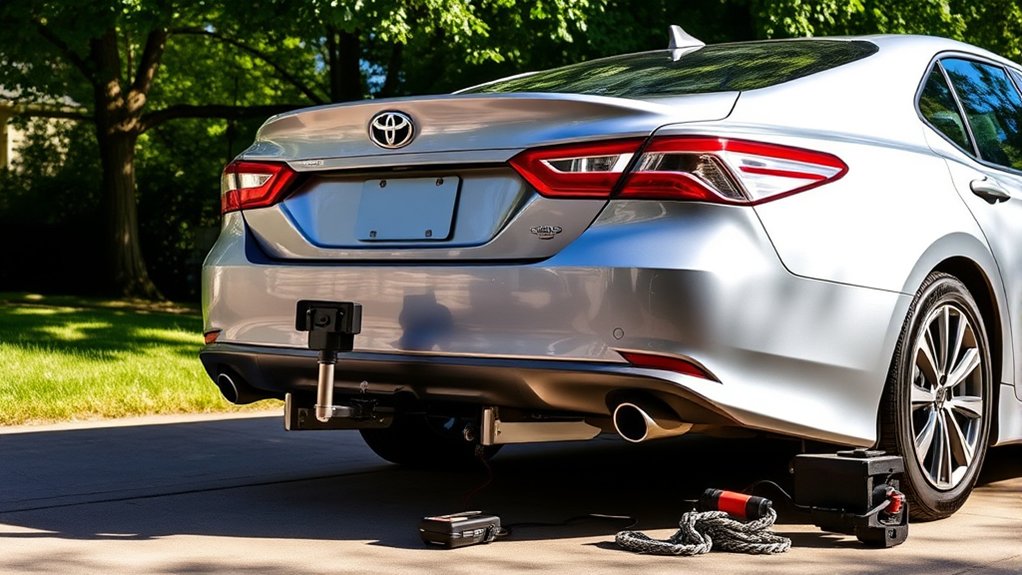
Use equipment approved for the exact Camry and trailer combination. Every component should have a clearly stated rating, but a hardware rating does not replace or override the vehicle’s towing restriction.
- Vehicle-compatible receiver or tow bar: It must be designed for the exact Camry generation and installed according to its instructions and Toyota’s requirements.
- Correct hitch ball and mount: Match the coupler size and keep the trailer level within the equipment manufacturer’s requirements.
- Approved attachment hardware: Use the specified fasteners and torque values. Do not attach a trailer to a recovery point, transport tie-down, or bumper unless Toyota explicitly approves it.
- Trailer wiring: Use a compatible wiring system that does not overload or improperly splice into the vehicle’s electrical circuits.
- Safety chains or cables: Use properly rated components attached to approved points.
- Trailer brakes and controller: Install and configure them when required by the manual, trailer design, or local law.
- Breakaway system: Confirm that the switch, cable, and battery work when the trailer is equipped with one.
- Mirrors: Add legally compliant towing mirrors when the trailer blocks the required rearward view.
- Tire-pressure gauge and torque wrench: Use them to maintain tire pressure and check wheel fasteners according to the applicable specifications.
- Load restraints: Use straps, chains, or other restraints rated for the cargo, and protect them from sharp edges and heat.
Does a Class I or Class II Hitch Increase Capacity?
No. A hitch class describes the hardware’s rating under its own conditions. It does not authorize the vehicle to tow that amount. The usable limit is the lowest restriction among the Camry, receiver, ball mount, ball, coupler, tires, axles, trailer, and applicable law.
A hitch advertised as fitting a Camry may be sold for a trailer, bicycle rack, wheelchair carrier, or cargo tray. Physical fit does not prove that Toyota approves the intended use.
Can You Use a Hitch-Mounted Bike or Cargo Carrier?
Check the exact manual separately from the trailer-towing question. A hitch-mounted carrier places static and dynamic leverage on the rear structure, uses payload, and can affect axle loading, ground clearance, lights, the license plate, sensors, and rearward visibility.
If the manual says that the vehicle is not designed for tow-hitch-mounted carriers, do not use one merely because an aftermarket receiver is available. Consider an approved roof or trunk carrier instead, provided it remains within Toyota’s applicable load limits and installation instructions.
Should You Add a Weight-Distribution Hitch?
Do not use one unless Toyota and the receiver manufacturer both approve it for your exact installation. A weight-distribution system changes the forces applied to the receiver and vehicle structure. It must never be used to compensate for an overloaded or incorrectly loaded combination.
Will a Transmission Cooler Increase the Tow Rating?
No. Extra cooling may help manage temperature in an application where Toyota already permits towing, but it does not change the manufacturer’s certified trailer rating. A cooler, suspension aid, stronger spring, larger tire, or higher-class hitch cannot justify exceeding the manual.
Pre-Tow Inspection Checklist
- The manual for the exact year, market, powertrain, and configuration permits trailer towing.
- The loaded trailer is below the applicable braked or unbraked limit.
- The loaded Camry remains below its GVWR or GVM.
- The combination remains below any stated GCWR or GCM.
- Neither vehicle axle exceeds its rating.
- The trailer remains below its GVWR, ATM, GTM, and axle rating as applicable.
- The hitch and measured tongue or tow-ball load remain within their limits.
- The Camry and trailer tires are correctly inflated, undamaged, and adequately rated.
- The hitch latch, retaining pin, safety chains, and breakaway cable are secure.
- All required trailer lights and brakes work.
- The cargo is balanced, secured, and unable to shift.
- The trailer jack and stabilizers are fully raised.
- The driver has suitable rearward visibility.
- The route, weather, grades, parking areas, and fuel or charging stops are suitable for the combination.
- The license, registration, insurance, inspections, and trailer equipment comply with local rules.
- The vehicle and towing equipment are within their required inspection and maintenance intervals.
Maintenance After Towing
Trailer towing adds load to the engine or hybrid system, cooling system, brakes, tires, suspension, wheel bearings, and transmission or transaxle. When towing is approved, follow the maintenance schedule and any severe- or special-operating-condition instructions for your exact Camry.
Inspect the receiver or tow bar, mounting fasteners, wiring, safety-chain points, ball, coupler, trailer brakes, wheel fasteners, and tires at the intervals specified by their manufacturers. Investigate unusual heat, odors, fluid leaks, braking changes, tire wear, noises, warning lights, or handling changes before towing again.
Alternatives to Towing With Your Camry
If your Camry is not approved for towing, or the loaded trailer exceeds any applicable limit, choose another transport method rather than modifying the car to force compatibility.
For bicycles or other light recreational equipment, a vehicle-compatible roof or trunk carrier may work when its load remains within Toyota’s roof, trunk, tire, axle, and vehicle payload limits. Confirm that the carrier fits the exact Camry and does not block lights, the license plate, sensors, or the driver’s view.
Do not assume that a hitch-mounted bicycle or cargo rack is acceptable when trailer towing is prohibited. The owner’s manual may restrict hitch-mounted carriers separately.
For furniture, appliances, campers, boats, personal watercraft, landscaping materials, or other heavy loads, rent a truck, van, or tow-rated SUV with sufficient trailer, payload, hitch, axle, and combined-weight capacity. You can also use a professional moving service, arrange delivery from the seller, or rent a vehicle and trailer as a compatible package.
A suitable tow vehicle provides more braking reserve, payload, cooling capacity, approved hitch options, and stability than an unapproved passenger-car setup.
Frequently Asked Questions
Can a Toyota Camry tow anything?
Some Camry configurations in some markets may have published trailer instructions, while others are not designed for towing. Check the owner’s manual for the exact year, market, powertrain, and configuration. Do not tow a road trailer when Toyota does not authorize it.
Can a 2026 U.S. Toyota Camry tow a trailer?
The official 2026 U.S. Camry owner’s manual states that the vehicle is not designed for trailer towing. Do not apply a generic 1,000-pound rating or an overseas-market specification to that vehicle.
What does a 3.5-ton towing capacity mean?
Check the unit used by the original source. A 3.5-metric-tonne rating is 3,500 kg, or about 7,716 pounds. A 3.5 U.S.-short-ton figure is 7,000 pounds. Neither is a universal Toyota Camry rating, and the manufacturer’s conditions still apply.
Which Toyota can tow 3,500 pounds?
Some Toyota trucks and SUVs may provide ratings of at least 3,500 pounds in specific configurations. Check Toyota’s current towing information and the exact vehicle manual because capacity can change with model year, drivetrain, equipment, passengers, cargo, and hitch requirements.
Can a Toyota Camry tow a 2,000-pound trailer?
Do not tow a 2,000-pound trailer unless the owner’s manual for your exact Camry explicitly authorizes at least that fully loaded trailer weight and every payload, axle, tire, hitch, tongue-load, combined-weight, equipment, and legal limit is satisfied.
Can a Toyota Camry tow a jet ski?
Only when the exact Camry is approved for towing and the fully loaded watercraft trailer remains within every applicable limit. Include the trailer, watercraft, fuel, battery, equipment, accessories, retained water, and coupling load. The watercraft’s dry weight alone is not sufficient.
Can I put a hitch-mounted bike rack on a Camry that cannot tow?
Not automatically. A carrier places load and leverage on the hitch and vehicle structure even though it has no trailer. Use one only when Toyota’s manual and the receiver manufacturer approve that use for the exact Camry, and keep the carrier, bicycles, payload, axle load, and hitch load within their limits.
Does installing a trailer hitch void the warranty?
In the United States, installing an aftermarket part does not automatically cancel the entire vehicle warranty. However, warranty coverage may be denied for damage the manufacturer or dealer proves was caused by a defective hitch, improper installation, overloading, or unauthorized use. Warranty law and Toyota’s terms differ by country, so obtain market- and VIN-specific guidance before installation.
Conclusion
Your Toyota Camry may or may not be authorized to tow a trailer, depending on its exact year, market, powertrain, and configuration. The 2026 U.S. Camry, for example, is not designed for trailer towing. Begin with Toyota’s manual for your VIN rather than a universal online chart, hitch advertisement, or specification from another country.
When towing is permitted, use the trailer’s fully loaded weight and verify the vehicle’s payload, axle, tire, hitch-load, combined-weight, equipment, maintenance, and legal limits. When towing is prohibited, no authorization is published, or the measured numbers are too close, use a properly rated rental vehicle or professional transport service.
Sources
- Toyota 2026 Camry Owner’s Manual — official U.S.-market guidance stating that the vehicle is not designed for trailer towing.
- Toyota Australia Manuals — official access to market- and vehicle-specific owner documentation.
- Toyota Australia Basic Towing Guide — general guidance on GVM, GTM, ATM, tow-ball load, weighing, equipment, stability, and maintenance; vehicle-specific specifications must be confirmed separately.
- Toyota Australia Vehicle Payload Guidance — definitions and guidance for payload, vehicle mass, axle capacity, and combined mass.
- SAE J2807_202411 — current SAE performance requirements and methodology for tow-vehicle combination and trailer weight ratings.
- U.S. Federal Trade Commission Auto Warranty Guidance — U.S. consumer guidance on aftermarket parts, installation-related damage, and warranty coverage.

