
The 2025 Toyota Camry earns a 5-star overall NHTSA safety rating for the tested front-wheel-drive and all-wheel-drive hybrid configurations and is an IIHS Top Safety Pick+. IIHS rates its main crashworthiness and front crash-prevention evaluations Good. The main caveats are Acceptable headlights and a few Acceptable passenger-restraint or rear-passenger submeasures.
Last updated: September 19, 2026. Safety ratings and feature availability were rechecked against current IIHS, NHTSA, Toyota, and ANCAP sources.
Affiliate disclosure: This page may contain affiliate links. If you buy through them, we may earn a commission at no extra cost to you.
Quick Answer
The 2025 Toyota Camry has a 5-star overall NHTSA rating for the tested FWD and AWD hybrid configurations and is an IIHS Top Safety Pick+. IIHS gives it Good ratings in the main crashworthiness and front crash-prevention tests, while the headlights are Acceptable. In Australia and New Zealand, the current-generation hybrid Camry also has a 5-star ANCAP rating, but that regional result should not be substituted for US-market testing.
Key Takeaways
- The tested 2025 Camry Hybrid FWD and AWD configurations have a 5-star overall NHTSA rating.
- The 2025 Camry earned the IIHS Top Safety Pick+ designation.
- IIHS rated its small-overlap, updated moderate-overlap, and updated side crash performance Good.
- Its standard vehicle-to-vehicle and pedestrian front crash-prevention systems earned Good ratings.
- The headlights are Acceptable, not Good, and selected rear-passenger submeasures are also Acceptable.
- Toyota Safety Sense 3.0, Blind Spot Monitor, Rear Cross-Traffic Alert, and Safe Exit Alert are standard.
- ANCAP rates the current-generation hybrid Camry 5 stars for Australia and New Zealand, with 95% Adult Occupant Protection and 87% Child Occupant Protection.
- A safety award is not a guarantee. Driver-assistance systems still depend on road, weather, visibility, maintenance, and operating conditions.
What Are the 2025 Toyota Camry Safety Ratings?

The US-market 2025 Toyota Camry has two major independent safety results. NHTSA gives the tested Camry Hybrid FWD and AWD configurations 5 stars overall, while the Insurance Institute for Highway Safety identifies the sedan as a Top Safety Pick+ and says its ratings apply to 2025–2026 models.
| Rating organization | 2025 Camry result | What to know |
|---|---|---|
| NHTSA | 5 stars overall | The tested FWD and AWD hybrid configurations are rated 5 stars overall. The frontal, side, and rollover category ratings are 5 stars; the driver frontal subrating is 4 stars and the passenger frontal subrating is 5 stars. |
| IIHS | Top Safety Pick+ | Good ratings in the main crashworthiness and front crash-prevention tests; Acceptable headlights. |
| ANCAP | 5 stars | Applies to all hybrid variants in Australia and New Zealand built from June 2024 onward; this is a regional result, not a US NHTSA or IIHS rating. |
| IIHS evaluation | 2025 Camry result | What it covers |
|---|---|---|
| Overall award | Top Safety Pick+ | IIHS award based on the applicable crashworthiness, crash-prevention, and headlight criteria. |
| Small overlap front | Good | Driver- and passenger-side frontal impacts involving a limited portion of the vehicle’s front end. |
| Moderate overlap front: updated test | Good | Front-seat and rear-seat protection in a frontal crash. |
| Side: updated test | Good | Structure, injury measures, and head protection in a side impact. |
| Vehicle-to-vehicle front crash prevention 2.0 | Good | Warnings and automatic braking in specified passenger-car, motorcycle, and semitrailer scenarios. |
| Pedestrian front crash prevention | Good | Day and night pedestrian scenarios at specified test speeds. |
| Headlights | Acceptable | Low- and high-beam illumination and glare for both available headlight systems. |
| Seat-belt reminders | Good | Reminder timing, volume, duration, and coverage. |
| LATCH ease of use | Good | Accessibility and usability of child-restraint anchors. |
Note: Ratings can be revised, and organizations may test different configurations. These results were rechecked on September 19, 2026. Use the linked source pages when comparing a specific vehicle or drivetrain.
NHTSA’s current 5-Star Safety Ratings data gives both tested 2025 Camry Hybrid configurations—FWD and AWD—5 stars overall. Both also receive 5 stars for the frontal, side, and rollover categories. Within the frontal test, the driver subrating is 4 stars and the passenger subrating is 5 stars. Use the official NHTSA 2025 Toyota Camry page to confirm the exact configuration and any later updates.
ANCAP gives the current-generation Toyota Camry a 5-star rating for all hybrid variants sold in Australia and New Zealand, covering build dates from June 2024 onward. Its published category scores are 95% for Adult Occupant Protection, 87% for Child Occupant Protection, 84% for Vulnerable Road User Protection, and 81% for Safety Assist. These results are useful regional context, but they should not be presented as a US-market NHTSA or IIHS score.
Camry Crash Test Performance Analysis
The Camry’s overall IIHS crashworthiness results are strong. It earned Good ratings in the small-overlap front, updated moderate-overlap front, and updated side tests. Its structure and safety cage also received Good ratings in the published frontal and side evaluations.
The detailed results provide a more balanced picture than the overall grades alone:
- Driver-side small overlap: The overall result, structure, injury measures, and driver restraints and kinematics were Good.
- Passenger-side small overlap: The overall result and injury measures were Good, while the passenger restraints and dummy-kinematics subrating was Acceptable.
- Updated moderate overlap: The overall result, structure, driver measures, and rear-passenger injury measures were Good. The rear-passenger restraints and dummy-kinematics result was Acceptable.
- Updated side test: The overall result and most injury measures were Good. The rear-passenger pelvis measure was Acceptable.
A Top Safety Pick+ award is a strong result, but it does not mean every individual measurement is rated Good. The Camry has several Acceptable subratings that buyers should understand alongside its overall performance.
IIHS also publishes raw test measurements that add context beyond the letter grades. In the driver-side small-overlap test, maximum lower hinge-pillar intrusion was 3 cm. In the updated moderate-overlap test, left footwell intrusion reached 9 cm. In the updated side test, the B-pillar stopped 18 cm short of the longitudinal centerline of the driver’s seat. These measurements are specific to the standardized IIHS tests; they are not universal injury thresholds or predictions for every real-world crash.
These results indicate effective occupant-compartment protection in the standardized tests. They do not predict the outcome of every collision, which can vary with speed, angle, vehicle size, seat position, belt use, occupant characteristics, and secondary impacts.
How Do NHTSA and IIHS Safety Ratings Differ?
NHTSA and IIHS use different test programs, rating scales, and award criteria. Their results complement each other, but one organization’s score cannot be converted directly into the other’s.
| Organization | Main output | Major areas evaluated |
|---|---|---|
| NHTSA | One to five stars, including an Overall Vehicle Score when available | Frontal, side-barrier, side-pole, and rollover-resistance performance |
| IIHS | Good, Acceptable, Marginal, or Poor ratings, plus safety awards | Crashworthiness, headlights, crash prevention, seat-belt reminders, and child-seat-anchor usability |
| ANCAP | Regional star and category results under the applicable protocol | Adult, child, vulnerable-road-user, and safety-assistance performance for specified Australasian vehicles |
According to NHTSA’s 5-Star Safety Ratings guidance, frontal ratings should be compared only among vehicles in the same class and within the stated weight range. Side and rollover results have different comparison rules.
Note: “Not Rated” does not mean that a vehicle failed. NHTSA uses that label when a vehicle has not been tested for a particular crash condition. Vehicles sold in the United States must still comply with applicable federal motor vehicle safety standards.
What Safety Features Are Standard on the 2025 Camry?
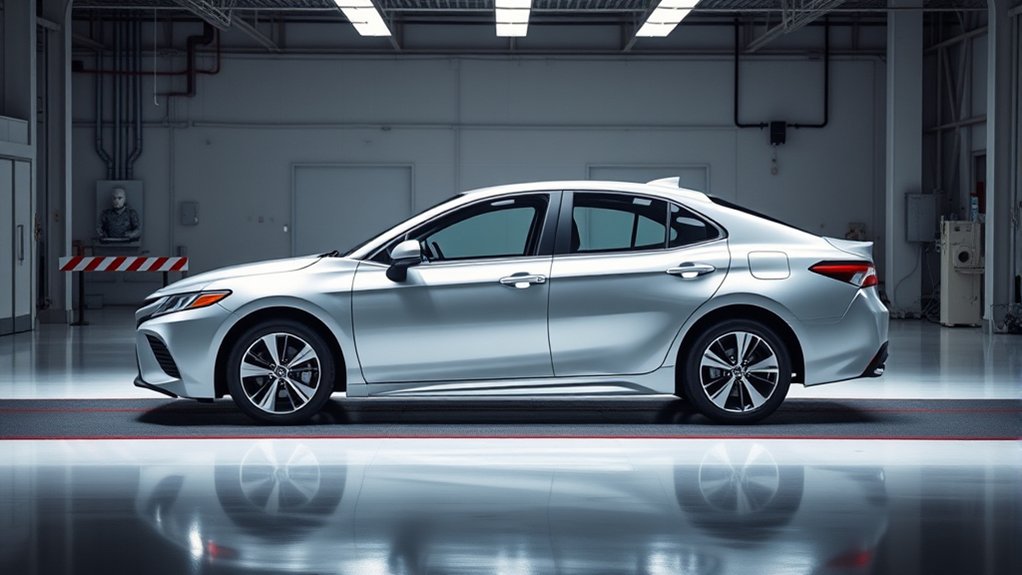
The 2025 Camry combines passive crash protection with active systems intended to warn the driver, support lane positioning, and reduce impact speed under certain conditions.
According to Toyota’s US launch information, standard safety and convenience equipment includes:
- Blind Spot Monitor
- Rear Cross-Traffic Alert
- Safe Exit Alert
- Toyota Safety Sense 3.0
Advanced Airbag and Restraint System
Airbags, seat belts, head restraints, the occupant compartment, and energy-absorbing body structures operate as a coordinated passive-safety system. Airbags supplement properly worn seat belts; they do not replace them.
In IIHS testing, the Camry received Good injury-measure results across the principal body regions for the tested driver and passenger dummies. However, selected restraint and dummy-kinematics subratings were Acceptable, which is why it is important to read beyond the overall crash-test grade.
Drivers should sit upright, keep a safe distance from the steering wheel, wear the shoulder belt across the chest, and ensure every passenger is correctly restrained. Children should use a car seat, booster, or seat belt appropriate for their age, size, and local law.
Collision Avoidance Technologies
The standard Toyota Safety Sense 3.0 suite includes a Pre-Collision System with Pedestrian Detection. Toyota says the system is designed to detect certain vehicles, pedestrians, bicyclists, and motorcyclists, warn the driver, and provide automatic emergency braking when operating conditions are met. For the model-year-specific control path and Toyota’s own cautions about when the system should be disabled, see how to temporarily disable the Camry Pre-Collision System.
IIHS gave the Camry a Good rating in its vehicle-to-vehicle front crash-prevention 2.0 evaluation. In the listed tests, the Camry avoided collisions with centered and off-center passenger-car and motorcycle targets at 31, 37, and 43 mph. Only warning performance is evaluated against the semitrailer target in that test.
The Camry also earned a Good pedestrian front crash-prevention rating. Its performance varied by scenario: it avoided several test collisions, while in some higher-speed cases it reduced impact speed rather than stopping completely.
Warning: Automatic emergency braking cannot detect every object or prevent every collision. Never test the system yourself, and do not delay braking because you expect the vehicle to intervene.
Lane Support Features
Toyota Safety Sense 3.0 includes Lane Departure Alert with Steering Assist and Lane Tracing Assist. Toyota describes Lane Departure Alert as a system that can warn of an unintended departure and provide gentle corrective steering when its operating conditions are met. Lane Tracing Assist can help center the vehicle while the adaptive cruise-control system is in use. On the 2025 Camry, Toyota also pairs LTA with an Emergency Driving Stop System designed to respond if the driver becomes unresponsive after prompts. For operating steps and limitations, see how to use Lane Tracing Assist in a Toyota Camry.
The suite also includes Full-Speed Range Dynamic Radar Cruise Control, Road Sign Assist, Automatic High Beams, and Proactive Driving Assist. These systems support the driver but do not make the Camry self-driving.
Additional equipment is available on certain grades. Toyota lists Traffic Jam Assist, Front Cross-Traffic Alert, Lane Change Assist, a Panoramic View Monitor, and Front and Rear Parking Assist with Automatic Braking in the available Premium Plus Package for XLE and XSE models. Traffic Jam Assist requires an active Drive Connect trial or subscription and depends on the 4G network. Buyers should verify the equipment and connected-service status on the specific vehicle rather than assuming every feature is standard or permanently included.
What Makes the 2025 Camry So Safe?
The Camry’s strong IIHS result comes from the combined performance of its structure, restraint systems, crash-avoidance technology, headlights, reminders, and child-restraint hardware. No single feature accounts for the entire rating. Under IIHS’s 2025 Top Safety Pick+ criteria, standard headlights may be rated Acceptable or Good, so the Camry’s Acceptable headlight rating does not conflict with its Top Safety Pick+ award.
Advanced Safety Technology
The standard active-safety suite addresses several common crash pathways:
- Forward conflicts: Collision warnings and automatic braking can respond to certain vehicles and vulnerable road users.
- Lane departures: Lane alerts and steering support can help when the vehicle begins to leave a detected lane unintentionally.
- Following distance: Adaptive cruise control can adjust speed to help maintain a selected gap from a detected vehicle ahead.
- Blind-zone and reversing conflicts: Blind Spot Monitor and Rear Cross-Traffic Alert warn of certain approaching vehicles.
- Door-opening conflicts: Safe Exit Alert can warn occupants of an approaching vehicle or bicycle before a door is opened.
Effectiveness depends on sensor visibility, lane markings, speed, lighting, weather, target type, and other operating conditions.
Strong Structural Integrity
IIHS rated the Camry’s structure and safety cage Good in its published small-overlap, updated moderate-overlap, and updated side evaluations. A strong occupant compartment helps limit intrusion and maintain survival space while other parts of the body manage crash forces.
Structural performance is only one part of occupant protection. Belt geometry, airbag timing, seating position, occupant size, and the direction and severity of the impact also influence injury risk.
Effective Crash Energy Management
During a collision, vehicle structures are designed to deform in controlled ways and redirect energy around the occupant compartment. Seat belts restrain occupants and manage forward movement, while airbags cushion contact with parts of the interior.
The Camry’s Good overall IIHS crashworthiness results indicate that these systems worked effectively in the standardized tests. The Acceptable passenger restraint and rear-passenger submeasures show why the detailed results still matter.
Child Safety Features and Front Crash Prevention Results
IIHS gives the 2025 Camry a Good rating for LATCH ease of use. The two rear outboard seating positions have complete LATCH hardware. The center rear position has a tether anchor but does not have its own pair of lower anchors.
A Good LATCH rating describes anchor accessibility and usability; it does not guarantee that every rear-facing seat, forward-facing seat, or booster will fit equally well. Vehicle-seat contour, front-seat position, child-seat width, and the installation method can affect fit.
For front crash prevention, the standard system earned Good IIHS ratings in both vehicle-to-vehicle and pedestrian evaluations. Those ratings are useful evidence of performance in controlled scenarios, but they should not be interpreted as child-specific crash-protection percentages or guarantees.
Understanding Child Occupant Protection Ratings
Different organizations measure child safety in different ways. IIHS evaluates child-seat-anchor ease of use as part of its US vehicle-rating program. ANCAP and similar regional programs may publish broader child-occupant categories using their own crash dummies, installation checks, scoring systems, and protocols.
For the current Australian and New Zealand Camry, ANCAP reports 87% for Child Occupant Protection and says its 5-star rating applies to all hybrid variants built from June 2024 onward. That percentage should not be treated as a US child-safety score because ANCAP and IIHS use different protocols. Use the official ANCAP current-generation Camry page for the regional report.
For a family choosing a Camry, the most useful practical checks are:
- Confirm that the child restraint is approved for the child’s age, height, and weight.
- Test the restraint in the intended rear seating position.
- Check that the seat can be tightened securely without interfering with front occupants.
- Use the top tether whenever the restraint manufacturer requires it.
- Follow both the child-restraint instructions and the Camry owner’s manual.
- Check the rear-door child-protector locks before carrying young children; see the Toyota Camry child safety lock location guide for the control location.
- Seek help from a qualified child-passenger-safety technician when the installation is uncertain.
Pro Tip: Bring the family’s actual child seat to a test drive. A rating can describe anchor usability, but only a hands-on installation confirms whether that particular seat fits the intended position and leaves enough room for other passengers.
Comparing the 2025 Camry Safety Ratings: NHTSA vs. IIHS
The verified IIHS answer is straightforward: the 2025 Camry is a Top Safety Pick+ with Good overall crashworthiness and crash-prevention results, Acceptable headlights, Good seat-belt reminders, and Good LATCH ease of use.
The current NHTSA result is also clear: both tested 2025 Camry Hybrid FWD and AWD configurations have a 5-star Overall Vehicle Score. NHTSA rates their frontal, side, and rollover categories 5 stars; the driver frontal subrating is 4 stars and the passenger frontal subrating is 5 stars. Because NHTSA and IIHS use different test procedures and scoring systems, the 5-star NHTSA result and the IIHS Top Safety Pick+ award should be read side by side, not converted into one another.
Note: Use IIHS results to understand its crashworthiness, crash-avoidance, headlight, belt-reminder, and LATCH evaluations. Use NHTSA to review federal frontal, side, rollover, complaint, investigation, and recall information. Looking at both provides a more complete picture than relying on one badge or number.
What Safety Ratings Do Not Tell You
Crash ratings are valuable comparison tools, but they cannot account for every real-world condition. They do not tell you:
- How every possible crash angle, speed, or collision partner will affect the vehicle
- How occupant protection changes when the collision partner is much larger or heavier; IIHS notes that vehicle size and weight still influence real-world protection even among award winners
- Whether tires, brakes, cameras, radar sensors, lights, and seat belts have been maintained correctly
- Whether a used vehicle has unrepaired crash damage
- Whether a particular VIN has an open safety recall
- Whether a driver-assistance feature will detect a specific object in rain, snow, fog, darkness, glare, or road debris
- Whether every child restraint will fit every rear seating position
Before buying, enter the vehicle identification number in NHTSA’s recall lookup. A model-level safety award does not confirm that an individual vehicle has received every required recall repair.
2025 Camry Safety Checklist Before You Buy
- Confirm the exact trim and equipment. Review the window sticker or official build details to distinguish standard features from optional packages.
- Check the VIN for recalls. Verify that any open safety campaigns have been completed.
- Inspect the warning lights. Airbag, ABS, brake, tire-pressure, and driver-assistance warnings should illuminate during the normal startup check and then turn off as designed.
- Test the seat belts. Check that each belt latches, retracts, and sits correctly across the occupant.
- Try the headlights at night. IIHS rates both available systems Acceptable, with documented low-beam limitations on some curves.
- Test child-seat fit. Install the actual restraint in the intended rear position.
- Keep sensors clear. Dirt, ice, snow, accessories, windshield damage, or collision repairs can affect cameras and radar sensors.
- Review system limitations. Read the owner’s manual before relying on adaptive cruise control, lane assistance, parking assistance, or automatic braking.
Frequently Asked Questions
What is the difference between NHTSA and IIHS ratings?
NHTSA uses a five-star program based mainly on frontal, side, and rollover evaluations. IIHS uses Good, Acceptable, Marginal, and Poor grades for crashworthiness, headlights, crash prevention, seat-belt reminders, and child-seat-anchor usability. IIHS also awards Top Safety Pick and Top Safety Pick+ designations.
What is the NHTSA rating of the 2025 Toyota Camry?
NHTSA gives both tested 2025 Camry Hybrid configurations—FWD and AWD—a 5-star Overall Vehicle Score. Their frontal, side, and rollover category ratings are also 5 stars. The driver frontal subrating is 4 stars and the passenger frontal subrating is 5 stars. Check the official NHTSA vehicle page for configuration details and later updates.
Is the 2025 Toyota Camry an IIHS Top Safety Pick+?
Yes. IIHS lists the 2025 Toyota Camry as a Top Safety Pick+. It has Good overall ratings in the principal crashworthiness and front crash-prevention evaluations, while its headlights are rated Acceptable.
Is the Toyota Camry the safest car?
No single credible rating proves that one vehicle is the safest in every situation. The 2025 Camry is a strong-performing midsize sedan in current IIHS testing, but buyers should compare its detailed results, equipment, visibility, child-seat fit, recalls, and driving needs with competing vehicles.
What is the ANCAP safety rating of the Toyota Camry?
ANCAP gives the current-generation hybrid Toyota Camry 5 stars for Australia and New Zealand. It reports 95% Adult Occupant Protection, 87% Child Occupant Protection, 84% Vulnerable Road User Protection, and 81% Safety Assist. That regional rating should not be substituted for US NHTSA or IIHS results.
Does the 2025 Camry have automatic emergency braking?
Yes. Toyota Safety Sense 3.0 is standard and includes a Pre-Collision System with Pedestrian Detection that can warn the driver and provide automatic emergency braking under specified conditions. The system cannot identify every hazard or prevent every collision.
Is the 2025 Camry suitable for child seats?
IIHS rates its LATCH ease of use Good. Both rear outboard positions have complete LATCH hardware, while the rear center has a tether anchor but no dedicated lower anchors. Test the family’s actual restraint because seat dimensions and installation needs vary.
Conclusion
The 2025 Toyota Camry has strong results from both major US safety-rating programs: a 5-star overall NHTSA rating for the tested FWD and AWD hybrid configurations and an IIHS Top Safety Pick+ designation. It also combines Good IIHS crashworthiness and crash-prevention grades with standard Toyota Safety Sense 3.0, Blind Spot Monitor, Rear Cross-Traffic Alert, Safe Exit Alert, and Good LATCH usability.
The details still matter. Its headlights are rated Acceptable, and selected passenger-restraint and rear-passenger submeasures are also Acceptable. Buyers should confirm the exact trim and optional equipment, test child-seat fit, inspect the individual vehicle, review driver-assistance limitations, and search its VIN for open recalls before making a decision.
Sources
- IIHS: 2025 Toyota Camry vehicle ratings — Top Safety Pick+ status, crashworthiness, headlights, crash prevention, seat-belt reminders, and LATCH results.
- NHTSA: 2025 Toyota Camry vehicle page — current federal rating, complaint, investigation, and recall information for the model.
- NHTSA: 5-Star Safety Ratings methodology — frontal, side, rollover, comparison, overall-score, and Not Rated explanations.
- Toyota USA Newsroom: 2025 Camry safety and convenience features — standard Toyota Safety Sense 3.0, Blind Spot Monitor, Rear Cross-Traffic Alert, Safe Exit Alert, and optional package equipment.
- ANCAP: current-generation Toyota Camry safety rating — 5-star Australasian rating, applicable hybrid variants, build period, and category scores.
- IIHS: 2025 Top Safety Pick criteria and midsize-car winners — explains why Acceptable or Good standard headlights can qualify for Top Safety Pick+ under the 2025 criteria.
- NHTSA recall lookup — VIN-based search for open safety recalls.
