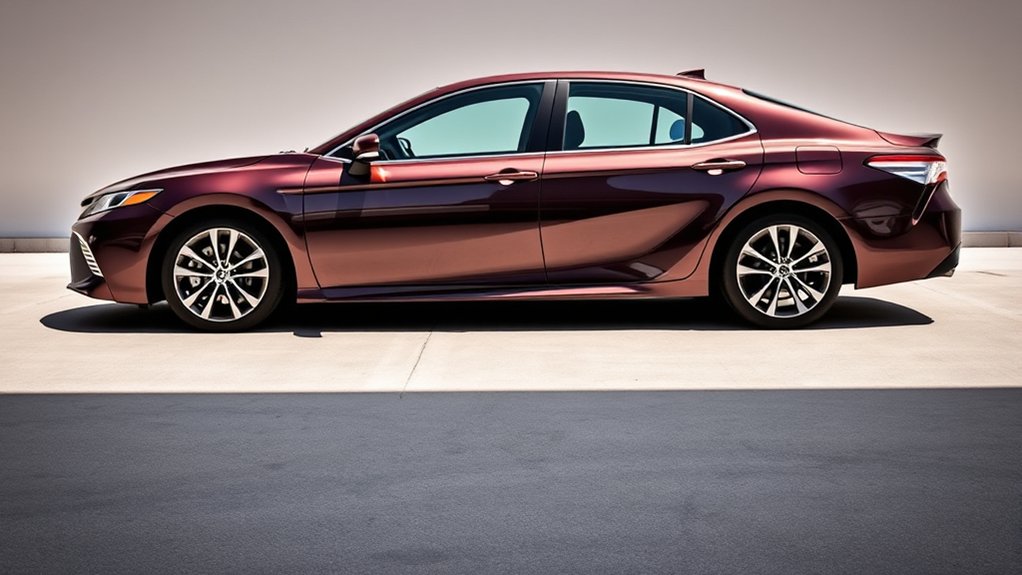
The 2025 Toyota Camry has a practical midsize-sedan footprint, with enough cabin and trunk room for everyday use while remaining manageable in most garages and parking spaces. Exterior measurements are only part of the picture, however. Interior packaging, door clearance, mirror width, trunk shape, curb weight, and the exact trim also matter when you compare space or fit.
Quick Answer
The U.S.-market 2025 Toyota Camry is 193.5 inches long, 72.4 inches wide, and 56.9 inches tall, with a 111.2-inch wheelbase and 5.4 inches of ground clearance. It seats five, provides 15.1 cubic feet of trunk space, and has a 37.4-foot turning circle.
Key Takeaways
- The 2025 Camry measures 193.5 inches long, 72.4 inches wide, and 56.9 inches high.
- Its 111.2-inch wheelbase supports five-passenger seating and 38.0 inches of rear legroom.
- The trunk holds 15.1 cubic feet, or approximately 428 liters.
- LE, SE, XSE, and XLE share the same main exterior dimensions, turning circle, and cargo volume.
- Toyota does not list a mirror-to-mirror width in its 2025 brochure, so measure the exact car for a narrow entrance.
- The U.S. 2025 Camry is exclusively hybrid and offers front-wheel drive or electronic on-demand all-wheel drive.
2025 Toyota Camry Dimensions at a Glance
| Measurement | 2025 Toyota Camry | Why It Matters |
|---|---|---|
| Overall length | 193.5 in. (4.915 m) | Affects garage fit, parallel parking, and walking space around the car. |
| Overall width | 72.4 in. (1.839 m) | Toyota does not provide a mirror-to-mirror figure in the cited brochure. |
| Overall height | 56.9 in. (1.445 m) | Useful for checking overhead clearance and comparing seating height. |
| Wheelbase | 111.2 in. (2.824 m) | Defines the distance between the front and rear axle centerlines. |
| Ground clearance | 5.4 in. (137 mm) | Calls for normal sedan care around curbs, snow, potholes, and steep ramps. |
| Turning circle | 37.4 ft. (11.4 m) | Helps indicate the space needed for a curb-to-curb U-turn. |
| EPA passenger volume | 99.9 cu. ft. without moonroof; 98.8 cu. ft. with moonroof | Shows the moonroof’s small effect on total measured cabin volume. |
| Trunk volume | 15.1 cu. ft. (about 428 L) | Provides useful space for groceries, luggage, and everyday equipment. |
| Seating capacity | 5 | Two front seats and a three-position rear bench. |
These figures apply to the U.S.-market 2025 Camry and come from Toyota’s official 2025 Camry e-brochure. Confirm the model year and market before using them to plan a tight parking or storage space.
At 193.5 inches, the 2025 Camry is approximately 16 feet 1.5 inches long before you add the clearance needed for walls, doors, storage, and trunk access.
Why Exterior Dimensions Matter in the Toyota Camry
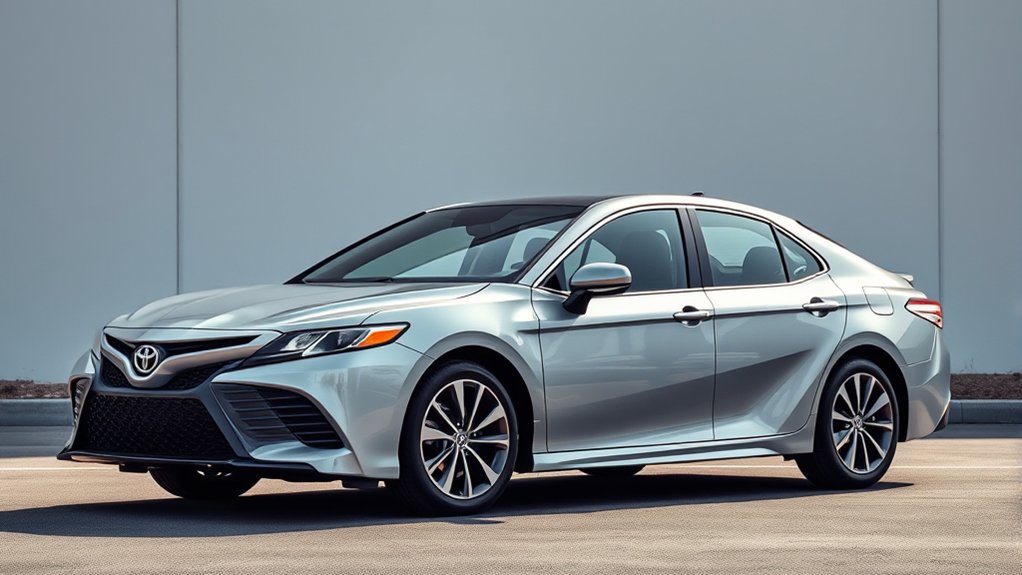
Exterior dimensions show how much physical space the Camry occupies. They help you check whether the car will fit inside a garage, pass through a narrow entrance, leave room beside another vehicle, or clear overhead storage.
The 193.5-inch length gives the Camry a substantial midsize-sedan body while remaining shorter than the 2025 Honda Accord. Its 72.4-inch published width helps with parking comparisons, but Toyota’s brochure does not provide the full mirror-to-mirror measurement.
The 56.9-inch height creates a low sedan profile. The 5.4-inch ground clearance is intended for paved-road use and requires care around tall parking stops, steep driveway transitions, and deep snow.
Exterior size gives designers a fixed envelope for the cabin and trunk. How roomy that envelope feels depends on the seats, floor height, roof shape, dashboard, door panels, suspension layout, and hybrid-component packaging.
Length: Parking Fit and Usable Space
At 193.5 inches long, the 2025 Camry measures 16.125 feet, or approximately 4.915 meters, from front to rear. It combines that length with a separate 15.1-cubic-foot trunk and seating for five.
Body length gives engineers room to position the cabin, suspension, bumpers, and trunk, but it is not the same as passenger legroom. Seat design and interior packaging determine how much of the exterior length occupants can use.
Practical benefits of the Camry’s length include:
- Space for a five-passenger cabin and a separate enclosed trunk
- Useful cargo capacity for errands and longer trips
- A midsize footprint that remains manageable in many parking areas
- Room for a 111.2-inch wheelbase without an unusually long body
Do not compare the car’s exact 193.5-inch length with the wall-to-door distance and assume it will fit comfortably. Account for the closed garage door, shelves, steps, walking space, and the room needed to open the trunk.
Width: Parking Clearance, Cabin Space, and Handling Context
Toyota lists the 2025 Camry at 72.4 inches wide, or approximately 6.03 feet and 1.839 meters. This figure is useful for comparing body size, but the cited brochure does not include a separate mirror-to-mirror measurement.
Width helps define the space available for the passenger compartment and chassis. It does not, by itself, establish grip, stability, or center-of-gravity height. Those qualities depend on track width, tires, suspension geometry, weight distribution, steering, and electronic controls.
Body Width Versus Track Width
Body width measures the exterior body, while track width measures the distance across the wheels on an axle. Toyota lists a 63.0-inch front track and 63.7-inch rear track for the 2025 Camry.
The 111.2-inch wheelbase is another separate measurement. It runs lengthwise between the axle centerlines rather than across the car.
What Contributes to Road Stability?
The Camry’s on-road behavior comes from the entire platform. Tire construction and pressure, steering calibration, suspension tuning, vehicle mass, aerodynamics, and stability-control programming all influence its response.
A wider body can create more room for passenger shoulder space, but exterior and interior widths are not interchangeable. Door structures, airbags, trim panels, pillars, and seat placement consume part of the body’s width.
Powertrain and Trim Differences
The U.S.-market 2025 Camry uses a hybrid system built around a 2.5-liter four-cylinder engine. Toyota lists 225 net combined horsepower for front-wheel-drive models and 232 horsepower for electronic on-demand all-wheel-drive models. A V6 engine is not offered for this model year. Toyota describes the full powertrain in its 2025 Camry launch information.
LE and XLE use comfort-focused suspension tuning, while SE and XSE receive sport-tuned suspension components. Wheel sizes and curb weights also vary even though the main body dimensions remain the same.
Note: Toyota’s 72.4-inch specification should not be treated as a guaranteed mirror-to-mirror width. Measure the exact vehicle with the mirrors extended and folded before using a very narrow garage, gate, trailer, or car-wash entrance.
Height: Roof Clearance, Seating, and Aerodynamics
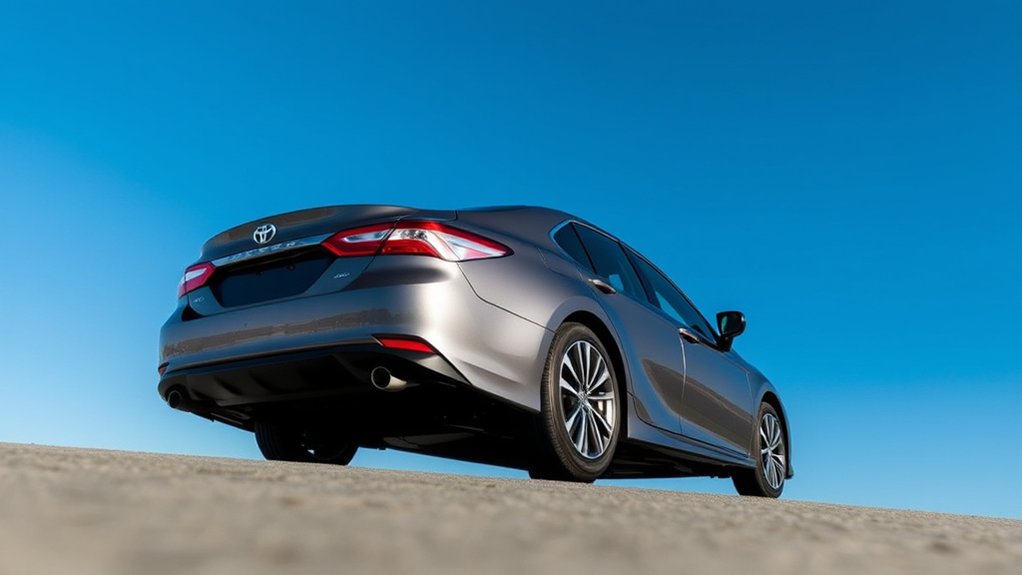
The 2025 Toyota Camry stands 56.9 inches high, equal to approximately 4 feet 8.9 inches or 1.445 meters. Toyota lists the same overall height for LE, SE, XSE, and XLE.
Vehicle height affects the available roof envelope, overhead clearance, seating position, and aerodynamic frontal area. Visibility also depends on window size, pillar thickness, mirrors, cameras, seat adjustment, and the driver’s eye position.
The Camry provides a conventional sedan seating position rather than the elevated view of an SUV. Drivers who prefer a higher eye point should sit in the car, adjust the seat and steering wheel, and check visibility in every direction.
Roof design also affects interior headroom. The available moonroof reduces published front headroom from 38.3 to 37.5 inches, while Toyota lists rear headroom at 37.6 inches in either configuration.
Wheelbase: What the 111.2-Inch Measurement Means
The 2025 Camry has a 111.2-inch wheelbase, measured horizontally from the center of the front axle to the center of the rear axle. That equals approximately 9 feet 3.2 inches or 2.824 meters.
Wheelbase helps define where the passenger compartment sits between the axles. It can also influence ride behavior, but springs, dampers, bushings, tires, wheels, seats, and road conditions remain important.
The Camry’s wheelbase contributes to:
- Space for front and rear seating within the body
- A balanced division between passenger and trunk space
- A stable midsize-sedan platform when paired with appropriate chassis tuning
- Useful cabin length without an excessively long exterior
Wheelbase alone does not establish turning radius or body roll. Steering angle, track width, tire dimensions, suspension geometry, and weight distribution also affect maneuverability.
Ground Clearance and Everyday Road Use
The Camry’s minimum ground clearance is 5.4 inches, or approximately 137 millimeters. That is appropriate for a road-focused sedan but not intended for deep ruts, off-road trails, or severe unplowed snow.
Approach steep driveway entrances slowly and at an angle only when traffic conditions make that maneuver safe. Watch for tall curbs, parking stops, potholes, raised drain covers, and debris that could contact the lower bumper or underbody.
Warning: Passengers, cargo, suspension movement, tire pressure, and road angle can reduce the clearance available at a particular point. The published 5.4-inch figure does not guarantee that every part of the car will clear an obstacle.
2025 Camry Interior Dimensions and Passenger Space
Toyota publishes the same main cabin measurements for all four U.S. trims. The moonroof changes front headroom and total passenger volume, but the listed legroom, shoulder room, and hip room remain consistent.
| Interior Measurement | Front | Rear |
|---|---|---|
| Headroom without moonroof | 38.3 in. | 37.6 in. |
| Headroom with moonroof | 37.5 in. | 37.6 in. |
| Legroom | 42.1 in. | 38.0 in. |
| Shoulder room | 57.7 in. | 55.7 in. |
| Hip room | 55.4 in. | 54.6 in. |
The moonroof reduces front headroom by 0.8 inch and total EPA passenger volume by 1.1 cubic feet. Taller drivers should compare both roof configurations in person because seat height, seatback angle, posture, and hairstyle can change perceived clearance.
How Do Dimensions Affect Comfort and Storage in the Camry?
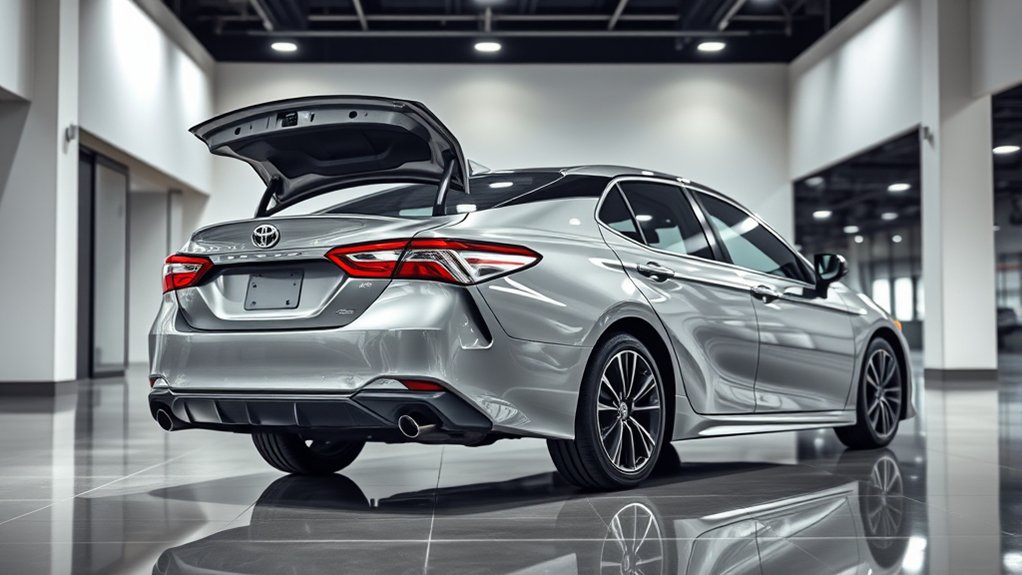
The Camry’s 193.5-inch body and 111.2-inch wheelbase provide the foundation for 42.1 inches of front legroom and 38.0 inches of rear legroom. Front and rear shoulder room measure 57.7 and 55.7 inches.
Numbers cannot show exactly how the cabin will feel to every occupant. Cushion length, seat contour, dashboard position, door-panel thickness, roof shape, and adjustment range all affect comfort.
The trunk provides 15.1 cubic feet, or approximately 428 liters, of cargo volume with the rear seatbacks up. That is useful for groceries, travel bags, and daily equipment, although the opening and wheel-well intrusions determine whether a large or unusually shaped object will fit.
If you regularly carry a stroller, wheelchair, musical instrument, sports equipment, or large case, test the actual item before buying. Total cubic volume does not reveal the narrowest point in the trunk opening.
Pro Tip: Measure the trunk opening’s width and height, the floor depth, and the space between the wheel wells. Those measurements are often more useful than total cargo volume for one specific item.
Curb Weight, Turning Circle, and Trim Differences
LE, SE, XSE, and XLE share the same published length, width, height, wheelbase, ground clearance, track width, turning circle, cabin dimensions, seating capacity, and trunk volume. Their curb weights differ because of wheels, equipment, trim content, and drivetrain.
| Trim | FWD Curb Weight | AWD Curb Weight |
|---|---|---|
| LE | 3,450 lb. | 3,594 lb. |
| SE | 3,494 lb. | 3,627 lb. |
| XSE | 3,538 lb. | 3,682 lb. |
| XLE | 3,516 lb. | 3,649 lb. |
Electronic on-demand all-wheel drive adds 133 to 144 pounds, depending on trim. Every trim has a published 37.4-foot curb-to-curb turning circle.
How the Camry Stacks Up Against Competitors in Dimensions
The Camry falls between the Honda Accord and Nissan Altima in several exterior measurements. The numerical differences are small enough that seating comfort, trunk-opening shape, garage clearance, and driving feel may matter more than one isolated figure.
| Vehicle | Length | Width | Height | Wheelbase | Trunk |
|---|---|---|---|---|---|
| 2025 Toyota Camry | 193.5 in. | 72.4 in. | 56.9 in. | 111.2 in. | 15.1 cu. ft. |
| 2025 Honda Accord | 195.7 in. | 73.3 in. | 57.1 in. | 111.4 in. | 16.7 cu. ft. |
| 2025 Nissan Altima | 192.9 in. | 72.9 in. | 56.7–57.4 in. | 111.2 in. | 15.4 cu. ft. |
Manufacturers may use different measurement conventions, and trim, roof, tire, or drivetrain changes can affect some figures. Compare the exact configuration rather than assuming one number applies to every version.
Camry vs. Honda Accord
The 2025 Accord is 2.2 inches longer and 0.9 inch wider than the Camry. It is also 0.2 inch taller and has a wheelbase that is 0.2 inch longer.
Honda publishes 16.7 cubic feet of trunk volume, which is 1.6 cubic feet more than the Camry’s 15.1 cubic feet. The Accord also lists 40.8 inches of rear legroom compared with the Camry’s 38.0 inches.
Those differences favor the Accord on paper, but buyers should still compare seat comfort, trunk access, visibility, control layout, and parking fit in person.
Camry vs. Nissan Altima
The Camry is 0.6 inch longer than the Altima, while the Altima is 0.5 inch wider. Both publish a 111.2-inch wheelbase.
The Altima provides 15.4 cubic feet of cargo volume, 0.3 cubic foot more than the Camry. Nissan lists different heights by trim and drivetrain: 56.7 to 56.9 inches for front-wheel-drive configurations and 57.3 to 57.4 inches for all-wheel-drive configurations.
How Camry Dimensions Influence Fuel Economy
The Camry’s exterior measurements form part of its aerodynamic package, but no single dimension guarantees better fuel economy. Body shape, frontal area, underbody airflow, wheel design, tires, curb weight, speed, weather, and powertrain efficiency all contribute.
Toyota designed the U.S.-market 2025 Camry as an exclusively hybrid model. Its fifth-generation hybrid system combines a 2.5-liter four-cylinder engine with electric motors, producing 225 net combined horsepower with front-wheel drive and 232 horsepower with all-wheel drive.
Toyota’s 2025 brochure lists up to 51 mpg combined for the LE front-wheel-drive model. Other trims, larger wheels, all-wheel drive, traffic, temperature, speed, and acceleration habits can produce different results. Check the window label for the exact vehicle.
- Length: Gives designers room to shape the body, but a longer car is not automatically more aerodynamic.
- Width: Contributes to frontal area and cabin packaging.
- Height: Affects frontal area and roof shape as part of the complete body design.
- Ground clearance: Influences underbody airflow but must also meet road-use and component-protection needs.
- Curb weight: Varies from 3,450 to 3,682 pounds across the trim and drivetrain range.
How to Check Whether the Camry Will Fit Your Space
Start with the published 193.5-inch length, 72.4-inch width, and 56.9-inch height, then measure the usable space rather than the room’s nominal dimensions.
- Measure the usable garage length. Include the closed garage door, shelves, steps, workbenches, charging equipment, and walking space.
- Measure the narrowest point. Check door frames, posts, wall cabinets, pipes, and any vehicle parked alongside.
- Measure the mirrors separately. Toyota does not provide a mirror-to-mirror width in the cited brochure.
- Allow room to open the doors. A car can fit between two walls while leaving too little room to enter or exit.
- Allow trunk access. Consider both the space behind the car and the trunk lid’s upward travel.
- Check overhead clearance. Look for garage-door hardware, hanging storage, lifts, and roof-mounted accessories.
- Inspect ramps and curbs. The 5.4-inch ground clearance requires care on sharp transitions.
For a very tight space, measure the exact vehicle at the dealership with the mirrors extended and folded. Also open every door and the trunk. Small differences in accessories, tires, loading, and measurement technique can matter when clearance is minimal.
Model-Year, Trim, and Market Differences
Not every Toyota Camry has the same dimensions. Redesigns can change length, width, height, wheelbase, cabin room, trunk volume, and ground clearance from one generation to another.
Measurements can also differ between countries because of bumpers, lighting requirements, powertrains, wheels, tires, and equipment. Always match a specification to the correct model year and market.
Within the U.S. 2025 range, Toyota lists the same main body, cabin, track, turning-circle, and cargo measurements for LE, SE, XSE, and XLE. Wheel size, suspension tuning, equipment, curb weight, and fuel-economy ratings still vary.
Frequently Asked Questions
What are the outside dimensions of a 2025 Toyota Camry?
The U.S.-market 2025 Toyota Camry is 193.5 inches long, 72.4 inches wide, and 56.9 inches high. It has a 111.2-inch wheelbase and 5.4 inches of minimum ground clearance.
How long is the 2025 Toyota Camry in feet and meters?
Its 193.5-inch length equals 16 feet 1.5 inches, or approximately 4.915 meters. Add extra space for the garage door, walking, storage, and trunk access.
What are the 2025 Camry’s interior dimensions?
The Camry has 42.1 inches of front legroom and 38.0 inches of rear legroom. Without a moonroof, headroom is 38.3 inches in front and 37.6 inches in back. Front and rear shoulder room measure 57.7 and 55.7 inches.
Do all 2025 Camry trims have the same dimensions?
Toyota lists the same main exterior dimensions, wheelbase, ground clearance, turning circle, cabin measurements, seating capacity, and trunk volume for LE, SE, XSE, and XLE. Wheel size, suspension tuning, equipment, curb weight, and fuel economy vary.
Are all Toyota Camrys the same length?
No. Camry dimensions change between generations and model years. Different markets may also use different bumpers, equipment, wheels, powertrains, or published measurement methods.
What is the length of a new Toyota Camry?
The U.S.-market 2025 Toyota Camry measures 193.5 inches from front to rear. Other model years may have different dimensions, so verify the exact year before planning garage or parking clearance.
Does the Camry’s published width include the mirrors?
Toyota’s 2025 brochure lists an overall width of 72.4 inches but does not publish a separate mirror-to-mirror measurement. Measure the exact car with its mirrors extended and folded when checking a narrow garage, gate, trailer, or entrance.
Will a Toyota Camry fit in a standard garage?
It fits in many residential garages, but there is no single universal garage size. Compare the Camry’s 193.5-inch length, 72.4-inch published width, and 56.9-inch height with the usable space, then add room for mirrors, doors, walking, storage, and trunk access.
What year of Toyota Camry should you stay away from?
Do not reject a model year solely because of a general online list. Check the individual vehicle’s maintenance history, accident history, mileage, condition, and open recalls. Arrange an independent pre-purchase inspection and use the NHTSA VIN recall search before buying.
Conclusion
The U.S.-market 2025 Toyota Camry measures 193.5 inches long, 72.4 inches wide, and 56.9 inches tall, with a 111.2-inch wheelbase, 5.4 inches of ground clearance, and a 37.4-foot turning circle. It seats five and provides 15.1 cubic feet of trunk space.
Its cabin includes 42.1 inches of front legroom, 38.0 inches of rear legroom, and up to 99.9 cubic feet of EPA passenger volume. The main dimensions remain consistent across LE, SE, XSE, and XLE, although curb weight, wheels, equipment, suspension tuning, and fuel economy vary.
Use the specifications to narrow your choices, then measure any tight garage or cargo item and test the seating position in person. Published dimensions cannot fully predict door clearance, mirror clearance, visibility, comfort, or whether an unusually shaped object will fit.
Sources
- Toyota 2025 Camry E-Brochure — exterior and interior dimensions, wheelbase, ground clearance, turning circle, curb weights, passenger volume, cargo volume, and fuel-economy figures
- Toyota Camry Goes Exclusively Hybrid — hybrid powertrain, drivetrain output, suspension information, and launch details
- 2025 Honda Accord Specifications and Features — official Accord dimensions, interior room, and cargo volume
- 2025 Nissan Altima Press Kit — official Altima dimensions, configuration-specific height, and cargo volume
- 2025 Nissan Altima Brochure — model-year equipment and configuration reference
- National Highway Traffic Safety Administration Recall Lookup — VIN-based recall checking for used vehicles

