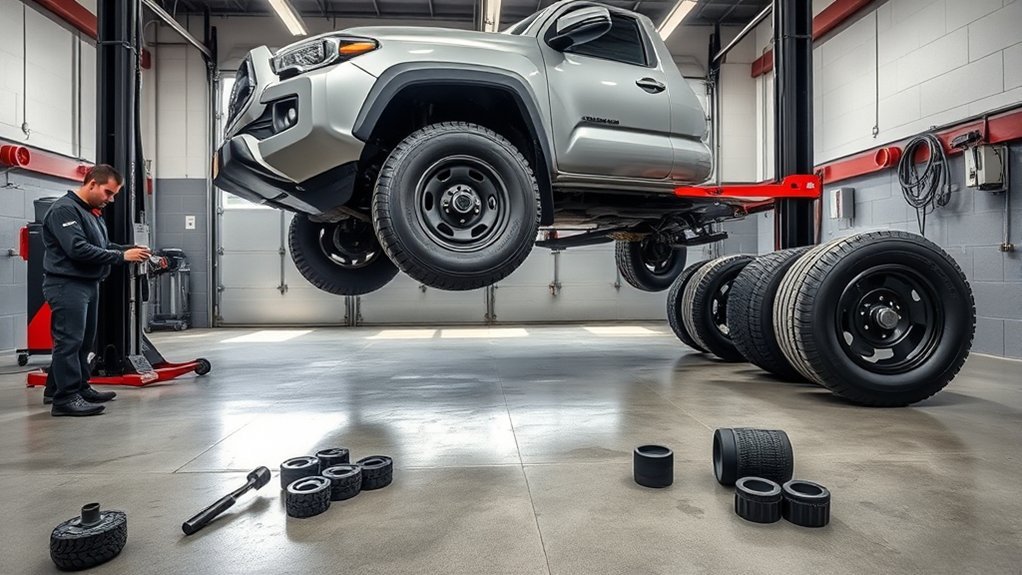
For most Toyota Tacoma owners, the practical Toyota Tacoma tire rotation interval is about every 5,000 miles or 6 months, whichever comes first. Confirm the exact interval and rotation pattern in your model-year Toyota maintenance guide and owner’s manual. Inspect and rotate sooner when towing, heavy payload, gravel or off-road use, or visible uneven wear accelerates tread wear.
Last updated: September 19, 2026 — interval, rotation-pattern, tread-safety, source, and schema guidance reviewed.
Quick Answer
Rotate your Toyota Tacoma tires about every 5,000 miles or 6 months, whichever comes first. Use the exact schedule in your model-year maintenance guide. Inspect and rotate sooner if towing, heavy payload, gravel or off-road use, or visible uneven tread wear is causing faster or irregular wear.
Key Takeaways
- Most Tacoma owners should plan tire rotation around the 5,000-mile or 6-month maintenance interval.
- Heavy towing, off-road use, rough roads, and uneven wear can justify earlier inspection and rotation.
- Use the rotation pattern shown for your exact Tacoma model year before relying on a generic 2WD or 4WD pattern.
- Vibration, pulling, cupping, feathering, or rapid edge wear may point to balance, alignment, suspension, or tire-pressure problems, not just rotation.
- If you rotate tires yourself, use jack stands, wheel chocks, approved jacking points, and the lug-nut torque listed for your Tacoma.
At a Glance
| Time Required | 30 to 60 minutes for a careful DIY rotation |
| Difficulty | Moderate, because the truck must be lifted safely |
| Tools Needed | Floor jack, jack stands, wheel chocks, lug wrench or breaker bar, torque wrench, tire-pressure gauge, and tire chalk |
| Cost | Often low if you already own the tools; shop pricing varies by location and service package |
Understanding the Importance of Tire Rotation for Your Tacoma
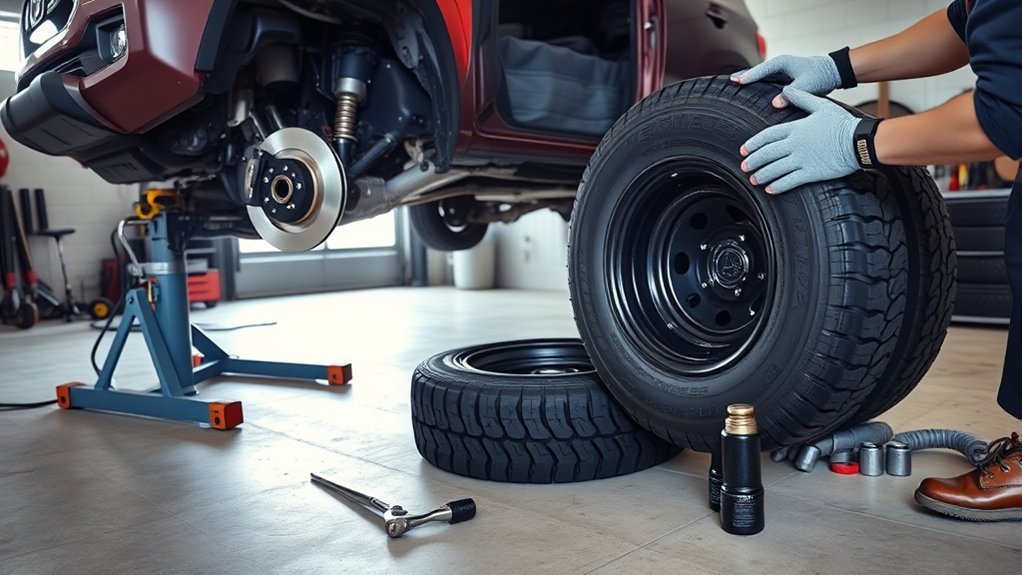
Your Tacoma’s tires do not wear at the same rate. Front tires handle steering and much of the braking load, while rear-tire wear can increase with acceleration, towing, or payload. Tire rotation moves tires between approved positions so those different wear loads are shared more evenly across the set.
Even wear helps your Tacoma track and brake more predictably and gives you regular opportunities to inspect tread depth, tire pressure, sidewall damage, punctures, and abnormal wear before a tire problem becomes more serious.
Toyota lists tire rotation as a regular scheduled maintenance item. Use the Toyota owner’s manual and maintenance guide for your exact model year because the interval, rotation diagram, tire setup, and service procedures can vary by vehicle and equipment.
A practical Tacoma routine is to rotate at the scheduled 5,000-mile service, then inspect sooner when towing, hauling, rough-road use, or abnormal tread wear increases the load on the tires.
How Often Should You Rotate Toyota Tacoma Tires?
For most Toyota Tacoma owners, plan on tire rotation every 5,000 miles or 6 months, whichever comes first. That interval aligns with regular Tacoma maintenance and creates a convenient point to check tire pressure, tread depth, brake condition, and abnormal wear.
You may also see general tire-industry recommendations in the 5,000-to-7,500-mile range. For a Tacoma, however, the exact model-year Toyota maintenance guide and the requirements of your tire warranty should take priority. If either calls for the shorter interval, follow the shorter interval.
Note: Four-wheel drive by itself does not create a universal 3,000-mile rotation schedule. Inspect more often when towing, carrying heavy loads, driving off-road or on rough surfaces, or when the tires show measurable uneven wear.
Use these timing rules to stay practical:
- Normal mixed driving: Rotate about every 5,000 miles or 6 months when that matches your model-year maintenance guide.
- Low-mileage driving: Use the time interval so the tires still receive regular inspection.
- Towing or heavy payload: Compare tread depth more often and rotate sooner if wear is becoming uneven.
- Off-road, gravel, or rough-road use: Inspect for cuts, punctures, chips, sidewall damage, and abnormal tread wear after demanding trips.
- New replacement tires: Follow the tire manufacturer’s required rotation schedule if it is shorter, especially when documentation is required for a treadwear warranty.
What Signs Mean Your Tacoma Tires Need Attention?
You do not have to wait for the odometer if the tires already show uneven wear. Compare all four tires. If one axle is wearing faster, one shoulder is disappearing more quickly, or the tread-depth difference is growing, the truck needs a tire inspection and may need an earlier rotation.
Common warning signs include:
- Uneven tread depth between front and rear tires
- Feathering or cupping across the tread blocks
- More road noise than usual on smooth pavement
- Steering vibration at certain speeds
- Pulling to one side while driving or braking
- Repeated low pressure in one tire
Rotation can redistribute normal wear, but it will not repair an underlying mechanical problem. Vibration can indicate wheel imbalance or tire damage. Pulling can result from tire pressure, alignment, brake, or suspension problems. Cupping can point to balance, shock, or suspension issues. If wear is severe or rapidly worsening, diagnose the cause instead of simply moving the tire to another corner.
[Amazon Products Picked for You]

1.Accurate and Efficient: Different colors on the bar represents different scopes, the red range on bar: 0 - 3/ 32; Yellow range on bar: 3/ 32 - 6/ 32; Green range on bar: 6/ 32 - 32/ 32, allowing you easy and fast to read and calibrated

1. Accurately measures tire tread depth gauge tool, Calibrated from 0 to 1 inch in 1/32 inch

Handy Pocket Clip
What Tire Rotation Pattern Should a Toyota Tacoma Use?
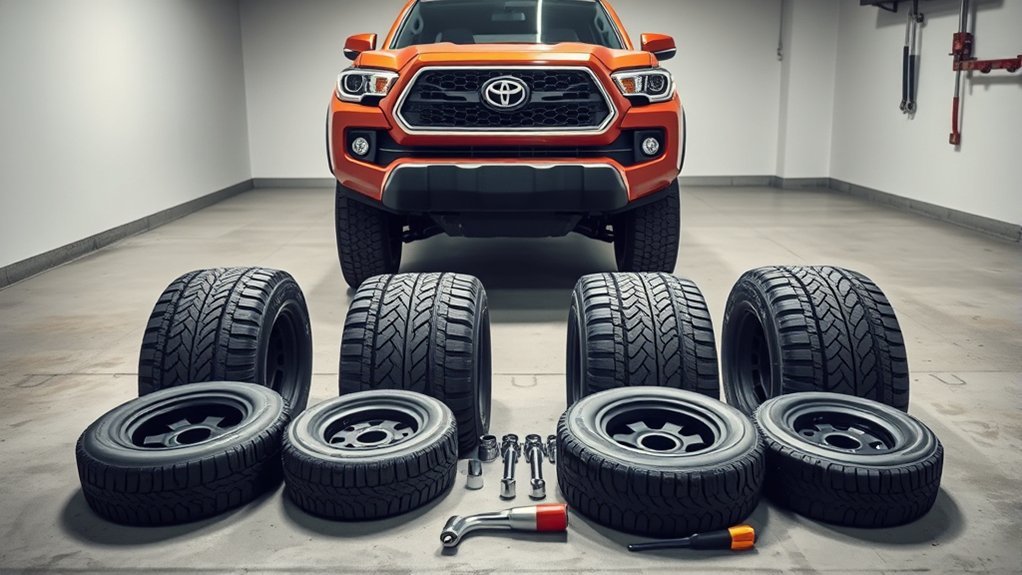
Use the rotation pattern shown in the owner’s manual for your exact Tacoma model year before relying on a generic 2WD or 4WD rotation chart. Then confirm that the pattern is compatible with the tires themselves. Directional markings, different front and rear sizes, wheel fitment, and spare-tire compatibility can restrict which positions a tire may occupy.
A practical decision order is: Toyota model-year instructions first, tire directionality second, tire and wheel sizing third, spare compatibility fourth, and tire-manufacturer requirements throughout. Do not select a pattern from drivetrain alone.
| Tacoma or tire setup | Pattern to use | Rule to follow |
| Your model-year Toyota manual shows a specific rotation diagram | Follow Toyota’s illustrated pattern | The vehicle-specific instructions take priority over a generic drivetrain chart. |
| Directional tires | Normally front-to-rear on the same side | Keep the direction arrow pointing correctly. Do not cross a mounted directional tire unless it is properly remounted and the applicable instructions allow it. |
| Same-size, non-directional tires | Use the model-year manual-approved pattern | A rearward cross, X-pattern, or same-side front-to-rear movement may be specified or permitted depending on the applicable vehicle and tire instructions. Do not choose from 2WD or 4WD alone. |
| Different front and rear tire sizes | Side-to-side only, if permitted | Do not move a tire to the other axle when the front and rear sizes or wheel requirements are different. |
| Matching full-size spare | Five-tire rotation only when approved | Include the spare only when it is compatible with the road tires and the vehicle or tire instructions provide an appropriate five-tire procedure. |
Pro Tip: Mark each tire with chalk before removal, such as LF, RF, LR, and RR. That simple step prevents confusion once wheels start moving between positions.
Never include a temporary or mismatched spare in a normal tire rotation. If your Tacoma uses aftermarket wheels, oversized tires, a modified suspension, or a non-standard tire setup, confirm the permitted pattern before moving the tires.
What Happens If You Skip Tacoma Tire Rotations?
Skipping rotations can allow one pair or one corner to wear much faster than the others. The result can include more road noise, rougher ride quality, reduced wet traction, and premature tire replacement.
Uneven tread depth can also change braking feel, steering response, and traction. On a 4WD truck, maintaining a reasonably matched tire set is especially useful because large differences in rolling circumference can be undesirable for drivetrain operation. Rotation helps control wear differences, although proper inflation, alignment, balance, and tire condition also matter.
There is also a warranty reason to keep a consistent schedule. Some tire treadwear warranties require documented rotations. Keep service receipts, dates, mileage, and tread records when your tire warranty requires them.
DIY Tacoma Tire Rotation: Safety Checks Before You Start
You can rotate Tacoma tires at home if you have suitable lifting equipment, a flat work area, and the correct model-year service information. This interval guide focuses on when to rotate. For the complete procedure, pattern considerations, and lifting workflow, see how to rotate tires on a Toyota Tacoma.
Warning: Never rely on a floor jack alone. Work on a flat surface, set the parking brake, chock the wheels as appropriate for the lifting procedure, use properly rated jack stands, and follow the approved jacking and support points in your Tacoma owner’s manual.
[Amazon Products Picked for You]

Pair of 3 Ton (2.7 metric Ton) jack stands with 6,000-pound capacity

Practical Function: These jack pads create a flexible buffer between jacks and the vehicle chassis, helping absorb and distribute pressure evenly. They keep the metal parts of the jack from directly contacting the chassis, which helps protect against scratches or damage
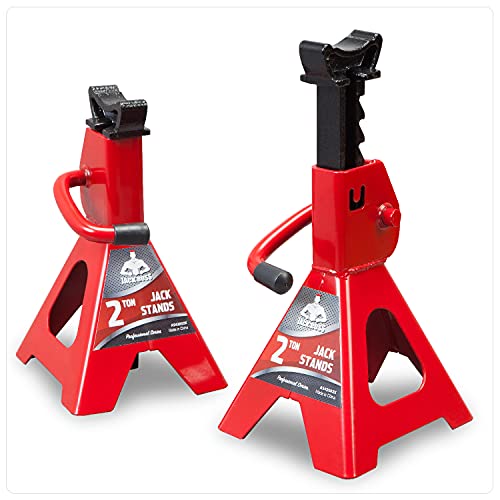
Specifications:2 ton (4,000 lb) capacity for single jack stand; Lifting range from min 9.8 " to max 15"; Net weight: 10.5 lb, which suitable for most 2 Ton Low profile autos, not recommendable for Pick-Up, Truck, too big SUVs etc. whose automobile chassis higher than 15".
Essential Tools Needed
Typical equipment includes a properly rated floor jack and jack stands, wheel chocks, a lug wrench or breaker bar, a torque wrench, a tire-pressure gauge, and tire-marking chalk. Confirm that your equipment has adequate capacity and lifting range for the truck before beginning.
Checks To Make Before Rotating
Before removing a wheel, confirm the rotation pattern for your exact model year, check the tire sidewalls for directional arrows and size differences, identify the approved lifting points, and verify the wheel-nut torque and tire-pressure information for your truck. Inspect each tire for punctures, sidewall damage, abnormal tread wear, and tread depth while the wheels are accessible.
After installation, hand-start the lug nuts to avoid cross-threading, tighten them using the proper sequence and model-year torque specification, and set cold tire pressure to the driver-side door-jamb placard. Do not substitute the maximum pressure molded into the tire sidewall for the vehicle’s specified pressure.
Safety Precautions To Follow
Before driving, confirm that every wheel is secure, all tools and supports have been removed, tire pressures are correct, and there is no interference between the tires, suspension, and body. Follow any wheel- or tire-manufacturer guidance on a post-service torque recheck.
If a tire-pressure warning remains after rotation, first verify all tire pressures when cold. Then follow the model-year Toyota instructions for any TPMS/TPWS initialization, relearn, or tire-position identification procedure. Do not assume the process is identical across Tacoma generations and equipment packages.
When to Seek Professional Help for Tire Rotation?
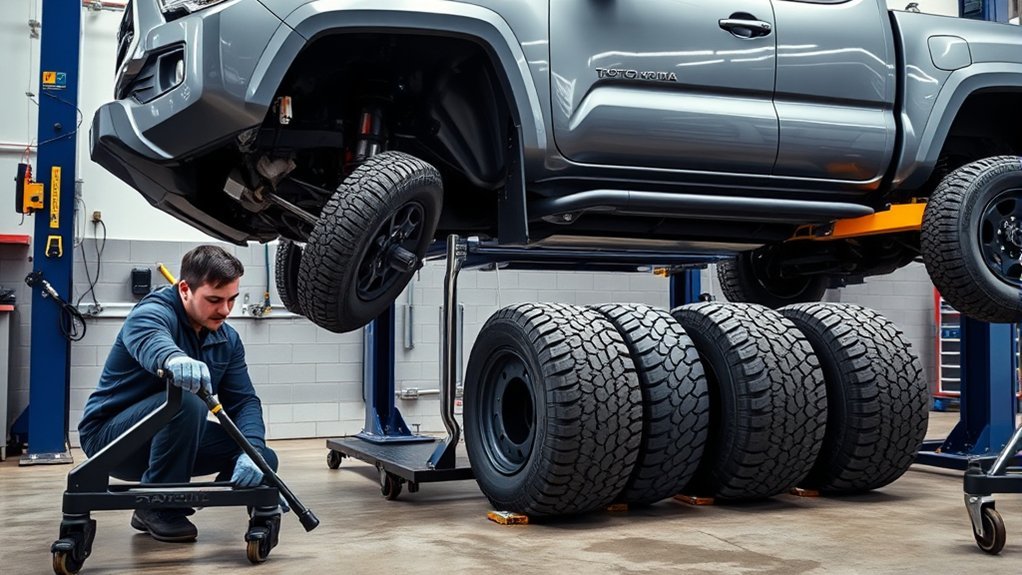
Choose professional service if you are unsure which pattern applies, do not have safe lifting equipment, or see abnormal tire wear. A technician can rotate the tires while also checking wheel balance, brakes, suspension condition, tire damage, and signs that an alignment inspection is needed.
Professional help is also sensible when your Tacoma has oversized tires, aftermarket wheels, a lift kit, a matching full-size spare, beadlock-style wheels, or tire-pressure sensor issues. Non-standard setups can change the equipment or procedure required for safe service.
Ask the shop to record the mileage, rotation pattern, tread depth, and tire pressures. Those records make it easier to track wear and may help document compliance with a tire warranty.
Essential Practices for Tire Care Beyond Rotation
Tire rotation works best when combined with correct inflation, tread-depth monitoring, wheel-balance and alignment attention, and regular damage inspections. Rotation cannot compensate for a leaking tire, incorrect pressure, damaged suspension component, or persistent alignment problem.
Regular Tire Pressure Checks
NHTSA TireWise recommends checking tire pressure and tread regularly. Check Tacoma tire pressure at least monthly and before long trips, using the pressure listed on the driver-side door-jamb placard or the applicable Toyota instructions rather than the maximum pressure molded into the tire sidewall.
Measure pressure when the tires are cold. Underinflation can increase heat and accelerate shoulder wear, while excessive pressure can affect ride quality and contribute to an undesirable wear pattern. A tire that repeatedly loses pressure needs diagnosis rather than repeated topping off.
Tread Depth Monitoring
Use a tread-depth gauge for the clearest measurement. As a quick check, NHTSA describes the penny test: place a penny into the tread with Lincoln’s head upside down. If the top of Lincoln’s head remains visible, the tire is at or below approximately 2/32 inch and should be replaced.
NHTSA says tires should be replaced when tread reaches 2/32 inch; legal requirements can vary by jurisdiction. For wet-road safety, AAA recommends planning replacement earlier, at about 4/32 inch.
That 4/32-inch recommendation is supported by measurable wet-road performance. In AAA testing, the light truck fitted with all-season tires worn to 4/32 inch needed an average 86 additional feet to stop on wet pavement compared with the same test using new tires.
Also compare measurements across each tire. Inner-edge wear can point toward alignment problems, center-heavy wear can be associated with excessive inflation, shoulder wear can be associated with low pressure or operating conditions, and cupping can indicate balance, shock, suspension, or other mechanical issues that need diagnosis.
Seasonal Tire Adjustments
Temperature changes affect tire pressure, so recheck cold pressures as seasons change. If you use a separate set of winter tires, keep rotation records for that set as well so each tire’s position and tread wear remain easy to track.
Drivers who regularly encounter snow, mud, gravel, sharp rocks, or rough trails should inspect tread and sidewall condition more frequently than drivers who stay on smooth pavement. The appropriate tire type and replacement threshold also depend on the conditions in which the truck must maintain traction.
Frequently Asked Questions
How often should I rotate tires on my Toyota Tacoma?
Most Tacoma owners should plan tire rotation around every 5,000 miles or 6 months, whichever comes first, when that matches the model-year Toyota maintenance guide. Inspect sooner when towing, heavy payload, rough-road use, or abnormal wear accelerates tread wear.
What does Toyota recommend for tire rotation?
Toyota lists tire rotation as a regular maintenance item. Use the Warranty & Maintenance Guide and owner’s manual for your exact Tacoma model year because the schedule, rotation diagram, and service procedures can vary by vehicle and equipment.
Is it okay to rotate Tacoma tires every 10,000 miles?
A 10,000-mile interval is too long when your Tacoma maintenance guide or tire warranty calls for rotation at 5,000-mile intervals. Following the shorter specified interval also gives you more frequent opportunities to identify pressure loss and abnormal wear.
What is the best tire rotation pattern for a Toyota Tacoma?
Use the rotation pattern shown in the owner’s manual for your exact Tacoma model year first. Directional tires normally stay on the same side and move front to rear, while equal-size non-directional tires may use another Toyota- or tire-manufacturer-approved pattern. Do not select a pattern from 2WD or 4WD alone.
Does 4WD change the Toyota Tacoma tire rotation interval?
Four-wheel drive by itself does not create a universal shorter rotation interval. Follow the schedule for your exact model year and inspect sooner when towing, heavy payload, off-road use, rough roads, or measured uneven wear increases tire stress.
Should I include the Tacoma spare tire in the rotation?
Include a spare only when it is a compatible full-size tire and the vehicle or tire instructions approve an appropriate five-tire rotation. Do not include a temporary or mismatched spare in a normal rotation.
Can tire rotation fix vibration or pulling?
Rotation may redistribute minor normal wear, but persistent vibration can indicate wheel imbalance, tire damage, or a wheel problem. Pulling can result from tire pressure, alignment, brake, tire, or suspension issues. Diagnose persistent symptoms instead of relying on rotation alone.
Conclusion
For most Toyota Tacoma owners, the simplest rotation routine is to use the model-year maintenance guide as the authority and plan around 5,000 miles or 6 months when that is the listed interval. Inspect sooner when towing, heavy loads, rough surfaces, or uneven wear demands it. For the rotation pattern, follow the exact Toyota diagram before applying a generic drivetrain rule, then confirm tire directionality, sizing, spare compatibility, pressure, and any TPMS/TPWS procedure. Consistent inspections and rotations help keep the tire set wearing more evenly while making mechanical or tire problems easier to catch early.
Sources
- Toyota 2026 Tacoma Warranty & Maintenance Guide — supports Tacoma scheduled maintenance and tire-rotation service guidance.
- Toyota Owners Manuals and Warranties — supports checking the exact model-year owner’s manual and maintenance guide.
- NHTSA TireWise — supports monthly pressure and tread checks, treadwear indicators, 2/32-inch replacement guidance, and the penny test.
- Bridgestone Tire Rotation Guide — supports common rotation patterns and tire-configuration considerations.
- Michelin Tire Rotation Guide — supports directional-tire handling and manufacturer-first rotation guidance.
- AAA Worn Tire Safety Research — supports 4/32-inch wet-weather replacement planning and the light-truck wet-stopping-distance comparison.
