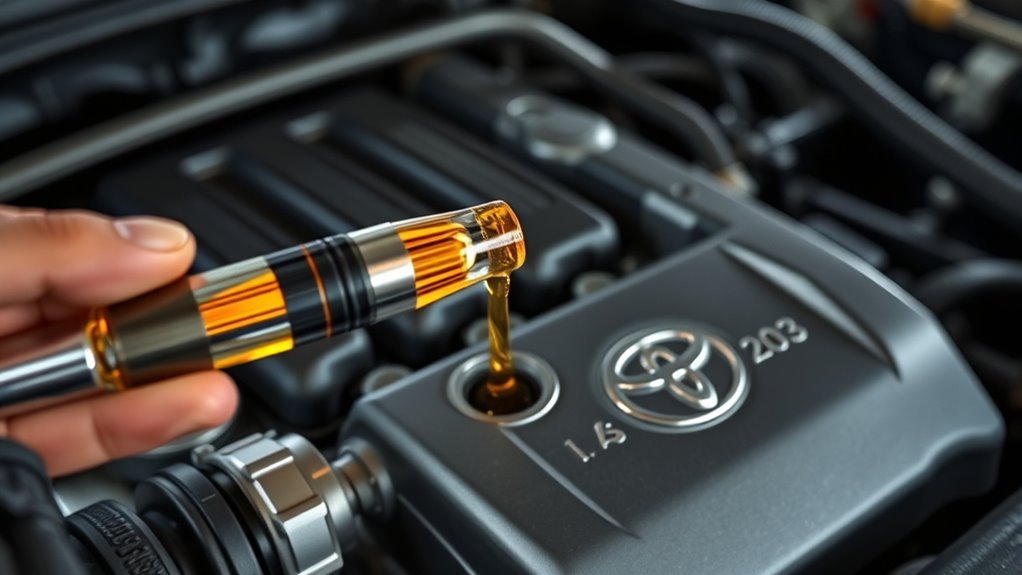
The 2024 Tacoma oil dipstick full mark tells you the highest recommended engine oil level, not how much oil to pour in every time you check it. Knowing how to read the dipstick helps you avoid both low oil and overfilling. This guide explains Toyota’s oil-level marks, the correct checking procedure, and what to do when the reading looks wrong.
Quick Answer
On a 2024 Toyota Tacoma, the engine oil should sit between the low mark and the refill upper limit mark on the dipstick. Toyota specifies approximately 1.5 quarts between these marks. Check the oil on level ground after warming the engine and allowing it to settle. Never add oil above the upper mark.
Last checked: September 26, 2026. Key specifications were verified against Toyota’s official documentation.
At a Glance
| Difficulty | Beginner |
| Tools Needed | Clean rag and dipstick; clean funnel if adding oil |
| Recommended Oil | SAE 0W-20, ILSAC GF-6A |
What the Tacoma Dipstick Full Mark Means
The Tacoma dipstick has two important reference points: the low level mark and the refill upper limit mark. Oil should remain between them.
The upper mark represents the maximum recommended refill level. It is not a target you should exceed to provide extra lubrication.
- Below the lower mark: Add the correct engine oil.
- At or near the lower mark: Toyota recommends adding oil.
- Between the marks: The oil level is within the specified range.
- Above the upper mark: Recheck the reading using the correct procedure. If it remains high, contact a Toyota dealer.
Maintaining the correct oil level helps the engine lubricate its moving parts and control heat. Too little oil can increase wear, while excessive oil can interfere with normal engine operation.
How to Check Tacoma Oil Correctly
For a reliable reading, park on level ground, warm the engine, shut it off, and allow the oil to return to the oil pan.
Toyota’s 2024 Tacoma manual recommends waiting about five minutes during a routine oil check. Its specifications section recommends about eight minutes when checking the level after refilling.
Level Ground Check
Parking on a slope can change where the oil sits inside the oil pan. That may produce a reading that is higher or lower than the actual level.
Follow this sequence:
| Step | Action |
|---|---|
| 1 | Park on level ground. |
| 2 | Warm the engine, switch it off, and allow the oil to settle. |
| 3 | Remove the dipstick and wipe it clean. |
| 4 | Reinsert the dipstick completely. |
| 5 | Remove it again and read the oil level. |
Keep the engine off while checking. Avoid touching hot engine components.
Cold or Warm?
Toyota’s specified procedure uses a warmed engine that has been switched off long enough for the oil to settle.
A cold, overnight reading can provide a useful comparison, but it should not replace the manufacturer’s recommended method when the result appears unusual.
This matters because oil temperature and the amount of oil remaining in engine passages affect the dipstick reading.
If a cold reading looks unexpectedly high or low, repeat the check after warming the engine and following Toyota’s specified waiting period.
Dipstick Reading Steps
Once the truck is properly parked and the engine has settled, use the following procedure.
- Locate the engine oil dipstick in the engine compartment.
- Pull it out while holding a clean rag beneath the end.
- Wipe the dipstick completely clean.
- Insert it fully into the dipstick tube.
- Pull it out again and inspect the oil level.
- Compare the reading with the low and refill upper limit marks.
- Return the dipstick fully to its tube.
If oil is smeared along one side of the dipstick, wipe it again and repeat the reading. Look for a consistent oil boundary rather than a streak.
Do not confuse the oil dipstick with the transmission fluid system or other engine-compartment components.
Why Cold and Warm Oil Read Differently
Cold and warm oil can produce different dipstick readings because temperature affects oil volume and how quickly it flows back into the pan.
Oil expands as it warms. However, the amount remaining in engine passages immediately after shutdown can also affect the reading.
This is why checking immediately after driving may give a different result from checking after the engine has settled.
There is another issue on the 2024 Tacoma: Toyota explains that repeated short trips without fully warming the engine can allow moisture or unburned fuel to mix with the oil.
That can cause the indicated oil level to rise. A high reading is therefore not always the result of adding too much oil.
If the level remains above the refill upper limit after a proper warm-engine check, Toyota recommends contacting a dealer.
How Much Oil the 2024 Tacoma Takes
The 2024 Tacoma’s 2.4-liter turbocharged engine has a listed drain-and-refill capacity of 5.9 US quarts with an oil filter change.
Without changing the filter, the reference quantity is 5.6 US quarts. These figures come from the 2024 Toyota Tacoma owner’s manual, pages 525–526 and 615.
The listed capacity is a service reference. It does not mean you should automatically pour that amount into an engine that already contains oil.
Oil Capacity Specs
| Specification | 2024 Tacoma |
|---|---|
| Oil capacity with filter | 5.9 US qt. (5.6 L) |
| Oil capacity without filter | 5.6 US qt. (5.3 L) |
| Low-to-upper dipstick range | Approximately 1.5 US qt. (1.4 L) |
| Recommended viscosity | SAE 0W-20 |
| Oil specification | ILSAC GF-6A |
Toyota allows SAE 5W-20 if 0W-20 is unavailable, but specifies returning to 0W-20 at the next oil change.
Dipstick Fill Range
The difference between the Tacoma’s low and upper dipstick marks is approximately 1.5 quarts.
This is separate from the engine’s total refill capacity.
For example, if the oil level is near the low mark, adding the full 5.9-quart service quantity would severely overfill an engine that already contains oil.
Instead, add small amounts and monitor the dipstick until the level returns to the proper range.
What Causes an Overfilled Oil Reading?
A high reading may indicate actual overfilling, an incorrect checking procedure, or oil-level changes caused by operating conditions.
Check the simplest possibilities first:
- Too much oil added: The quantity poured in exceeded what the engine needed.
- Oil on the dipstick tube: Residual oil creates a misleading smear.
- Uneven parking: The truck’s angle changes the apparent level.
- Incorrect checking time: The oil has not settled consistently.
- Short-trip operation: Moisture or unburned fuel may contribute to a rising oil level.
- Incorrect dipstick: An unsuitable replacement can give inaccurate readings.
During an oil change, incomplete drainage can also affect how much new oil the engine accepts.
Warning: Do not drive with a persistently overfilled engine or ignore a low oil pressure warning. Excessive oil can damage the engine. If the oil pressure warning appears, stop safely and contact a Toyota dealer.
How Much Oil to Add When It’s Low
When the oil reaches or falls below the low mark, add enough to restore it to the specified range.
Toyota lists approximately 1.5 quarts between the two dipstick marks. That does not mean every low reading requires the entire amount.
Use this approach:
- Confirm the reading using the proper checking procedure.
- Remove the engine oil filler cap.
- Add the correct oil through a clean funnel.
- Begin with a small amount, such as 1/4 quart.
- Allow the oil to settle and recheck the dipstick.
- Repeat as needed without exceeding the upper mark.
- Secure the filler cap when finished.
If the level is repeatedly low between oil changes, inspect for leaks and arrange a professional inspection.
Why Tacoma Dipstick Readings Can Be Off
Inconsistent readings usually come from checking under different conditions rather than an immediate mechanical failure.
Temperature, parking angle, residual oil, and the time since shutdown can all change the apparent level.
For a useful comparison, perform repeated checks under the same conditions. A reading taken after a warm engine has settled is more meaningful than comparing a cold morning reading with one taken immediately after driving.
After an oil change, remember that the new filter must fill with oil during initial operation. Recheck the level after the engine has run, been switched off, and settled.
If the dipstick consistently shows an unexpected level despite following the correct procedure, have the oil quantity and dipstick installation checked.
Tacoma Oil Change Tips From Owners
Some Tacoma owners prefer changing oil every 3,000–4,000 miles, particularly on turbocharged engines. That is an owner-selected maintenance practice, not Toyota’s standard factory interval.
Toyota’s 2024 Tacoma warranty and maintenance guide lists oil and filter replacement at 10,000 miles or 12 months under normal conditions.
For specified special operating conditions, including primary use on dirt or dusty roads, the guide calls for oil and filter replacement at 5,000 miles or six months.
Practical oil-change habits include:
- Confirm the correct oil specification before starting.
- Replace the filter as required by the service schedule.
- Use the correct filter installation procedure.
- Check the drain plug and filter area for leaks after service.
- Verify the final oil level using the dipstick.
- Keep records of oil and filter changes.
Some owners prefill replacement oil filters to reduce the time needed to establish oil flow. However, filter designs and installation positions differ. Follow the applicable filter instructions rather than assuming prefilling is required.
Use the correct filter installation procedure, then verify the oil level and check for leaks after service.
Toyota also recommends resetting the oil maintenance reminder after replacing the oil.
What Toyota Says About Oil Level Marks
Toyota specifies that the oil level must remain between the low mark and the refill upper limit mark.
The service capacity is only a reference quantity. The dipstick determines whether the actual refill is correct.
The distinction is especially useful after an oil change, when retained oil and drainage conditions may affect the amount needed.
Toyota also warns against overfilling and recommends checking the oil level regularly.
Its general engine oil maintenance guidance explains that oil supports lubrication and temperature control, while neglected or deteriorated oil can increase engine wear.
For your Tacoma, follow the specified checking procedure and treat an unexpected dipstick reading as something to investigate rather than immediately adding more oil.
Frequently Asked Questions
What Is the Average Lifespan of a 2003 Toyota Tacoma?
A well-maintained 2003 Tacoma can reach 200,000–300,000 miles, but that range is not a verified average for the 2003 model year. Actual lifespan depends on maintenance history, rust, driving conditions, and previous repairs. Broader Tacoma lifespan research from iSeeCars provides a model-wide comparison rather than a 2003-specific result.
How Full Is Too Full on an Oil Dipstick?
Any consistent reading above the refill upper limit mark is too high. Confirm it by warming the engine, parking on level ground, and allowing the oil to settle. If the reading remains above the mark, contact a Toyota dealer rather than continuing to add oil.
How Far Can a Tacoma Go on Empty?
There is no guaranteed distance. The original estimate of 30–50 miles depends heavily on driving conditions. Toyota’s 2024 manual states that the low-fuel warning appears when approximately 2.7 gallons or less remain. Refuel promptly rather than relying on a calculated reserve.
Is It Okay to Go Over 5,000 Miles Between Oil Changes on a Toyota?
Yes, when the vehicle’s maintenance schedule permits it. The 2024 Tacoma has a normal oil-change interval of 10,000 miles or 12 months. Specified special operating conditions require shorter intervals. Some owners choose 5,000–7,500 miles voluntarily, but the correct schedule depends on the vehicle and its use.
Why Is My Tacoma Oil Above Full After an Oil Change?
The engine may have received too much oil, or the reading may be affected by checking conditions. Repeat the measurement on level ground after warming the engine and allowing it to settle. If the level remains above the upper limit, have the excess oil and possible causes checked.
Does the Oil Pressure Warning Light Tell Me When Oil Is Low?
No. The oil pressure warning indicates excessively low engine oil pressure, not a routine dipstick-level measurement. A dangerously low oil level is one possible cause. If the warning appears, stop the vehicle safely and contact a Toyota dealer. Check oil quantity separately with the dipstick.
Conclusion
The 2024 Tacoma oil dipstick full mark is the upper limit of the correct operating range, not a reason to add more oil.
Use Toyota’s recommended checking procedure, keep the level between the marks, and remember that the 5.9-quart refill capacity is a service reference rather than a topping-off quantity.
If the reading remains unusually high or low after a proper check, investigate it before driving further.
Sources
- Toyota 2024 Tacoma Owner’s Manual: Oil-checking procedure, dipstick marks, oil quantities, viscosity, and warning-light guidance.
- Toyota 2024 Tacoma Warranty and Maintenance Guide: Factory service intervals and special operating conditions.
- Toyota Engine Oil Maintenance Guidance: Oil condition, maintenance, and engine protection.
- iSeeCars Tacoma Lifespan Research: Broader model-level longevity information.
