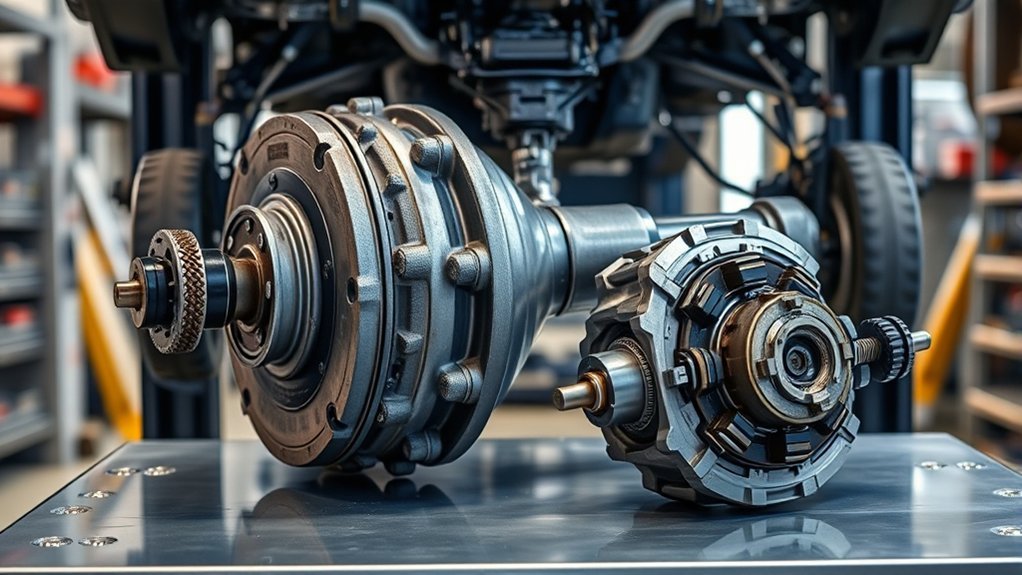
For a Toyota Tacoma, a limited-slip-style traction system and a locking differential solve different problems. Toyota Auto LSD uses electronic brake intervention rather than a conventional mechanical limited-slip differential, while a selectable rear locker connects the rear axle shafts so both rear wheels rotate together. For pavement, gravel, rain, and mild traction loss, normal traction control or Auto LSD is usually easier to live with. For rocks, deep ruts, mud, and wheel lift, a rear locker provides a stronger low-speed traction advantage. A Tacoma Limited’s locking center differential is a separate system that manages front-to-rear driveline traction. The right setup depends on model year, trim, drivetrain, and terrain.
Last updated: September 19, 2026.
Quick Answer
For pavement, gravel, and mild traction loss, Tacoma’s normal traction systems or Auto LSD are usually easier to live with because they preserve normal differential action. Choose an electronic rear locker when you regularly face cross-axle ruts, rocks, deep mud, or wheel lift. Do not confuse Toyota Auto LSD with a mechanical limited-slip differential, and verify equipment and operating procedures by model year and trim.
Key Takeaways
- Toyota Auto LSD is an electronic traction aid and should not automatically be described as a mechanical limited-slip differential.
- A rear locker forces both rear axle shafts to rotate together, which gives you a major advantage when one tire has little grip or leaves the ground.
- A locking center differential connects the front and rear driveline paths. It does not lock the two rear wheels together.
- A rear locker is not limited to 4WD Tacomas. Toyota offers one on the rear-wheel-drive TRD PreRunner.
- Always confirm the equipment and operating restrictions for your exact model year, powertrain, and trim.
What Are Open, Limited-Slip, and Locking Differentials?
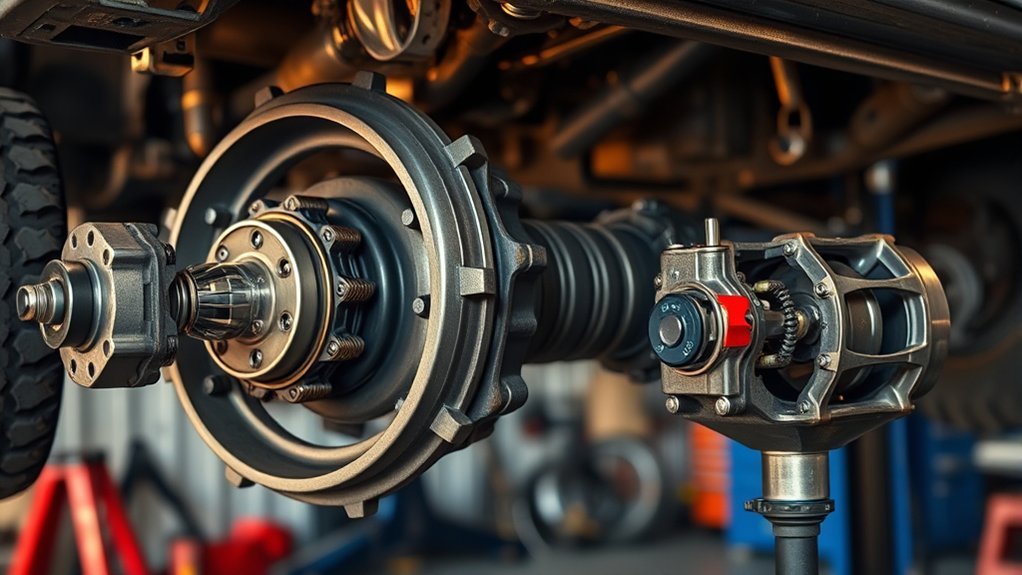
A differential lets the left and right wheels on an axle rotate at different speeds. That speed difference is necessary during a turn because the outside tire travels farther than the inside tire.
Open Differential
An open differential provides smooth, predictable operation on normal roads. It allows unrestricted side-to-side wheel-speed differences, which reduces binding and tire scrub during turns.
Its weakness appears when one tire has much less traction than the other. The available torque at both wheels becomes limited by the tire with less grip, so that tire may spin while the tire on firmer ground does little to move the truck.
Mechanical Limited-Slip Differential
A mechanical limited-slip differential still allows the rear wheels to rotate at different speeds, but it resists an excessive speed difference. Depending on the design, it may use clutch plates, gears, cones, or a viscous coupling to bias more usable torque toward the tire with better traction.
An LSD works smoothly without requiring you to press a locker switch. That makes it useful for street driving, wet roads, graded dirt, towing launches, and mild trails. However, it does not create the same solid axle connection as a fully locked differential.
Some mechanical LSDs also lose much of their advantage when one tire is completely unloaded or off the ground. Performance depends on the design, preload, wear, lubricant, and available traction.
Toyota Auto LSD
Toyota’s Auto LSD name can create confusion. On applicable Tacoma configurations, Auto LSD is an electronic traction function rather than proof that the rear axle contains a clutch-type or gear-type mechanical LSD.
The system uses wheel-speed information and controlled brake application to reduce excessive rear-wheel spin. Applying the brake to a spinning wheel creates resistance that can help the open differential deliver more usable drive to the other side.
Auto LSD activation behavior varies by Tacoma generation and drive mode. Some applications require a driver-selected traction-control setting before Auto LSD operates, so use the owner’s manual for your exact year and drivetrain. Because the system uses the brakes, prolonged intervention can generate heat and may temporarily reduce assistance.
Locking Rear Differential
A locking rear differential connects the left and right rear axle shafts so both rear wheels rotate at the same speed. This prevents one rear tire from spinning rapidly while the other remains nearly stationary.
The main benefit is not a guaranteed fixed torque percentage at each tire. The defining mechanical effect is that the axle shafts remain locked to the same rotational speed, allowing each tire to use whatever traction is available beneath it.
Toyota describes the current Tacoma’s electronically activated rear locker as splitting power evenly between the rear wheels when traction is extremely limited. The feature is designed for low-speed obstacles and loose or uneven terrain, not routine cornering on dry pavement.
Locking Center Differential
A locking center differential performs a different job. It links the front and rear driveline outputs in a full-time 4WD system, helping prevent one axle from receiving most of the available rotation when traction differs between the front and rear.
A center lock does not lock the left and right rear wheels. A Tacoma can therefore have a locking center differential without having a locking rear differential.
Tacoma Limited-Slip vs Locking Differential: Key Differences
| System | How It Works | Best Use | Main Limitation |
|---|---|---|---|
| Open differential | Allows unrestricted left-to-right wheel-speed differences. | Normal road driving and easy turns. | One low-traction tire can limit usable drive at both wheels. |
| Mechanical LSD | Resists excessive wheel-speed differences while still permitting turns. | Mixed street use, rain, graded roads, and mild trails. | May provide limited help when one tire has almost no load. |
| Toyota Auto LSD | Uses electronic brake control to reduce rear-wheel spin. | Daily driving, loose surfaces, and moderate traction loss. | Operation varies by generation and drive mode, and prolonged brake intervention can create heat. |
| Electronic rear locker | Locks both rear axle shafts to the same speed. | Rocks, ruts, deep mud, wheel lift, and uneven climbs. | Restricts normal differentiation and should not remain locked during high-traction turns. |
| Locking center differential | Locks the front and rear driveline paths together. | Loose surfaces where front-to-rear traction differs. | Does not lock the two rear wheels together. |
[Amazon Products Picked for You]

Designed for efficient, consistent performance and manufactured using only the highest quality materials

✅ Enhanced Traction & Stability – Differential Locker ensures power is evenly distributed to both wheels, preventing wheel spin and improving off-road, towing, and daily driving performance.

Compatible with the Toyota OEM style light switch (1.28" x 0.87", 33 x 22mm)
Daily Driving and Wet Roads
Auto LSD or a properly functioning mechanical LSD is generally easier to live with during daily driving. You can turn normally, change lanes smoothly, and use the available traction assistance without engaging a solid axle lock.
A selectable rear locker should remain disengaged during routine paved driving. Locking the rear axle while turning on a high-grip surface can cause tire scrub, steering resistance, driveline windup, and added stress on axle components.
Snow and Ice
Your tires usually affect snow and ice performance more than the differential alone. Winter-rated tires can provide braking and steering grip that no differential can create.
Auto LSD can help when one rear tire begins spinning, while 4WD and Active Traction Control can improve forward motion on equipped trucks. A rear locker may help at very low speed in deep snow or when the truck is stuck, but it can also make the rear of the truck slide sideways more easily if both tires lose lateral grip.
Ruts, Rocks, and Wheel Lift
A rear locker provides its clearest advantage when one rear tire becomes lightly loaded or leaves the ground. Because both rear axle shafts rotate together, the tire still touching the ground can continue pushing the truck.
An open differential may spin the airborne tire. Auto LSD may improve the situation by braking that tire, but its response is not identical to a physical lock. A mechanical LSD may also need some resistance at the unloaded tire before it can bias useful torque to the other side.
Which Differential Does Your Tacoma Have?
Tacoma differential equipment varies by generation, trim, drivetrain, powertrain, package, and market. Do not assume that every TRD model has the same axle or that every system labeled “LSD” contains mechanical limited-slip hardware.
Toyota’s fourth-generation launch documentation states that rear-wheel-drive Tacomas use Auto LSD, while four-wheel-drive models combine Auto LSD with Active Traction Control. It also lists an electronic locking rear differential on TRD PreRunner, TRD Off-Road, TRD Pro, and Trailhunter grades.
Auto LSD and A-TRAC are therefore not interchangeable names. Toyota lists them as separate traction functions on fourth-generation 4WD Tacomas. Their availability and operating modes still depend on model year and configuration.
The current 2026 Toyota Tacoma overview specifically lists an electronically controlled locking rear differential on the TRD PreRunner. That matters because the TRD PreRunner is rear-wheel drive, proving that a Tacoma rear locker is not automatically limited to 4WD models.
The Tacoma Limited requires extra attention. Toyota’s 2026 Tacoma information states that Limited trims feature full-time 4WD with an electronic locking center differential. That center lock is separate from the electronic rear locker used on trail-focused grades.
Fourth-Generation Tacoma Differential System Map
| Toyota Reference | Configuration | Differential / Traction System |
|---|---|---|
| 2024 launch documentation | Rear-wheel drive | Auto LSD |
| 2024 launch documentation | Four-wheel drive | Auto LSD plus Active Traction Control (A-TRAC) |
| 2024 launch documentation | TRD PreRunner, TRD Off-Road, TRD Pro, Trailhunter | Electronic locking rear differential |
| Current 2026 lineup | TRD PreRunner | Electronically controlled locking rear differential |
| 2026 Toyota newsroom | Limited trims | Full-time 4WD with electronic locking center differential |
Note: Toyota can change standard and optional equipment between model years. Confirm your truck through its window sticker, build sheet, VIN-specific owner information, dashboard controls, and the correct owner’s manual.
How to Identify Your Tacoma Differential
- Check the original window sticker or build sheet. Look for “electronic locking rear differential,” “Auto LSD,” “full-time 4WD,” or “locking center differential.”
- Inspect the dashboard controls. A rear differential lock switch indicates a selectable rear locker, but its location and symbol vary by model year.
- Read the correct owner’s manual. Use Toyota’s manuals and warranties portal and select the exact year and model.
- Check the axle and differential housing. An electronic locker normally has wiring and an actuator attached to the differential housing.
- Ask a Toyota dealer to verify the VIN. This is useful when a used truck has been modified or its original paperwork is missing.
Key Benefits of Limited-Slip and Auto LSD Systems for Tacoma Owners
A mechanical LSD or Toyota Auto LSD provides traction assistance without keeping the rear axle fully locked. That balance makes these systems suitable for commuters, tow vehicles, wet roads, gravel, boat ramps, and occasional trail use.
A mechanical LSD reacts through its internal friction or gearing. Auto LSD reacts through electronic brake control. Both can reduce uncontrolled wheelspin, but they do so through different hardware and may feel different from the driver’s seat.
Auto LSD is useful for everyday traction, but it is not a substitute for the solid axle connection a rear locker provides during severe cross-axle traction loss.
These systems also preserve normal left-to-right wheel-speed differences while cornering. You avoid the tire scrub and driveline binding associated with leaving a rear differential locked on a high-traction surface.
The tradeoff is ultimate off-road capability. When one rear tire is suspended in the air or resting on an extremely slippery surface, a selectable locker generally provides a more direct and dependable connection between the engine and the tire that still has traction.
Benefits of a Locking Differential for Off-Roading
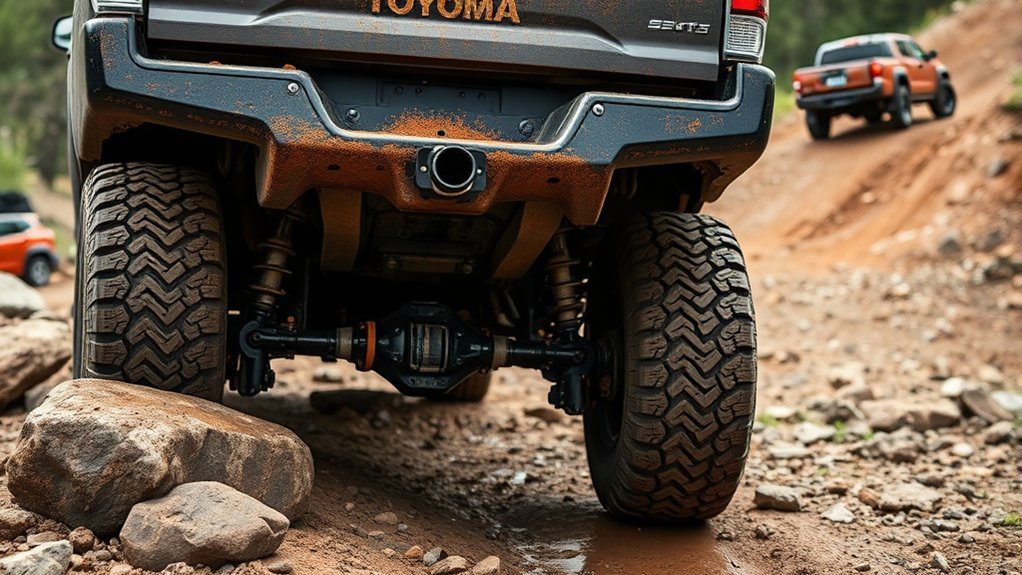
A locking rear differential gives your Tacoma a major traction advantage when the rear tires encounter very different surfaces. Instead of allowing one wheel to spin much faster, the locker makes both rear axle shafts rotate together.
This feature is most useful at low speed, where controlled movement matters more than normal cornering behavior. You should normally engage it before entering the obstacle rather than after a tire is spinning rapidly.
Superior Traction in Mud
Deep mud often creates uneven traction. One tire may find a firm patch while the other drops into a slick rut. A locked rear axle lets the tire on firmer ground continue producing forward force instead of surrendering most of the wheel speed to the tire that is spinning.
A locker cannot create grip where none exists. Tire tread, inflation pressure, vehicle weight, throttle control, and ground conditions still determine whether the truck moves. Excessive throttle can dig the tires deeper or damage the trail.
Enhanced Control on Slopes
On a slow, uneven climb, a rear locker can help maintain forward motion as weight shifts from one tire to the other. The locked axle also helps when diagonal wheel lift unloads one rear tire.
- Consistent rear-wheel speed: Both rear axle shafts rotate together instead of allowing one tire to spin rapidly.
- Better use of available grip: The tire on firmer ground can continue helping move the truck.
- Predictable driver control: A selectable system lets you engage the lock before a difficult obstacle and disengage it afterward.
Warning: Do not use a locked rear differential on dry, high-traction pavement or outside the speed, gear, transfer-case, and steering conditions listed in your owner’s manual. Avoid engaging it while a wheel is spinning rapidly. Incorrect use can cause tire scrub, poor steering response, driveline binding, or component damage.
What Tacoma Drivers Should Expect in Real Use
Auto LSD usually feels less dramatic than a rear locker. You may hear or feel the braking system intervene as it controls a spinning rear wheel. Depending on the Tacoma generation and active traction system, engine output may also be managed while wheel slip is being controlled.
A mechanical LSD generally reacts more smoothly because its torque-biasing action occurs inside the differential. Its behavior still varies by design. A worn clutch-type LSD may become less effective, while a gear-type LSD may need some load at both tires before it can transfer substantial torque.
A selectable rear locker creates a more obvious change. Steering may feel heavier on loose ground, and the truck may resist tight turns because both rear tires must rotate at the same speed. The benefit appears when one rear tire loses most of its grip and the other tire can keep driving.
No differential replaces careful throttle control, suitable tires, recovery equipment, and sound route selection. A locker can help you cross an obstacle, but it can also carry you farther into terrain that exceeds the truck’s clearance, tires, or recovery capability.
What to Consider When Choosing a Tacoma Differential
- Your normal terrain: Auto LSD or a mechanical LSD is usually enough for pavement, rain, graded dirt, forest roads, and mild snow. A rear locker becomes more valuable on rocks, deep ruts, mud, and uneven climbs.
- How often a tire becomes unloaded: Frequent wheel lift strongly favors a selectable locker.
- Street manners: An LSD preserves smooth cornering automatically. A rear locker must be disengaged when full locking is unnecessary.
- Your exact Tacoma configuration: The system installed by Toyota may differ from the feature name used in advertisements or online discussions.
- Tires: Proper tires often improve acceleration, braking, and steering more than changing the differential alone.
- Maintenance: Use only the lubricant and service procedure specified for the axle. Do not add an LSD friction modifier unless Toyota or the differential manufacturer requires it.
- Aftermarket changes: Larger tires, altered gearing, and aftermarket lockers can increase axle loads and may affect electronic traction-control behavior.
Pro Tip: Choose for the most difficult terrain you realistically drive, not the most extreme trail you might attempt once. A factory rear locker gives you strong off-road capability without sacrificing normal road behavior because you can leave it disengaged during everyday driving.
[Amazon Products Picked for You]


Included are Timken bearings and races along with high quality seals and small parts.

Precise Replacement: Top hex head size is 24 mm, thread specification is M18 x 1.5, thread length is 11.5 mm, and thread diameter is 17.8 mm. Each set includes 1 drain plug and 2 sealing gaskets. The rear differential fill plug is a direct replacement for OEM part 90431-18057
Which Setup Is Best for Your Tacoma?
Choose Auto LSD or a mechanical limited-slip differential when you want traction assistance, smooth road manners, and occasional light-trail capability. These systems suit daily drivers that rarely place a rear tire completely in the air.
Choose a selectable electronic rear locker when you regularly drive through deep ruts, rocks, mud, loose climbs, or terrain that unloads one rear tire. The locker provides the strongest answer to severe side-to-side traction differences.
A Tacoma Limited with a locking center differential belongs in a separate category. Its center lock improves front-to-rear driveline traction, but it does not provide the same rear-wheel connection as a locking rear differential.
Before buying or modifying a Tacoma, verify the exact hardware by model year and VIN. The words “TRD,” “4WD,” “Auto LSD,” and “Limited” do not tell the complete story by themselves.
[Amazon Products Picked for You]

Easy, drop-in installation

Set of 2 REAR diff drain plugs with a crush washers replace worn or damaged plugs that cause oil leaks, maintains proper gear oil levels to protect differential from damage.
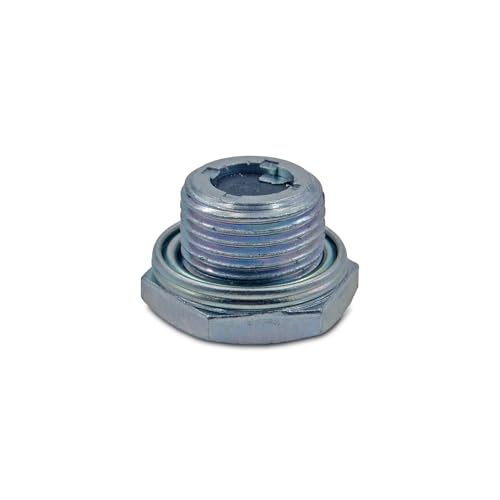
1 pcs REAR diff drain plug with a crush washer replaces worn or damaged plugs that cause oil leaks, maintains proper gear oil levels to protect differential from damage.
Related Guides
Frequently Asked Questions
Which is better, a limited-slip or locking differential?
A limited-slip system is usually better for automatic, mixed road use. A locking rear differential is better when you need maximum low-speed traction in ruts, rocks, mud, or wheel-lift situations. A selectable locker gives you both behaviors because it operates like an unlocked differential until you activate it.
What are the drawbacks of a locking differential?
A locked rear axle resists the different wheel speeds needed during a turn. That can cause tire scrub, heavier steering, understeer, driveline binding, and added component stress on high-traction surfaces. You must also follow the operating limits in the Tacoma owner’s manual.
Do Toyota Tacomas have limited-slip differentials?
Toyota uses the Auto LSD name on many Tacoma configurations, but Auto LSD is an electronic brake-based traction function and should not automatically be treated as a mechanical LSD. Some Tacoma configurations and earlier model years may use different hardware, so check the build sheet, VIN, and owner’s manual.
Does the Toyota Tacoma Limited have a locking differential?
Current 2026 Tacoma Limited trims use full-time 4WD with an electronic locking center differential. That center lock connects the front and rear driveline outputs. It is not the same as the locking rear differential used by trail-focused Tacoma grades.
Can a 2WD Tacoma have a locking rear differential?
Yes. Toyota lists an electronically controlled locking rear differential on the rear-wheel-drive TRD PreRunner. This means rear-locker availability depends on the trim and model year rather than a simple 2WD-versus-4WD rule.
Is Toyota Auto LSD the same as a mechanical limited-slip differential?
No. Toyota Auto LSD uses electronic brake control to reduce wheelspin on applicable Tacoma configurations. A mechanical LSD uses components inside the differential, such as clutches or gears, to resist a speed difference between the axle shafts.
Are Toyota Auto LSD and A-TRAC the same thing?
No. Toyota lists Auto LSD and Active Traction Control (A-TRAC) as separate traction functions on fourth-generation Tacoma configurations. Toyota’s launch documentation identifies Auto LSD on rear-wheel-drive trucks and both Auto LSD and A-TRAC on four-wheel-drive models. Exact operating modes vary by model year, so use the correct owner’s manual.
Can you drive a Tacoma with the rear differential locked on pavement?
A selectable Tacoma rear locker should not be used for normal driving on dry, high-traction pavement. Locking both rear axle shafts prevents the wheel-speed difference needed in a turn, which can cause tire scrub, steering resistance, driveline binding, and component stress. Follow the exact operating restrictions in your model-year owner’s manual.
Should you use a Tacoma rear locker in snow?
A rear locker may help at low speed in deep snow or when the truck is stuck, but it can reduce cornering flexibility and make both rear tires slide sideways together. Use it only under the conditions allowed by your owner’s manual, and prioritize suitable winter tires.
Conclusion
Auto LSD, a mechanical LSD, a rear locker, and a locking center differential are not interchangeable systems. Before buying a Tacoma or changing its differential, verify the exact model year, trim, drivetrain, VIN equipment, and owner-manual operating limits.
Sources
- 2026 Toyota Tacoma Overview — current Tacoma lineup and TRD PreRunner electronically controlled locking rear differential.
- The 2026 Toyota Tacoma: Adventure Awaits — current Limited full-time 4WD and locking center differential information, plus rear-locker operation description.
- 2024 Toyota Tacoma Is the Ultimate Adventure Machine — fourth-generation Auto LSD, Active Traction Control, rear-locker, and Limited center-locking differential details.
- The 2025 Toyota Tacoma Is Ready for Adventure — full-time 4WD, center differential, and electronically activated rear-locker information.
- Toyota Manuals and Warranties — model-specific differential controls, restrictions, maintenance, and operating instructions.
