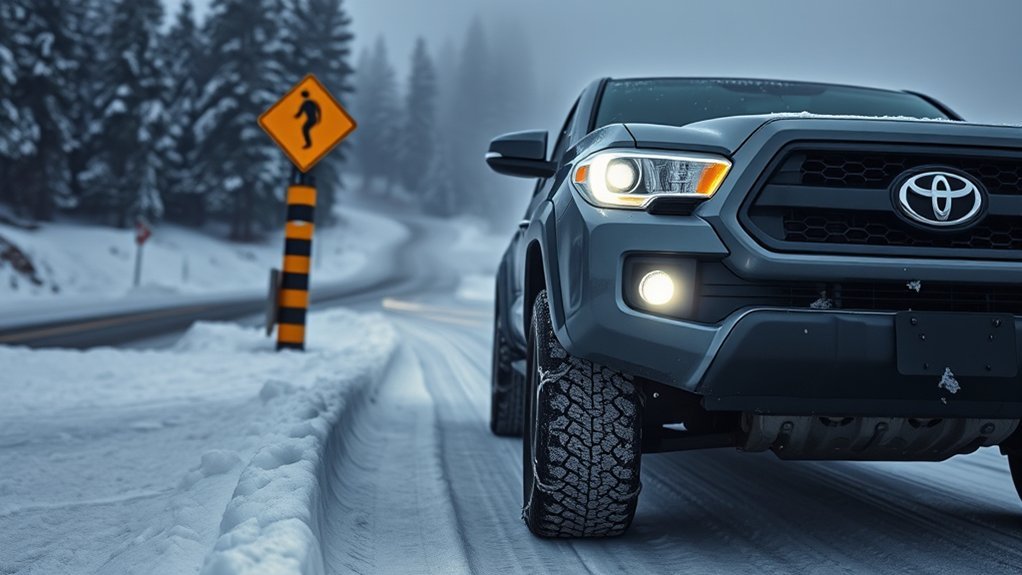
Tire chains can give your Toyota Tacoma extra grip on packed snow and ice, but an incorrect size or installation position can damage the truck’s tires, brake components, suspension, or bodywork. Before traveling, confirm your model year, factory tire size, wheel clearance, and the chain-control rules for your route.
Quick Answer
Use tire chains on your Tacoma when posted signs require them or severe snow and ice overwhelm normal tire traction. Most chain-compatible Tacomas use devices on the rear tires, but your model-year owner’s manual controls. Buy the exact size, verify clearance, retighten after moving, and obey the lowest posted or manufacturer speed limit.
Key Takeaways
- Check your Tacoma’s model year, trim, tire size, and owner’s manual before buying or installing traction devices.
- Do not assume four-wheel drive means chains belong on the front tires. Follow Toyota’s exact axle-placement instructions.
- Passenger chain requirements usually depend on active road signs and weather conditions, not one nationwide winter date range.
- Retighten the chains after moving a short distance and stop immediately if you hear striking, scraping, or heavy slapping.
- Winter tires, cables, or snow socks do not automatically replace chains when a chain law is active.
Last reviewed for accuracy: July 13, 2026.
At a Glance
| Time Required | About 20–30 minutes for your first practice installation and 10–15 minutes with experience |
| Difficulty | Moderate, especially during cold, dark, or roadside conditions |
| Tools Needed | Compatible traction devices, waterproof gloves, headlamp, reflective vest, kneeling pad, and any tensioners required by the manufacturer |
| Cost | Varies according to tire size, chain construction, clearance class, and whether the device is reusable or intended for emergencies |
When Are Tire Chains Necessary for Your Tacoma?
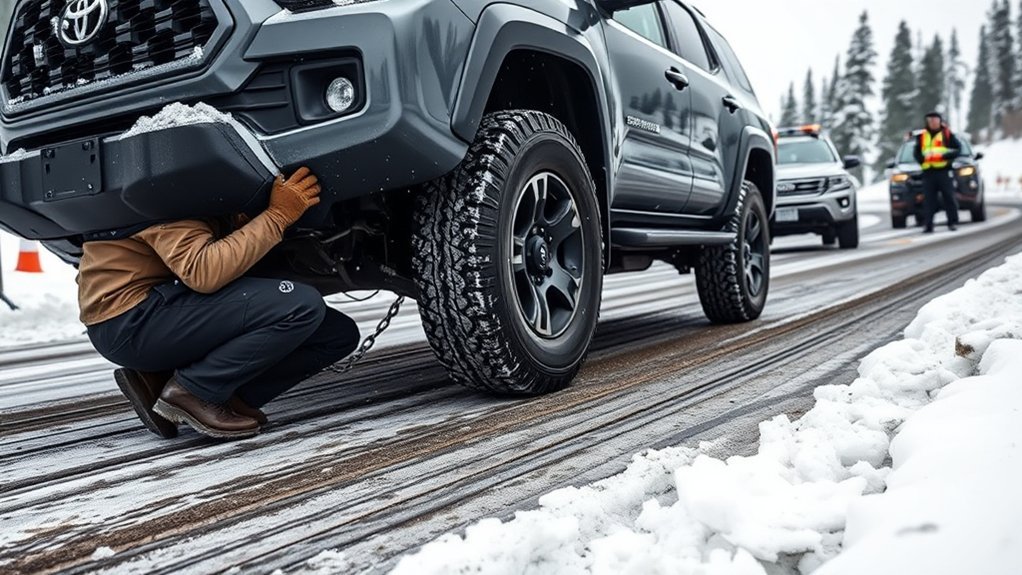
You should install tire chains or an approved traction device when a road sign, checkpoint officer, or transportation agency requires them for your vehicle. Chains may also help on deep packed snow or ice when ordinary tires cannot maintain safe traction, provided Toyota permits their use on your Tacoma’s tire and wheel combination.
Do not install chains simply because snow appears in the forecast. Conventional chains should not be used on dry or mostly clear pavement because they can wear rapidly, reduce control, damage the road, and strike the truck’s wheel wells or suspension.
- Install them when required: Obey active chain-control signs and law-enforcement instructions.
- Carry them when required: Some mountain routes require four-wheel-drive vehicles to carry chains even when installation is temporarily waived.
- Use them only when compatible: Your Tacoma’s manual and the traction-device instructions must allow the tire size and axle position.
- Remove them promptly: Use a safe turnout after signs indicate that chain control has ended.
Warning: Do not install conventional chains when your Tacoma’s manual prohibits them for the fitted tire size or wheel package. Insufficient clearance can damage brake hoses, steering parts, suspension components, sensors, bodywork, and the tire itself.
Check Your Tacoma Before Buying Chains
Tacoma specifications differ across generations, trims, drivetrains, and wheel packages. A chain that fits one Tacoma may be unsafe on another, even when both trucks were built in the same model year.
Find Your Exact Tire Size
Read the size molded into the sidewall of the tires currently installed on the truck. A code such as 265/70R16 identifies the tire width, sidewall ratio, construction, and wheel diameter. Match all parts of that code to the traction-device manufacturer’s fit chart.
Do not rely only on the size listed in an online vehicle catalog. Previous owners may have fitted different wheels, larger all-terrain tires, spacers, suspension parts, or replacement tire sizes.
Confirm Model Year, Trim, and Clearance
Use Toyota’s official owner’s-manual portal to select the exact Tacoma model year. Find the tire-chain or winter-driving section and check:
- Whether conventional chains are permitted
- Which tire sizes accept chains
- Which axle receives the devices
- Any required low-clearance chain class
- The maximum speed or operating restriction
- Warnings for specific trims or wheel packages
Measure clearance with the steering straight and inspect the inner sidewall area, brake components, suspension, and bodywork. Clearance must remain adequate as the suspension moves and the tire flexes.
Note: Oversized aftermarket tires may eliminate the clearance that existed with the factory tire package. A device that physically wraps around the tire is not automatically safe to drive with.
Understanding Tire Chain Regulations for Your Tacoma
Tire-chain laws vary by state, route, weather condition, vehicle weight, tire marking, and whether you are towing. Posted signs and instructions from transportation officials take priority over general online guidance.
State-Specific Chain Laws
California: Caltrans uses R1, R2, and R3 chain-control levels. R1 and R2 provide limited exemptions for qualifying vehicles and snow tires, while R3 requires traction devices on every vehicle. Four-wheel-drive vehicles must still carry traction devices in chain-control areas.
Colorado: Under the Colorado passenger traction law, an activated traction law requires a qualifying four-wheel-drive or all-wheel-drive vehicle with approved tires and sufficient tread, or chains or an approved alternative device. During the more restrictive passenger chain law, every vehicle must use chains or an approved alternative traction device.
Washington: For vehicles under 10,000 pounds, WAC 204-24-050 requires the device specified by posted signs on the drive tires. A qualifying all-wheel-drive vehicle may receive an exemption under certain “chains required” controls, but it must carry chains for at least one set of drive tires.
Other locations: Utah, Oregon, Nevada, national parks, local mountain corridors, and Canadian provinces may use different markings, exemptions, and approved-device lists. Check the official transportation-agency page for every state or province on your route immediately before departure.
Seasonal Usage Guidelines
No single November-to-April rule applies to every Tacoma or every U.S. road. Passenger controls usually depend on actual conditions and posted restrictions. Separate seasonal carry requirements may apply to commercial vehicles, heavier combinations, or specified mountain routes.
Weather can change faster than a travel forecast. Check official road conditions before leaving, again near the mountain corridor, and whenever electronic signs announce updated restrictions.
How to Choose the Right Tire Chains for Your Tacoma
The correct traction device must satisfy three requirements: it must fit the exact tire, provide enough vehicle clearance, and be accepted by both Toyota and the road authority.
Tire Chain Sizing Guide
- Read the installed tire size: Use the complete code printed on the sidewall.
- Check Toyota’s restrictions: Confirm that your model year, trim, and wheel package permit the device.
- Use the manufacturer’s fit chart: Match the full tire code rather than only the wheel diameter.
- Check the clearance class: Some Tacomas may require a low-profile cable or chain design.
- Test both devices: Confirm that the pair fits evenly and that all fasteners work before the trip.
- Carry the instructions: Keep a waterproof copy with the chains.
Types of Tire Chains
- Link chains: Steel links provide strong traction and durability but need more wheel-well clearance.
- Cable chains: Steel cables usually have a lower profile and may be easier to handle, although durability and deep-snow grip vary.
- Diamond-pattern devices: These provide more continuous tread coverage than a basic ladder pattern and may offer smoother engagement.
- Self-tensioning devices: These can simplify installation but must still match the tire and clearance requirements.
- Textile or composite devices: Snow socks and similar products are lightweight, but they count as legal alternatives only where the road authority approves them.
A tire marked M+S, M/S, or M&S may meet some traction-law definitions, but the marking alone does not guarantee strong severe-snow performance. A three-peak mountain snowflake symbol identifies a tire that meets a standardized severe-snow traction test. Always check the exact wording of the active road restriction.
Pro Tip: Complete a full practice installation on dry ground at home. Use the same gloves, light, tensioners, and storage bag you will carry in the truck so you can identify missing or difficult parts before reaching a snowy turnout.
Where to Put Tire Chains on a Tacoma
Do not assume that a four-wheel-drive Tacoma needs chains on the front tires. Front wheel wells contain steering, brake, suspension, and sensor components that may leave inadequate clearance.
For most chain-compatible Tacoma configurations, the devices belong on the rear tires. However, Toyota’s instruction for your exact model year, drivetrain, tire size, and wheel package is the controlling source.
- Rear-wheel drive: Install the approved devices on the rear drive tires.
- Part-time four-wheel drive: Follow Toyota’s specified position, which is commonly the rear tires on chain-compatible Tacoma applications.
- Full-time all-wheel-drive configuration: Follow the exact model-year manual rather than applying a generic front- or rear-axle rule.
- Towing: The trailer may have separate chain requirements, especially when it has brakes.
If Toyota prohibits conventional chains for the installed tire size, do not force them onto the truck. Use only an alternative traction device that Toyota permits and the road authority accepts, or choose another route or transportation option.
How to Install Tire Chains on Your Tacoma
Read the instructions supplied with your traction devices before beginning. Their connector, tensioning, and retightening procedure takes priority over a generic installation sequence.
- Move completely off the roadway: Use a designated chain-up area or a wide, level turnout. Turn on the hazard lights and keep away from moving traffic.
- Secure the Tacoma: Shift to Park, set the parking brake, switch off the engine, and keep the wheels straight.
- Put on visibility and weather gear: Wear reflective outerwear and waterproof gloves. Use a headlamp rather than holding a flashlight.
- Inspect the devices: Lay them flat and remove twists. Look for broken links, worn cables, damaged connectors, or missing tensioning parts.
- Drape the first device over the authorized tire: Center it across the tread and keep hooks or sharp connector ends facing away from the tire sidewall when the manufacturer specifies that orientation.
- Connect the inner fastener: Reach behind the tire from the side without placing your body underneath the truck.
- Connect and tighten the outer fastener: Remove as much slack as possible while keeping the cross sections centered over the tread.
- Attach the tensioning system: Use only tensioners approved by the device manufacturer. Some self-tensioning chains can be damaged by added rubber adjusters.
- Repeat on the other tire: Both devices should have similar tension and alignment.
- Move forward slowly: Travel approximately 50–100 feet in a safe area, stop, set the parking brake, and retighten both devices.
- Complete a final clearance check: Confirm that nothing contacts a brake hose, suspension part, body panel, or wheel component.
Warning: Never crawl under the Tacoma during roadside installation. If you cannot reach a connector safely from beside the tire, stop and follow the device manufacturer’s approved method or use a professional chain installer.
Troubleshooting Tire-Chain Problems
The Chains Are Slapping the Wheel Well
Stop in the nearest safe turnout. A loose or off-center device can damage the truck quickly. Recenter it over the tread, reconnect the fasteners, and remove remaining slack. Do not continue if the device cannot stay tight.
The Device Will Not Connect
Confirm the tire-size code and check for twists. Do not use tools to stretch an undersized chain or leave a partially connected fastener in place. The wrong device can separate while driving.
A Chain or Cable Breaks
Slow down smoothly without abrupt braking, pull off the road, and remove or secure the damaged device according to its instructions. Inspect the brake hose, tire, wheel well, and suspension for impact damage before continuing.
The Truck Vibrates After Installation
Mild vibration is expected, but strong shaking often means the devices are uneven, twisted, loose, or off-center. Stop and correct the installation instead of increasing speed.
Essential Safety Tips for Driving With Tire Chains
- Obey the lowest speed limit: Follow the lower of the posted chain-control speed and the device manufacturer’s limit. California chain controls commonly use 25 or 30 mph limits.
- Accelerate gently: Wheelspin can loosen or break a traction device.
- Brake early: Chains improve grip but do not create dry-road stopping performance.
- Avoid sharp steering: Sudden steering inputs can shift chains and reduce stability.
- Increase following distance: Leave substantially more room than you would on dry pavement.
- Recheck the tension: Inspect the devices after the initial retightening and periodically during the trip.
- Listen for changes: Stop when you hear heavy slapping, scraping, or a new repeating impact.
- Remove devices on clear pavement: Continue beyond the end-of-control sign to a safe turnout before removal.
- Inspect after use: Clean, dry, and examine the devices before storing them.
Four-wheel drive can help your Tacoma start moving, but it does not remove the need for careful braking, greater following distance, or compliance with an active chain law.
Alternative Solutions to Tire Chains You Should Consider
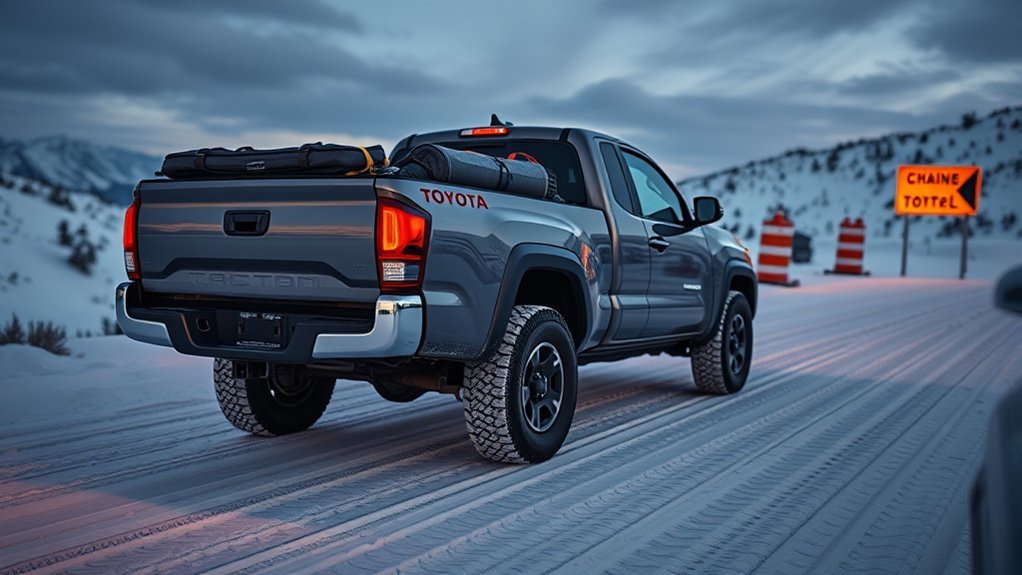
Several products can improve winter traction, but their capabilities and legal status differ. Do not assume that an alternative automatically satisfies an active chain requirement.
- Dedicated winter tires: These provide better cold-weather and deep-snow performance than ordinary all-season tires. They may qualify for an exemption under some lower chain-control levels but not under every restriction.
- Three-peak mountain snowflake all-weather tires: These can provide stronger snow performance than basic all-season tires while remaining suitable for year-round use, but local rules still control.
- Cable traction devices: These may provide better clearance than traditional link chains and are accepted as chains in many locations when correctly sized.
- Approved textile devices: Snow socks can be easier to install and store, but only authority-approved products count as legal alternatives in controlled areas.
- All-terrain tires: These are designed as an on-road and off-road compromise. Check their sidewall markings because an all-terrain description alone does not establish winter-law compliance.
NHTSA recommends using the tire type that matches your climate and driving conditions. It also advises checking the vehicle manual or tire-information label for the correct size and inflation pressure.
Get Ready for Winter: Your Essential Tacoma Travel Checklist
Prepare before reaching the first chain-control sign. A complete winter kit should help you install the devices safely and remain comfortable if traffic stops or the road closes.
- Correctly sized chains, cables, or approved traction devices
- Waterproof manufacturer instructions
- Waterproof insulated gloves and a spare pair
- Reflective vest or jacket
- Headlamp with spare batteries
- Waterproof kneeling pad or small tarp
- Ice scraper and snow brush
- Warm clothing, blankets, water, and shelf-stable food
- Phone charging cable and power bank
- First-aid kit
- Small shovel
- Recovery strap rated for the vehicle and used only from approved recovery points
- Full windshield-washer reservoir with winter-rated fluid
- Properly inflated tires and spare tire
- Official road-condition information saved before departure
Avoid remote shortcuts and unmaintained back roads during major storms. Main routes usually provide better plowing, signage, chain-up areas, communications, and emergency access.
Related Guides
Frequently Asked Questions
Where do you put tire chains on a Toyota Tacoma?
Most chain-compatible Tacoma configurations use traction devices on the rear tires. Do not install them on the front merely because the truck has four-wheel drive. Check the tire-chain section of the exact model-year owner’s manual because Toyota’s restrictions can vary by drivetrain, trim, wheel package, and tire size.
When should you put tire chains on a Tacoma?
Install them when signs, checkpoints, or transportation officials require them for your vehicle, or when severe packed snow or ice requires added traction and Toyota permits their use. Put them on in a designated chain-up area before entering the controlled or hazardous section.
What are the chain requirements in Washington State?
For vehicles under 10,000 pounds, Washington requires the traction device specified by the posted sign on the drive tires. A qualifying all-wheel-drive vehicle may be exempt from installing chains under certain controls, but it must carry chains for at least one set of drive tires. Posted instructions and Washington State Patrol directions control.
What is the 7/32 rule for winter tires?
There is no universal U.S. rule requiring winter tires to remain above 7/32 inch. NHTSA says a tire is unsafe and should be replaced at 2/32 inch, but useful snow traction declines before that point. Some winter-control exemptions require at least 3/16 inch, which equals 6/32 inch. Follow the strictest applicable road rule and replace tires earlier if winter performance has deteriorated.
Can a four-wheel-drive Tacoma skip tire chains?
Sometimes, but not always. A four-wheel-drive Tacoma with qualifying tires may receive an exemption under a lower traction-control level. More restrictive controls can require every vehicle to install chains or an approved alternative device. Some areas also require exempt four-wheel-drive vehicles to carry chains.
Can you use chains with oversized Tacoma tires?
Only when the tire size, device, and available wheel-well clearance are compatible. Larger aftermarket tires can reduce clearance around brake, suspension, steering, and body components. Confirm the fitted tire size, measure clearance, check Toyota’s restrictions, and use the traction-device manufacturer’s fit chart.
Conclusion
Tire chains can make a Tacoma more capable on snow and ice, but safe use starts before the installation. Verify the exact tire size, read the model-year manual, check current road controls, and practice fitting the devices at home.
When a chain law is active, pull fully off the roadway, install the devices on Toyota’s authorized tires, retighten them after moving a short distance, and drive smoothly at the lowest applicable speed. Posted signs, law-enforcement instructions, Toyota guidance, and the traction-device manufacturer’s directions always take priority over general advice.
Sources
- Toyota Manuals and Warranties — model-year owner’s manuals and vehicle-specific operating guidance
- Caltrans Chain Controls and Chain Installation — California control levels, posted requirements, installation areas, and speed guidance
- Colorado DOT Passenger Vehicle Traction and Chain Laws — current passenger traction requirements and approved alternative devices
- Washington Administrative Code 204-24-050 — drive-tire, AWD, carry, and posted-sign requirements
- NHTSA TireWise — tire sizing, winter-tire selection, tread depth, pressure, and maintenance
- National Park Service Tire Chain Requirements — chain-control preparation, drive-wheel guidance, carrying requirements, and safe chain-up practices
