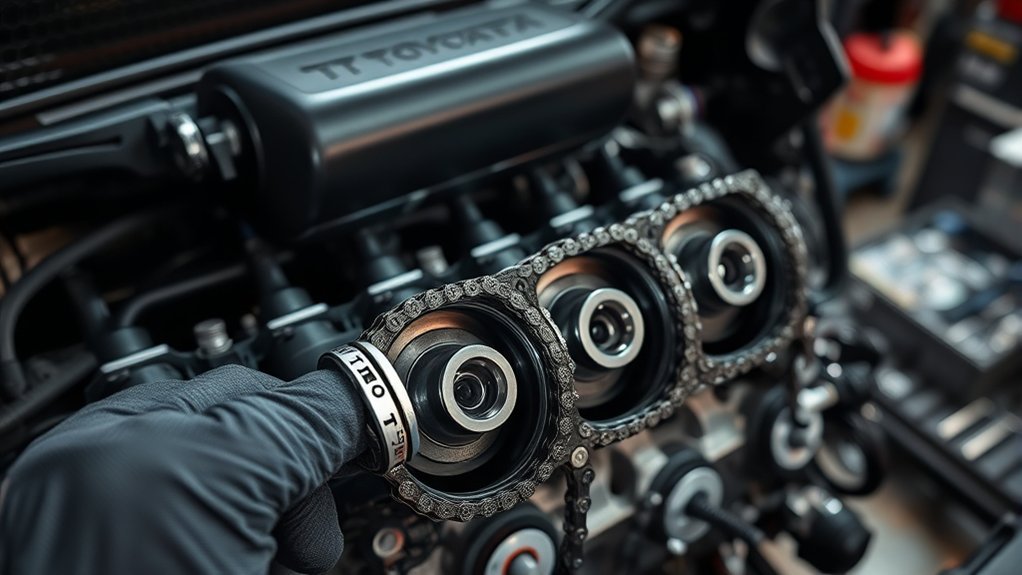
A Toyota Tacoma timing chain is designed for long service, but Toyota does not publish one universal mileage at which every chain wears out. For chain-equipped Tacomas, condition depends on the engine, oil-service history, operating conditions, and related parts such as the tensioner, guides, sprockets, and variable-valve-timing components. Toyota’s 2026 Tacoma maintenance chart runs through 150,000 miles without listing routine timing-chain replacement.
Last updated: September 19, 2026 — Toyota’s 2026 Tacoma maintenance schedule and Toyota’s 2004 5VZ-FE timing-belt guidance were rechecked for this update.
Quick Answer
Toyota does not publish a universal lifespan or routine replacement mileage for a chain-equipped Tacoma. The 2026 maintenance chart lists scheduled service through 150,000 miles without a timing-chain replacement item. Replace timing components when diagnosis confirms wear or failure, and investigate persistent rattling, timing-related fault codes, rough running, hard starting, or major performance changes promptly. First confirm that your exact Tacoma engine actually uses a chain, because some older models use a timing belt instead.
Key Takeaways
- No Toyota-published mileage range guarantees how long every Tacoma timing chain will last.
- Toyota’s 2026 Tacoma maintenance chart reaches 150,000 miles without listing routine timing-chain replacement.
- A persistent startup rattle, check-engine light, misfire, or loss of power deserves diagnosis but does not prove the chain has failed.
- Correct oil, the proper oil level, and model-specific service intervals help protect the chain, tensioner, guides, and VVT system.
- A 2004 Tacoma with the 5VZ-FE 3.4L V6 is a key exception to chain guidance: Toyota’s maintenance schedule calls for timing-belt replacement at 90,000 miles.
- Severe mechanical noise, stalling, an oil-pressure warning, or major performance loss can make continued driving unsafe for the engine.
Does Your Toyota Tacoma Have a Timing Chain or Timing Belt?
Tacoma generations and engines do not all use the same timing-drive design. Before applying timing-chain advice, identify your model year, engine, and VIN. You can then check the correct documents through Toyota’s official manuals and warranties portal.
One important example is the 2004 Tacoma with the 5VZ-FE 3.4L V6. Toyota’s 2004 Scheduled Maintenance Guide calls for timing-belt replacement at 90,000 miles and identifies the Tacoma with the 5VZ-FE as one of the applications. Do not apply timing-chain lifespan advice to that engine.
For a detailed year-and-engine breakdown, see Toyota Tacoma timing chain vs timing belt explained. Keeping the year/engine identification details in that dedicated guide lets this page stay focused on chain lifespan, symptoms, maintenance, and replacement decisions.
Your owner’s manual may not explain every internal engine component, but it identifies the correct maintenance information for your vehicle. A Toyota dealer or qualified repair shop can also confirm the timing-drive type from the VIN and engine code.
Note: This article uses U.S.-market Toyota maintenance documents. Do not use an interval from a different Tacoma model year, engine, or market. Oil viscosity, service intervals, special operating conditions, and engine designs can differ.
What Is a Timing Chain and How Does It Work?
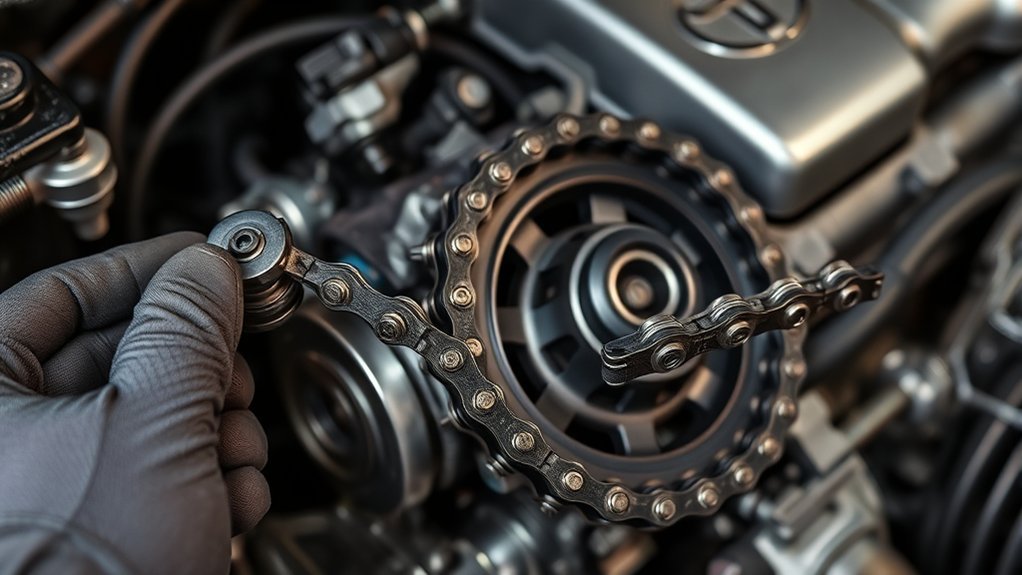
A timing chain is an internal metal chain that synchronizes the crankshaft with one or more camshafts. This synchronization allows the intake and exhaust valves to operate at the correct point in each combustion cycle.
The chain works as part of a system rather than as an isolated component. Depending on the engine, that system can include guides, sprockets, an oil-fed tensioner, camshaft actuators, seals, and other variable-valve-timing parts. A problem with one related component can produce symptoms that resemble chain wear.
A timing chain usually receives lubrication from the engine’s oil supply. Low oil, contaminated oil, incorrect viscosity, restricted oil flow, or inadequate oil pressure can affect the tensioner and other timing components. That is why correct oil service matters even though Toyota does not normally list the chain as a routine maintenance item.
How Long Does a Toyota Tacoma Timing Chain Last?
Toyota does not publish an official average of 225,000, 250,000, or 300,000 miles for every Tacoma timing chain. Mileage alone cannot show how much usable life remains because condition varies with the engine, maintenance history, oil level, operating environment, previous repairs, and related component wear.
The 2026 Toyota Tacoma Warranty and Maintenance Guide provides scheduled maintenance through 150,000 miles without listing routine timing-chain replacement. This supports treating the chain as a condition-based component rather than replacing it at an invented universal mileage.
Toyota’s 2026 Tacoma maintenance chart does not assign the timing chain a routine replacement mileage through 150,000 miles.
What Does Toyota’s 150,000-Mile Maintenance Chart Actually Mean?
The 150,000-mile chart does not mean a Tacoma timing chain is guaranteed to last 150,000 miles, and it does not mean the chain becomes due for replacement at 150,001 miles. It means Toyota does not list routine timing-chain replacement among the scheduled maintenance items shown through that point for the 2026 Tacoma. A chain, guide, tensioner, sprocket, actuator, or lubrication-related component can still develop a fault earlier or remain serviceable much longer.
Use mileage as context rather than a diagnosis. A high-mileage Tacoma with normal oil pressure, no timing-related codes, no persistent abnormal noise, and good service history should not receive a timing-chain replacement merely because the odometer crossed an internet milestone. Conversely, a lower-mileage truck with confirmed mechanical timing problems may require repair.
What Are the Signs of a Bad Toyota Tacoma Timing Chain?
Timing-system problems can create recognizable warning signs, but no single symptom proves the chain itself is defective. Accessory-drive parts, exhaust shields, injectors, camshaft actuators, oil-pressure problems, ignition faults, and other engine components can cause similar sounds or performance changes. Noise from the external Tacoma serpentine belt system should also be separated from internal timing noise before major engine work is authorized.
| What You Notice | What It Proves | Best Next Step |
|---|---|---|
| High mileage with no abnormal noise, warning light, or drivability change | Mileage alone does not prove timing-chain wear. | Continue the model-specific maintenance schedule and investigate only when symptoms, service history, or testing gives a reason. |
| Brief startup rattle | It does not prove the chain is bad. Oil-pressure delay, an actuator, tensioner, accessory component, or another source may be involved. | Check the oil level and record when the noise occurs, how long it lasts, and whether it is becoming more frequent. |
| Persistent rattle with a check-engine light, rough running, hard starting, or reduced power | A timing or other engine-control fault is possible. | Arrange diagnosis soon, including code scanning, oil checks, timing data, and noise-source verification. |
| Severe mechanical noise, oil-pressure warning, repeated stalling, or sudden major power loss | A serious engine fault may be present. | Shut the engine off safely and arrange professional help or towing rather than continuing to drive. |
[Amazon Products Picked for You]

【Compatible Vehicle】 Engine Timing Chain Kit Fit Fit for V6 Pentastar 2011-2020 Chrysler 200 300 Town Country 3.6L Fit for Dodge Avenger Challenger Charger Durango Grand Caravan Journey 3.6L Fit for Jeep Cherokee Grand Cherokee Wrangler Wrangler JK 3.2L 3.6L Fit for Ram 1500 Classic C/V ProMaster 1500 2500 3500 3.6L
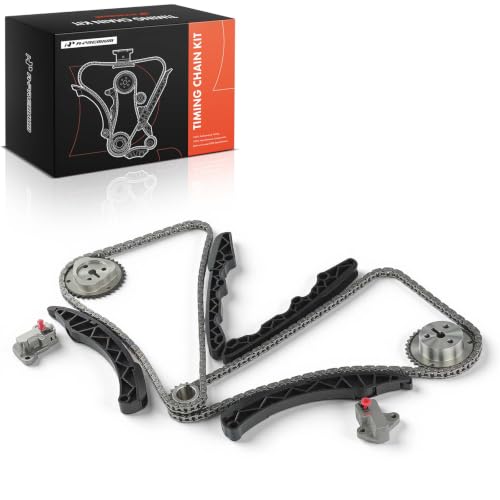
[Compatible with A-Premium Forester Timing Chain Kit-Vehicle Fitment]: ①Compatible with Scion FR-S 2013-2015 ②Compatible with Subaru BRZ 2013-2015, Forester 2011-2015, Impreza 2012-2015, WRX 2015, XV Crosstrek 2013-2015 --- [It fits the model for DOHC Engine, H4 2.0L H4 2.5L Only]

Package Include:1 Timing Chain (130 Links),1 Crank Sprocket (20 Teeth),1 Timing Chain Tensioner,3 Guide Rails,1 Oil Seal,3 Bolts
Does a Rattling Noise Mean the Timing Chain Is Bad?
A persistent metallic rattle or slapping sound from the timing-cover area can justify prompt inspection. Pay attention to when it occurs, such as immediately after a cold start, while idling, during acceleration, or after the engine has warmed.
A brief startup noise can have several causes. Possible timing-related sources include delayed tensioner operation, a worn guide, chain elongation, an actuator problem, or insufficient oil pressure. A technician should locate the sound before recommending internal engine work.
What Performance Problems Can a Timing Fault Cause?
If valve timing moves outside the engine control system’s expected range, you may notice rough idling, hard starting, misfires, hesitation, reduced power, poor fuel economy, stalling, or an illuminated check-engine light. These symptoms can also come from ignition, fuel, sensor, air-intake, or compression problems.
A diagnostic scan may reveal camshaft-position, crankshaft-position, misfire, or timing-correlation trouble codes. A code narrows the investigation, but it does not automatically mean the chain must be replaced.
Can You See Timing-Chain Wear Without Opening the Engine?
The timing chain sits inside the engine, so you normally cannot inspect it for cracks or slack during a basic under-hood check. An owner can instead watch for low oil, contaminated oil, warning lights, recurring noises, and metal debris found during professional oil-filter inspection.
If testing points toward the timing system, a technician may need to inspect timing data, oil pressure, the tensioner, guides, sprockets, actuators, and chain position. Mechanical access may be required before the condition of internal parts can be confirmed.
Warning: Shut the engine off and arrange professional help if you hear severe mechanical rattling or knocking, see an oil-pressure warning, experience repeated stalling, or notice a sudden major loss of power. Continuing to drive could turn a repairable fault into extensive engine damage.
What Affects Toyota Tacoma Timing Chain Lifespan?
The timing system’s condition depends on more than odometer mileage. Oil quality and level, service history, engine temperature, contamination, previous repairs, component quality, and operating conditions can all affect wear.
How Does Oil Service Affect the Timing Chain?
Use the oil viscosity and quality specified for your exact engine. Follow the maintenance guide for your Tacoma’s model year rather than applying one interval to every truck.
For the 2026 Tacoma, Toyota lists scheduled service checkpoints every 5,000 miles. Under the normal schedule shown in the maintenance chart, engine oil and filter replacement appears at 10,000-mile increments. Toyota’s maintenance note also calls for oil and filter replacement after 12 months or when more than 10,000 miles have passed since the previous change, and it specifies 5,000 miles or six months for certain conditions such as primarily driving on dirt or dusty roads or repeated trips of less than five miles below freezing. Earlier Tacoma guides can contain different requirements, so verify the schedule for your truck.
Oil changes cannot reverse mechanical wear, but correct oil service helps maintain lubrication and supports oil-operated parts such as the tensioner and variable-valve-timing system.
Do Driving Conditions Affect Timing-System Wear?
Dusty roads, repeated short trips, prolonged idling, heavy loads, towing, extreme temperatures, and off-road operation can increase contamination, heat, operating hours, or maintenance demands. The exact special-operating criteria and affected service items vary by model year.
These conditions do not prove that the timing chain is under excessive tension or needs replacement. Instead, they are reasons to review the special-operating schedule in the correct Toyota maintenance guide and service the vehicle accordingly.
Which Maintenance Habits Help Protect the Timing System?
- Check the oil level regularly: Do not rely only on the oil-change date. Investigate unexplained oil loss and correct leaks.
- Use the specified oil and filter: Match the viscosity, performance standard, and capacity required for your engine.
- Respond to warning lights: An oil-pressure, check-engine, or temperature warning needs timely attention.
- Keep maintenance records: Accurate records help a technician assess whether lubrication or service history may be contributing to a fault.
- Correct overheating problems: Repeated overheating can harm oil, seals, and engine components even though heat alone does not prove timing-chain failure.
How Does a Technician Diagnose Tacoma Timing-Chain Problems?
A professional diagnosis should come before an expensive timing-chain replacement. Depending on the symptoms and engine, the process may include:
- Checking the oil level, condition, viscosity, and service history
- Scanning the engine computer for stored and pending diagnostic codes
- Comparing camshaft and crankshaft timing data
- Listening for the source and timing of the noise
- Checking relevant oil-pressure readings
- Separating timing noise from accessory-drive, exhaust, injector, or actuator noise
- Inspecting electrical connectors and position sensors
- Inspecting the tensioner, guides, sprockets, actuators, and chain if mechanical access is justified
A shop should be able to explain the test results that support its recommendation. A written estimate should identify whether the proposed repair includes only one failed component or a complete timing-component set.
When Should You Replace a Toyota Tacoma Timing Chain?
Replace the timing chain when testing or internal inspection confirms excessive wear, elongation, damaged teeth, incorrect mechanical timing, or a failure that cannot be corrected by repairing another component. Do not replace it solely because the odometer has reached an arbitrary number.
Depending on the engine and the condition found, a proper repair may include the chain, guides, tensioner, seals, sprockets, actuators, or other related parts. Replacing only the chain while leaving damaged supporting components can lead to repeat labor or another failure.
Timing-chain service is labor-intensive because the system is inside the engine. Cost varies with the model year, engine, parts required, local labor rate, and whether valve, piston, or other internal damage has occurred. Obtain a written diagnosis and itemized estimate before approving the work.
[Amazon Products Picked for You]
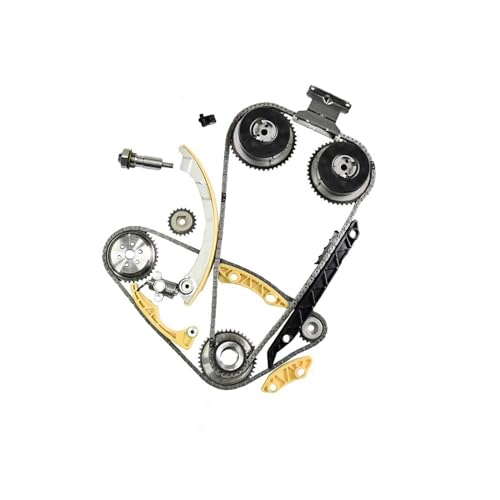
【Compatible】: This timing chain kit is compatible with Toyota Camry Corolla Highlander Solara RAV4 02-09 2.4L, for more details please check the page below.

2.4 Ecotec Timing Chain Kit, also known as Timing Kit. It's a major component in your engine. If you have a rattling noise from front of engine, or noisy timing chains, or timing related fault codes in ECU, and all problems related to timing chains, tensioners, phasers, or guides, you may consider replace you 2.4L Engine Timing Kit with these

【FITMENT】Compatible with Hyundai Elantra 2.0L 2017-2020, Kona 2.0L 2018-2021, Veloster 2.0L 2019-2021 and Kia Forte 2.0L 2017-2022, Forte 5 2.0L 2017-2018. Please confirm your car model and year before purchasing to prevent incorrect fit and save time
Can You Drive With a Suspected Timing-Chain Problem?
Do not assume the truck is safe to drive until the severity of the symptom is understood. A mild, brief noise with normal oil pressure and no performance change may allow you to schedule an inspection, but a severe or worsening symptom deserves immediate attention.
A loose or mistimed chain can disrupt valve timing. If the chain jumps or another timing component fails, the engine may stall, fail to start, or suffer internal damage. Arrange towing instead of driving when the engine runs severely rough, loses substantial power, stalls repeatedly, shows an oil-pressure warning, or produces loud mechanical noise.
[Amazon Products Picked for You]
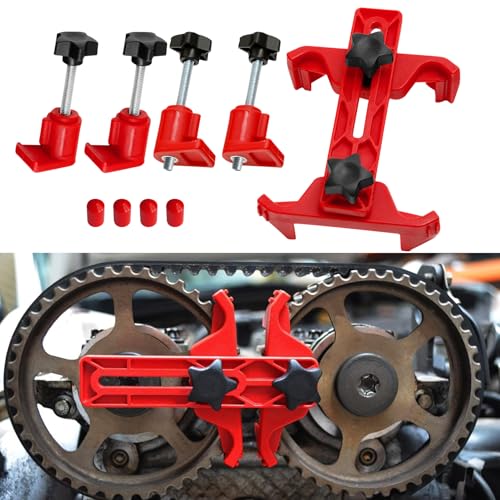
Function:This engines repair tool can precisely lock the position of the engine's dual camshafts, keeping the camshafts in the correct position during belt replacement. Meanwhile, this locking tool uses a raised anti-slip design to prevent sprocket slippage, thereby enhancing work efficiency
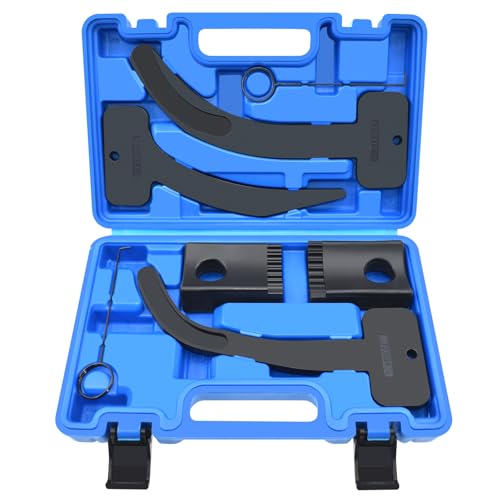
Our products are engineered with market-exclusive glass fiber-reinforced nylon composite, delivering superior durability that resists breakage. As the professional manufacturer of this innovative design in the market, we prioritize precision and longevity to meet demanding automotive repair needs.

Part Number:14520-004-0000,14630-004-0000,14000-004-0000,14320-004-0000,14508-002-0000
How Can You Help a Tacoma Timing Chain Last?
- Follow the correct Toyota maintenance guide: Use the schedule for your exact model year, engine, and operating conditions.
- Maintain the proper oil level: Check it regularly and investigate leaks or unexplained consumption.
- Use the required oil specification: Do not choose oil solely because it is marketed as premium or synthetic.
- Do not ignore startup noise: Record when it happens, how long it lasts, and whether warning lights appear.
- Address cooling and oil-pressure problems: These faults can affect multiple engine components, including the timing system.
- Use qualified parts and repair procedures: Timing work requires precise alignment and model-specific specifications.
Pro Tip: Record a cold-start noise with your phone and note the outside temperature, oil level, engine temperature, and duration. This information can help a technician reproduce an intermittent problem, but do not delay service when the noise is severe.
Frequently Asked Questions
How long does a Toyota Tacoma timing chain last?
Toyota does not publish a universal lifespan for every Tacoma timing chain. The 2026 maintenance chart does not list routine timing-chain replacement through 150,000 miles. A chain may remain serviceable much longer or require repair earlier because of lubrication problems, guide or tensioner wear, damage, or another related fault.
When should a Toyota Tacoma timing chain be replaced?
Replace a Tacoma timing chain when engine-specific diagnosis confirms excessive chain wear, incorrect mechanical timing, damaged guides or sprockets, a failed tensioner, or another timing-system fault that requires chain service. Do not replace a chain solely because the truck reached a particular mileage.
What happens if your timing chain starts to go bad?
You may hear rattling, see a check-engine light, or notice hard starting, rough running, misfires, stalling, or reduced power. These symptoms have other possible causes, so diagnosis is necessary. If mechanical timing becomes severely incorrect, the engine may stop running or suffer internal damage.
Does a 2004 Toyota Tacoma have a timing belt or timing chain?
It depends on the engine. Toyota’s 2004 maintenance guide specifically calls for timing-belt replacement at 90,000 miles on the Tacoma equipped with the 5VZ-FE 3.4L V6. If you have a different 2004 engine, confirm the timing-drive type from the engine code, VIN, Toyota documentation, or the dedicated Tacoma belt-versus-chain guide before applying maintenance advice.
Can a timing chain last 300,000 miles?
A timing chain can remain serviceable at very high mileage, but 300,000 miles is not a Toyota-published Tacoma guarantee or replacement interval. Maintenance history, oil condition, related-component wear, symptoms, and current diagnostic findings are more useful than mileage alone.
Is a startup rattle always caused by the timing chain?
No. A startup rattle can come from the tensioner, camshaft actuator, accessory drive, exhaust shielding, oil-pressure delay, or another engine component. The location, duration, temperature, oil condition, trouble codes, and test results help identify the actual source.
Conclusion
A chain-equipped Toyota Tacoma does not have a reliable one-size-fits-all expiration mileage. Toyota’s 2026 maintenance chart does not schedule routine timing-chain replacement through 150,000 miles, but that is not a lifetime guarantee. Follow the maintenance schedule for your exact truck, maintain the correct oil level and specification, and treat persistent rattling, warning lights, or major performance changes as reasons for diagnosis.
First confirm that your Tacoma actually uses a timing chain, especially on older trucks. Do not authorize chain replacement based only on mileage or a general internet claim. A qualified inspection should identify whether the chain, tensioner, guides, sprockets, actuator, lubrication system, sensor, or another component is responsible. Prompt diagnosis can reduce the chance that a smaller timing-system fault develops into extensive engine damage.
Sources
- 2026 Toyota Tacoma Warranty and Maintenance Guide — current scheduled-maintenance checkpoints, oil-service guidance, and maintenance chart through 150,000 miles.
- 2004 Toyota Scheduled Maintenance Guide — 90,000-mile timing-belt service and the Tacoma 5VZ-FE application note.
- 2023 Toyota Tacoma Warranty and Maintenance Guide — earlier model-year maintenance intervals and special-operating-condition guidance.
- Toyota Manuals and Warranties — official model-specific owner documentation.
