
A Toyota Tacoma can vibrate and pull for more than one reason, so choosing between wheel balancing and alignment starts with the exact symptom. A speed-related shake often points toward a tire or wheel problem. Consistent pulling, an off-center steering wheel, or feathered tread wear more often calls for an alignment and suspension inspection.
Quick Answer
Wheel balancing is the likely service when your Tacoma shakes at a repeatable road speed, especially through the steering wheel or seat. Alignment is more likely when the truck pulls on a straight, level road, the steering wheel sits off-center, or tread wear is uneven. Some vibrations require tire, brake, suspension, wheel, or driveline diagnosis.
Key Takeaways
- Balancing corrects weight imbalance in the tire-and-wheel assembly. Alignment corrects wheel angles such as toe, camber, and caster.
- A particular speed range is a useful clue, but it does not prove that the tires need balancing.
- Toyota lists tire rotation every 5,000 miles or six months for the 2018 Tacoma, but it does not require balancing or alignment at every rotation.
- Request a road-force test when a standard balance does not fix a repeatable highway-speed vibration.
- Stop driving if you find a tire bulge, exposed cords, rapid pressure loss, severe shaking, grinding, or signs that a wheel may be loose.
At a Glance
| Time Required | 10–15 minutes for basic owner checks; professional diagnosis and service commonly take 30–90 minutes. |
| Difficulty | Easy for visual checks; professional equipment and training are required for balancing and alignment. |
| Tools Needed | Accurate tire-pressure gauge, flashlight, tread-depth gauge or penny, plus a shop balancer and alignment rack when service is needed. |
| Cost | Basic checks cost nothing. Professional service varies by location, tire size, equipment, and whether damaged parts need repair. |
Understanding Tacoma Vibration and Pulling Symptoms

Start by recording exactly when the vibration or pull happens. A symptom that follows road speed usually points toward the tires, wheels, hubs, brakes, or driveline. A vibration that follows engine rpm while the truck is stopped or moving may come from the engine, transmission, exhaust, or mounts instead.
Also note where you feel the movement. Steering-wheel vibration often comes from the front tire-and-wheel assemblies, although that is not a guaranteed diagnosis. A shake felt mainly through the seat or floor may involve a rear wheel, rear tire, driveshaft, or another driveline component.
The operating condition matters as much as the vibration itself. Record the road speed, whether you are accelerating, braking, coasting, or turning, and where the movement is felt.
Do not assume that new tires rule out a tire problem. A new tire can have excessive radial-force variation, improper bead seating, shipping damage, or an installation error. A wheel may also be bent, dirty at the hub mounting surface, or incorrectly centered on the balancer.
Warning: Stop driving and have the Tacoma inspected if the vibration becomes severe, a wheel appears loose, a tire has a bulge or exposed cords, pressure drops rapidly, the truck suddenly becomes difficult to control, or you hear grinding or repeated thumping. These conditions may indicate tire, wheel, hub, brake, or suspension damage.
Wheel Balancing vs. Wheel Alignment
Balancing and alignment address different parts of the wheel-and-tire system. A shop may recommend both when the truck has more than one symptom, but one service does not replace the other.
| Symptom | More Likely Starting Point | What the Service Checks |
|---|---|---|
| Shake at a repeatable road speed | Balance and tire/wheel inspection | Weight imbalance, mounting, wheel runout, tire uniformity, and damage |
| Pulling on a straight, level road | Pressure, tire-pull, brake, and alignment checks | Toe, camber, caster, tire lateral force, brake drag, and suspension condition |
| Off-center steering wheel | Alignment | Steering-wheel centering and vehicle-specific alignment angles |
| Vibration mainly while braking | Brake and suspension inspection | Rotor runout, thickness variation, calipers, wheel bearings, and worn joints |
| Vibration while coasting or decelerating | Driveline and tire/wheel diagnosis | Driveshaft, propeller shaft, joints, mounting angles, and tire/wheel condition |
What Wheel Balancing Corrects
Wheel balancing measures how weight is distributed around a mounted tire-and-wheel assembly. A balancing machine identifies heavy and light areas, and the technician adds or moves wheel weights to reduce rotating imbalance.
According to the National Highway Traffic Safety Administration, balancing helps the wheels rotate without creating shake or vibration. New tires should be balanced when installed.
A conventional balance cannot correct every ride-quality problem. A perfectly balanced assembly may still vibrate if the tire is out of round, the rim is bent, the bead is not seated correctly, or the tire has excessive stiffness variation.
What Wheel Alignment Corrects
Wheel alignment measures and adjusts the direction and angle at which the wheels sit. The main measurements are toe, camber, and caster. These settings affect straight-line tracking, steering-wheel position, self-centering, handling, and tire wear.
The correct values depend on the Tacoma’s model year, drivetrain, suspension, ride height, load condition, and factory service specification. A general left-to-right angle rule cannot replace the correct specification.
Ask the technician for a before-and-after alignment printout. Each final value should fall within the correct Toyota range, and the technician should explain any reading that cannot be adjusted into specification.
Signs Your Tacoma Needs Wheel Balancing
Your Tacoma may need balancing or a tire-and-wheel inspection when you notice one or more of these symptoms:
- A repeatable vibration at road speed: The shake grows as speed rises, reaches a noticeable range, and may lessen outside that range.
- Steering-wheel shake: The movement is often associated with a front assembly, but the shop should test all four wheels.
- Seat or floor vibration: A rear assembly or driveline component may be involved.
- Vibration after tire installation or repair: The assembly may be imbalanced, incorrectly centered, improperly seated, or damaged.
- A missing wheel weight: A clean mark on the rim may show where a clip-on or adhesive weight came off.
- Mud, packed snow, or ice inside the wheel: Added material can create a temporary imbalance.
- Scalloped or cupped tread wear: Balance may contribute, although worn shocks, loose parts, runout, or tire defects can cause similar wear.
If a standard balance does not solve the vibration, request a road-force balance and tire-uniformity test. A load roller can help identify radial-force variation, wheel runout, bead-seating problems, and certain tire-pull conditions.
Signs Your Tacoma Needs a Wheel Alignment
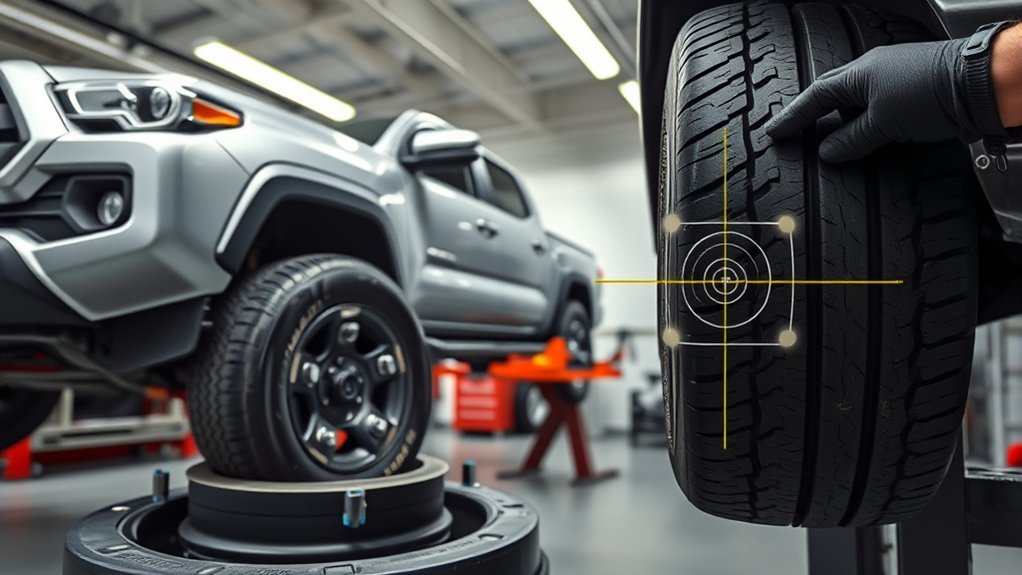
Misalignment is more likely when your Tacoma consistently changes direction without steering input on a reasonably flat and level road. First confirm that the tires are cold and inflated to the pressure on the driver-side door-jamb label.
Common alignment symptoms include:
- Consistent pulling or drifting: The truck moves toward one side after tire pressure, road crown, and crosswind are considered.
- An off-center steering wheel: The wheel is not centered while the Tacoma travels straight.
- Feathered tread blocks: The tread feels smooth in one direction and sharp in the other, which may indicate a toe problem.
- One-sided shoulder wear: Inner or outer shoulder wear may involve camber, toe, pressure, load, or worn suspension parts.
- A recent pothole or curb impact: A hard impact can bend a wheel, move an adjustment, or damage a steering or suspension component.
- Recent suspension or steering work: Alignment should be checked after replacing parts that affect wheel position.
Pro Tip: Evaluate pulling on more than one safe, straight road. Road crown, wind, unequal cargo, and tire pressure can make a properly aligned truck appear to drift. Do not perform a hands-off steering test in traffic.
Other Problems That Can Mimic Balance or Alignment Issues
Balancing and alignment are common solutions, but they are not the only possibilities. A complete inspection should consider the following causes.
Tire Pressure and Tire Damage
Unequal pressure can change handling and tire wear. Check all tires when cold, meaning the Tacoma has been parked for at least three hours. Use the pressure on the vehicle label, not the maximum pressure printed on the tire sidewall.
Inspect the tread and sidewalls for bulges, cuts, exposed cords, cracking, uneven wear, embedded objects, or an irregular shape. A separated belt or damaged carcass can cause vibration even when the assembly balances on a machine.
Wheel Runout and Mounting Problems
A bent wheel, corrosion between the wheel and hub, an incorrectly seated wheel, or improper balancer mounting can create vibration. The technician may need to measure radial and lateral runout rather than repeatedly adding weights.
After wheel removal, the wheel fasteners must be tightened evenly with a calibrated torque wrench to the specification for the exact Tacoma configuration. Uneven or incorrect tightening can damage components or affect brake-rotor seating.
Brake, Steering, and Suspension Problems
A vibration that appears mainly while braking may involve brake-rotor runout or thickness variation, a sticking caliper, worn steering parts, loose suspension joints, or a wheel bearing. Worn shocks can also allow tire movement that contributes to cupping.
Alignment should not be performed as the only repair when ball joints, tie-rod ends, bushings, bearings, or other locating parts are loose. The damaged parts must be repaired before the final alignment.
Tacoma Driveline Vibration
Toyota’s revised T-SB-0124-20 Rev1 describes a driveline vibration during deceleration between 30 and 10 mph on certain 2016–2023 Tacoma configurations. The vibration may be felt in the seat, floorboard, or steering wheel.
The bulletin does not mean every Tacoma with a low-speed vibration needs the listed repair. Applicability depends on the model, drivetrain, transmission, production details, modifications, and diagnosis. An authorized Toyota service department can check the VIN and current service information.
Note: A vibration tied to deceleration, braking, engine load, or throttle position should not automatically be treated as a wheel-balance problem.
How to Diagnose Tacoma Vibration and Pulling
- Check for an immediate safety problem. Look for low pressure, visible tire damage, loose fasteners, a damaged wheel, fluid leaks, grinding, or severe shaking. Do not road-test an unsafe vehicle.
- Record the operating condition. Note the road speed, engine rpm, gear, throttle position, braking input, road surface, load, and whether the truck is turning.
- Check cold tire pressure. Set each tire to the pressure on the Tacoma’s tire-and-loading label. Do not use the sidewall maximum as the target pressure.
- Inspect tread and wheels. Look for uneven wear, missing weights, mud, ice, dents, bulges, exposed cords, and signs of a separated tire.
- Perform a careful road test. Determine whether the vibration follows road speed, engine rpm, braking, acceleration, or deceleration. Compare more than one safe road before diagnosing a pull.
- Choose the correct service. Request balancing for a speed-related shake, alignment for verified tracking or steering-wheel-center problems, and brake, suspension, tire-uniformity, or driveline diagnosis when the symptom points elsewhere.
- Review the results. Ask for the alignment printout, balance findings, road-force values when measured, wheel-runout results, and any identified loose or damaged parts.
- Verify the repair. Road-test the Tacoma under the same conditions that produced the original symptom.
How Alignment Affects Handling, Tire Wear, and Efficiency
Impact on Steering Stability
Correct alignment helps the tires track in their intended direction and supports predictable steering. Caster contributes to self-centering and straight-line stability, while toe and camber affect tracking, steering response, and tread contact.
Pulling is not always caused by alignment. Unequal pressure, tire lateral force, brake drag, road crown, wind, cargo distribution, and damaged suspension parts can create a similar symptom. These items should be checked before adjustments are made.
Effects on Tire Wear
Tread wear provides useful clues, but no pattern confirms a single cause by itself. Pressure, rotation history, driving conditions, load, tire construction, balance, alignment, and suspension condition can interact.
| Wear Pattern | Possible Causes | Recommended Check |
|---|---|---|
| Both shoulders worn | Underinflation, load, or operating conditions | Cold pressure, leaks, load, and tire condition |
| Center worn | Overinflation or tire/application mismatch | Door-jamb specification and tire suitability |
| One shoulder worn | Camber, toe, pressure, load, or worn parts | Alignment and steering/suspension inspection |
| Feathered tread | Toe error or loose steering components | Toe measurement and linkage inspection |
| Cupped or scalloped wear | Imbalance, runout, worn shocks, or loose parts | Balance, road force, runout, and suspension checks |
| Bulge, exposed cord, or localized distortion | Structural tire damage | Stop driving and have the tire inspected immediately |
Influence on Fuel Efficiency
Severe misalignment can make the tires scrub instead of rolling freely, which increases resistance and accelerates tread wear. However, no single fuel-consumption percentage applies to every Tacoma.
Correct cold pressure, suitable tires, proper rotation, sound wheel bearings, and correct alignment all support efficient operation. Treat improved fuel economy as a possible secondary benefit, not a guaranteed result of alignment.
What Happens When Your Tacoma’s Tires Are Not Balanced Properly?
An imbalanced tire-and-wheel assembly can create several problems:
- Road-speed vibration: The steering wheel, seat, floor, or cab may shake within a repeatable speed range.
- Reduced ride comfort: Continuous vibration makes highway driving tiring and can hide other developing problems.
- Irregular tread wear: Imbalance may contribute to cupping or uneven contact, especially when combined with worn suspension parts.
- Accelerated component wear: Persistent vibration can add stress to tires, bearings, steering parts, and suspension components.
- Repeat service visits: A standard balance may not solve a tire-uniformity, runout, bead-seating, or bent-wheel problem.
Ordinary weight imbalance usually causes vibration rather than a true directional pull. If the Tacoma pulls, the technician should also evaluate tire lateral force, pressure, alignment, brake drag, steering parts, suspension condition, and road effects.
Tacoma Tire, Balancing, and Alignment Maintenance
| Action | When to Do It | Why It Matters |
|---|---|---|
| Check cold tire pressure | At least monthly and before long trips | Unequal or incorrect pressure affects wear, ride, and handling. |
| Inspect tread and sidewalls | Monthly and after a hard impact | Finds uneven wear, bulges, cuts, exposed cords, and embedded objects. |
| Rotate tires | Every 5,000 miles or six months for a 2018 Tacoma, unless the applicable Toyota guide states otherwise | Promotes more even wear and creates a regular inspection opportunity. |
| Balance wheels | When tires are installed, remounted, repaired, or when vibration or irregular wear appears | Corrects rotating weight imbalance rather than following an arbitrary mileage interval. |
| Check alignment | After a hard impact, steering or suspension repair, verified pulling, an off-center wheel, or abnormal wear | Confirms wheel angles and steering-wheel position using vehicle-specific specifications. |
| Inspect suspension and steering | During scheduled service and whenever looseness, noise, pulling, or uneven wear appears | Loose or worn parts can prevent a lasting alignment and create unsafe handling. |
The official 2018 Toyota Tacoma Warranty and Maintenance Guide lists tire rotation at 5,000-mile or six-month intervals. Use the guide for your exact model year because maintenance requirements can differ.
Note: NHTSA recommends replacing a tire when tread reaches 2/32 inch. Earlier replacement may be appropriate when wet, snow, off-road, towing, or other demanding conditions require more traction.
Frequently Asked Questions
Why is my Tacoma vibrating and pulling to the right?
The vibration and pull may have separate causes. Check cold tire pressure and visible tire damage first. A speed-related shake may need balancing or tire-uniformity testing, while a consistent right pull may involve alignment, tire lateral force, brake drag, road crown, or worn steering and suspension parts.
Can bad wheel balance cause pulling?
Ordinary weight imbalance mainly causes vibration. A tire can still create directional pull because of construction-related lateral force or conicity. A technician may confirm this by swapping tire positions or using equipment that measures tire-pull force.
How do I know whether I need balancing or alignment?
Choose balancing as the first check for a repeatable road-speed vibration. Choose alignment when the Tacoma pulls after pressure and road conditions are ruled out, the steering wheel is off-center, or the tread has feathered or one-sided wear. Some trucks need both services or a separate mechanical repair.
Can a bad wheel balance cause vibration?
Yes. Weight imbalance in a mounted tire-and-wheel assembly can create steering-wheel, seat, or floor vibration as road speed rises. If balancing does not solve it, the technician should check tire uniformity, wheel runout, mounting, damage, and driveline components.
Why does my Tacoma vibrate only when braking?
A vibration that appears mainly while braking is less likely to be a simple balance problem. Possible causes include brake-rotor runout or thickness variation, a sticking caliper, loose steering or suspension parts, and wheel-bearing wear. Have the brake and front-end systems inspected.
When should I request a road-force balance?
Request a road-force test when a conventional balance does not correct the vibration, when new tires still shake, or when the shop suspects an out-of-round tire, bent rim, bead-seating problem, excessive tire stiffness variation, or tire-induced pull.
Conclusion
Wheel balancing and alignment solve different Tacoma problems. Start with balancing when the truck has a repeatable road-speed vibration. Start with pressure, tire, brake, suspension, and alignment checks when it consistently pulls, the steering wheel is off-center, or tread wear is uneven.
Do not rely on one speed range or an automatic mileage interval as proof. Record when the symptom occurs, inspect the tires, use the correct Toyota maintenance schedule, and request measured results from the technician. A road-force test or driveline inspection may be necessary when a standard balance and alignment do not correct the problem.
Sources
- NHTSA TireWise — tire pressure, tread depth, rotation, balancing, and alignment safety guidance.
- 2018 Toyota Tacoma Warranty and Maintenance Guide — factory tire-rotation and scheduled-maintenance guidance.
- Toyota T-SB-0124-20 Rev1 — Tacoma driveline vibration during deceleration for applicable configurations.
- Hunter Engineering Road Force Wheel Balancing — diagnostic balancing, tire-uniformity, wheel-runout, bead-seating, and tire-pull testing.
